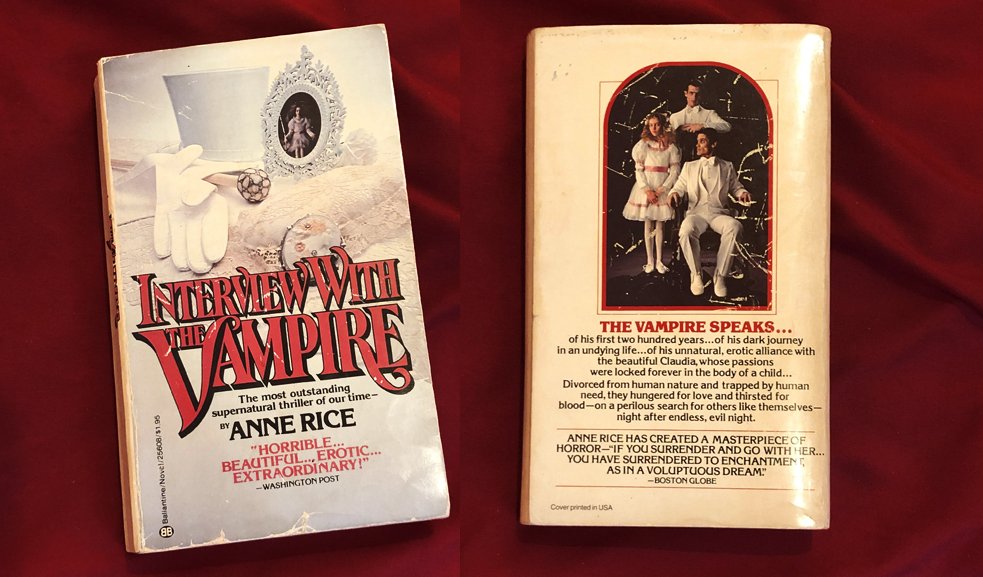
On April 12, 1976, a novel from first-time author Anne Rice called Interview with the Vampire hit bookstores. In hardcover, the book barely made a dent. But in paperback, it slowly grew into a cult hit over the years, and over the past five decades, it has sold 80 million copies worldwide. The book led to a series, The Vampire Chronicles, which sold another 70 million copies. Only Dracula and Twilight have had a greater overall impact on pop culture when it comes to our shared perception of the undead. Besides its popular film and television adaptations, here are some of the ways that Rice’s signature work influenced vampire pop culture over the past 50 years. And in some cases, just pop culture in general.
New Orleans as the Fictional Vampire City of Choice

The city of New Orleans, LA, had its share of vampiric folklore, long before Anne Rice wrote her first novel. Notably, Jacques Saint Germain and the Carter brothers were well-known New Orleans vampire urban legends. But none of those stories sparked much in the way of film or television inspiration. But after IWTV, the Crescent City became undead central in all kinds of fiction. From the Poppy Z. Brite novel Lost Souls, to True Blood, to The Originals, all of them used New Orleans as America’s Transylvania. Even the cheesy Gerard Butler movie Dracula 2000 took place in NOLA. But it was certainly IWTV that popularized the concept in wider pop culture.
The Brooding-Yet-Sexy-Vampire Trope

Since Dracula, most vampires in novels and films have been unrepentantly evil. There were some examples of brooding, self-loathing vampires, like Countess Zaleska in Dracula’s Daughter, one of Rice’s direct inspirations. Another notable example was Barnabas Collins in the ’60s TV soap Dark Shadows, who pre-dated IWTV. But the novel’s narrator, Louis, presented a new level of self-hatred in a vampire character. One who physically starved himself and ate rats in alleys to avoid hurting humans. That level of sad (yet somehow still sexy) vampire represented by Louis gave birth to many others over the years. Most famous among them are Angel on Buffy, Bill Compton on True Blood, and, like it or not, Edward Cullen in Twilight. In their own way, each is a direct descendant of Louis de Pointe du Lac.
Lestat and Louis Introduce the Sexual Tension Male Vampire Duo
Vampires have always been queer-coded. There were plenty of sapphic vampires in pop culture, going back to Carmilla and all its adaptations. Girl-on-girl vampire action was all the rage in the ’70s. But a homoerotic charge between two male vampires was too taboo (except for porn films) until Rice’s IWTV. The Lestat/Louis dynamic, between one flamboyant vampire who relishes in wickedness (often light-haired), and his brooding, self-hating companion (usually dark-haired), is a large reason why early readers who embraced the book were queer readers. It was the Heated Rivalry of its day. Only with a lot more blood.

Ever since Lestat and Louis in IWTV, we’ve had similar (if less overtly queer) vampiric pairings in fiction. Chief among them are David and Michael in The Lost Boys, Angel and Spike in Buffy, and Bill Compton and Eric Northman on True Blood. In all of these examples, there’s a woman involved in a form of love triangle with them, but it’s always clear she’s just there to “no homo” their clear sexual tension. This is less so in The Vampire Diaries, but that’s only because the two male Salvatore vamps are literal brothers. But all of these undead male pairings owe their existence in some way to Louis and Lestat. At least now, the adaptations don’t have to be vague about the queer nature of these stories.
IWTV’s Claudia Introduces the Angry Child Vampire

Undead children existed before IWTV’s Claudia, to be certain. Just the year before Rice’s novel was published, Stephen King had a pair of memorable child vampires in Salem’s Lot. Yet those vampires didn’t really have any agency, and were just extensions of a powerful master vampire’s will. But Claudia was the first vampire who really felt the horror of immortality while trapped in a child’s body. But since that character emerged in IWTV, we’ve had many similar to Claudia. There’s Homer in Near Dark, Eli in Let the Right One In, and most recently, Abigail. It’s fair to say Rice’s ruthless child vampire Claudia is the template for all of them.
A Community of the Undead

In most vampire fiction since Dracula, the power structure was one master vampire, and a brood of mindless minions. But none of them were really a family in the way we think of today. But IWTV popularized the idea of vampiric covens, something often reserved for witches before. This was exemplified not only by Lestat’s New Orleans family, but also by Armand’s theatrical troupe in Paris. We’ve seen that kind of vampiric society all over the place ever since, from the Lost Boys, to the Master’s brood in Buffy. Other examples include the Mikaelson Family in The Originals, and the Cullens in the Twilight saga. This also extends to RPGs, where Vampire: The Masquerade had multiple undead clans. While other examples may have existed before, IWTV certainly popularized the concept of vampire communities.
Tony Scott’s The Hunger Was a Stealth Anne Rice Adaptation

Tony Scott’s stylish 1983 New Wave cult vampire film The Hunger is based on the novel by Whitley Strieber, a guy who’s mostly famous for being abducted by aliens and writing books about it. The film adaptation stars David Bowie, Susan Sarandon, and Catherine Deneuve as elegant urban vampires. The opening scene features Bauhaus performing their song “Bela Lugosi’s Dead.” In case there was any doubt, this was the gothiest movie of all time. Strieber’s book had a more sci-fi take on vampires than Scott’s film, which is lush, gothic, and sexy. The reason for that is Tony Scott really wanted to direct a version of IWTV, but the rights were at another studio. So, Scott just injected a heavy dose of Rice’s style, atmosphere, queerness, and themes into his version of Streiber’s tale. In some ways, it was a quasi IWTV adaptation a decade before Neil Jordan’s film.
Interview with the Vampire Inspired Songs from Prominent Artists
Once IWTV became a hit in paperback and achieved cult status, many musicians became enthralled by it and wrote songs about it. One of the first was Sting, who included the song “Moon Over Bourbon Street,” inspired by the character of Louis, on his 1985 album The Dream of the Blue Turtles. The band Concrete Blonde’s 1990 song “Bloodletting” was all about a vampire coven in New Orleans, clearly the vamps from IWTV. One funny example is Annie Lennox’s “Love Song for a Vampire,” from the film Bram Stoker’s Dracula. The singer later admitted she wrote the song inspired by Rice’s novel, not Stoker’s. And the Goddess of Pop, Cher, was a huge fan of IWTV, and wrote a song inspired by it, “Lovers Forever,” which she pitched to be used in the 1994 film. It ultimately wound up on her 2013 album Closer to the Truth. Like any good vampire, it couldn’t stay in its coffin.

Interview with the Vampire has now been adapted twice, first as a feature film, then as a television series. And no doubt it will be adapted again for a new generation when the time is right. In another fifty years, we imagine readers will still be absorbing it, and getting lost in Rice’s flowery prose. In the end, the most vampiric thing about this story is perhaps that it just won’t die.
The post 50 Years of INTERVIEW WITH THE VAMPIRE in Pop Culture appeared first on Nerdist.
This articles is written by : Nermeen Nabil Khear Abdelmalak
All rights reserved to : USAGOLDMIES . www.usagoldmines.com
You can Enjoy surfing our website categories and read more content in many fields you may like .
Why USAGoldMines ?
USAGoldMines is a comprehensive website offering the latest in financial, crypto, and technical news. With specialized sections for each category, it provides readers with up-to-date market insights, investment trends, and technological advancements, making it a valuable resource for investors and enthusiasts in the fast-paced financial world.