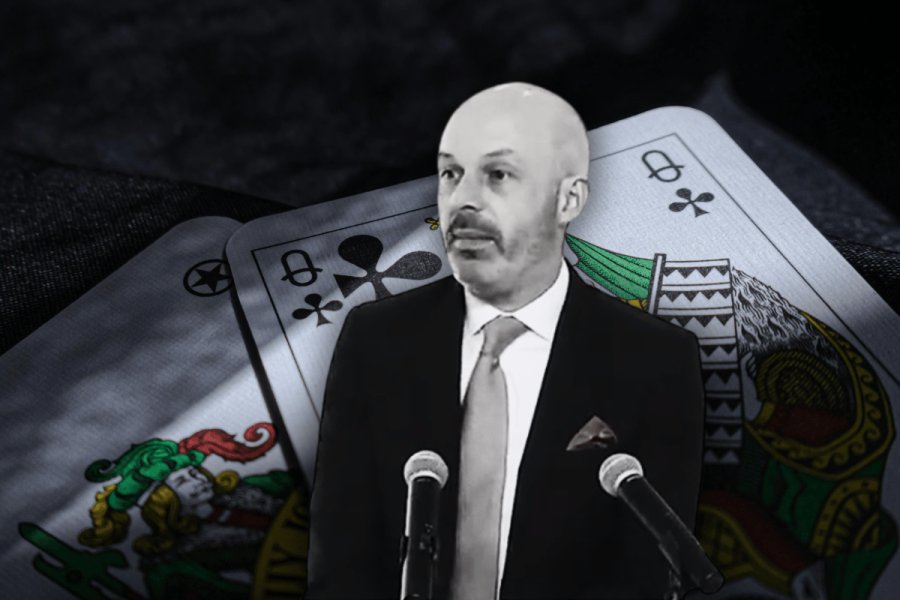
When a federal jury in Maryland found Thomas Goldstein guilty this week, it brought a stunning chapter in American legal culture to an abrupt end. A man who once moved comfortably inside the marble corridors of the Supreme Court now stands convicted of federal crimes, his reputation reshaped by a case built on poker debts, hidden income, and years of misleading financial records.
Jurors convicted Goldstein on 12 out of 16 felony counts, including tax evasion, filing false tax returns, failing to pay taxes, and making false statements to lenders. The seven-week trial pulled back the curtain on what prosecutors described as a double life. In public, he was a polished appellate lawyer and legal commentator. In private, they said, he was chasing multimillion-dollar poker games while scrambling to keep the IRS and creditors at bay.
Prominent Lawyer Convicted at Trial of Tax Evasion and Mortgage Fraud
The SCOTUSblog Founder Hid Millions in Gambling Income and Debts
: https://t.co/PVWR763XYM pic.twitter.com/Qacm4Qkkec
— Criminal Division (@DOJCrimDiv) February 26, 2026
He now faces the possibility of spending decades in federal prison when he is sentenced.
Thomas Goldstein, a lawyer at the center of the court
For much of his career, Goldstein occupied a rare position in Washington’s legal world. He founded the boutique appellate firm Goldstein & Russell, P.C., based in Bethesda, Maryland, and built a national reputation arguing before the Supreme Court. Over the years, he presented more than 40 cases to the justices and taught Supreme Court advocacy at top law schools, training the next generation of high-end litigators.
Colleagues saw him as a meticulous strategist. He was often described as non-ideological and pragmatic, someone who understood not just how to argue a case but how to get the Court to hear it in the first place.
At the same time, according to federal prosecutors, he was nurturing a gambling habit that would grow larger and riskier with each passing year.
“In addition to the legal work he performed,” prosecutors wrote, “GOLDSTEIN was also an ultrahigh-stakes poker player, frequently playing in matches or series of matches in the United States and abroad involving stakes totaling millions, and even tens of millions, of dollars.”
Poker at a scale few could imagine
By 2014, Goldstein was playing heads-up poker against wealthy business figures and international financiers. These were not casino tournaments with modest buy-ins. They were private matches where the swings could reach into the tens of millions.
To fund those games, he borrowed heavily. At one point, he secured more than $9.5 million from a California businessman under a promissory note that prosecutors say went largely unpaid for years.
In 2016, his luck appeared to turn dramatically. Prosecutors told jurors that Goldstein racked up tens of millions of dollars in poker winnings in Asia and the United States that year. He carefully tracked the results in private messages, calculating his gains down to the hour.
“I was going to use [hundreds of thousands of dollars in available funds] to pay my personal 2016 taxes, but I’m just paying penalties instead. That’s fine, and it’s my problem.”
Indictment cites a message from Thomas Goldstein to a representative of California Businessman-I
After a string of matches against three opponents, Goldstein texted fellow poker players that “[o]ur average win rate [was] US$660k per hour over an extended period of 77 hours,” a figure he calculated as more than $50 million in gross winnings.
But when it came time to file taxes, the numbers told a very different story.
For the 2016 tax year, Goldstein reported gambling winnings of $13,687,050. In reality, the indictment states, “his gambling winnings were more than $17,500,000,” and that his net gambling winnings for 2016 were more than $5,000,000, nearly double what he reported.
The government’s case rested on the gap between what he privately recorded and what he officially reported.
As the years went on, prosecutors said, the financial pressure intensified. They described a pattern in which personal gambling debts began bleeding into the finances of his law practice. Between 2016 and 2022, more than $1.1 million in firm funds went toward personal gambling obligations, according to the indictment.
In one instance, wire transfers totaling $1,171,600 were sent from the firm’s account to poker creditors and lenders without the firm’s manager being told that the debts were personal. Those payments, prosecutors wrote, were “falsely classified and deducted, for tax reporting purposes, as G&R expenses.”
The government portrayed Goldstein as maintaining tight control over the firm’s books. As sole owner, he oversaw finances and relied on managers who lacked experience, while accountants were left without complete information.
“GOLDSTEIN systematically and repeatedly failed to provide…records of his gambling wins and losses,” prosecutors alleged, even though bank statements and tax forms reflected the income.
By 2018, the IRS was pressing him about unpaid taxes. That October, Goldstein emailed his accounting firm and declared that he had “[n]o gambling winnings” for the 2017 tax year.
Prosecutors told jurors that statement was flatly untrue. They said he had actually earned more than $3.25 million in gambling income that year, none of which appeared on his return.
When an IRS revenue officer questioned him about his unpaid 2016 taxes, Goldstein attributed the shortfall to a sizable legal fee. In reality, prosecutors said, “his liability was attributable principally to gambling income.”
The financial maneuvers extended beyond traditional bank accounts. In October 2018, Goldstein flew back to the United States from Hong Kong carrying nearly $1 million in cash inside a duffel bag. He told a Customs and Border Protection officer that the money represented gambling winnings, but he did not report it as income.
Two years later, when IRS agents asked about that cash, he described it as a loan and failed to produce supporting documentation.
Around the same time, he was moving money through cryptocurrency. Prosecutors said that in 2020 and 2021 he carried out dozens of crypto transactions totaling more than $10 million. Yet on tax forms that specifically asked whether he had engaged in virtual-currency activity, he checked “no.”
Perhaps the most damaging evidence came from his own words. In a message to a representative of California Businessman-1, Goldstein wrote, “I was going to use [hundreds of thousands of dollars in available funds] to pay my personal 2016 taxes, but I’m just paying penalties instead. That’s fine, and it’s my problem.”
Prosecutors pointed to that message as proof that he understood his obligations and consciously chose to ignore them, satisfying the legal requirement of willfulness.
The verdict
Goldstein’s defense team argued that he depended on accountants, misunderstood complex reporting rules, and never set out to cheat the government. They portrayed the case as a story of disorganization and poor oversight rather than criminal intent.
The jury was not persuaded.
The Justice Department cast the conviction as a reminder that status offers no shield. “No one is above the law. The defendant was a prominent attorney who argued cases before the Supreme Court of the United States, but as the jury found, he repeatedly chose to violate the law for years,” a senior Justice Department official said in a statement after the verdict.
Federal prosecutors framed the case as deliberate rather than accidental. “The evidence at trial showed a years-long pattern of deception, including concealing millions in income and lying to lenders to sustain a lavish lifestyle,” the U.S. Attorney’s Office said.
Investigators also drew attention to the financial trail that helped build the case. “This case demonstrates that IRS Criminal Investigation will follow the money, no matter how complex the scheme or how prominent the individual,” the agency said.
The conviction leaves behind a complicated legacy. Goldstein helped shape modern Supreme Court advocacy and co-founded SCOTUSblog, a site that became essential reading for lawyers, journalists, and judges. For years, he was known for decoding the Court’s inner workings for a broader audience.
Now, his name is tied to a different set of documents ie. wire transfers, tax returns, loan agreements, and text messages that prosecutors said revealed a sustained effort to conceal income and juggle mounting debts.
Sentencing has yet to take place, and appeals are widely expected. His attorneys reportedly have asked for him not to be taken into custody pending his sentencing, stating that he is not a flight risk.
Featured image: Screenshot from UNC School of Law via YouTube
The post Thomas Goldstein convicted in sweeping federal tax case: high-stakes poker and the fall of a Supreme Court lawyer appeared first on ReadWrite.
This articles is written by : Nermeen Nabil Khear Abdelmalak
All rights reserved to : USAGOLDMIES . www.usagoldmines.com
You can Enjoy surfing our website categories and read more content in many fields you may like .
Why USAGoldMines ?
USAGoldMines is a comprehensive website offering the latest in financial, crypto, and technical news. With specialized sections for each category, it provides readers with up-to-date market insights, investment trends, and technological advancements, making it a valuable resource for investors and enthusiasts in the fast-paced financial world.