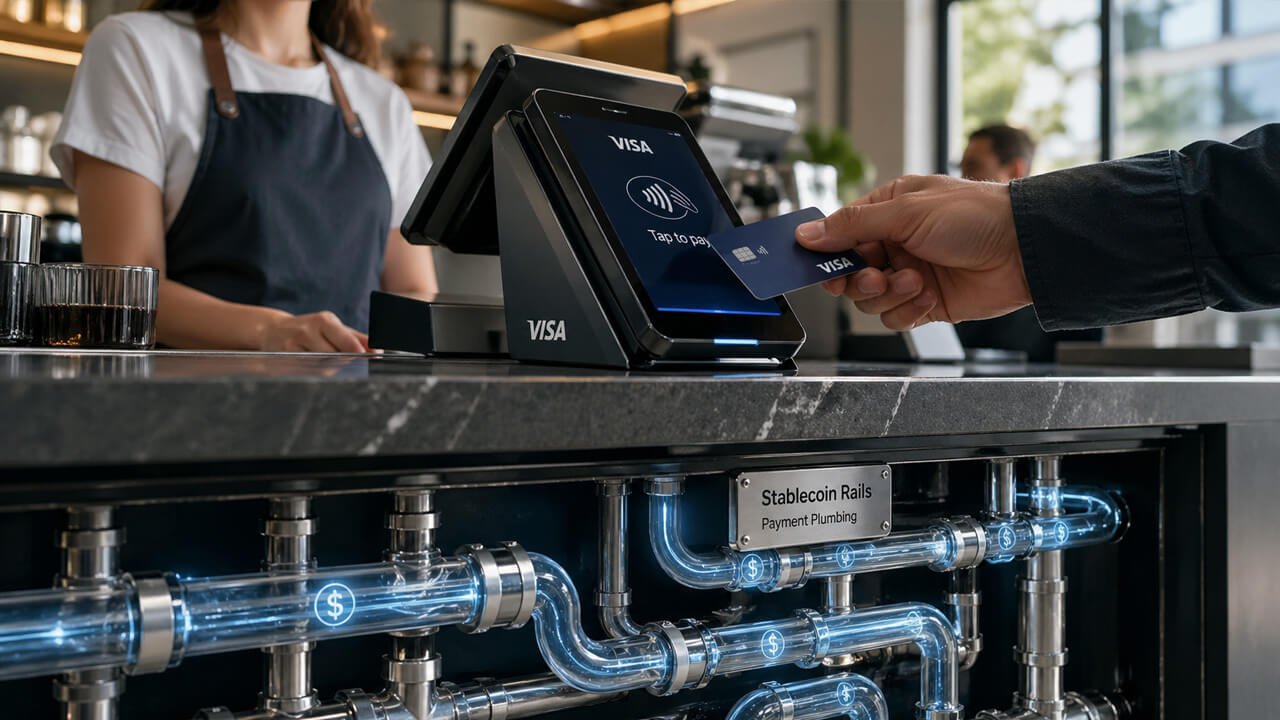
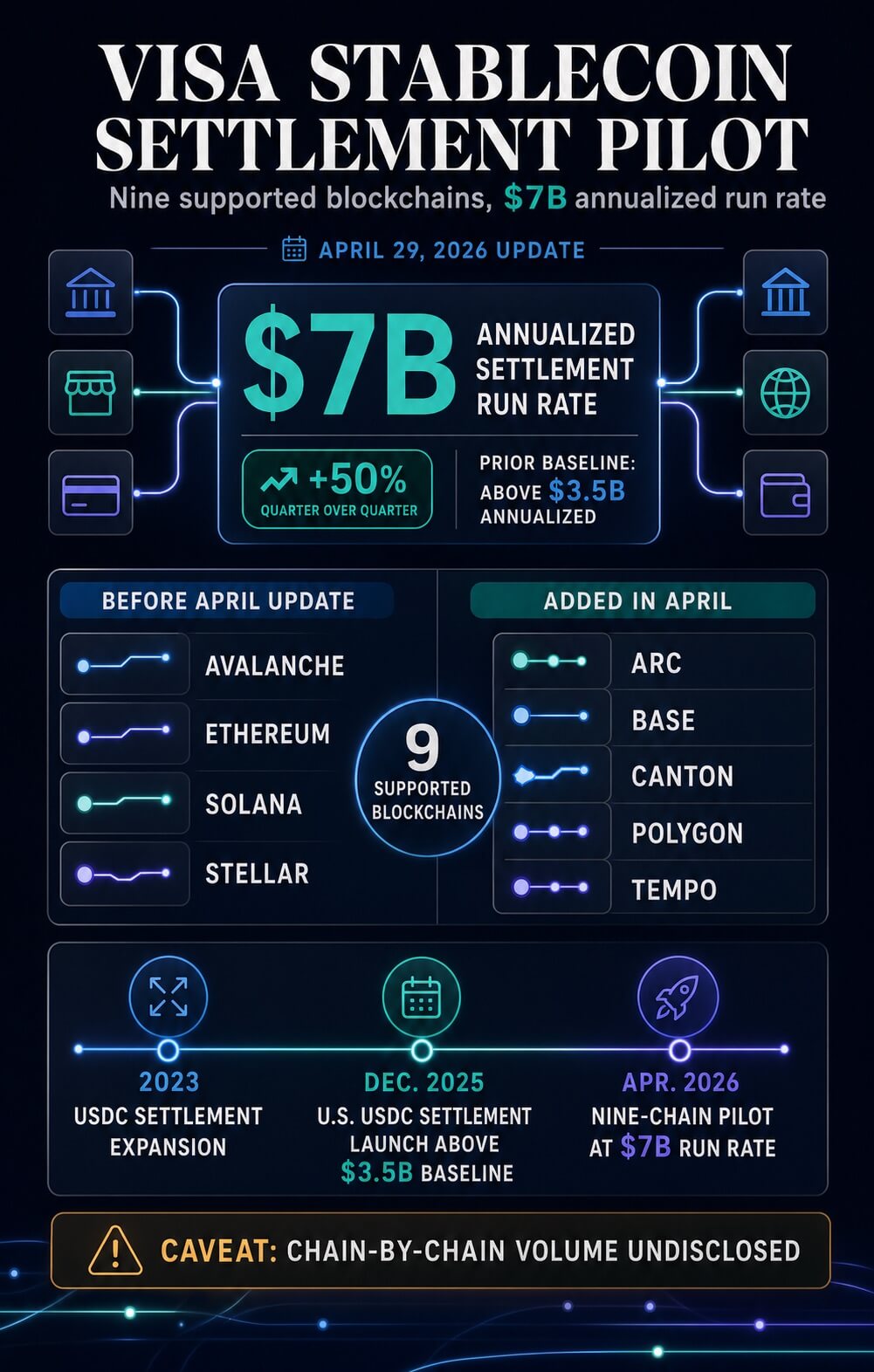
Visa said its settlement pilot for stablecoins now supports nine blockchains and has reached a run rate of $7 billion a year.
The company announced on April 29 that it added Arc, Base, Canton, Polygon and Tempo to a pilot that already used Avalanche, Ethereum, Solana and Stellar.
Visa said the annualized settlement run rate is up 50% from the prior quarter.
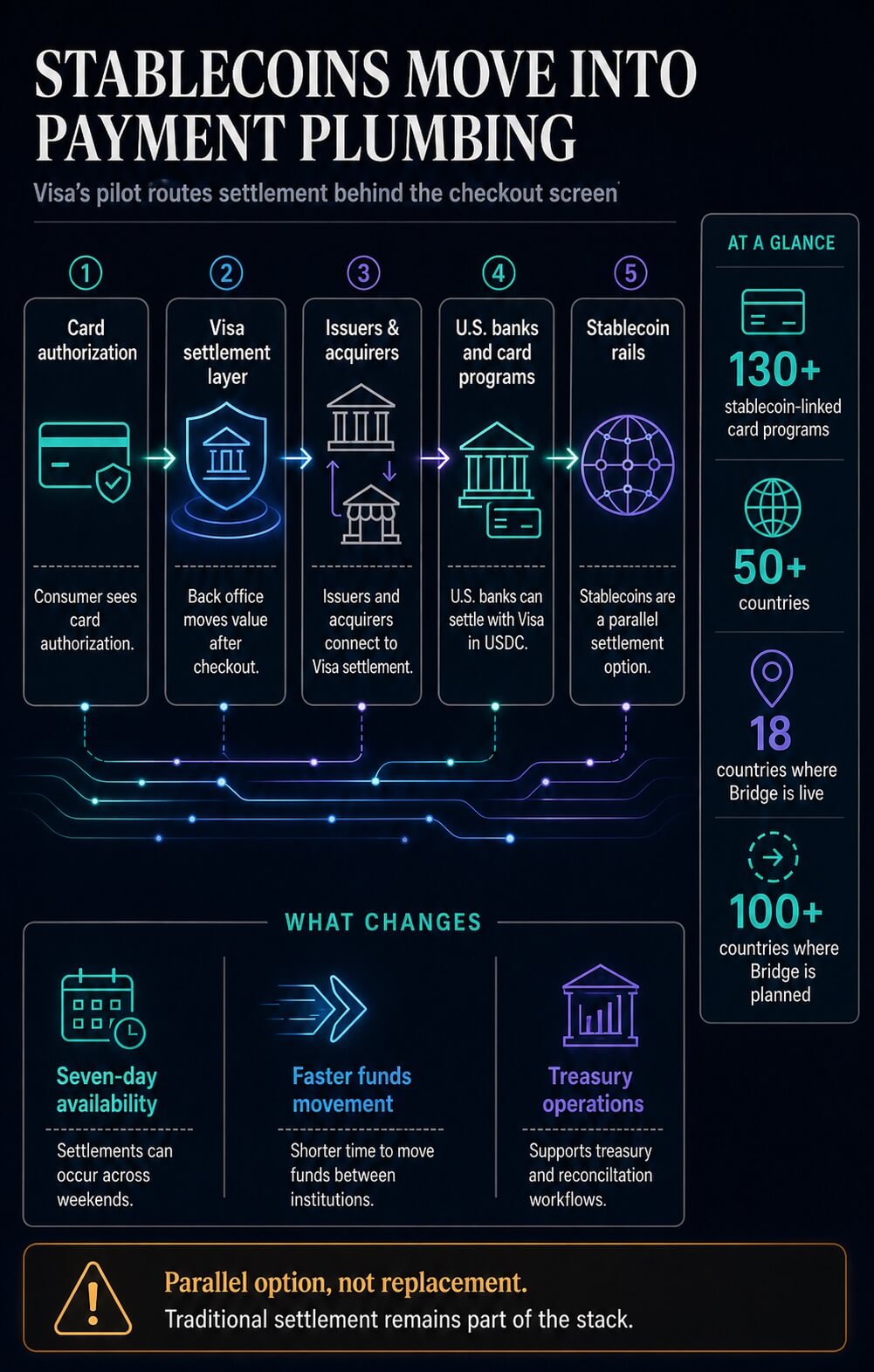
The pilot remains bounded by Visa’s own language, but the signal is in where the volume sits. Stablecoins are entering the part of payments consumers rarely see, the settlement layer that moves value between issuers, acquirers, banks, program managers and treasury systems after a transaction has already been authorized.
That makes the update a settlement-infrastructure signal as much as a blockchain support list. Visa is testing whether stablecoins can become a parallel settlement option inside payment infrastructure that already touches banks, card programs and merchants across markets.
The operational point is direct: crypto adoption is moving into the back office before it becomes visible at the checkout screen.
The conclusion has limits. The company described a pilot and support, gave a run rate for stablecoin settlement, and left the split by chain, stablecoin, partner, and geography undisclosed.
That keeps things bounded: the network is adding optional settlement rails, while traditional settlement remains part of the stack.

How Visa got to nine chains
Visa has been building toward this point for several years. In 2023, the company said it had moved millions of USDC between partners over Solana and Ethereum to settle fiat-denominated VisaNet payments.
That announcement followed an earlier Crypto.com issuer pilot and expanded the settlement work to merchant acquirers Worldpay and Nuvei.
The operational issue is familiar in card payments. A consumer gets near-instant authorization at the point of sale, but funds still have to move between the issuing bank and the merchant’s bank.
Visa’s treasury and settlement systems sit inside that process, moving value across currencies and institutions.
In December 2025, U.S. issuer and acquirer partners gained the ability to settle with Visa in USDC, with Cross River Bank and Lead Bank initially settling over Solana.
The company cited faster funds movement, seven-day availability, and resilience across weekends and holidays.

The April release also connected the chain expansion to Visa’s stablecoin-linked card programs, which it said numbered more than 130 programs across more than 50 countries.
That makes the nine-chain footprint part of a broader payment operating model, beyond a ledger experiment.
The new run rate gives that timeline a sharper shape. The December 2025 U.S. launch put the prior annualized stablecoin settlement baseline above $3.5 billion.
The April update puts the run rate at $7 billion, with five more blockchains added to the pilot.
| Before the April update | Added in April | Operational signal |
|---|---|---|
| Avalanche, Ethereum, Solana, Stellar | Arc, Base, Canton, Polygon, Tempo | Visa is widening the settlement pilot across public chains, payment-focused networks and institution-oriented infrastructure. |
The table serves as a footprint rather than a volume map. The run rate applies to the pilot as a whole; the available disclosure leaves that volume undivided across the nine supported networks.
The sequence also shows a shift in who the product is for. The early work proved that USDC could move between card ecosystem participants.
The current phase asks whether the same settlement logic can be offered across a wider menu of rails while reducing the need for each partner to build separate crypto operations from scratch.
What the chain mix shows
The five additions suggest the types of environments Visa wants available to partners.
Arc is a stablecoin-native Layer 1 created by Circle. It brings USDC-denominated fees, optional privacy, sub-second deterministic finality and direct integration with Circle’s stack.
That makes Arc relevant to payment flows where predictable costs, stablecoin liquidity and transfer guarantees count more than token speculation.
Arc’s public materials also describe public testnet status, which keeps production claims bounded.
Base brings a different route into the same problem. Visa described Base as powered by Coinbase, while Base offers USDC payments that settle in seconds, use low gas costs and can be funded from a Base Account or Coinbase Account.
Base connects wallets, payment tooling, and exchange-linked liquidity into a consumer and developer surface.
Canton adds the institutional privacy layer. Visa had already said in March that it would become a Canton Super Validator, helping banks and financial institutions explore privacy-preserving payments, settlement and treasury use cases.
Canton centers stablecoin payments on need-to-know privacy, so counterparties, amounts and strategies can remain visible only to the parties that need them, unlike many open blockchains.
As an analytical reading of the chain mix, Polygon and Tempo fit the payment-infrastructure side of the roster. Polygon emphasizes global payments, stablecoin liquidity and lower-cost transactions.
Tempo emphasizes dedicated payment lanes, stablecoin-native gas, payment metadata for reconciliation and deterministic settlement.
Together, the additions create a wider operating menu across chain types. One partner may need low-cost stablecoin movement.
Another may need privacy controls for regulated finance. Another may value Coinbase-connected payment tooling.
Visa’s role is to make those differences usable through a common settlement layer.
The result is a portfolio of settlement options across chain types. That portfolio lets Visa present stablecoins as infrastructure that can adapt to partner constraints, from regulated privacy to low-cost throughput, while keeping the payment-network relationship in the center.
The adoption signal is operational
The broader market context supports the shift while keeping price moves out of the frame. As of April 30, the crypto market stood at around $2.55 trillion, while DefiLlama put total stablecoin market capitalization at around $319.802 billion.
USDC sits in that context as a core settlement asset used for payments, treasury management, collateral, and cross-chain liquidity.
Ethereum, Solana, and Polygon Ecosystem Token are large or payment-relevant networks and tokens that can carry settlement infrastructure while keeping price data in the background.
Stablecoins already have enough liquidity and operating history for large payment networks to treat them as infrastructure options.
The adoption test shifts from whether a consumer chooses a wallet over a card to whether payment firms can use stablecoins to move value after the customer-facing transaction is done.
The market-side thesis has been building. A January analysis of BlackRock’s stablecoin thesis argued that dollar tokens were shifting from trading utility to settlement infrastructure within and alongside traditional finance.
An April analysis of Visa, Stripe, and Mastercard described stablecoins as a settlement and liquidity layer beneath existing payment brands.
Visa’s update provides a current operating example for that thesis. The company is connecting stablecoin settlement to issuers, acquirers, U.S. banks, and stablecoin-linked card programs.
Its March expansion with Bridge said stablecoin-linked Visa cards were live in 18 countries, with planned expansion to more than 100 countries.
That release also said issuers and acquirers involved in those programs could settle with Visa using stablecoins over supported networks.
Regulation sits in the background. Treasury framed the U.S. GENIUS Act as providing regulatory clarity for a market it expects could become much larger.
A CryptoSlate analysis of stablecoin economics under the CLARITY and GENIUS framework showed why the policy fight has moved toward who captures digital-dollar economics.

Visa tied the expansion to pilots, banks, partners, and supported networks, while the policy debate helps explain why payment stablecoins are drawing more mainstream attention.
The $7 billion run rate shows real activity, while the lack of a chain-by-chain breakdown leaves the depth of each rail unclear.
The nine-chain footprint shows optionality, while the pilot label keeps the conclusion bounded.
The adoption signal is therefore specific. Stablecoins are taking on a role beyond trading-market distribution.
Within Visa’s settlement pilot, they are becoming a treasury and settlement option for institutions already within mainstream payments.
The next test is whether that option remains a specialist rail for selected partners or becomes a routine part of how global payment firms move value after the consumer never sees the transaction again.
The post Visa is quietly building stablecoins into mainstream payment plumbing without you knowing appeared first on CryptoSlate.
Visa said its settlement pilot for stablecoins now supports nine blockchains and has reached a run rate of $7 billion a year. The company announced on April 29 that it added Arc, Base, Canton, Polygon and Tempo to a pilot that already used Avalanche, Ethereum, Solana and Stellar. Visa said the annualized settlement run rate
The post Visa is quietly building stablecoins into mainstream payment plumbing without you knowing appeared first on CryptoSlate. Banking, Enterprise, Featured, Payments, Stablecoins
This articles is written by : Nermeen Nabil Khear Abdelmalak
All rights reserved to : USAGOLDMIES . www.usagoldmines.com
You can Enjoy surfing our website categories and read more content in many fields you may like .
Why USAGoldMines ?
USAGoldMines is a comprehensive website offering the latest in financial, crypto, and technical news. With specialized sections for each category, it provides readers with up-to-date market insights, investment trends, and technological advancements, making it a valuable resource for investors and enthusiasts in the fast-paced financial world.