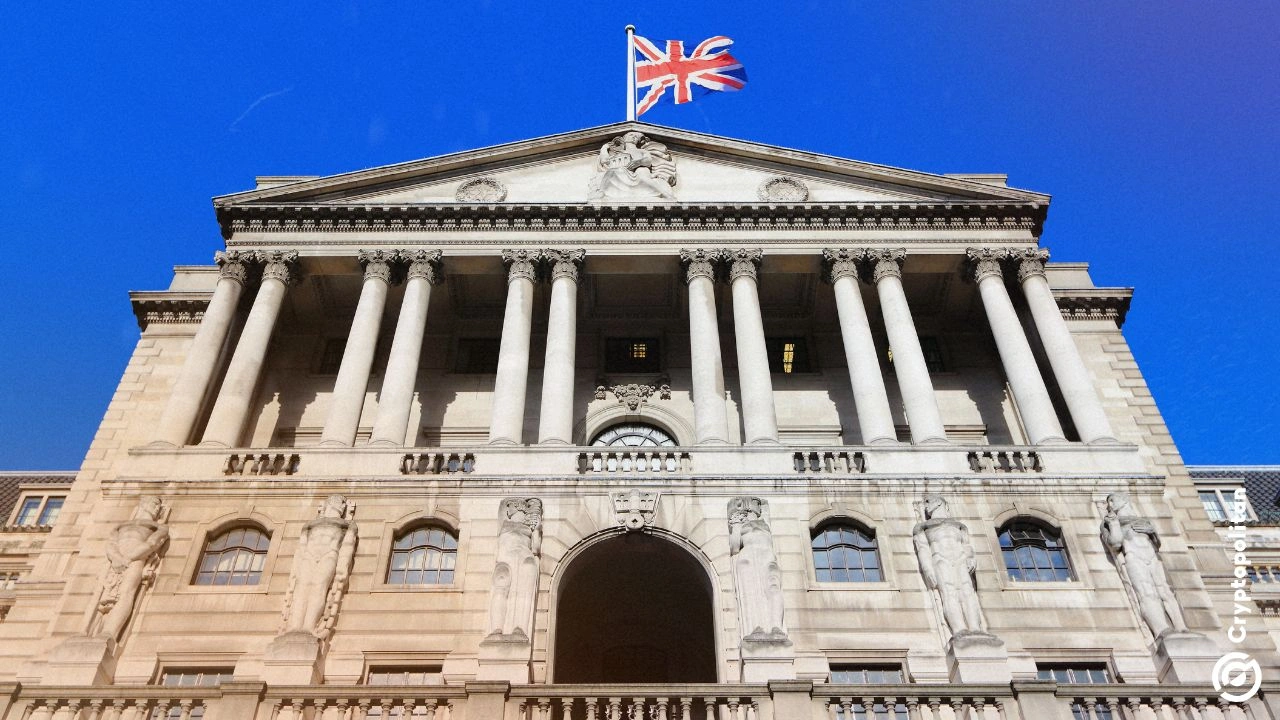
The Bank of England is showing signs that it may ease parts of its proposed stablecoin framework after strong criticism from crypto companies, legal experts, and digital asset advocates who argue that some of the rules could make sterling-backed stablecoins commercially unattractive and drive innovation outside the UK.
At the center of the debate is how Britain should regulate stablecoins that could eventually become widely used for payments and settlements. While the Bank says the framework is designed to protect financial stability and consumer trust, critics warn that the UK risks falling behind the United States and the European Union as those jurisdictions move faster to establish workable digital asset regimes.
Bank of England says it is willing to adjust proposals
The Bank of England launched its consultation on systemic sterling stablecoins in November, setting out rules for issuers whose tokens could become large enough to pose broader financial stability risks.
Deputy Governor Sarah Breeden later told lawmakers that the central bank remained open to revisiting aspects of the framework after receiving industry feedback.
“Today’s proposals mark a pivotal step towards implementing the UK’s stablecoin regime next year,” Breeden said in the Bank’s consultation announcement. “Our objective remains to support innovation and build trust in this emerging form of money.”
She added: “We’ve listened carefully to feedback and amended our proposals for achieving this, including on how stablecoin issuers interact with the Bank of England.”
Under the current proposal, issuers would be permitted to hold up to 60% of reserves in short-term UK government debt, while the remaining 40% would sit in non-interest-bearing deposits at the Bank of England. The framework also introduces temporary holding caps of 20,000 pounds for individuals and 10 million pounds for businesses.
Reuters later reported that Breeden acknowledged concerns that parts of the structure could be too restrictive and said the Bank was reviewing whether some measures were “overly conservative.”
Reserve structure could pressure issuer profits
The proposed 40% reserve requirement has become one of the industry’s biggest concerns because funds parked at the central bank would not generate any yield.
That issue matters because stablecoin issuers typically depend on income earned from reserve assets such as government bonds. In the United States, major dollar-backed stablecoin issuers generate substantial revenue by investing reserves into short-term Treasury securities while retaining the interest income.
Analysts say the Bank of England’s approach could significantly reduce profitability for sterling-backed issuers compared with their dollar-based competitors. With UK gilt yields still relatively elevated, forcing nearly half of reserves into non-yielding central bank deposits could materially compress margins and make it harder for sterling stablecoins to scale.
The Bank argues that the structure is necessary to reduce the risk of destabilizing runs during periods of market stress and to maintain trust in digital money if stablecoins become systemically important.
In its consultation paper, the Bank said it would seek feedback on “alternative mechanisms” that could help manage financial stability risks while still allowing room for innovation.
Questions grow around unhosted wallet restrictions
Another area drawing intense criticism is the Bank’s reported position on unhosted wallets, which are crypto wallets controlled directly by users rather than regulated custodians.
Breeden said unhosted wallets “will not be permissible in the UK,” pointing to anti-money laundering and know-your-customer concerns.
The comments triggered sharp reactions across the crypto industry.
Benoit Marzouk, CEO of tGBP, called the proposal “a serious misstep for the UK, risking long-term damage that is hard to unwind.” Joey Garcia, chief strategy and regulatory affairs officer at Xapo Bank, said the proposal “restricts any attempt to understand and mitigate the perceived risks.”
Freddie New, chief policy officer at Bitcoin Policy UK, described the idea as “of such monumental, such overweening, stupidity, that it is hard to formulate a sensible response.”
Critics also questioned whether such restrictions would even be enforceable in practice, given that anyone can generate a crypto wallet using open blockchain software.
Digital pound project still undecided
The stablecoin debate is unfolding alongside the Bank of England’s broader exploration of digital sterling, including a possible retail central bank digital currency known as the digital pound.
In its latest update, the Bank reiterated that no final decision has been made on whether Britain will move ahead with the project.
“No decision has been made on whether to introduce a digital pound,” the Bank said in its March 2026 progress report.
The report said the Digital Pound Lab had completed its first phase of experiments involving merchant payments and wallet technologies, while further testing remains underway.
The Bank and HM Treasury are expected to publish a blueprint and formal assessment later in 2026 before deciding whether to proceed further with the project.
UK faces pressure to keep pace globally
The UK’s stablecoin debate comes as regulators around the world accelerate efforts to establish digital asset frameworks amid the rapid expansion of dollar-backed stablecoins.
The European Union has already implemented its Markets in Crypto-Assets framework, while lawmakers in Washington continue advancing stablecoin legislation that many in the industry expect to be more commercially flexible than the UK approach.
The Bank of England has repeatedly emphasized that it is trying to balance innovation with financial stability as it develops its digital asset regime.
“Our objective remains to support innovation and build trust in this emerging form of money,” Deputy Governor Sarah Breeden said in the Bank’s consultation announcement.
Sterling-backed stablecoins still account for only a tiny share of the global market, which remains overwhelmingly dominated by dollar-linked tokens used largely across crypto trading and decentralized finance markets.
If you’re reading this, you’re already ahead. Stay there with our newsletter.
This articles is written by : Nermeen Nabil Khear Abdelmalak
All rights reserved to : USAGOLDMIES . www.usagoldmines.com
You can Enjoy surfing our website categories and read more content in many fields you may like .
Why USAGoldMines ?
USAGoldMines is a comprehensive website offering the latest in financial, crypto, and technical news. With specialized sections for each category, it provides readers with up-to-date market insights, investment trends, and technological advancements, making it a valuable resource for investors and enthusiasts in the fast-paced financial world.