

It’s time to return to our no-punches-pulled look at food manufacture, and this time we’re looking at the humble loaf of bread. As before, we’re approaching the subject with a look at breadmaking both in the traditional sense that marketing people would like you to imagine, and in the modern sense of the loaf you’ll find on your supermarket shelf.
A Food Of Great Cultural Significance
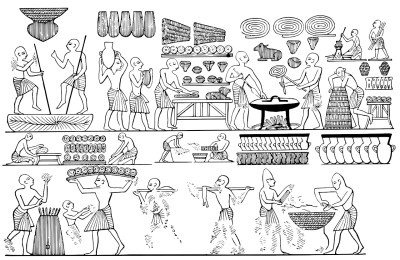
Perhaps there are few foods with as much cultural significance as bread. If your distant ancestors took the path of growing grain as their major subsistence carbohydrate, the chances are there will be some form of bread woven into your identity. Where this is being written for example were I to head for the cathedral of a Sunday morning I would recite the Lord’s Prayer as part of the service, Give us this day our daily bread. Whether your culture leavens its bread or not, or whatever grain it uses, the chances are that there will be something similar about the humble foodstuff within it.
Sitting in a coffee shop writing this a few streets away from that cathedral in a British county town, the bread here is made from wheat flour and leavened using yeast. I’d hazard a guess that it’s the loaf most of you reading this will find at your local store, and with apologies to people whose bread takes a different form it’s the bread I’ll be examining here. It’s the loaf the wheat fields where I grew up supply grain for, so it’s the one whose production I’m most familiar with.
The Ideal Bread, At Least For The Adverts
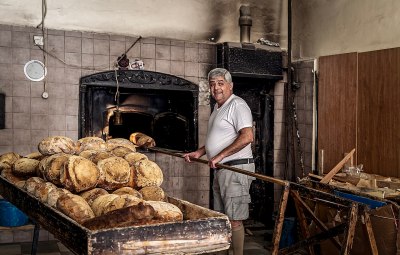
Advertising for bread is steeped in a tradition both real and imaginary, but behind the image does lie an artisan past. Very few English villages did not have a mill or a baker, whether the stone grinding wheels were driven by water or wind. The bread would have been made in much the same way as you’d make it in your 21st century kitchen, with the flour being mixed with water to a dough, before being slowly proved and leavened using a yeast culture, and baked. The oven would have been a wood-fired domed clay or brick affair rather than a gas or electric device, and perhaps our artisan baker of yore wouldn’t have used a neat rectangular tin, but the final product would be something you’d recognise.
You can still buy artisan bread made this way and it’s a fine product, but despite the industry leaning heavily on such imagery the loaf in your supermarket is not quite the same. This is not a judgement on its quality but a statement on the technological advancement that has given us an affordable, consistent, and often high quality mass produced product.
First, Chase The Ingredients
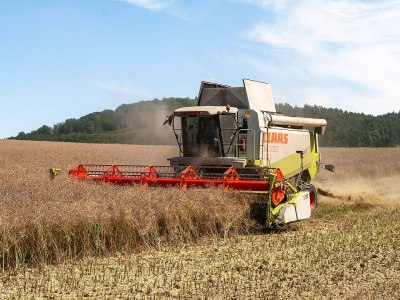
So to start with 21st century bread making, we need to stand in an Oxfordshire field like the one surrounding where I grew up. It’s the end of July, so the wheat is being harvested. The field will be part of a crop rotation scheme, so it may have had canola, beans, or any of a number of other crops grown in it the previous year. The wheat may be so-called hard wheat, usually a winter wheat with a high gluten content planted last autumn, or depending on the bread process it can be a spring-planted variety with a lower gluten content.
The wheat will be stored by the farmer in a silo until the best price can be had for it, then once sold it goes to a mill. A modern industrial mill rather than the rustic watermill of our previous description, but the principle is the same. The grain may be moistened to aid the separation of its outer husk, and then it’s passed through sets of rollers to grind it. This results in a flour, but it’s not the flour you buy, nor is it the flour that goes into your bread.
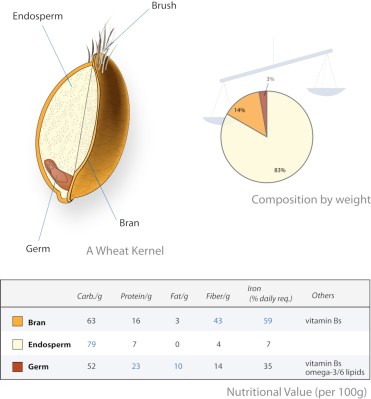
A single piece of grain, a wheat seed, is loosely comprised of three components. The endosperm is the white flour portion you may recognise, the wheatgerm is the embryo, the part of the grain which germinates, and the outer husk is referred to as bran. The raw flour is wholewheat flour and you can bake with it, but it has the problem of a limited shelf life as the wheatgerm will spoil after milling if left. This the three components are separated, and the wheatgerm is heat treated to render it inert. The flour used for baking bread is thus compounded from these components to the formulation required, along with a set of additives to preserve it, improve its baking qualities, or add vitamins and nutrients. For a flour to be referred to as wholemeal its proportions of these components are defined by law, at least where this is being written.
The other major bread ingredient is yeast, which for a modern baker is a carefully maintained monoculture of a yeast strain selected for best performance in baking. The traditional method of farming a yeast strain is something we had a look at back in the pandemic when there was a shortage of the stuff, and its industrial equivalent is a much more sterile and scientifically controlled version of the same thing. It will arrive at the baker not as the dried yeast you’ll pick up at the supermarket but as a damp paste, which will be activated by dissolving it in a sugar solution.
A Loaf That’s Better Bread
For a traditional or specialty style bread then, the baker will take a compounded strong flour and fresh yeast, and follow a surprisingly similar process to that of the rustic baker mentioned earlier. The equipment will be stainless steel and the quantities may be greater, but our baker from the past would recognise it. It makes lovely bread, and you have no doubt enjoyed it in your time.
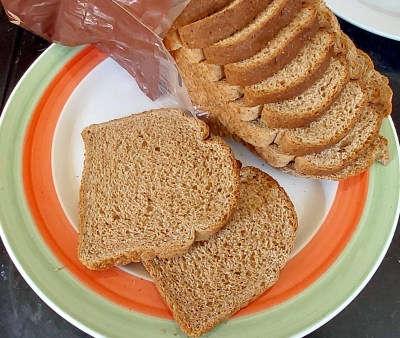
The more mundane loaves in your supermarket though, are not made in quite the same way. They take flour and yeast and make a leavened dough just as with a traditional loaf, but the process is very different indeed. The Chorleywood process, named after the town hosting the research institution where it was invented, is a high-speed baking process designed to use a wheat with a much lower gluten content than traditional bread. The problem facing the mid-20th-century researchers who created it was that the UK’s climate and agriculture isn’t suitable for growing the quantities of hard wheat its bread market demanded. Their innovation was to replace the leavening and proving of the traditional bakery with high-speed mechanical mixing, which since some of the gluten is broken down in the traditional fermentation, requires less gluten. The result is an extremely fast industrial process that produces an extremely consistent light and fluffy bread, and over the last three quarters of a century it has become the dominant loaf. It’s likely that wherever you are, a similar process tailored to your country is also responsible for most of your bread.
So you now know a little about where your daily bread comes from, and how it is made. As is usual for this series, it’s now time to look at the various claims and controversies surrounding the modern loaf, which can sometimes even take on a political dimension. Is the nutritional value of a supermarket load less than that of an artisan loaf made by that village baker? This is a question which has caused some considerable controversy over the years.
As we said earlier, modern flour is a refined and processed product whether it’s wholemeal or bleached white, and a process such as the Chorleywood one is designed to make a loaf from a cheaper ingredient. It’s then not unreasonable to suppose that the artisan loaf might be a better product, and in the sense of flavours and textures imparted by the traditional process you would probably be right to take that view. An artisan loaf is a high quality culinary experience.
But from the nutritional perspective it becomes a much less clear-cut assessment, because while a true artisinal loaf contains all the nutrients of the raw grain, the formulated flour used by the industrial baker has its nutrition precisely controlled. If the recipe uses a high-nutrition flour then the resulting bread has a high nutritional value, and since at least where this is being written such things are regulated, you can eat a Chorleywoord loaf with confidence that it’s not a nutritional desert.
As a parting thought I’d say this: eat the highest quality bread you can, support artisan producers if you can, you’ll eat some really nice bread. But don’t worry too much about the cheaper stuff, it’s only cheaper because it’s mass-produced, not because it’s worse for you.
This articles is written by : Nermeen Nabil Khear Abdelmalak
All rights reserved to : USAGOLDMIES . www.usagoldmines.com
You can Enjoy surfing our website categories and read more content in many fields you may like .
Why USAGoldMines ?
USAGoldMines is a comprehensive website offering the latest in financial, crypto, and technical news. With specialized sections for each category, it provides readers with up-to-date market insights, investment trends, and technological advancements, making it a valuable resource for investors and enthusiasts in the fast-paced financial world.