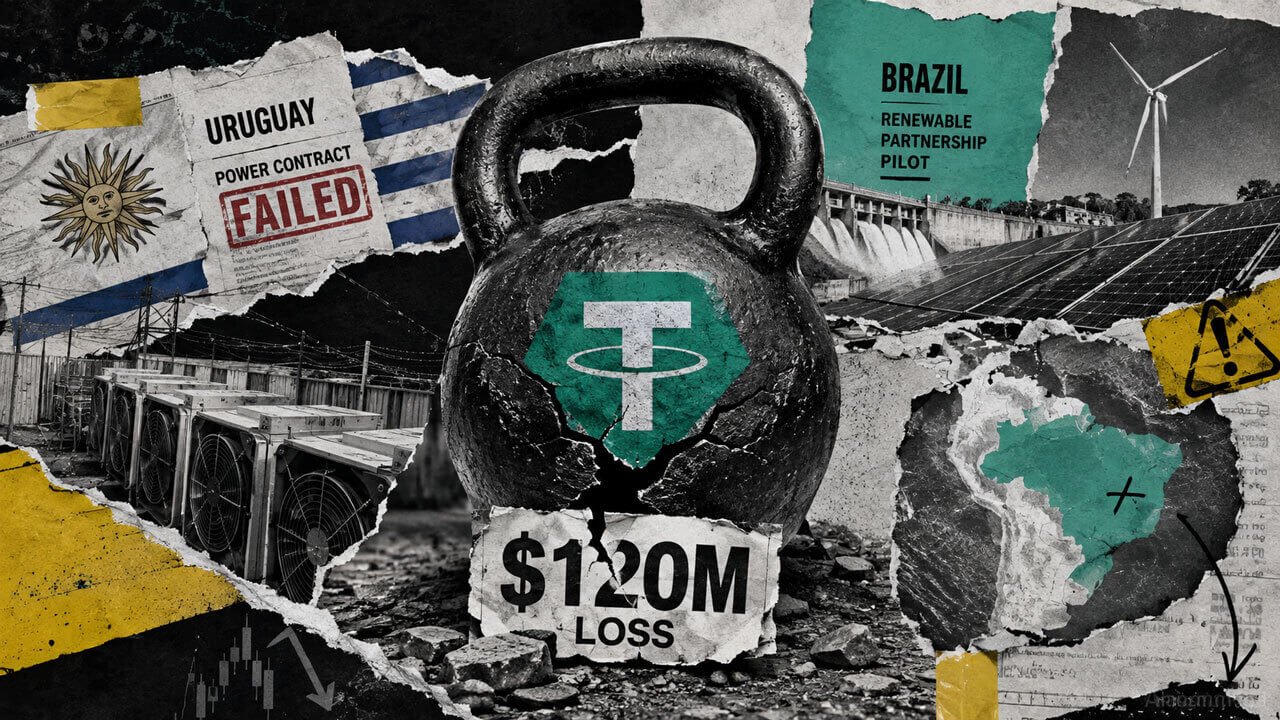
Tether’s abandoned Bitcoin mining venture in Uruguay, where a former contractor estimated spending reached about $120 million across two sites, is casting a shadow over the stablecoin issuer’s smaller renewable-energy pilot in Brazil.
The Uruguay project unraveled after Tether’s local entity, Microfin, and state utility UTE disagreed over the terms governing electricity use, Reuters reported. Microfin understood its contracted allocation as a minimum that could be expanded, while UTE treated it as a maximum.
The dispute was underway by late 2024. Microfin stopped paying power bills in May 2025, notified UTE the following month that it planned to terminate the contracts, and later failed to complete revised terms. UTE disconnected the sites on July 25.
By November, Tether, the USDT issuer, had notified labor authorities that it would cease operations and lay off most staff. Microfin settled the outstanding UTE debt in December.
A former contractor estimated Tether spent roughly $60 million at each of the two sites in Uruguay’s Florida department. The approximately $120 million figure is an estimate of spending, not a confirmed loss disclosed by Tether.
The collapse contrasts with Tether’s 2023 launch of the venture, when the company cited Uruguay’s renewable generation and grid reliability as advantages for Bitcoin mining.
The experience is directly relevant to Tether’s next South American project, which is tied to Adecoagro, a leading producer of sustainable agricultural goods and energy in South America.
Adecoagro representatives visited Tether’s Uruguay mining facility in February 2025 while the agricultural producer and Tether explored using renewable power for cryptocurrency mining. Five months later, the companies announced a memorandum of understanding for a 230 MW pilot in Brazil.
Meanwhile, that project is materially smaller. Adecoagro said the pilot would use about 10 megawatts of surplus renewable energy that would otherwise be sold into the spot market.
The more than 230 MW cited in the companies’ announcement refers to Adecoagro’s broader renewable generation capacity across South America, not power committed to Bitcoin mining.
The disclosures do not show that Tether redesigned the Brazil project because of what happened in Uruguay, nor do they establish that the new venture faces similar problems.
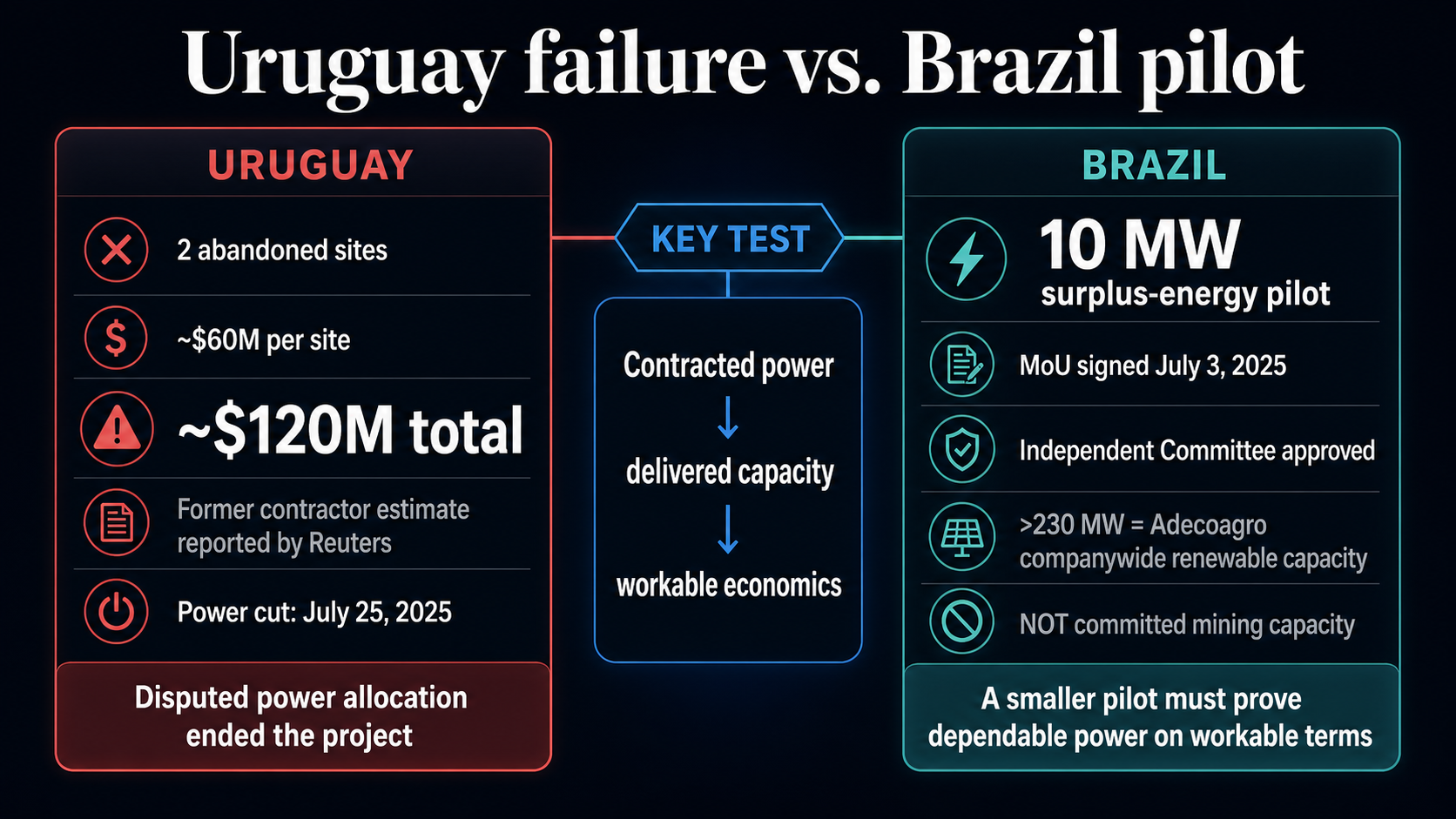
However, they make Brazil the next test of Tether’s regional mining strategy after Uruguay showed that renewable-energy availability alone does not guarantee a workable mining operation. Clear power terms, dependable capacity and sustainable economics proved just as important.
The post Tether’s $120 million Uruguay mining failure now shadows its next Bitcoin bet in Brazil appeared first on CryptoSlate.
A power-allocation dispute ended two Uruguay mining sites, leaving Tether’s smaller Adecoagro pilot to prove it can secure dependable energy on workable terms.
The post Tether’s $120 million Uruguay mining failure now shadows its next Bitcoin bet in Brazil appeared first on CryptoSlate. Featured, Mining, Stablecoins, Bitcoin, BTC, mining, stablecoins, Tether
This articles is written by : Nermeen Nabil Khear Abdelmalak
All rights reserved to : USAGOLDMIES . www.usagoldmines.com
You can Enjoy surfing our website categories and read more content in many fields you may like .
Why USAGoldMines ?
USAGoldMines is a comprehensive website offering the latest in financial, crypto, and technical news. With specialized sections for each category, it provides readers with up-to-date market insights, investment trends, and technological advancements, making it a valuable resource for investors and enthusiasts in the fast-paced financial world.