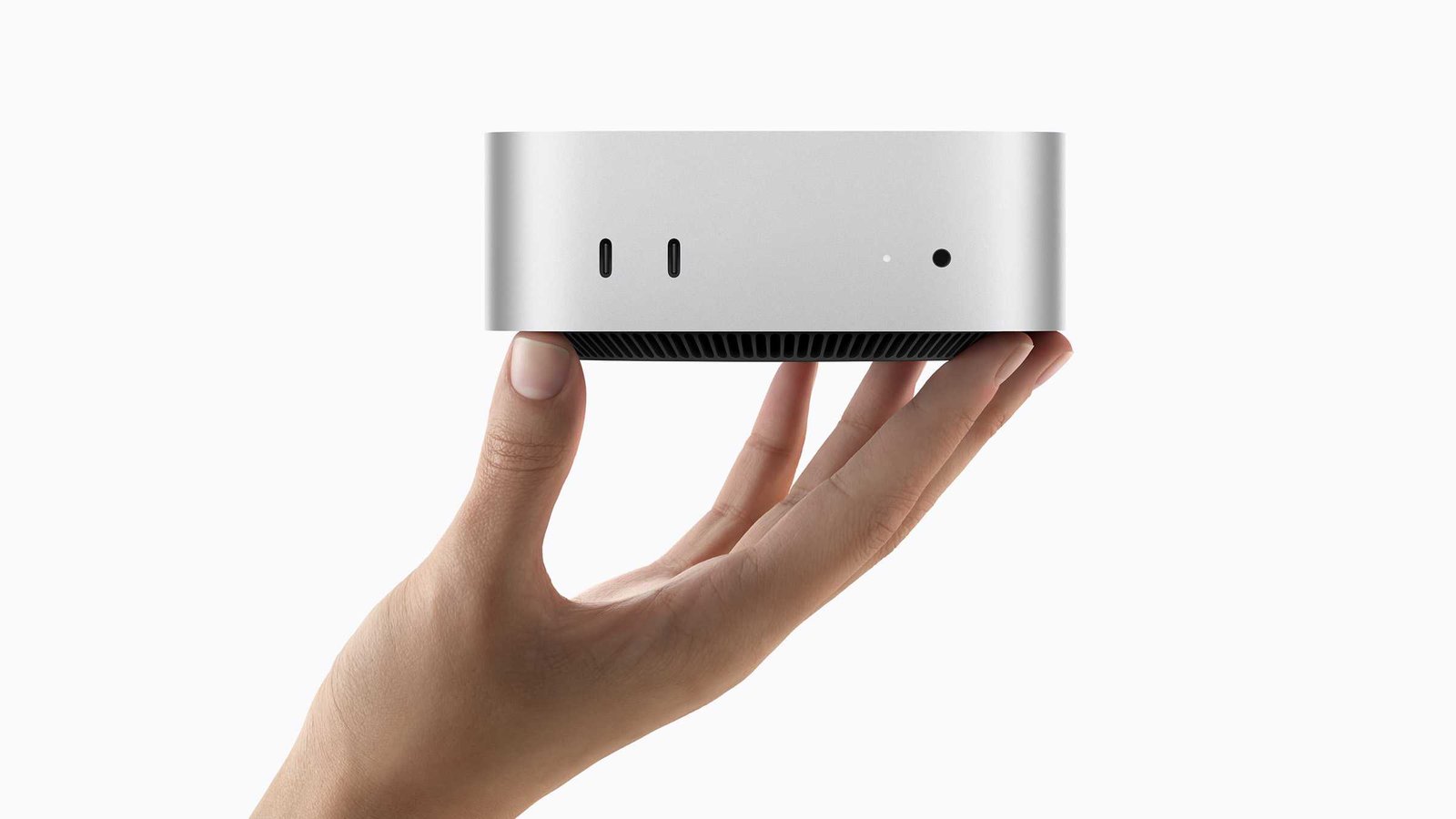
The Mac mini became the surprise local AI hero earlier this year, packing a relatively large pool of RAM into a small, always-on, reasonably affordable form factor that was catnip for OpenClaw AI users.
Since then, both AMD and Nvidia have teed up their own AI-centric Mac mini rivals, with AMD’s Ryzen AI Halo and Nvidia’s RTX Spark-powered systems serving up beefy processors and gobs of unified memory. But with prices starting in the $4,000 range, AMD’s and Nvidia’s local AI offerings are aimed more at enterprise customers, not everyday users looking to shed (or augment) their ChatGPT subscriptions.
Now hip to the Mac mini’s local LLM prowess, Apple is back with new and souped-up Mac minis that swap out the older M4 and M4 Pro chips with mightier M6 and M5 Pro chips (confusingly, the M5 Pro processors are the more powerful ones) offering more CPU and GPU cores, higher memory bandwidth (up to 160GB/s), and most importantly, a solid amount of unified RAM, which is the be-all-end-all of speedy AI inference.
But while the newest Mac minis are still much cheaper than AMD Ryzen AI Halo and Nvidia RTX Spark systems (which, arguably, are actually competing with Apple’s stratospherically priced Mac Studio), their prices have spiked compared to their two-year-old M4-packing predecessors. The reason is… well, you know why.
Apple just announced its new M6 and M5 Pro Mac minis, so we haven’t had the chance to benchmark them compared to the older M4 and M4 Pro models, nor have we stacked them up against AMD’s and Nvidia’s local AI workhorses. For its part, Apple is promising an overall 4x local AI boost versus the older Mac mini models, but we haven’t put that claim to the test yet. (There are also some important “gotchas” to consider with local AI on a Mac mini, which I’ll get to in a bit.)
What I can do is tell you the Mac mini system I’d be eyeing as a local AI user, assuming I were game for buying a premium Apple system at the very height of the PC hardware market—which I’m not, and you probably shouldn’t be either. But hey, at least we can browse, right?
For background, I currently own a Mac Mini M4 Pro with 64GB of unified RAM and 512GB of internal storage, with that storage upped by several external SSDs plus a 1GB Thunderbolt NVMe for loading local AI models. (I should’ve sprung for a bigger NVMe drive, but I was being cheap.)
My particular Mac mini cost me roughly $2,000 in late 2024, and while it can handle the current local LLM favorite, Alibaba’s Qwen 3.8 27B, the MLX variant of that model (optimized to run on Apple Silicon) starts to chug once its context window fills to much higher than 40,000 tokens or so, making the Mac mini’s cooling fans spin up like jet engines.
Looking at today’s new Mac minis, the base price of $899 for the M6 model with 16GB of RAM and 256GB of internal storage is up roughly 25 percent versus the $599 starting price of the older M4 mini with the same specs—not much of a shocker given the current jacked-up state of PC hardware prices. For local AI, though, we’re going to breeze past the base Mac mini M6, as its paltry 16GB of unified RAM simply isn’t going to cut it. Actually, I’m skipping the M6 altogether, as its RAM configuration options top out at 32GB. If you ask me, 64GB of RAM is the floor if you’re looking for decent local LLM performance.
That brings us to the M5 Pro, which starts at $1,699. First, we’re going to opt for the 18-core CPU and 20-core CPU configuration, bumping the price up another $200. Then there’s the all-important unified RAM, which we’ll max out at 64GB, tacking on another grand. For storage, I’d stick with the base option at just 512GB. Apple has historically charged a premium for internal storage, and the storage pricing options for the Mac mini M5 Pro go up exponentially, starting with $300 extra for 1TB of storage, $800 for 2TB, all the way to an insane $3,800 for 8TB.
Personally, I say skip the Apple storage tax and go for third-party external drives, but keep in mind that while you can store local AI models on garden-variety SSDs, they’ll load like molasses unless you pony up for speedy NVMe sticks in Thunderbolt enclosures. Looking on Amazon, you can snag a 2TB PCIe 4.0 Samsung NVMe for a little less than $400 (or half the price of what Apple will charge you).
So, if we were to take this particular Mac mini M5 Pro configuration up to the register, our total would come to $2,899. That’s way pricier than the base M6 Mac mini model, but not bad for a machine that can handle some fairly beefy local LLM models.
I did promise a couple of local AI “gotchas” with the Mac mini, and here they are. First, while 64GB of unified memory is doable for local inference, it’s still just 64GB, which will barely fit a 27B model like Qwen 3.8 that you’d actually trust with coding or other local work. AMD Ryzen Halo AI and Nvidia RTX Spark systems generally start at 128GB of unified RAM, giving you way more headroom (at a steeper price).
The other big catch? As impressive as they sound, Apple’s new M6 and M5 Pro chips don’t support Nvidia’s CUDA, an architecture that allows AI software to work hand-in-hand with Nvidia GPUs. Sure, Apple’s Metal architecture can be a beast for AI inference (and there are plenty of MLX-optimized models, including Qwen 3.8), but the most popular AI workflows are designed for CUDA, particularly when it comes to video.
So, if you have your heart set on generating eye-popping local AI videos with a state-of-the-art model like MiniMax H3 on a topped-up Mac mini M5 Pro, just know that Nvidia RTX Spark-powered systems will be running circles around you. (And yes, AMD Ryzen Halo AI systems are in the same CUDA-deficient situation, although AMD has its own ROCm platform to narrow the gap.)
For a Mac that truly competes with Nvidia and AMD local AI workstations, you’ll have to step up to the Mac Studio, which also doesn’t do CUDA but does offer RAM configurations at 128GB and up, all for the “low” price of $5,099—and that’s just for starters. Want the M5 Ultra version with 256GB of RAM? That’ll be $10,799, please.
This articles is written by : Nermeen Nabil Khear Abdelmalak
All rights reserved to : USAGOLDMIES . www.usagoldmines.com
You can Enjoy surfing our website categories and read more content in many fields you may like .
Why USAGoldMines ?
USAGoldMines is a comprehensive website offering the latest in financial, crypto, and technical news. With specialized sections for each category, it provides readers with up-to-date market insights, investment trends, and technological advancements, making it a valuable resource for investors and enthusiasts in the fast-paced financial world.