
Bitcoin accelerated above $81,000 on Thursday as easing rate fears and fresh institutional demand lifted the broader crypto market.
On Sept. 3, Federal Reserve Gov. Christopher Waller said he could support keeping interest rates unchanged this month if August inflation continues to cool, helping push the market-implied odds of a September rate increase to roughly 50% from about 65% earlier in the day. Treasury yields declined following the remarks.
This news helped spark a rally across major cryptocurrencies, with Ethereum, XRP and Solana gaining more than 5%, while Zcash and Cardano climbed more than 10%.
Fresh capital starts replacing the short squeeze
Bitcoin’s rally is beginning to draw fresh capital from several parts of the market after its initial advance relied heavily on bearish traders being forced out of positions.
US spot Bitcoin ETFs drew $730.9 million on Thursday, their largest daily inflow since January. BlackRock’s IBIT accounted for roughly $454 million, while products from Fidelity, Grayscale and others also attracted capital.
The inflows provide a stronger source of demand after CryptoQuant found that much of Bitcoin’s earlier push toward $81,000 was driven by shorts being liquidated or closed, with relatively few traders opening new long positions. That left the first phase of the rebound dependent on forced buying that fades as bearish positions are cleared.
The latest market activity suggests that composition is starting to change.
Thursday’s ETF haul followed a strong August in which US Bitcoin funds attracted about $3.5 billion, their best month since September 2025. At the same time, spot trading activity across exchanges has accelerated sharply as Bitcoin recovered toward $80,000.
CryptoQuant data showed daily Bitcoin spot volume rising roughly three to four times from early-August lows. Binance captured the largest increase, while Coinbase and MEXC also recorded stronger activity.
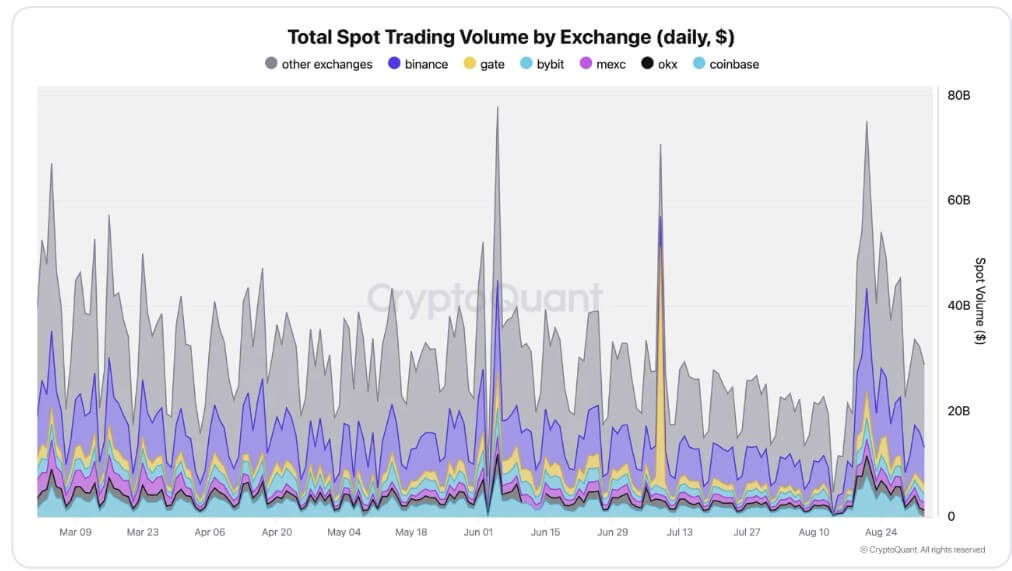
Large holders have also become more active around exchanges. Hourly Bitcoin whale inflows repeatedly exceeded 2,000 BTC, while the average deposit size on Binance climbed from roughly 20 to 30 BTC to more than 50 BTC, with peaks near 75 BTC.
Those transfers point to heavier participation rather than outright accumulation, since coins sent to exchanges can also precede selling.
Combined with stronger ETF subscriptions and rising spot turnover, however, they show that the rally is drawing activity from a broader group of market participants than during its initial short-covering phase.
Notably, this market expansion is also spreading beyond Bitcoin. Seven-day cumulative altcoin deposit transactions increased from roughly 15,000 to 20,000 to around 45,000, suggesting improving sentiment is translating into greater participation across the wider crypto market.
That leaves Bitcoin entering its next test with a broader demand base than it had during the first phase of the rebound.
Options traders stay cautious near Bitcoin’s breakout zone
The stronger spot backdrop is running into a derivatives market clustered around the same price region Bitcoin needs to clear.
About 29,600 Bitcoin options worth $2.39 billion expired Friday, carrying a put-call ratio of 0.65 and a maximum pain level of $73,000. The expiry represented only about 7% of outstanding options, leaving most positioning intact.
Greeks.live said call gamma exposure, previously spread across multiple strikes, has increasingly converged as traders sell calls above $80,000, while put gamma exposure remains minimal. That positioning could create additional friction around heavily populated strikes if option sellers adjust hedges as Bitcoin moves higher.
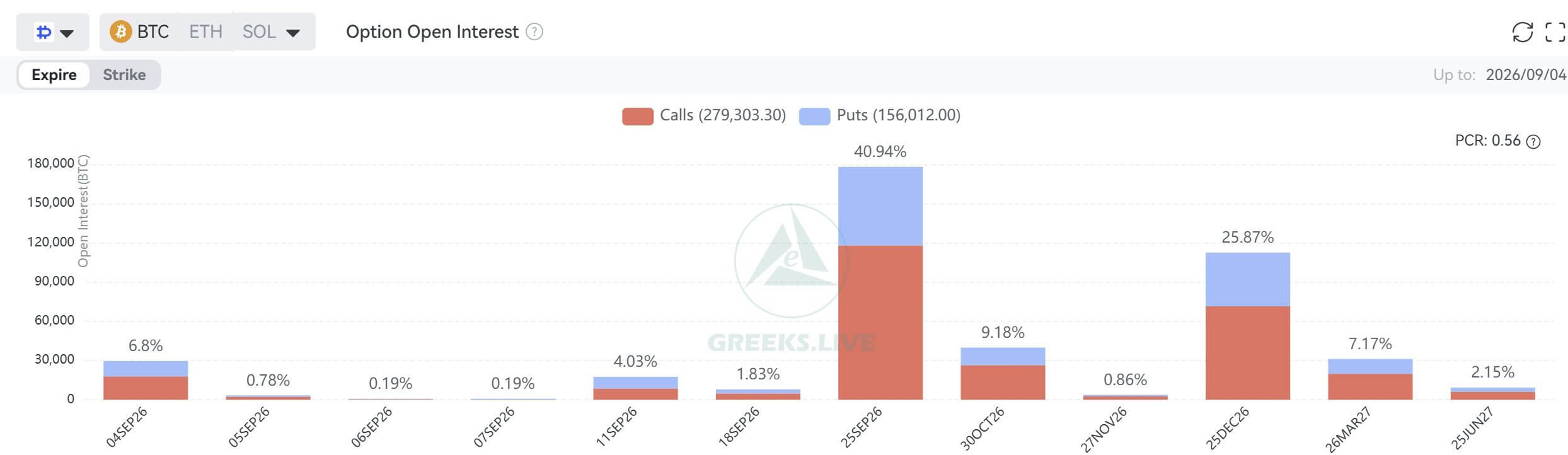
The concentration sits directly below another major threshold.
Bitcoin reached $81,400 on Aug. 28 before retreating into a roughly $76,000 to $81,000 range. CryptoQuant’s 365-day moving average is near $82,300, a level the firm uses to distinguish stronger long-term bull-market regimes.
Its Bull Score remains at 70 after briefly reaching 80 during the August rally, the highest since October 2025. Readings above 60 have historically coincided with stronger market conditions.
Yet volatility markets are becoming less aggressive as Bitcoin approaches that test.
Monthly realized volatility increased to about 40% this week, while monthly implied volatility declined to roughly 36%. The 15-day volatility risk premium briefly dropped to negative 16% on Thursday before recovering to about negative 6%, well below last month’s peak near 15%.
Bitcoin has therefore been moving more sharply than options prices imply it will move in the coming period.
Headline leverage figures also look less extreme beneath the surface. Bitcoin open interest is approaching $48 billion when measured in dollars, but Alphractal data show the same exposure declining when denominated in BTC. Part of the rise in dollar open interest reflects Bitcoin’s higher price rather than a proportional increase in the amount of exposure traders are taking.
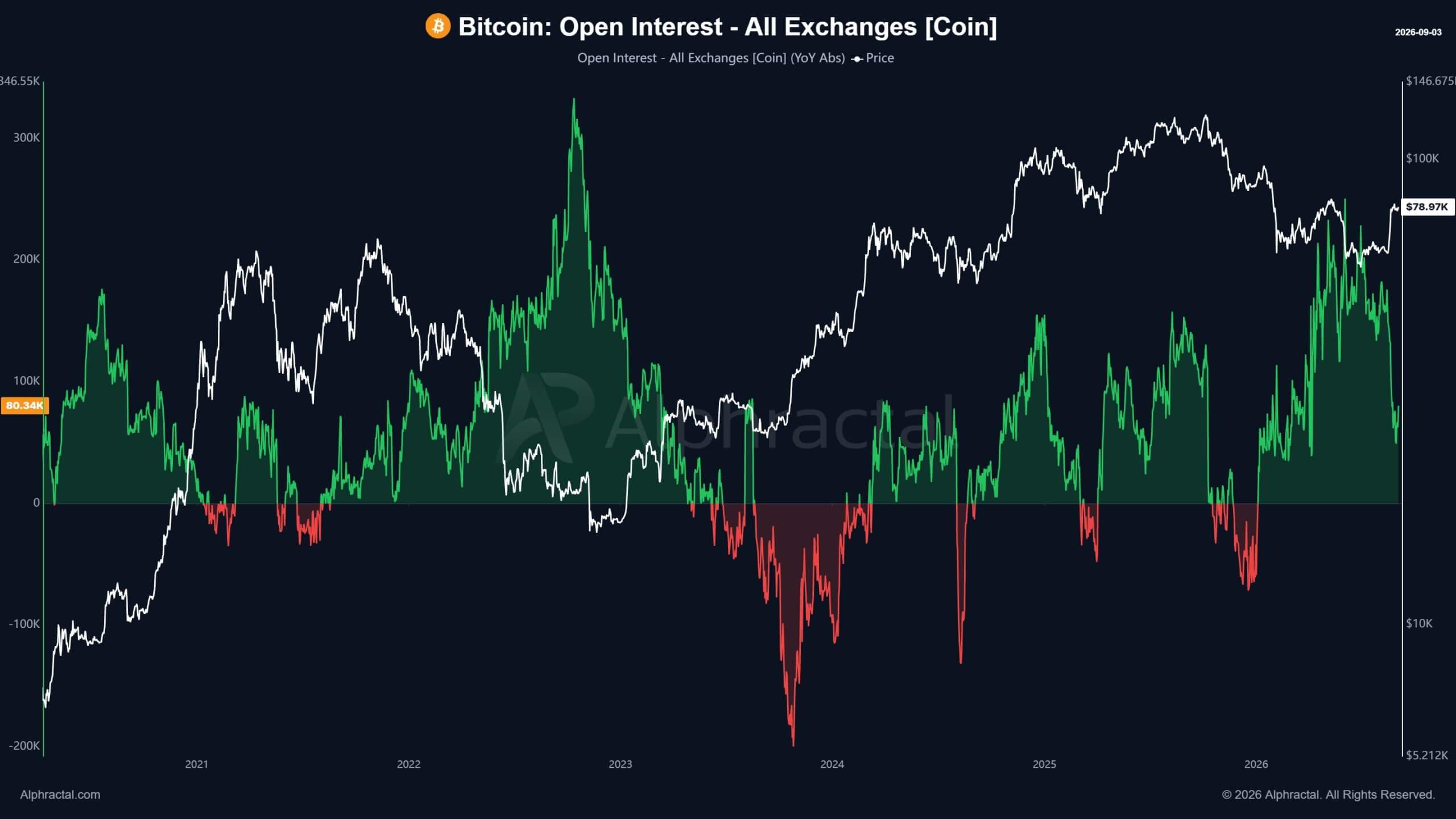
The result is a derivatives market that remains comparatively restrained even as Bitcoin sits beneath a major breakout level.
With call positioning building above $80,000 and implied volatility falling below realized volatility, traders appear to be pricing consolidation rather than an immediate expansion in price swings.
The next move needs buyers to stay
Bitcoin now enters its next attempt at the $80,000 to $83,000 zone with a stronger foundation than it had during the first phase of the rebound.
Short covering can accelerate a rally, but its contribution fades as bearish positions are closed. Sustained advances eventually require investors willing to keep buying at progressively higher prices.
Thursday’s ETF flows suggest that transition may be beginning.
The test is persistence. A single $730.9 million session can strengthen demand without establishing a durable institutional bid, particularly after the funds recorded a $236 million outflow earlier in the week.
Bitcoin must also absorb call positioning above $80,000 and clear the roughly $82,300 long-term threshold while the options market continues to price lower volatility.
Waller’s comments have improved the macro backdrop, but that support remains conditional on incoming inflation data. A stronger-than-expected reading could quickly restore expectations for tighter policy and reverse some of Thursday’s easing in financial conditions.
For now, Bitcoin has gained something its initial rebound lacked: a large fresh injection of spot capital alongside expanding participation across the crypto market.
Whether that becomes a sustained bull-market breakout depends on those buyers returning after the first surge. If ETF demand persists, Bitcoin’s next attempt at $83,000 may also test how long the options market’s subdued volatility expectations can hold.
The post Bitcoin’s rally over $81,000 is finding real buyers, but options traders still aren’t pricing a clean breakout appeared first on CryptoSlate.
This articles is written by : Nermeen Nabil Khear Abdelmalak
All rights reserved to : USAGOLDMIES . www.usagoldmines.com
You can Enjoy surfing our website categories and read more content in many fields you may like .
Why USAGoldMines ?
USAGoldMines is a comprehensive website offering the latest in financial, crypto, and technical news. With specialized sections for each category, it provides readers with up-to-date market insights, investment trends, and technological advancements, making it a valuable resource for investors and enthusiasts in the fast-paced financial world.