Web3 gaming has spent years promising that blockchain would change what it means to own, earn, and trade inside games. The problem was that too many projects tried to prove the economics before they proved the game.
A token launched. An NFT collection followed. A reward loop appeared. Then someone eventually asked the uncomfortable question: is this actually fun? That question is becoming harder for Web3 games to avoid in 2026.
The sector is still active. Industry trackers still list thousands of gaming dApps; new projects are launching across multiple chains, and established companies such as Animoca Brands still operate major gaming and digital-ownership businesses.
But the easy-money phase is clearly gone.
Capital is more selective. Players are less impressed by the existence of a token. Projects that cannot keep users entertained are disappearing faster. The result may look painful from the outside, but it could be exactly what blockchain gaming needed.

The Token Is No Longer Enough
The first generation of play-to-earn games benefited from novelty. A game did not necessarily need to compete with the best traditional titles if the economic loop itself was the attraction. Players could tolerate simple gameplay because earning was part of the entertainment.
That model has obvious limits. If the token price becomes the main reason to play, the game becomes extremely sensitive to the token price. If new users are needed primarily to support rewards for existing users, the economy becomes fragile. If players leave the moment rewards fall, the project never built a real game community in the first place.
The healthier version of Web3 gaming flips the order. The game has to work first. Blockchain can then provide optional ownership, portable assets, open marketplaces, transparent rewards or other features that make sense for the particular game.
That sounds less revolutionary than the old pitch. It is also much more realistic.
Better Web3 Games Hide the Blockchain
One of the clearest changes in the current market is how often stronger Web3 titles try to reduce crypto friction. Players increasingly encounter browser logins, social accounts and familiar onboarding before they ever see a wallet.
That is a big philosophical shift. Earlier blockchain games often treated the wallet as proof that the product was Web3. Newer projects are more willing to treat blockchain as infrastructure that can sit behind the experience.
That is how mainstream software usually wins. Nobody chooses a streaming service because of the database architecture. Nobody downloads a competitive game because the payment processor is technically interesting. Players care about the experience.
If blockchain improves ownership or settlement without making the game worse, it can become useful infrastructure instead of the product’s entire identity.
The same logic applies to tokens. A token that has a real job inside an active economy can be useful. A token that exists mainly because the project wanted a token is much harder to defend.
The Market Is Becoming Brutally Selective
The current state of crypto gaming reflects that pressure. Recent 2026 industry snapshots show a market that is still populated but no longer receiving automatic capital simply for attaching blockchain to a game.
One August 2026 tracker counted more than 2,300 gaming dapps and a multi-billion-dollar gaming-token market, while another monthly report found very little traditional venture funding flowing into the sector during the same period.
That combination tells an interesting story. Web3 gaming has not disappeared. It has lost the assumption that every project deserves to survive. That is normal for a mature entertainment market.
Most traditional games fail too. Most studios do not create a blockbuster. Most multiplayer games struggle to retain an audience. The difference is that traditional gaming never promised that financial engineering could solve those problems.
Web3 gaming is learning the same lesson. Retention beats tokenomics. Community beats a roadmap. A good game beats a clever whitepaper.
Ownership Still Has a Real Use Case
None of that means digital ownership is useless. Games already contain enormous virtual economies. Players care about skins, collectibles, weapons, vehicles, land, trading cards and status items even when those objects never touch a blockchain.
The interesting Web3 question is whether some of those assets become more valuable to players when ownership is clearer, trading is more open or identity can follow a user across a broader ecosystem.
The answer will not be the same for every game. A competitive shooter may have completely different needs from a trading-card game. A persistent virtual world may benefit from open marketplaces more than a tightly balanced single-player experience.
That is why forcing the same token model into every genre was always unlikely to work. Blockchain has to earn its place feature by feature.
The Creator Layer May Be More Valuable Than the Game Token
There is another possibility that Web3 gaming discussions often overlook. The most useful crypto economy may not live inside the game at all. Modern games create economic activity around themselves.
Streamers produce entertainment. Video editors create clips. Modders build experiences. Communities organize events. Brands sponsor creators. Fans make guides, art, commentary and entire media businesses around games they do not own.
That creator layer has its own problems. Payments are fragmented. Campaign work is difficult to coordinate. Small creators can be hard for brands to discover. International payouts create friction. Reward systems are often opaque. Those problems are much closer to the kinds of infrastructure blockchain can realistically help with.
Crypto can settle payments across borders. Tokens can coordinate incentives in a defined network. On-chain systems can make some reward flows transparent. None of that requires a player to buy an NFT before they are allowed to enjoy a game.
That distinction becomes especially important as enormous mainstream launches such as GTA 6 concentrate attention around creator communities.

Where Wanted Network Makes a Different Bet
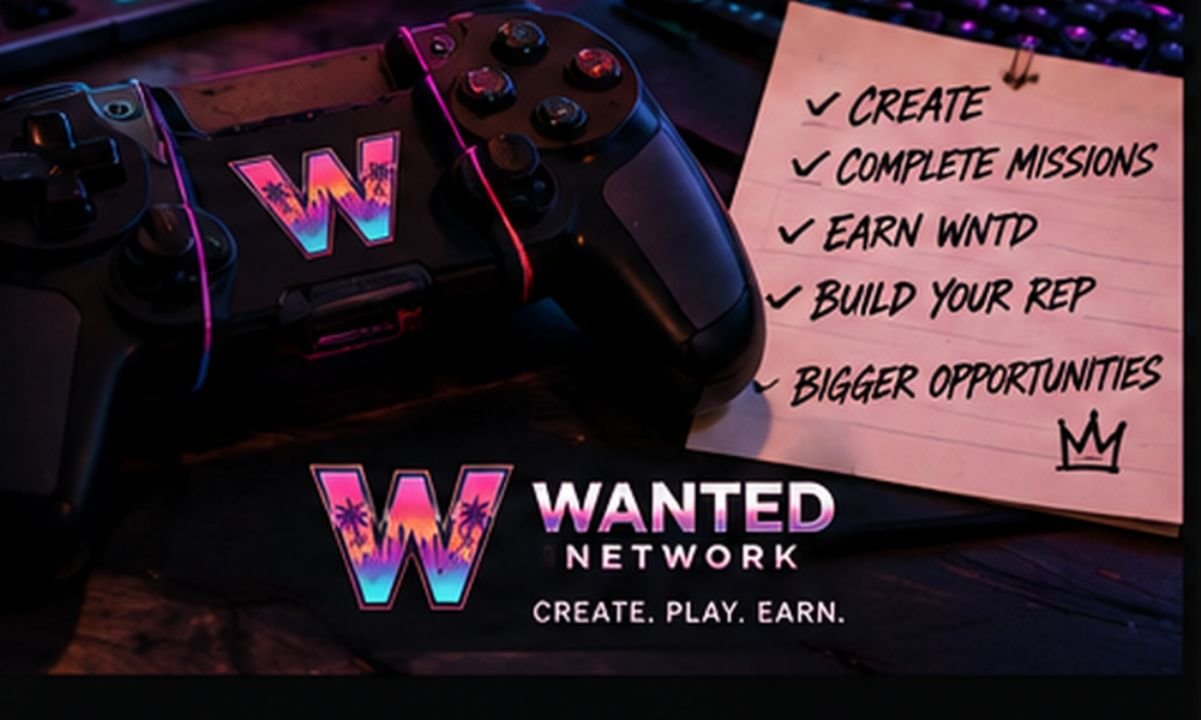
Wanted Network is built around that external creator economy rather than trying to manufacture a blockchain game. Its Missions system gives creators structured challenges with defined objectives, submission rules and reward opportunities.
Creators can build reputation through Heat and earn WNTD-powered rewards for qualifying participation. As the network expands, the same framework is intended to support advertiser-funded creator campaigns. That means WNTD has a role inside a creator marketplace rather than pretending to be necessary to gameplay.
Wanted Network’s advertiser model is designed to connect campaign demand to WNTD use, including supported routes where advertiser spending can create market purchases of WNTD and token burns.
Whether that model succeeds will depend on the same thing every useful token economy eventually depends on: real activity. Creators have to want the opportunities. Brands have to value the output. Campaigns have to produce something economically useful.
The token cannot substitute for that activity. It can only help coordinate it.
Web3 Gaming’s Next Win May Look Almost Normal
That may be the broader lesson for Web3 games too. The strongest version of blockchain gaming probably will not constantly remind players that it is blockchain gaming.
It will look like a good game with unusually flexible ownership. Or a competitive game with a transparent reward system. Or a creator ecosystem with better ways to coordinate paid work.
The technology becomes more credible when users stop being asked to care about the technology itself. That is why the difficult phase Web3 gaming is going through may ultimately be healthy.
Weak projects are being forced to answer the question the industry should have asked from the beginning. Would anyone still want this if the token disappeared?
For the games that can answer yes, blockchain finally has a chance to become an advantage instead of a distraction.
More About Wanted Network:
Website — https://wantednetwork.io
Discord — https://discord.gg/wantednetwork
X — https://x.com/Wanted_Network
Disclaimer: The above article is sponsored content; it’s written by a third party. CryptoPotato doesn’t endorse or assume responsibility for the content, advertising, products, quality, accuracy, or other materials on this page. Nothing in it should be construed as financial advice. Readers are strongly advised to verify the information independently and carefully before engaging with any company or project mentioned and to do their own research. Investing in cryptocurrencies carries a risk of capital loss, and readers are also advised to consult a professional before making any decisions that may or may not be based on the above-sponsored content.
Readers are also advised to read CryptoPotato’s full disclaimer.
The post Web3 Games Aren’t Dying — They’re Finally Being Forced to Become Good Games. What About Wanted Network? appeared first on CryptoPotato.
Web3 gaming has spent years promising that blockchain would change what it means to own, earn, and trade inside games. The problem was that too many projects tried to prove the economics before they proved the game. A token launched. An NFT collection followed. A reward loop appeared. Then someone eventually asked the uncomfortable question: Projects
This articles is written by : Nermeen Nabil Khear Abdelmalak
All rights reserved to : USAGOLDMIES . www.usagoldmines.com
You can Enjoy surfing our website categories and read more content in many fields you may like .
Why USAGoldMines ?
USAGoldMines is a comprehensive website offering the latest in financial, crypto, and technical news. With specialized sections for each category, it provides readers with up-to-date market insights, investment trends, and technological advancements, making it a valuable resource for investors and enthusiasts in the fast-paced financial world.