
OpenAI is facing legal trouble on Monday due to the filing of a trademark infringement lawsuit by software company TradeSun, which is based in Del Mar, California.
The case was filed in a federal court in San Francisco and adds to the string of name-related lawsuits faced by OpenAI, according to a report from Reuters.
The lawsuit also highlights a rising challenge for the AI sector. As businesses hurry to introduce their products and features, catchy names are starting to collide with each other more often in the software world. As a result, trademark clearance has become more than a marketing procedure.
What TradeSun is claiming
TradeSun told the court that OpenAI’s flagship model could cause consumer confusion. “By saturating the market with ‘Astra,’ OpenAI is teaching the public that Astra means OpenAI,” the company said in its complaint, according to Reuters.
TradeSun’s Astra software uses AI agents to analyze trade documents for banks and other financial institutions. The company is seeking unspecified damages and an order blocking OpenAI from using the Astra name.
OpenAI denied the allegation. “This complaint lacks any merit whatsoever,” a representative said to Reuters, while emphasizing that the company is “focused on responsibly building technology that benefits everyone.”
The case is identified as TradeSun Inc. v. OpenAI Opco LLC, No. 3:26-cv-11360, and takes place in the United States District Court for the Northern District of California. At this point, the claims are simply allegations without any court ruling yet on whether OpenAI violated TradeSun’s trademarks.
A trademark with its own challenge history
TradeSun has federal registration number 6746198 for the trademark ASTRA, which covers an AI-based software-as-a-service for document classification and data extraction.
That registration was put into contest on April 7, 2026, through a petition that BizUpUSA Holdings filed with the Trademark Trial and Appeal Board to cancel it. However, USPTO records indicate that BizUpUSA withdrew the petition and consequently terminated the proceedings in July 2026.
This situation nevertheless shows how easily the ownership of short, catchy names using AI technology can be contested.
OpenAI launched GPT-6 Astra on September 3, rolling it out across ChatGPT paid tiers, its API, Microsoft Azure, and AWS Bedrock. Reuters later reported that OpenAI scrapped an updated Astra model amid safety concerns.
OpenAI has faced similar disputes before. OverDrive sued in November 2025 over the Sora name, arguing its established reading platform had prior rights, as detailed by Accelerate IP.
The company also clashed with wearable startup IYO over the “io” name. A judge temporarily restricted OpenAI’s use of the branding before the company dropped the name and settled the dispute, which Cryptopolitan previously covered.
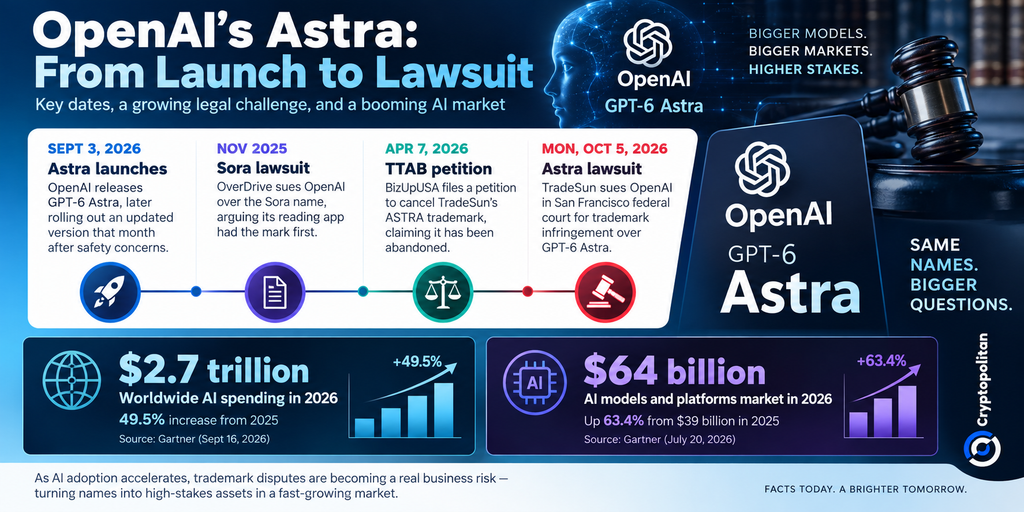
The stakes are rising with the AI market. Gartner forecasts worldwide AI spending will reach $2.7 trillion in 2026, up 49.5% year over year. Gartner also expects the AI models and platforms market to hit $64 billion, up 63.4% from $39 billion in 2025.
For AI companies, making an error in naming a product can become quite costly. When that name is integrated into the API, services, and customer processes, changing it may lead to legal fees, technical rework, and postponement of future releases of products.
If you’re reading this, you’re already ahead. Stay there with our newsletter.
This articles is written by : Nermeen Nabil Khear Abdelmalak
All rights reserved to : USAGOLDMIES . www.usagoldmines.com
You can Enjoy surfing our website categories and read more content in many fields you may like .
Why USAGoldMines ?
USAGoldMines is a comprehensive website offering the latest in financial, crypto, and technical news. With specialized sections for each category, it provides readers with up-to-date market insights, investment trends, and technological advancements, making it a valuable resource for investors and enthusiasts in the fast-paced financial world.