
Companies in the United States continue to pay less for AI despite increasing usage levels, according to a recent study released by Ramp AI Index. This information indicates that the AI price wars are not adversely affecting demand. Instead, companies are now finding it easier to deploy AI on a large scale.
If the above trend continues, one can expect that the companies engaged in supplying chips, cloud capacity and inference will receive a boost in terms of financial gain.
Usage up 50%, spending down since July
Ramp economist Ara Kharazian has stated that the amount of money injected by businesses into AI has dropped after hitting a record high in July when the market was wide open for companies like OpenAI and Anthropic to lower their prices.
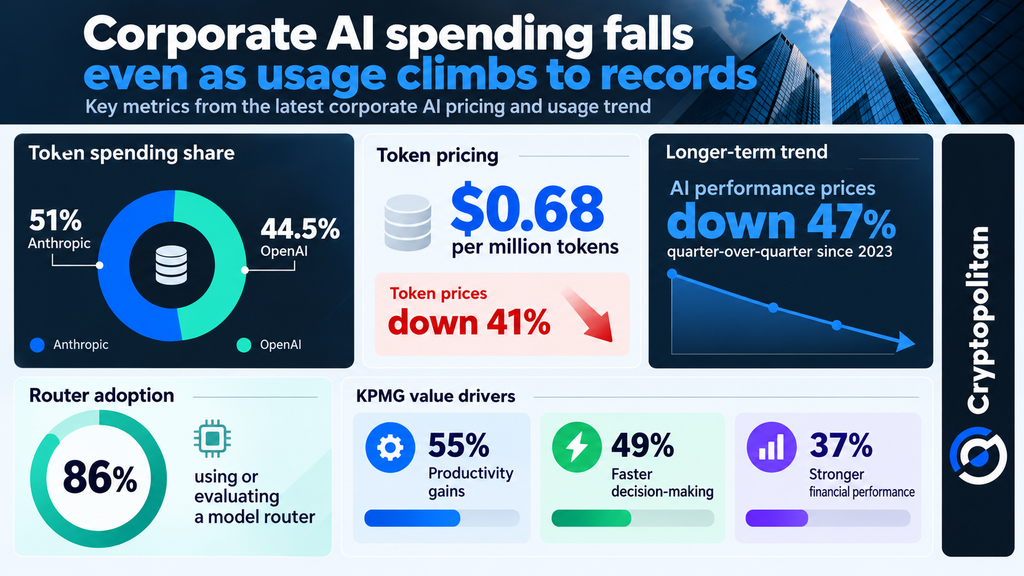
Usage has shown the opposite trend completely. Through September, usage has increased nearly 50% and hit an all-time high. Anthropic’s token usage was 51% in the final week of the month, and OpenAI’s was 44.5%. Open-source alternatives, according to Ramp, remained under 5%.
Ramp has collected transaction data from 70,000 U.S. firms, but its token data comes from a smaller API-focused sample that prioritizes large purchasers.
According to Kharazian, competition between Anthropic and OpenAI is “making AI more accessible” to more people while driving down the costs for companies.
Why cheaper tokens can mean more AI, not less
Lower prices do not necessarily imply a declining AI industry. Citadel Securities specialist Frank Flight has asserted in his tokenomics evaluation that the degree of adoption is more and more reliant on the affordability and availability of compute, power, and inference capacity.
Data from Ramp itself shows that the price for effective tokens decreased by 41%, to about $0.68 for one million tokens.
Enterprises route work to the cheapest model that fits
Companies are also getting more selective about which models handle each task. The State of Tokenomics survey of 472 companies found 86% were using or evaluating model routers. Router users were four times more likely to show measurable value to CFOs.
Many companies are also beginning to rely less on frontier models. Today, 51% indicate that they heavily depend on them, while only 24 % think they will still belong to that category in a year.
Tighter cost controls, but still more deployment
KPMG’s Q3 AI Pulse found nearly six in ten leaders reporting measurable AI value. Productivity led at 55%, followed by faster decision-making at 49% and stronger financial performance at 37%.
“AI’s value story is getting sharper,” said Todd Lohr, KPMG’s Vice Chair and Head of Client Technology & Innovation.
BCG likewise found that almost half of companies now generate value from AI.
What falling prices could mean for the market
Cheaper AI could bring automation into workflows that were previously too expensive. The OECD’s AI markets study found quality-adjusted language-model prices falling sharply, while noting that agents can consume far more tokens per task.
That means cheaper tokens may lower unit costs without reducing total AI bills. As adoption spreads, companies may simply use much more AI.
The smartest crypto minds already read our newsletter. Want in? Join them.
This articles is written by : Nermeen Nabil Khear Abdelmalak
All rights reserved to : USAGOLDMIES . www.usagoldmines.com
You can Enjoy surfing our website categories and read more content in many fields you may like .
Why USAGoldMines ?
USAGoldMines is a comprehensive website offering the latest in financial, crypto, and technical news. With specialized sections for each category, it provides readers with up-to-date market insights, investment trends, and technological advancements, making it a valuable resource for investors and enthusiasts in the fast-paced financial world.