
Paolo Ardoino’s ambition to cut companies’ capital-raising costs by 80% faces a practical test at Bitfinex Securities: the platform’s example of a $5 million, one-year bond carries a $100,000 issuer fee, equal to 2% of the raise.
Bitfinex Securities is a platform for raising capital through tokenized securities. An Oct. 5 Bitfinex account set out the Bitfinex CTO’s five-year benchmark for the tokenization industry.
The question it raises is how businesses outside established financial centers can obtain affordable financing when issuing a security still involves a substantial minimum charge.
The economics point toward two routes: a business raising enough capital to spread those costs, or an intermediary pooling financing for smaller enterprises.
ALTERNATIVE, a Luxembourg securitization fund, offers a working example of the second route. Its bond records show completed funding and repayments, while leaving the effect on borrowers’ loan prices unanswered.
Ardoino’s benchmark covers the cost of navigating the regulatory process, listing, and raising debt or equity, an industry ambition over five years.
His illustration is a farming business in Buenos Aires generating $50 million in annual revenue, describing the business’s size. The comparison is between its access to conventional and tokenized capital markets.
In an Oct. 5 X post, Ardoino also described tokenization’s purpose as helping companies and entrepreneurs raise capital in markets underserved by traditional finance.
That makes the issuer’s experience central to the argument. Easier trading can improve an investor’s experience without telling a business whether it can fund expansion at an acceptable total cost.
The minimum changes the headline rate
Bitfinex’s published fee schedule makes the distinction concrete. The one-year bond example produces $20,000 under its 0.4% formula, but the $100,000 minimum applies instead. The payable charge is five times the formula result.
This is an issuer platform fee, separate from a bond coupon or a small business borrower’s annual interest rate.
Equity fees are progressive, starting at 4%, while bond fees depend on remaining time to maturity. Permanent equity and a one-year bond therefore carry different fee calculations.
The capital-raise package includes document review, tokenization, marketing materials, and secondary-market listing, with no additional listing charge. Issuers receiving proceeds pay no withdrawal fee.
Economically, a fee floor makes the amount raised consequential: while it binds, more capital spreads the fixed charge more widely. A low percentage formula can therefore coexist with a substantial entry cost for a smaller issuer.
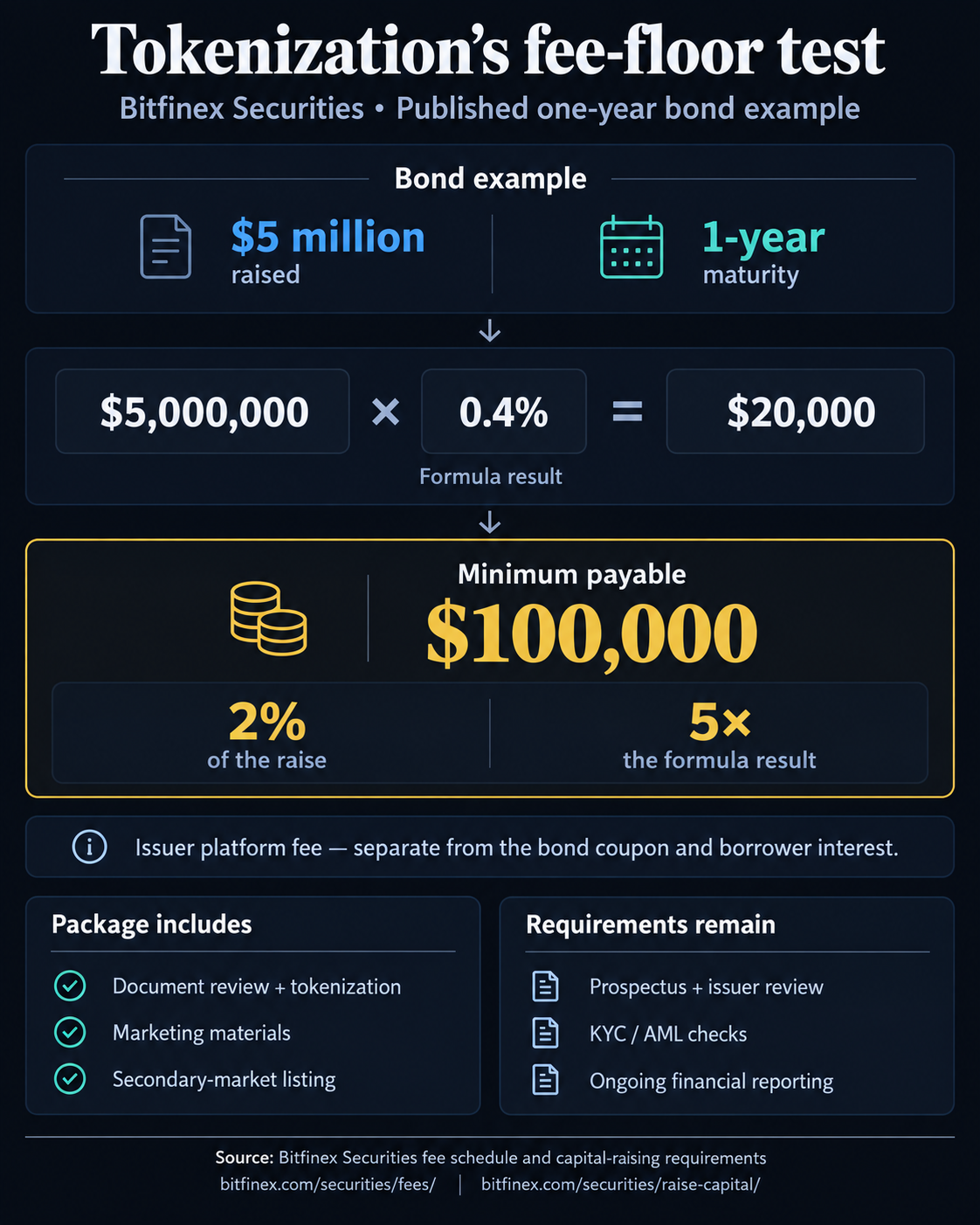
Bitfinex’s capital-raising process still requires issuer review and acceptance, an offering prospectus and supporting documents, strong know-your-customer and anti-money-laundering checks, and continuing financial reporting.
The main page requires quarterly financial statements. Its AIFC-specific guide describes quarterly or yearly statements or reports, as applicable under the market rules. Moving ownership records onto a blockchain does not remove that continuing obligation.
The investor guide gives individuals participating in Astana International Finance Centre offerings minimum-investment or accreditation routes. El Salvador offerings and corporate accounts have different provisions.
The platform excludes US persons and participation where an offer would be unlawful.
For an underserved business, the relevant test is whether preparing an eligible offer and reaching eligible investors become simpler and less expensive together. A technology change that helps settlement addresses part of that task.
A meaningful comparison with conventional financing would need the same issuer, instrument, maturity, and financing objective, including the work of preparing documents and maintaining reporting.
ALTERNATIVE shows the pooled route in operation
ALTERNATIVE’s structure changes who faces the capital market. Managed by MK Global Kapital, the fund sells debt to investors, with financing reaching businesses through its portfolio.
The manager says proceeds support lending, leasing, and mobility initiatives. This places the fund between securities investors and the entrepreneurs receiving finance, allowing smaller businesses to access that route without each preparing an exchange issuance.
The potential scale advantage is that one issuance can support financing across a portfolio. Whether an enterprise gains a cheaper loan still depends on the terms offered through that portfolio.
In a Dec. 20, 2023 announcement, Bitfinex reported that ALT2612 had raised 5,200,100 USDT and closed earlier that week. The bond had a 36-month tenor and a 10% coupon, and the program presented microfinance bond offerings in 2024.
The manager’s July 2025 lifecycle report put the Bitfinex program at four issues totaling $6.2 million-equivalent as of July 1. One matured issue totaling $630,000-equivalent had been fully repaid, alongside 15 coupon payments exceeding $850,000-equivalent.
By March 2, 2026, the reported issuance total was still four bonds and $6.2 million-equivalent, while three matured bonds totaling $1 million-equivalent had been fully repaid. The reported coupon count reached 20, exceeding $1.1 million-equivalent.
The announcements describe different scopes, and the manager also describes a wider tokenized program exceeding $10 million. Bitfinex’s March announcement separately expected future issuance to exceed $10 million.
A pooled route could spread issuance work across financing for many businesses and also leaves an intermediary to decide how capital is allocated and priced. That makes loan terms, underwriting, and access the next measures of whether the industry’s efficiency gains reach entrepreneurs.
The next useful evidence would link lower issuance and compliance costs to comparable financing offers for businesses: total charges, amount available, maturity, and ongoing obligations. For pooled lending, it would also show what changed in the end borrower’s terms.
Ardoino’s benchmark puts a demanding economic standard behind tokenization’s inclusion promise. Meeting it requires cheaper capital access at the business end of the transaction, whether the business issues directly or borrows through a fund.
The post Cheap crypto capital hits wall as Bitfinex fee rule binds appeared first on CryptoSlate.
Bitfinex’s published minimum makes its $5 million, one-year bond example cost 2% upfront, leaving borrower savings unproven.
The post Cheap crypto capital hits wall as Bitfinex fee rule binds appeared first on CryptoSlate. Analysis, Featured, Lending, Tokenization, payments, regulation, stablecoins, Tether, USDT
This articles is written by : Nermeen Nabil Khear Abdelmalak
All rights reserved to : USAGOLDMIES . www.usagoldmines.com
You can Enjoy surfing our website categories and read more content in many fields you may like .
Why USAGoldMines ?
USAGoldMines is a comprehensive website offering the latest in financial, crypto, and technical news. With specialized sections for each category, it provides readers with up-to-date market insights, investment trends, and technological advancements, making it a valuable resource for investors and enthusiasts in the fast-paced financial world.