AI companies are borrowing more money in order to create the computing facilities they require. Although sales are booming, it is uncertain whether they will be able to cover the rising costs.
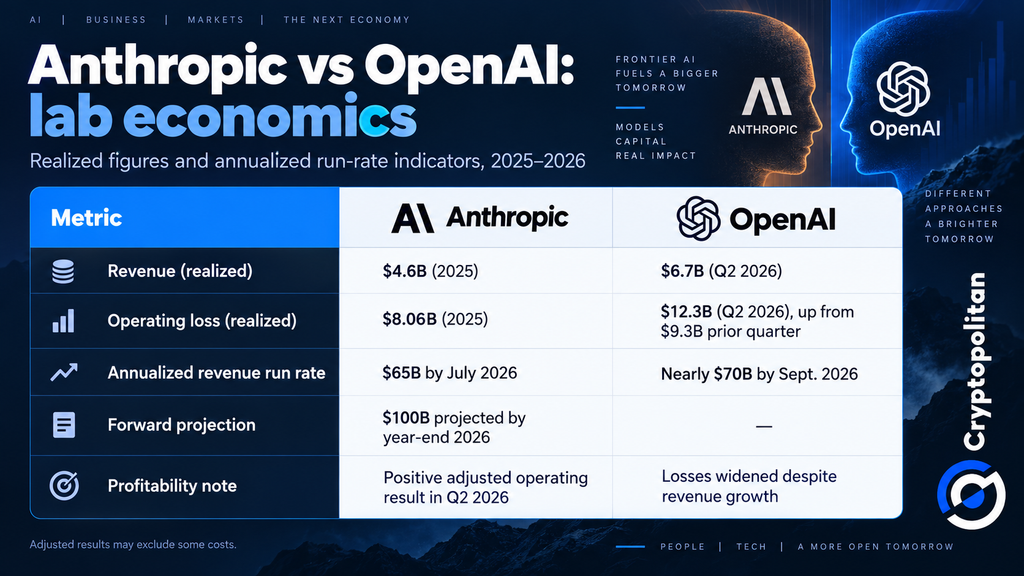
The gap can be seen in Anthropic’s financial performance. According to Reuters, the company made $4.6 billion in sales but had an operating loss of $8.06 billion in 2025.
Its finances have since improved. CNBC reported that Anthropic’s annualized revenue run rate reached $65 billion in July 2026, with projections of $100 billion by year-end. 24/7 Wall St. also reported a positive adjusted operating result in the second quarter.
Meanwhile, OpenAI earned $6.7 billion in revenue in the second quarter but faced a loss of $12.3 billion on its operations. By September, its annual revenue was heading towards $70 billion, as reported by Axios.
Anthropic is said to be nearer to achieving profitability, even though its adjusted results do not include certain costs, and rapid growth in revenues does not necessarily lead to sustainable profits.
AI borrowing exposes growing financial risks
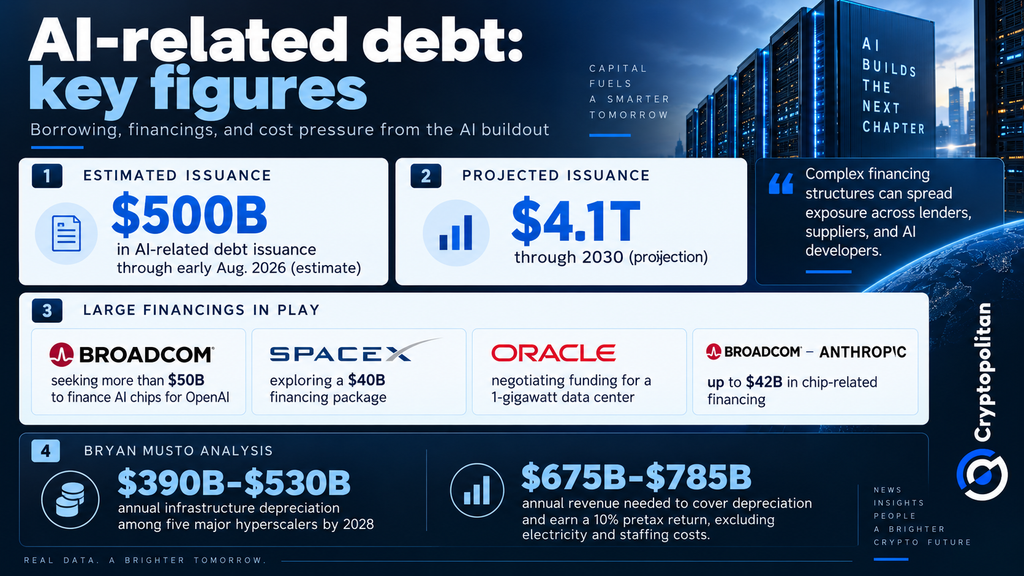
By early August 2026, Goldman Sachs estimated approximately $500 billion in AI-related debt issuance. CNBC reported that JPMorgan anticipates $4.1 trillion in total issuance through 2030.
While it is reported that Broadcom is looking for more than $50 billion to finance OpenAI chips, SpaceX is seeking an additional $40 billion. Oracle is also searching for funding of its data centers. Broadcom is additionally expected to grant Anthropic $42 billion for its chip developments.
These arrangements lead to the distribution of financial risks across lenders, suppliers and AI developers. Hence, the financial stability of AI labs is becoming relevant for the overall lending market.
However, borrowing money is just one of the problems. Costs of infrastructure do not end with construction. Bryan Musto estimates yearly depreciation costs of between $390 billion and $530 billion for the five largest hyperscalers by 2028. His model shows that the annual revenues of the hyperscalers should be within the range of $675 billion and $785 billion in order to cover depreciation and earn a 10% pretax return, excluding electricity and staffing.
Debt boom could reshape global AI competition
According to estimates by PwC, the total amount of global investment into data centers may reach an astonishing $31.6 trillion by 2050. On a separate note, another paper considers the potential scenarios under which the amount of AI-related debts may reach anywhere from $3 trillion to $7 trillion in 2029. Of course, these are expected figures, not actual borrowings.
The increasing dependence on borrowing gives rise to concerns about financial stability. The Bank for International Settlements warns that a downturn in AI investments may impact the wider financial market. Small firms with a lot of debt would be the most affected. Meanwhile, tech giants with stronger finances would be able to gain additional ground as a result of this situation.
Nevertheless, a debt crisis is by no means guaranteed. The much bigger issue is whether AI businesses can bring in enough revenues to cover their debt, while simultaneously continuing to eliminate costly computing infrastructures.
Don’t just read crypto news. Understand it. Subscribe to our newsletter. It’s free.
This articles is written by : Nermeen Nabil Khear Abdelmalak
All rights reserved to : USAGOLDMIES . www.usagoldmines.com
You can Enjoy surfing our website categories and read more content in many fields you may like .
Why USAGoldMines ?
USAGoldMines is a comprehensive website offering the latest in financial, crypto, and technical news. With specialized sections for each category, it provides readers with up-to-date market insights, investment trends, and technological advancements, making it a valuable resource for investors and enthusiasts in the fast-paced financial world.