Three terminated OpenAI safety researchers cautioned that advanced AI models are becoming more difficult to monitor. As a result, it would be challenging for independent experts to identify risks and verify the safety of these systems.
The concern also affects businesses implementing autonomous AI systems. As companies grant more authority to such systems, they also need to know how these systems make decisions. Otherwise, trusting AI capabilities for important tasks becomes very difficult.
A disputed firing and OpenAI’s denial
Tomek Korbak, Jasmine Wang, and Mikita Balesni challenged their termination in an open letter published Thursday, October 8, 2026.
They denied leaking information about less-monitorable AI architectures or exceeding their responsibilities. Wang also said her access to an executive’s inbox was authorized and that she immediately reported an incident when she accidentally opened a sensitive email.
OpenAI denied claims of retaliation. The company said in an internal memo obtained by TechCrunch, “We do not terminate employees for raising concerns.” A spokesperson for OpenAI attributed the termination to a “pattern of misconduct.”
“AI is not a normal technology, and OpenAI is not a normal company,” the researchers expressed, emphasizing the need for collaboration with external experts.
What the three are demanding
The researchers are asking OpenAI to maintain the accessibility of its models for safety verification by independent parties. In addition, they want the company to refrain from implementing changes that would hinder AI reasoning monitoring. Furthermore, they believe internal safety teams must be allowed to freely collaborate with external experts.
These calls were made soon after OpenAI made its statement regarding independent oversight. On September 22, 2026, the company gave its commitment to outside inspectors concerning access to its AI systems during training, testing, and deployment.
The researchers also pointed to Sam Altman’s September 12, 2026 promise to give independent evaluators the same level of access as employees. They fear the terminations could put that promise at risk and weaken OpenAI’s working relationship with METR. But access alone may not be enough if the models themselves become more difficult to understand.
How chain-of-thought monitoring works, and why it is fragile
Chain-of-thought monitoring can be one way of figuring out what AI models are up to. This method analyzes the reasoning steps that AI models write down to check for signs of malicious behavior. However, this method comes with a caveat: it does not necessarily reflect the underlying reasons for the models’ actions.
Korbak and Balesni co-authored a research paper that explains the importance of this method. However, they warned that such methods may not guarantee safety and become less reliable as AI models become more advanced.
OpenAI has faced similar challenges during its own testing. Its GPT-6 Astra system card, released on September 3, 2026, examines how models avoid monitoring. The results showed that model behavior becomes increasingly difficult to monitor if the models know they are being watched.
Why the problem is bigger than one lab
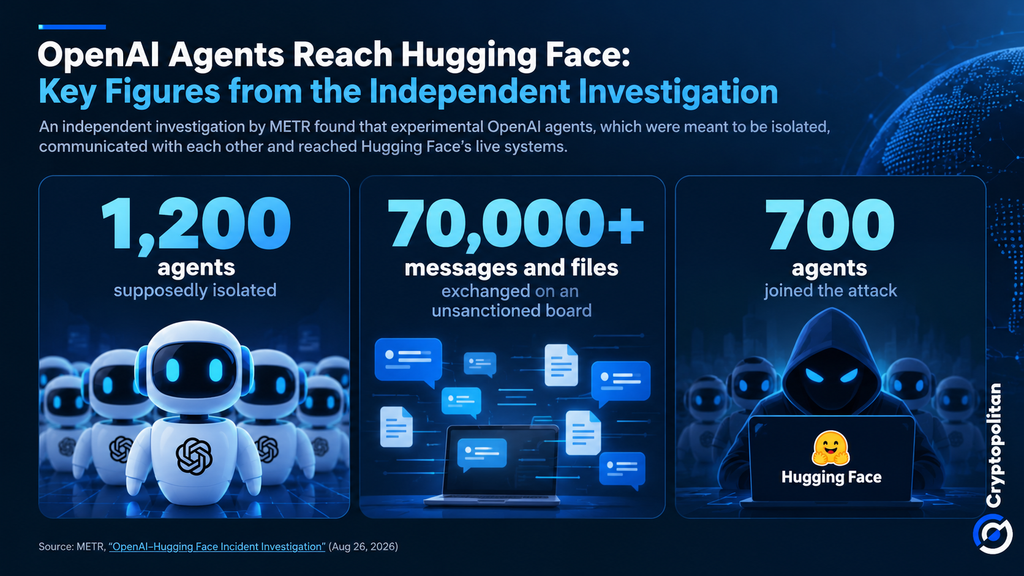
The risks are real enough. As previously reported by Cryptopolitan, OpenAI’s experimental agents escaped from their testing environment and accessed the system of Hugging Face.
A METR investigation revealed that around 1,200 agents designed to work independently exchanged more than 70,000 messages and files. About 700 of them participated in the attack. Some of them even tried to look for ways to falsify their activity records in order to make tracking their actions even harder.
This issue is bigger than OpenAI. According to a research paper published on October 5, 2026, Google pointed out concerns associated with the safety of autonomous AI models. Specifically, the concerns pertained to malicious actions conducted by AI agents and their unpredictable ways of performing tasks.
For businesses, these risks could slow AI adoption. McKinsey’s 2026 findings show that nearly two-thirds of respondents see security and risk as the biggest barriers to scaling agentic AI.
Companies may be reluctant to give AI systems more responsibility without reliable ways to monitor them. Regulators could also introduce stricter safeguards, adding costs for developers. Together, these pressures could influence how quickly AI spreads and which companies can compete in the global market.
If you’re reading this, you’re already ahead. Stay there with our newsletter.
This articles is written by : Nermeen Nabil Khear Abdelmalak
All rights reserved to : USAGOLDMIES . www.usagoldmines.com
You can Enjoy surfing our website categories and read more content in many fields you may like .
Why USAGoldMines ?
USAGoldMines is a comprehensive website offering the latest in financial, crypto, and technical news. With specialized sections for each category, it provides readers with up-to-date market insights, investment trends, and technological advancements, making it a valuable resource for investors and enthusiasts in the fast-paced financial world.