
On October 20, Utah brought a lawsuit against Kalshi’s five companies and two trading companies that belong to Susquehanna, alleging illegal gambling and asking for restitution, injunctions and disgorgement in accordance with the complaint issued by the state.
By going after companies that run the markets for Kalshi, Utah is expanding the legal battle beyond just the exchange.
Why the Susquehanna defendants matter
The lawsuit also involves Susquehanna International Group and Susquehanna Government Products. The state of Utah contends that the companies function as market makers and take the opposite position on trades initiated by retail consumers. This means that these companies provide their clients with pricing for the purchase and sale of contracts, allowing trading to continue and minimizing fluctuations in price.
If states are able to make these companies accountable in addition to exchanges, it is possible for the legal risks to run throughout the industry. However, the claims are not yet verified and neither company has been shown to be liable.
According to the estimates of Utah, Kalshi has received amounts between $30.6 million to $61.2 million in fees from accounts in the state. As reported by Utah News Dispatch, Attorney General Derek Brown demands the halting of the alleged illegal gambling along with the return of the money collected by Kalshi.
Federal oversight faces conflicting court rulings
Kalshi argues that, since it operates a designated contract market regulated by the Commodity Futures Trading Commission (CFTC), its event contracts are therefore subject to federal regulation. Hence, the firm argues that states cannot classify such contracts as illegal gambling.
The CFTC has broad authority over swaps under 7 U.S.C. § 2, but the statute recognizes that the authority of other federal and state regulators and courts remains intact. Utah contends that this allows it to enforce its gambling laws against sports contracts offered by Kalshi. Kalshi, on the other hand, argues that federal law dominates the issue.
Courts have reached varied conclusions. On August 4, a court in Utah ruled that Kalshi’s claims about federal supremacy over state gambling laws were incorrect. The Third Circuit agreed with Kalshi in New Jersey, but the Ninth and Sixth Circuits supported the states in separate cases.
Cryptopolitan previously reported on the ongoing case in Connecticut. Attorney General William Tong filed a lawsuit against Kalshi on August 26 to stop what state officials believe is illegal sports betting.
The lawsuit came after a federal court ruling on August 10 that rejected Kalshi’s efforts to stop the enforcement of Connecticut’s gambling laws. The court held that the contracts for sports betting are not covered by federal law as swaps. Kalshi contested the court’s ruling and said that the CFTC regulation takes precedence over state law.
The CFTC has also moved to defend its authority. It sued three states on April 2 and proposed rules on October 9 that would explicitly classify event contracts as swaps. Neither action settles Utah’s latest lawsuit.
A $394 billion market confronts legal boundaries
Artemis data as of October 21 puts trailing-year prediction-market trading volume at $394.2 billion. Kalshi accounted for $309.8 billion and Polymarket $84.4 billion. Sports contracts generated $169.9 billion, or 43.1% of the total. These figures measure trading activity, not revenue.
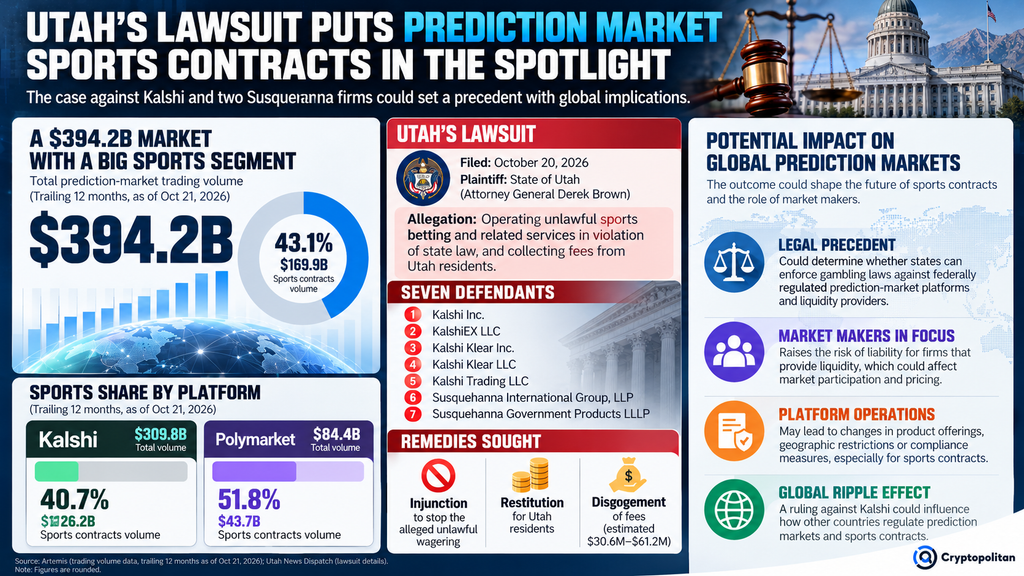
Legal pressure on market makers could widen spreads, weaken liquidity or push trading elsewhere, including offshore. However, there is no evidence that Susquehanna has withdrawn from Kalshi.
The regulatory divide extends overseas. In July, ESMA warned that event contracts qualifying as financial instruments fall under European binary-options restrictions. Tiger Research says much of Asia still treats prediction markets as gambling, potentially missing out on capital and oversight.
Utah’s lawsuit now raises a bigger question: Can states regulate not just prediction exchanges, but also the firms that keep their markets running?
Don’t just read crypto news. Understand it. Subscribe to our newsletter. It’s free.
This articles is written by : Nermeen Nabil Khear Abdelmalak
All rights reserved to : USAGOLDMIES . www.usagoldmines.com
You can Enjoy surfing our website categories and read more content in many fields you may like .
Why USAGoldMines ?
USAGoldMines is a comprehensive website offering the latest in financial, crypto, and technical news. With specialized sections for each category, it provides readers with up-to-date market insights, investment trends, and technological advancements, making it a valuable resource for investors and enthusiasts in the fast-paced financial world.