
Orbital Matter has claimed that its Replicator 2 satellite has created a rigid beam of 50 centimeters directly in the vacuum of space. The company calls this achievement a first for any free-flying spacecraft in orbit around Earth.
The breakthrough could eventually allow engineers to construct larger structures in orbit. However, half a meter is far from being considered a commercially viable product. Redwire, which is supported by NASA, created similar beams in 2023 in a vacuum chamber on Earth; however, this experiment never reached space, unlike Orbital Matter’s test.
How UV light turns resin into a beam in vacuum
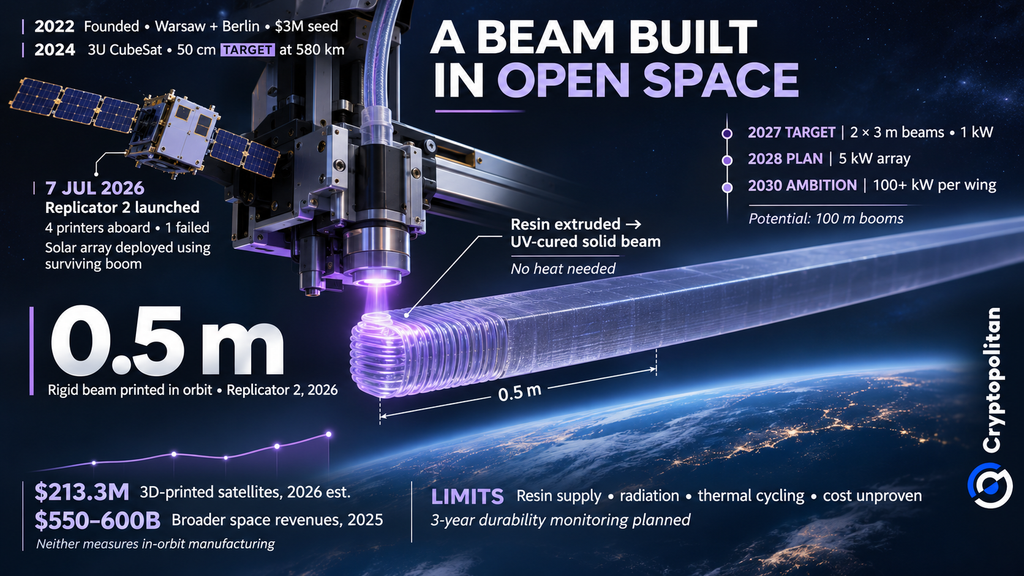
Building larger structures in orbit starts with a practical challenge: how do you make a solid beam in the vacuum of space? Orbital Matter’s printer pushes out coils of resin, which ultraviolet light hardens into a cylinder. The process needs no heating. That is important in space, where ESA explains there is no air to carry heat away.
The technology could also solve another problem: launch size. Solar arrays and antennas must currently be folded to fit inside rockets. Printing their supporting beams in orbit could allow engineers to build larger structures without the same constraints. ESA engineer Advenit Makaya highlighted this limitation of conventional designs:
“Deployables will hit a certain ceiling.”
From a 3U CubeSat to four printers on Replicator 2
Orbital Matter has pursued the goal of building larger structures in space since its establishment in 2022. The company, which is based in Warsaw and Berlin and was founded by Jakub Stojek and Robert Ihnatisin, managed to raise $3 million in funding during its early phase. Its first CubeSat, measuring 3U in size, was launched on Ariane 6 in 2024. The aim was to print a beam 50 cm in length at the height of 580 km altitude. However, no successful result has been reported.
The company proceeded to develop Replicator 2 and launched it on July 7, 2026. It was equipped with four printers. An initial test resulted in excessive resin released, necessitating software modifications. Later, one of the printers failed, but another was able to successfully deploy a flexible solar array. In spite of the setback, the result gave Stojek hope. In an interview with TechCrunch, he said:
“Replicator 2 is the first proof that we can simply build the array in space.”
The road from 50 centimeters to 100 kilowatts
Replicator 2’s successful solar-array deployment is only the first step. Orbital Matter wants to build much larger structures, including booms stretching 100 meters. That is a big leap from its current 50-centimeter beam.
An earlier plan called for two 3-meter beams supporting a 1-kilowatt solar array by late 2027. The newer roadmap targets a 5-kilowatt demonstration in 2028. By 2030, the company hopes to reach more than 100 kilowatts per wing. For now, those larger systems remain plans rather than proven technology.
What could stop it: heat, radiation, resin and cost
Printing longer beams brings tougher challenges. How much resin can a satellite carry? And will the finished structures survive years in orbit?
Orbital Matter plans to monitor how its beams withstand temperature swings and radiation throughout Replicator 2’s expected three-year mission. Four onboard cameras inspect the printing automatically. Even if the beams hold up, the company must still show that its technology can compete with established fold-out structures on cost.
Ihnatisin acknowledged that more testing is needed:
“We need to demonstrate it first.”
Who might buy orbital structures
Orbital Matter sees potential customers among operators that need larger antennas and solar arrays. Developers of orbital data centers are another promising market. Their growing power needs could create demand for bigger structures, particularly as companies explore the space-computing applications Cryptopolitan previously covered. So far, Orbital Matter has not publicly named its prospective customers.
Market estimates suggest room for growth, but they need context. Grand View Research values the 3D-printed satellite market at $213.3 million in 2026. Most of that involves components manufactured on Earth.
Meanwhile, the OECD estimates broader space revenues of $550 billion–$600 billion in 2025. Neither figure specifically measures manufacturing in orbit. For Orbital Matter, the potential market may be enormous, but actual commercial demand remains unproven.
The smartest crypto minds already read our newsletter. Want in? Join them.
This articles is written by : Nermeen Nabil Khear Abdelmalak
All rights reserved to : USAGOLDMIES . www.usagoldmines.com
You can Enjoy surfing our website categories and read more content in many fields you may like .
Why USAGoldMines ?
USAGoldMines is a comprehensive website offering the latest in financial, crypto, and technical news. With specialized sections for each category, it provides readers with up-to-date market insights, investment trends, and technological advancements, making it a valuable resource for investors and enthusiasts in the fast-paced financial world.