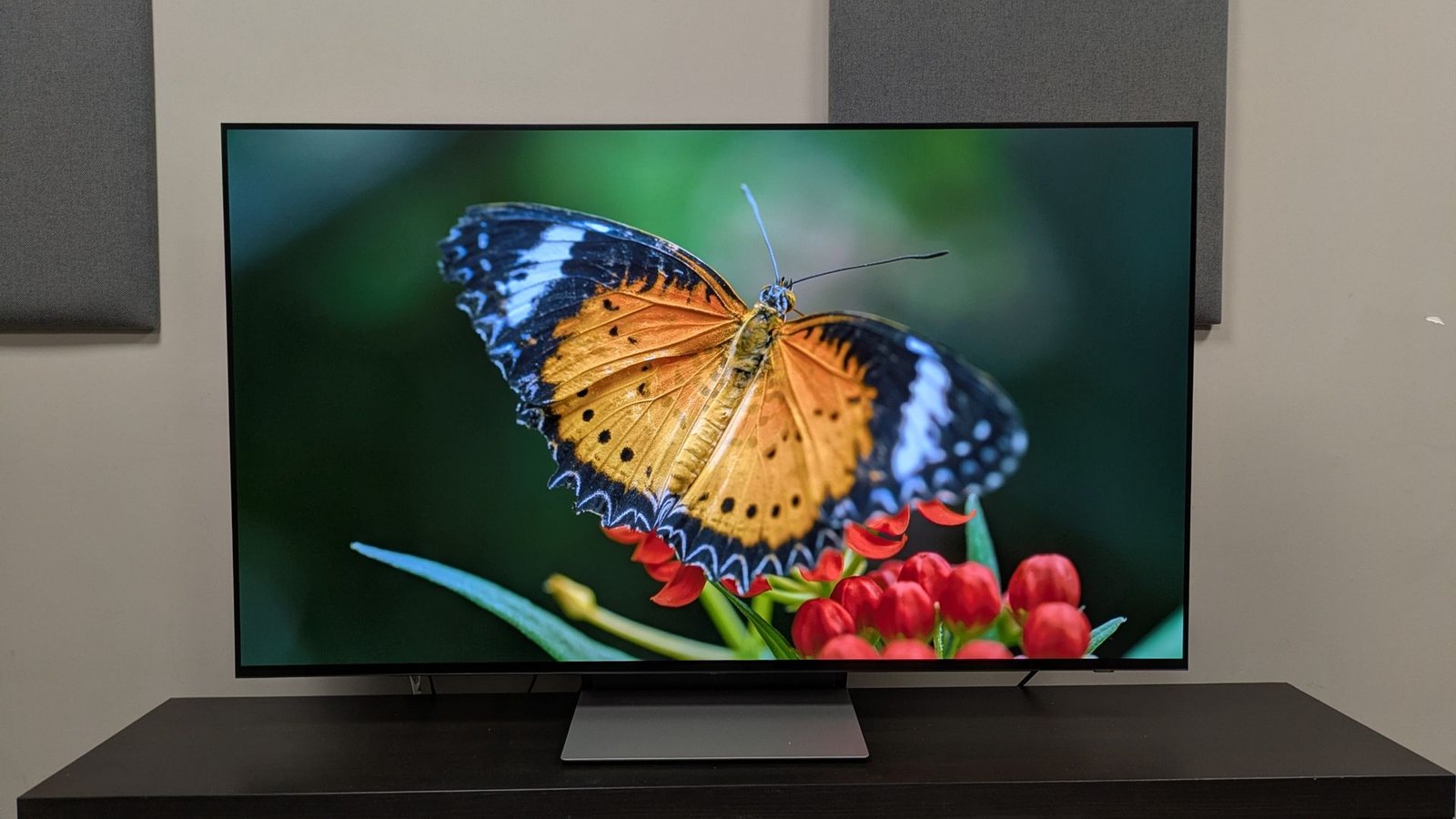
Samsung S90H review: Two minute review
The Samsung S90H is the brand’s mid-range OLED TV for 2026. It delivers brilliant performance and features across the board, putting it up there with the best TVs of the year. While it doesn’t quite dethrone the rival LG C6 for me, the S90H proved to be a worthy opponent when I put the two side-by-side.
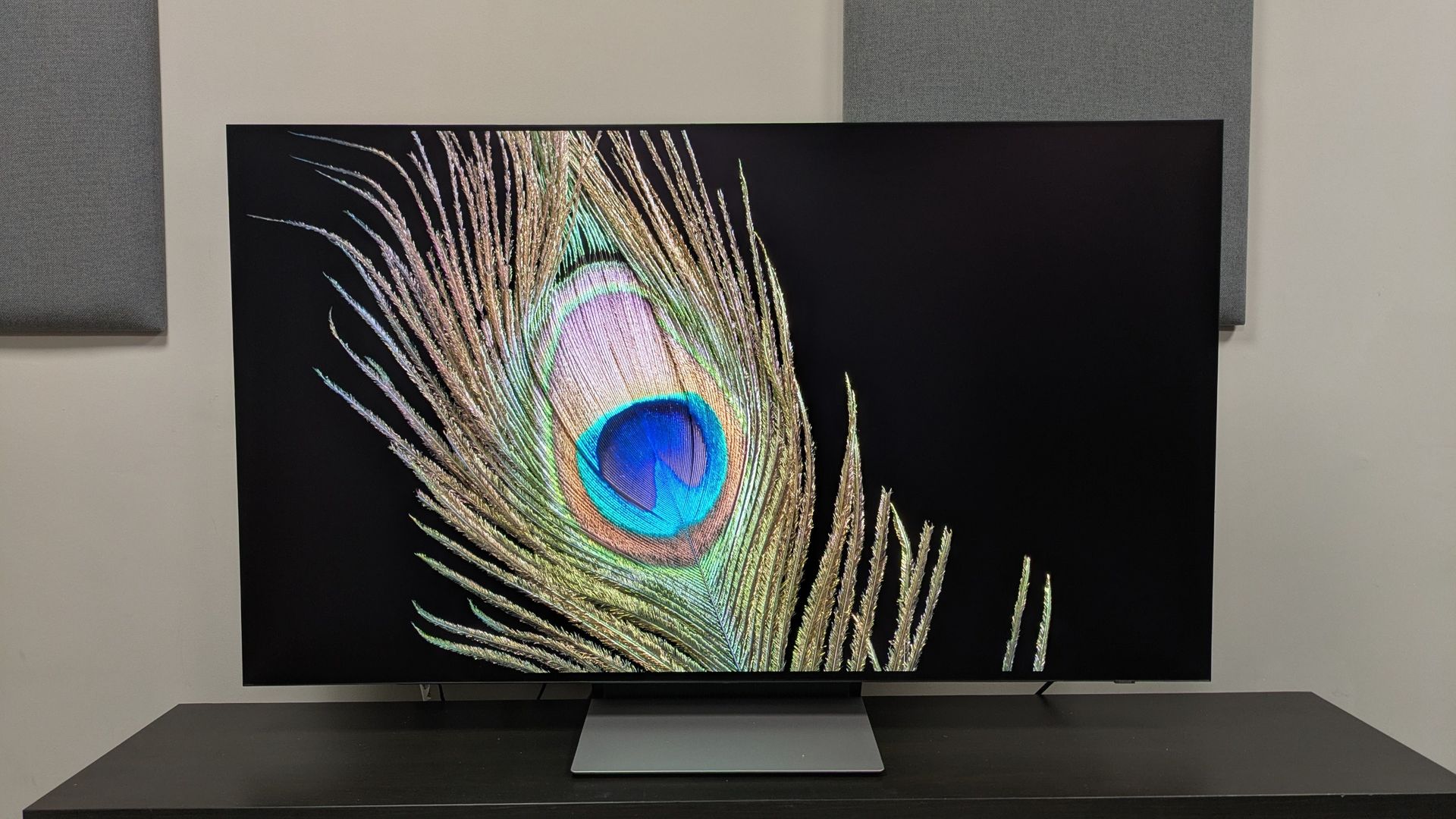
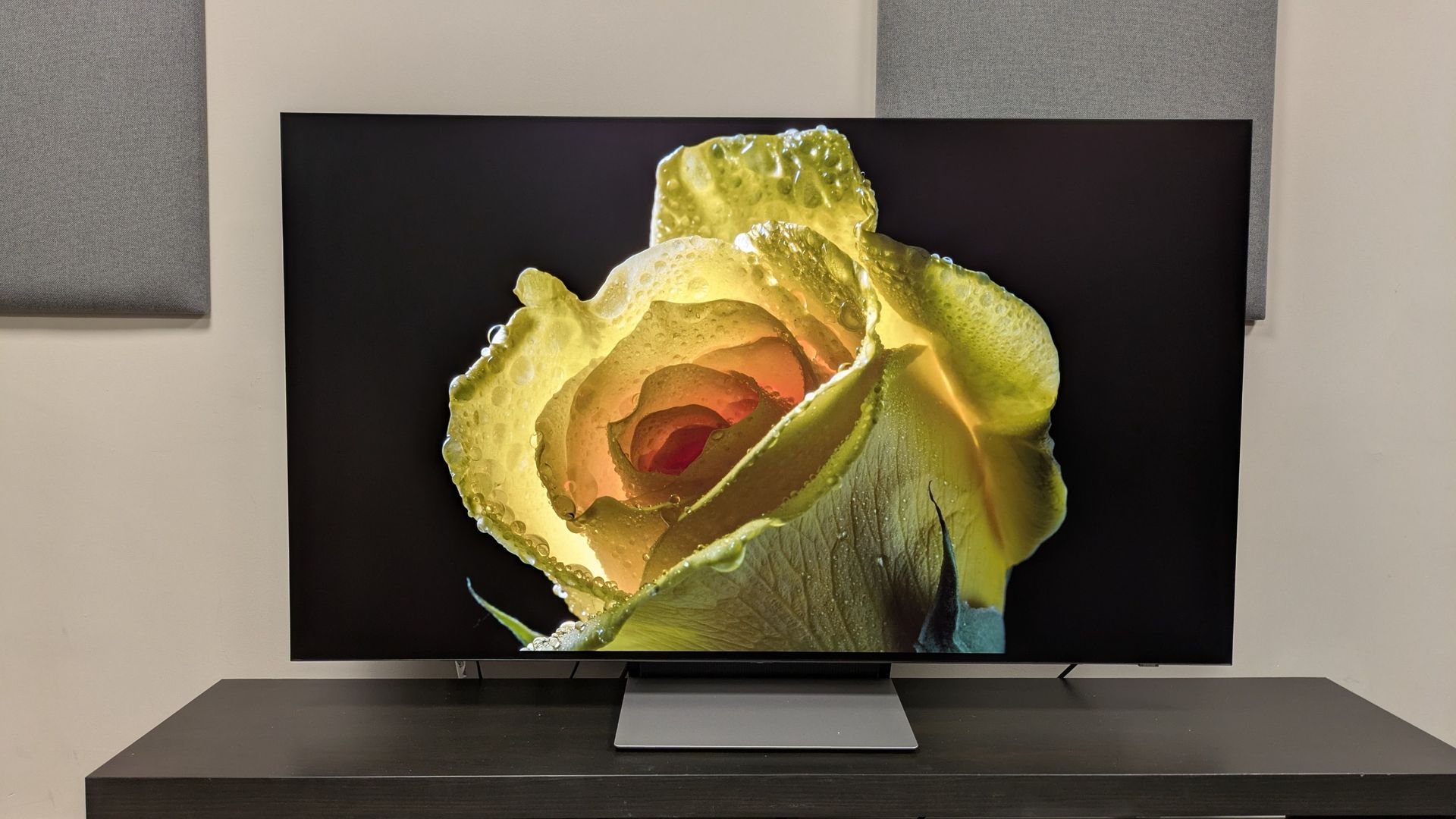
Picture quality is the S90H’s best highlight. With an effective anti-glare screen, it’s perfect for OLED viewing in a bright room, without many compromises. It delivers vibrant, punchy colors, powerful contrast and crisp, realistic textures. While there were black crush issues during some scenes, there were settings to mitigate this, meaning the S90H delivers picture quality that’s up there with the best OLED TVs.
The S90H is one of the best gaming TVs on the market. With a full suite of features, including 4K 165Hz and full VRR, and an ultra-low input lag time of 9.2ms (4K 60Hz), the S90H delivers strong gaming performance.
The S90H’s built-in sound is pretty good overall, being accurately connected to the action on screen, with punchy bass and good width. The S90H’s AI Sound is also competent and improves on the standard built-in sound, although I still found speech and mid-tones could get a bit muddled at times. While its built-in speakers are good enough for casual viewing, I’d recommend adding one of the best soundbars to match its fantastic picture.
Priced similarly to its rival LG C6, the S90H is very good value for money. It covers pretty much every base you’ll need and is available in sizes 42-83-inch. A 55-inch model will currently cost you $1,199 / £1,199 / AU$2,995, and while there are cheaper TVs with similar features available, the S90H offers great bang for your buck.
Samsung S90H review: Prices & release dates
- Release date: May 2026
- 42-inch: $999 / £899 / AU$1,995
- 48-inch: $1,099 / £999 / AU$2,395
- 55-inch: $1,199 / £1,199 / AU$2,995
- 65-inch: $1,499 / £1,6,99 / AU$3,995
- 77-inch: $2,499 / £2,499 / AU$5,495
- 83-inch: $3,499 / £3,599 / AU$7,495
As Samsung’s mid-range 2026 OLED TV, the S90H sits above the entry-level Samsung S85H and below the flagship Samsung S95H (known as the S99H in the UK). It’s available in six sizes, from 42-inch to 83-inch. The above prices are what you can expect to pay at the time of writing (November 2026).
The 55-inch model I tested launched for $1,999 / £1,799 / AU$2,995 in May/June 2026. Since its release, prices have fallen in all sizes in the US and UK, with the 55-inch model now priced at $1,199 / £1,199 / AU$2,995. (Prices remain unchanged in Australia.) The 55-inch LG C6, the S90H’s direct rival, currently retails for $999 / £1,199 / AU$2,495, and I expect the S90H’s prices will fall in line with the C6’s soon.
Samsung S90H review: Specs
|
Screen type |
OLED |
|
Refresh rate |
165Hz |
|
HDR support |
HDR10, HDR10+, HLG |
|
Audio support |
Dolby Atmos |
|
Smart TV |
Tizen |
|
HDMI ports |
4 x HDMI 2.1 |
|
Built-in tuner |
ATSC 1.0 |
Samsung S90H review: Benchmark results
Brightness measurements
| Product | HDR Filmmaker Mode (10% window) (nits) | HDR Filmmaker Mode (Fullscreen) (nits) |
|---|---|---|
| Samsung S90H | 1689 | 305 |
| LG C6 | 1427 | 247 |
| Samsung S95H/S99H | 2739 | 449 |
| Product | HDR Standard Mode (10% window) (nits) | HDR Standard Mode (Fullscreen) (nits) |
|---|---|---|
| Samsung S90H | 1677 | 329 |
| LG C6 | 1364 | 243 |
| Samsung S95H/S99H | 2831 | 463 |
| Product | SDR Filmmaker Mode (10% window) (nits) | SDR Filmmaker Mode (Fullscreen) (nits) |
|---|---|---|
| Samsung S90H | 260 | 163 |
| LG C6 | 333 | 237 |
| Samsung S95H/S99H | 220 | 219 |
| Product | SDR Standard Mode (10% window) (nits) | SDR Standard Mode (Fullscreen) (nits) |
|---|---|---|
| Samsung S90H | 512 | 299 |
| LG C6 | 391 | 234 |
| Samsung S95H/S99H | 229 | 229 |

HDR color gamut
Closer to 100% is better. Taken using a colorimeter and test pattern generator.
| Product | UHDA-P3 () | BT.2020 () |
|---|---|---|
| Samsung S90H | 99.3 | 76.5 |
| LG C6 | 99.7 | 75.9 |
| Samsung S95H/S99H | 99.9 | 89.2 |
Picture accuracy
A lower score is better. Taken using a colorimeter and test pattern generator.
SDR Delta-E
| Product | Value |
|---|---|
| Samsung S90H | 2.4 |
| LG C6 | 1.3 |
| Samsung S95H/S99H | 1.6 |
Input lag
Lower is better. Taken using a Leo Bodnar 4K HDMI Video Signal Lag Tester.
| Product | 4K 60Hz (ms) | 1080p 120Hz (ms) |
|---|---|---|
| Samsung S90H | 9.2 | 4.8 |
| LG C6 | 9.2 | 4.7 |
| Samsung S95H/S99H | 9.5 | 5 |
Samsung S90H review: Features
- Glare Free screen
- WOLED panel on 55-inch UK model
- NQ4 AI Gen 3 processor
Much like last year’s Samsung S90F, the panel on the S90H can vary based on size and region, though most models now seem to use a standard WOLED panel rather than a QD-OLED panel. Based on my measurements, I can confirm the 55-inch model I tested in the UK uses a WOLED panel.
The S90H has Samsung’s OLED Glare Free screen, which reduces mirror-like reflections in bright rooms. It uses Samsung’s NQ4 AI Gen 3 processor, the same one used in the flagship S95H/S99H, which has AI picture features such as Real Depth Enhancer Pro and AI 4K Upscaling Pro.
It supports HDR10+ enhanced HDR format, but like all Samsung TVs, there’s no support for Dolby Vision. For sound, the S90H supports Dolby Atmos but doesn’t support DTS formats.
For audio, it uses a 2.1-channel, 40W speaker system and features Object Tracking Sound Lite (OTS Lite), a step-down version of the OTS+ used in the flagship S95H/S99H. There are two sound modes, Standard and Amplify, and a number of AI sound features, such as Adaptive Sound Pro and AI Sound Controller Pro.
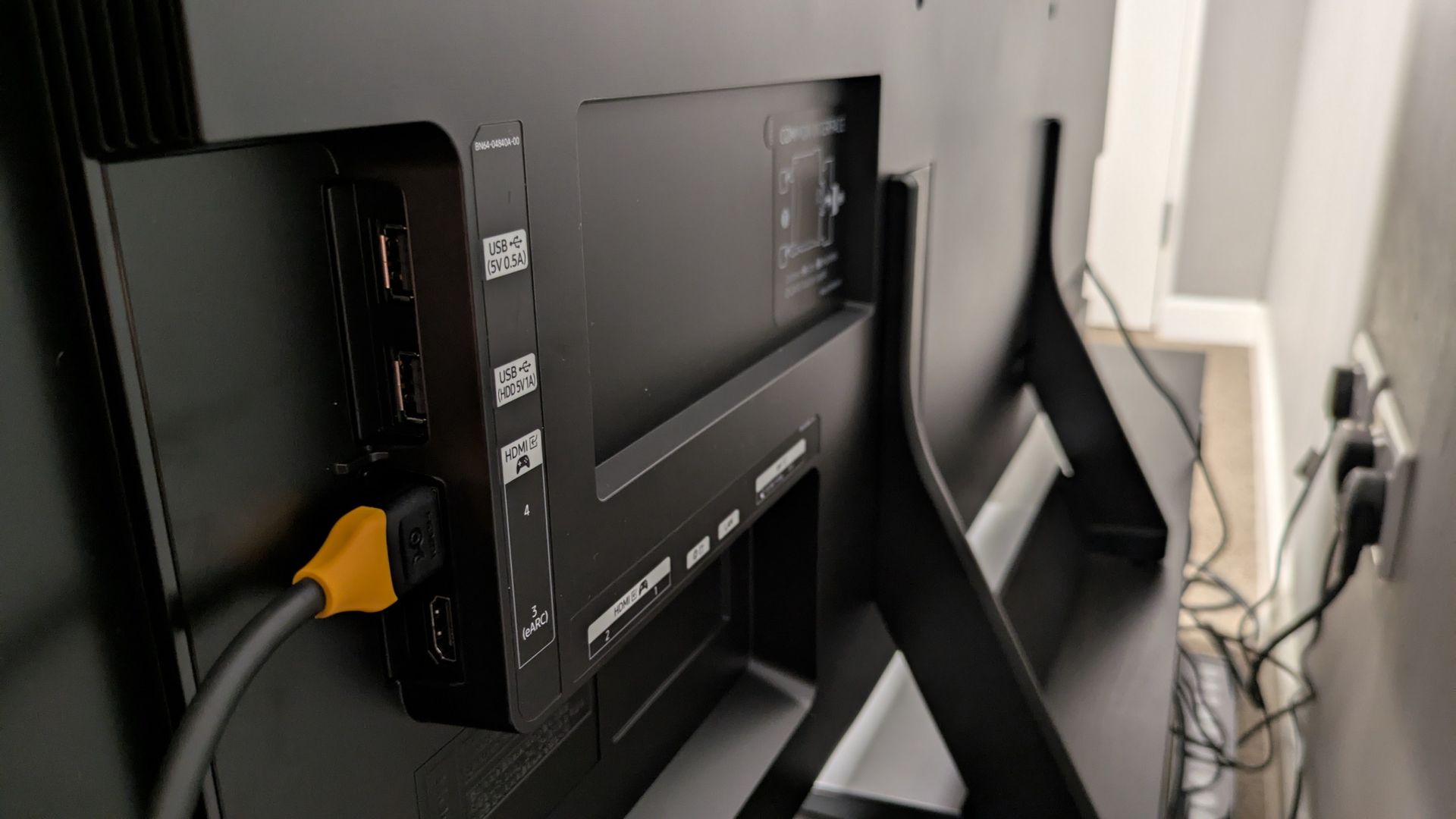
The S90H supports 4K 165Hz, full VRR including AMD FreeSync and Nvidia G-Sync (the latter being introduced into Samsung’s TVs in 2025), ALLM, and HDR10+ gaming. These are featured in all four HDMI 2.1 ports.
Samsung’s own Tizen OS is the smart TV platform here. It features the Vision AI companion, which can be used to recommend content and help with settings. In terms of app support, the S90H supports all major streaming apps, including BBC iPlayer and ITVX for those in the UK.
- Features score: 5 / 5
Samsung S90H review: Picture quality
- Vibrant, punchy colors
- Effective glare screen
- Occasional black crush
Starting with brightness measurements, the S90H registered an impressive 1,689 nits peak HDR brightness (measured on a 10% window) in Filmmaker Mode, a great result for a mid-range WOLED TV that beats the LG C6’s 1,427 nits in the same tests. It also registered 305 nits fullscreen HDR brightness, again besting the C6’s 249 nits in the same tests.
When I compared the C6 and the S90H side by side, however, the C6 had higher perceived brightness, which I believe was the work of the C6’s processor. Still, in isolated viewing, the S90H’s picture looked bright, even in the often dim Filmmaker Mode. Movie Mode, which looks brighter in person, registered similar results in the same tests. Movie Mode does have Active Tone Mapping on by default (it’s set to Static in Filmmaker Mode), which would explain the added brightness in practice.
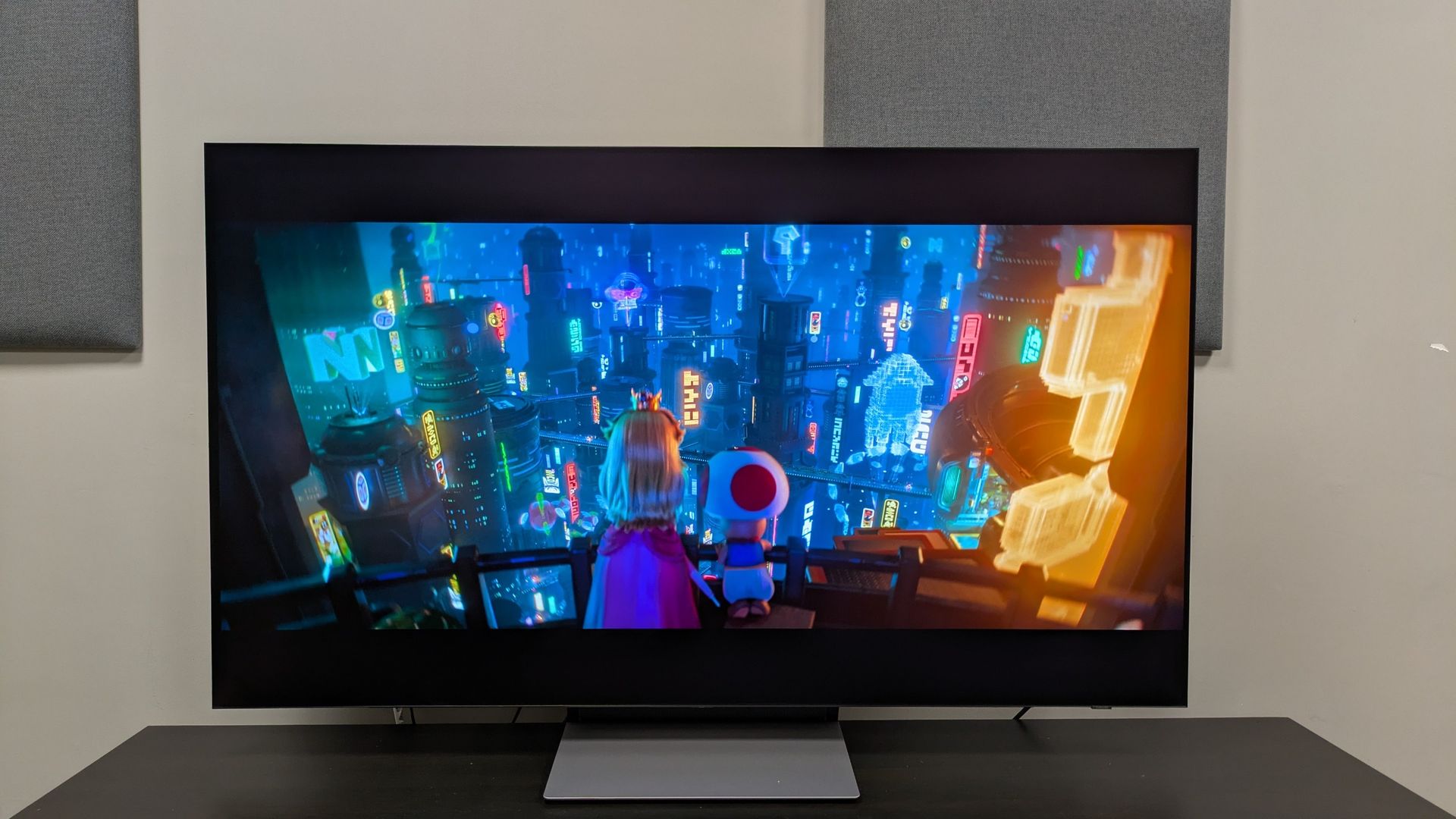
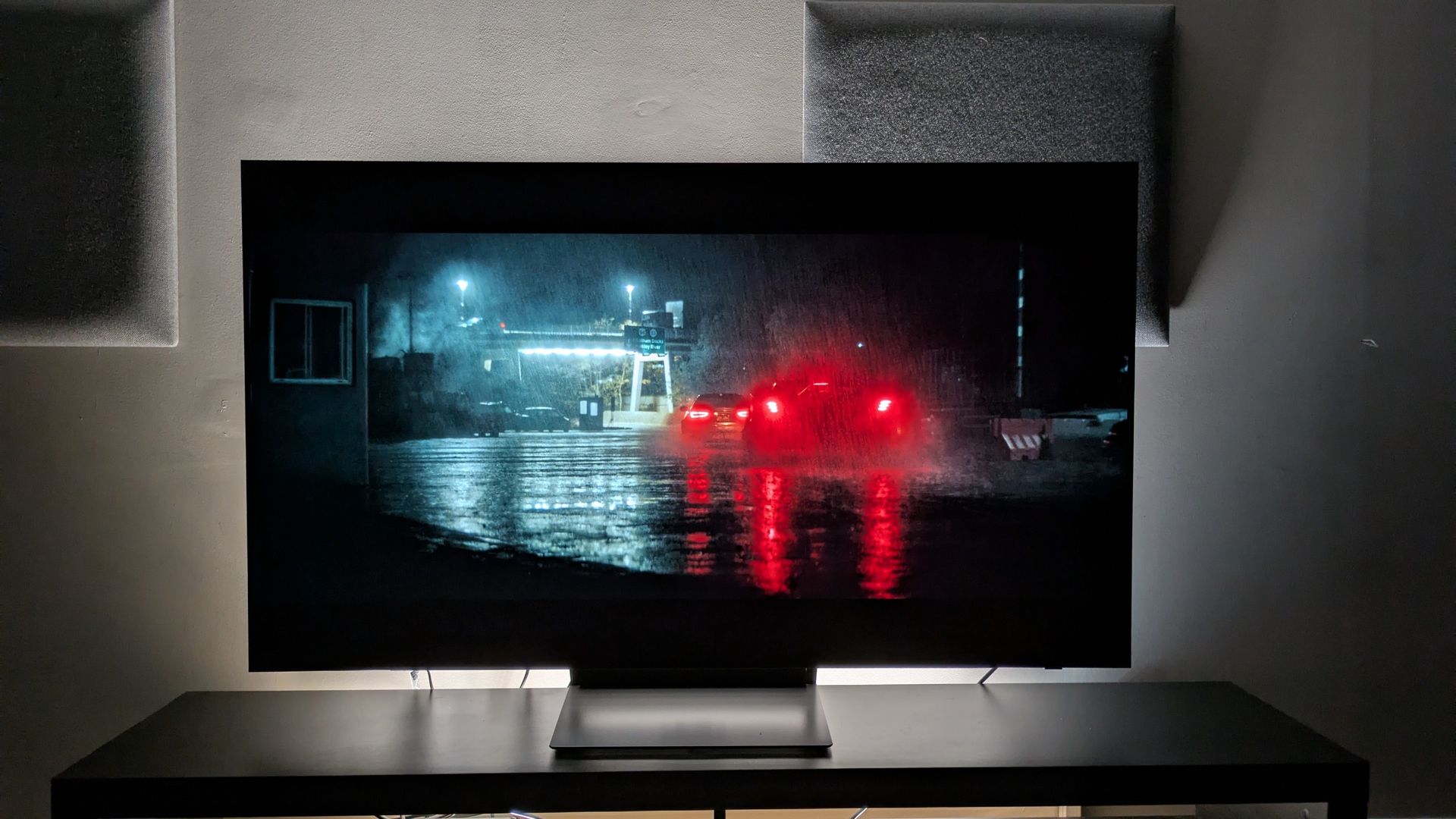
The S90H has Samsung’s OLED Glare Free screen, which is effective at reducing mirror-like reflections, meaning darker scenes are still visible in bright rooms. With Movie Mode on, I was even able to watch a challenging scene from The Batman with no reflections.
When watching daytime TV via Samsung TV Plus, the S90H’s upscaling proved effective. It sharpened textures for news broadcasts and streaming sports. Watching an HD movie, Treasure Planet on Disney Plus, the S90H again did a good job upscaling. Activating the Auto HDR Remastering feature boosted brightness, colors and contrast effectively. This feature also worked well for sports streamed through Prime Video, adding more depth to the picture.
Switching to reference 4K Blu-ray scenes, the S90H demonstrated excellent picture quality. It produced vibrant, punchy colors that looked great in scenes from Speed Racer, accurately rendering the vivid oranges, pinks, and yellows of the Racer family’s candy-colored kitchen. In The Super Mario Galaxy Movie, Mario and Luigi’s red and green overalls were striking, and the Lumas had plenty of punch, which made the movie look fantastic.
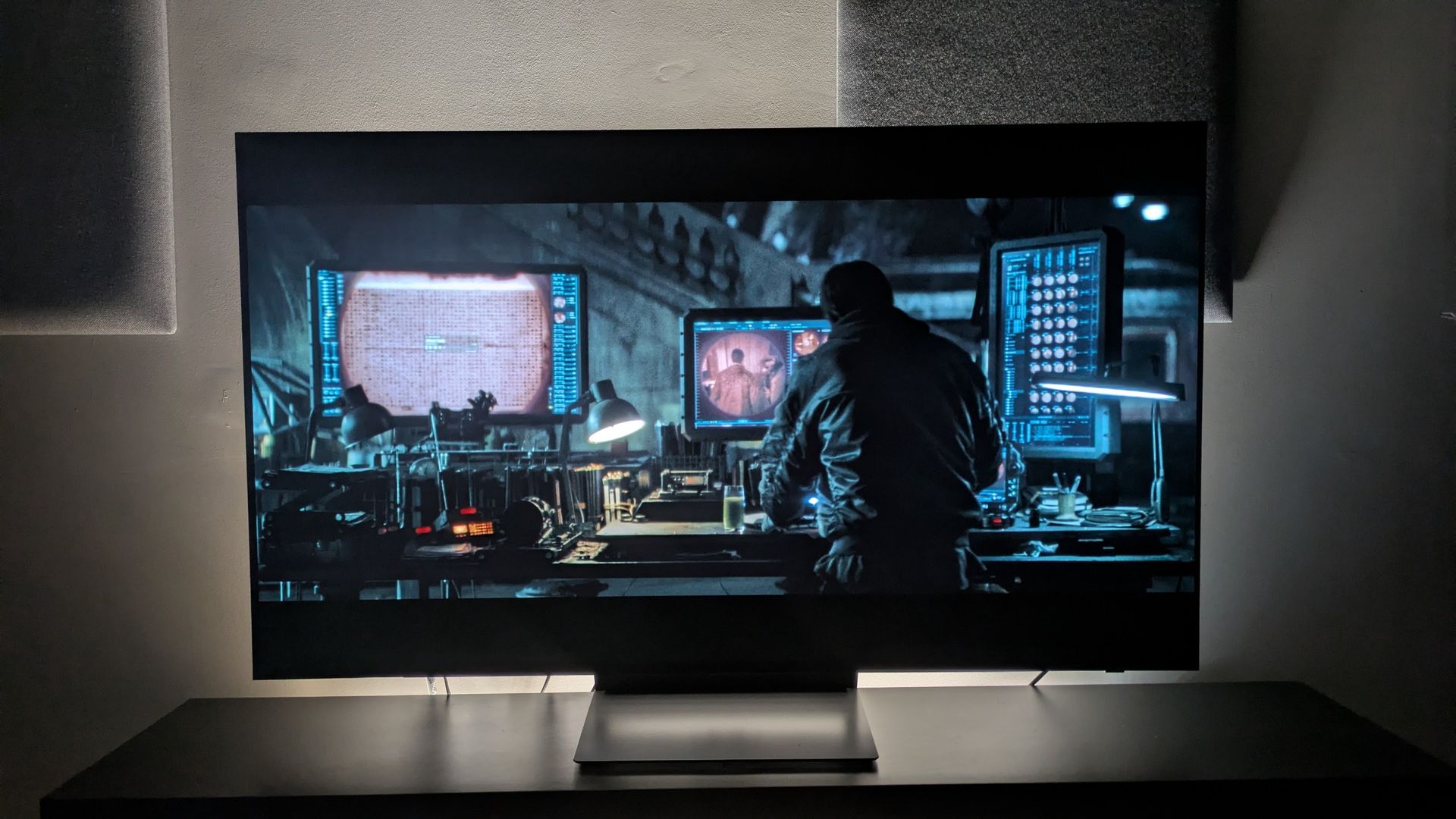
Measuring HDR color gamut, the S90H hit 99.3% of the UHDA-P3 color space and 76.5% of the BT.2020 color space. These are great results in line with mid-range OLED rivals like the LG C6 and even flagship models like the Samsung S95H/S99H and LG G6 in the UHDA-P3 space, which is important for HDR content.
The S90H also demonstrated strong contrast, with a great balance between light and dark tones. Scenes from The Batman, whether it was the crime scene in Mayor Mitchell’s house or the Batcave, all looked fantastic, with bright lamps contrasting well with dark surroundings. The S90H’s blacks were inky and deep, and perfectly showcased in the shots of space from Project Hail Mary.
While the S90H does mostly deliver great shadow detail, with textures such as the roof and back wall of a dimly lit subway in The Batman still legible, this is where I noticed the S90H was prone to some black crush in its default Filmmaker Mode. Dark tones in movies like The Batman and Project Hail Mary looked too dark, resulting in occasional detail loss. Bumping up the Shadow Detail setting from 0 to the maximum 5 mitigated a lot of this, but there was still a hint of black crush in places.
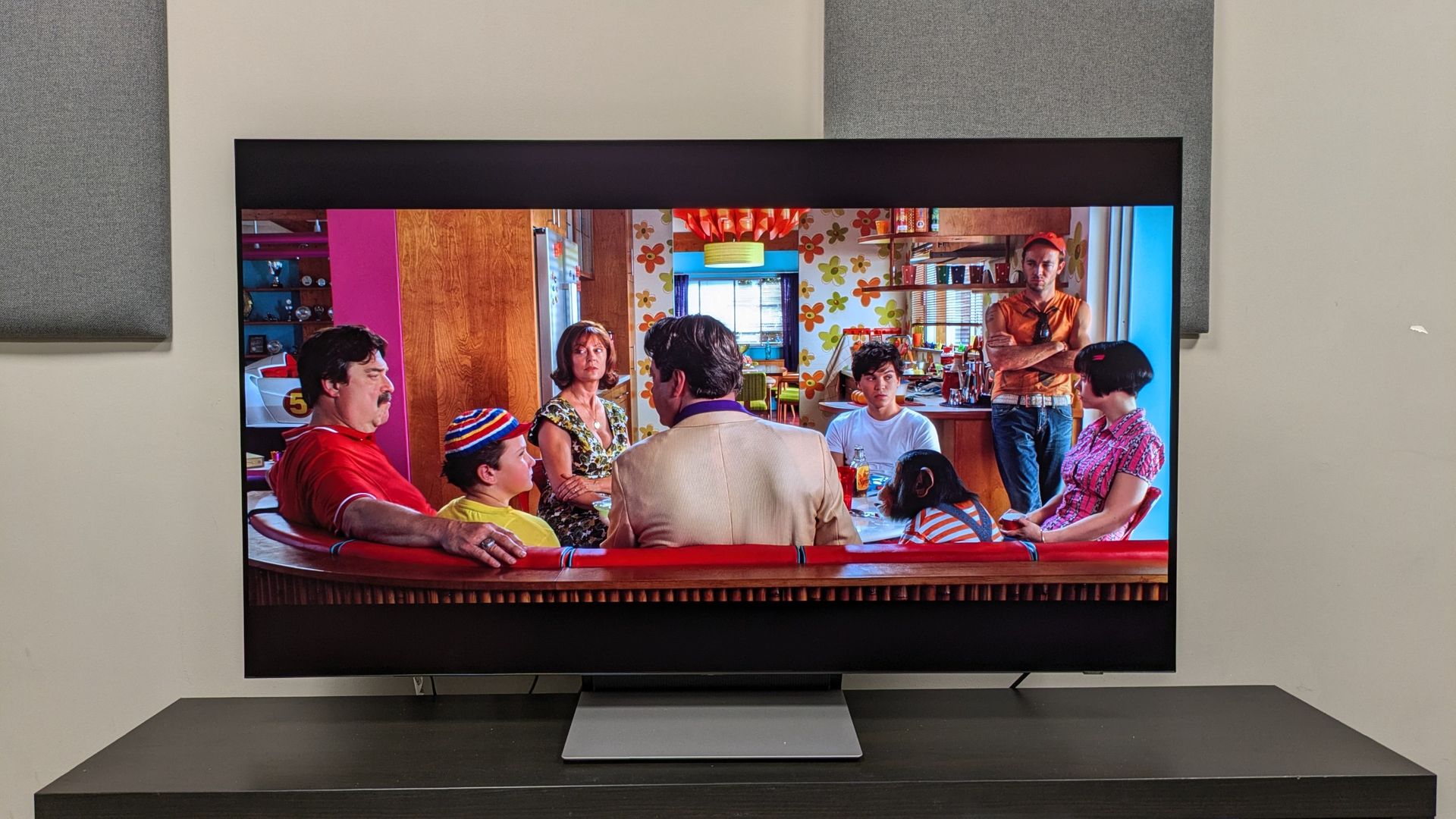
Motion is very good on the S90H when you have the right settings. Watching a soccer game on Prime Video with the default settings, where Blur and Judder reduction are set to the maximum 10, resulted in some motion artifacts like ghosting of the ball. Reducing Blur to 3 and Judder to 5 or 6 resulted in smooth motion that didn’t look artificial. The same settings also worked well for movies, such as the high-speed races in Speed Racer and the Batmobile chase in The Batman.
Throughout viewing, textures looked very refined and realistic, giving everything a near-3D-like level of detail. People in particular looked incredibly lifelike, and with HDR pictures, everything looked crisp.
- Picture quality score: 5 / 5
Samsung S90H review: Sound quality
- 2.1 channel, 40W speakers
- Object Tracking Sound Lite (OTS Lite) is effective
- Mid-tones can be muddled
The S90H has a 2.1-channel, 40W speaker system and supports AI Sound features such as Adaptive Sound Pro and uses OTS Lite. There is support for Dolby Atmos, but not DTS. There are two sound modes to choose from: Standard and Amplify.
I was impressed by the S90H’s punchy bass on its default Amplify settings, which did a good job rendering the rumble of the Batmobile’s engine in The Batman. During the same Batmobile chase scene, the S90H’s speakers delivered fantastic detail, such as swerving tyres and impacts with traffic, and the sound was accurately mapped to the action on screen, showing the effectiveness of the OTS system.
It also demonstrated a good balance between the score and other sound effects. While speech was mostly clear, it did get lost at times during the chaotic moments within the scene. I noticed too that mid-tones could get a bit muddled at times, but the sound was still very good.
Turning on the Adaptive Sound Pro setting in the AI Sound menu (found under the AI settings in the Advanced Features menu) yielded some good results, which I’ve not always found with AI sound modes on other TVs. More width was added, extending the sound further beyond the screen; the volume was louder overall, and more detail was produced. Bass was punchier, but it had lost the warmth of the default Amplify Mode. For a lot of viewing, you could get away with not using a soundbar, but the sound doesn’t quite match up to the picture’s excellence, so I’d recommend a soundbar for movies.
- Sound quality score: 4 / 5
Samsung S90H review: Design
- Razor-thin frame
- Lightweight but premium build
- SolarCell remote
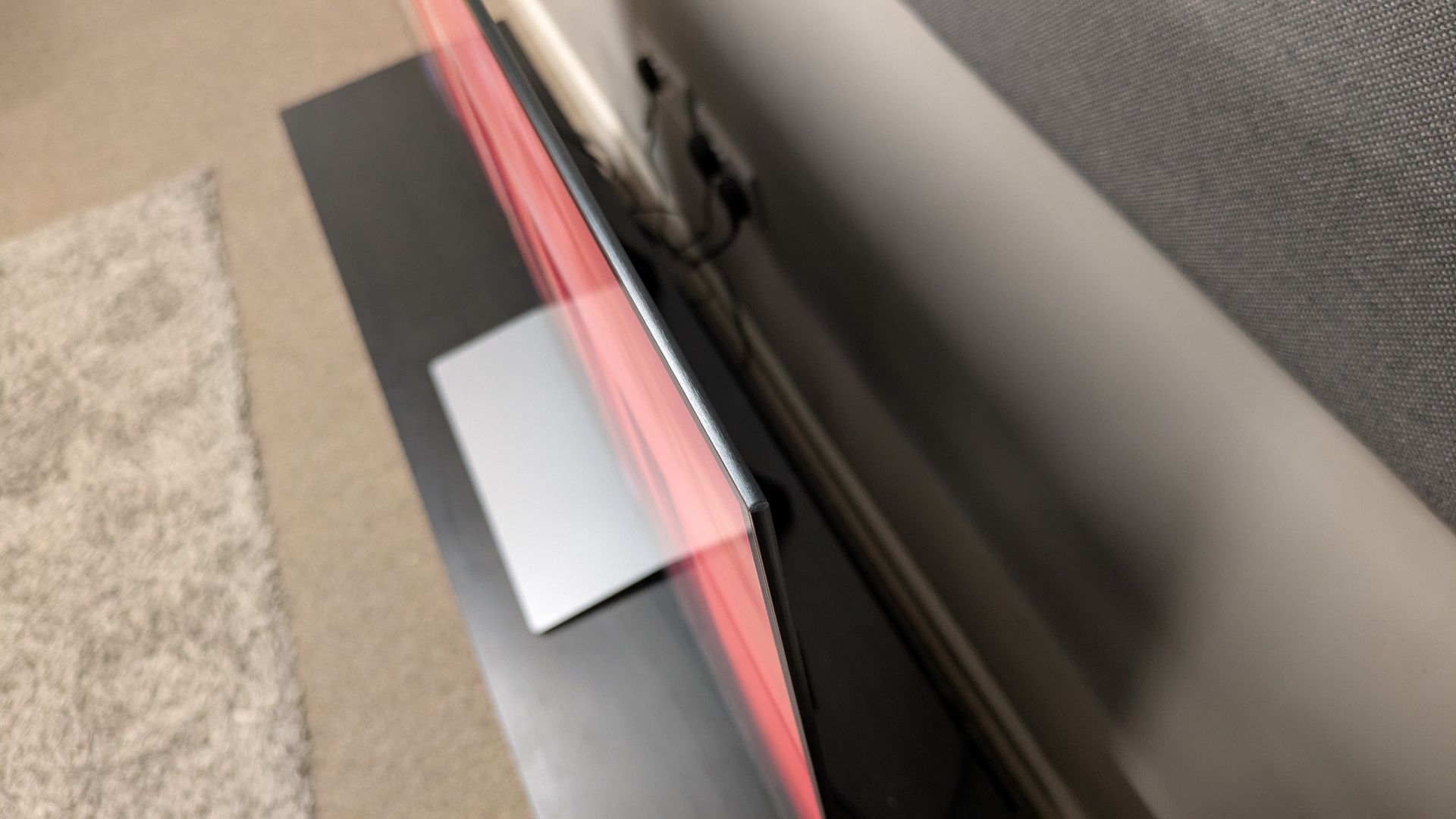
The most striking thing about the S90H physically is its razor-thin frame. While there is a bit of bulk on the rear panel to accommodate speakers and various connections like HDMI ports, the top of the frame is incredibly slim. This gives it a sleek, modern appearance that makes the TV feel premium.
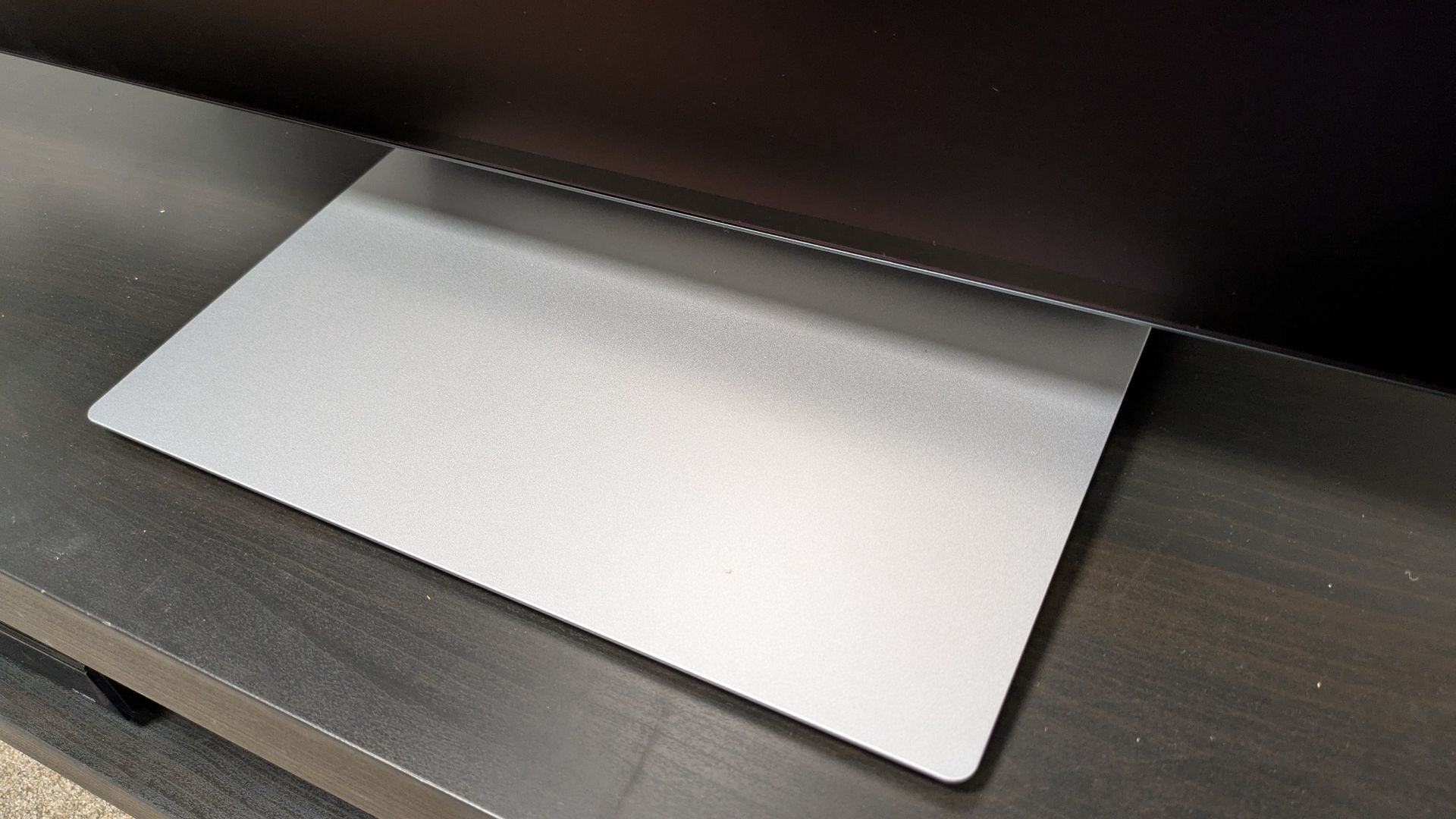
The S90H has a lightweight design, but still feels premium when viewed on its stand. The supplied plastic pedestal stand on my 55-inch review model did feel a little cheap compared to the rival LG C6’s metal stand. However, once fully assembled, the TV was visually appealing.
As with most Samsung TVs, the S90H is supplied with Samsung’s SolarCell remote. While on the small side, the inclusion of Solar and USB-C rechargeable options is very useful. The design hasn’t changed much in the past few years, but honestly, it doesn’t need to.
- Design score: 4.5 / 5
Samsung S90H review: Smart TV & menus
- Tizen smart TV platform
- Easy-to-navigate menus
- Some odd quirks that can be annoying
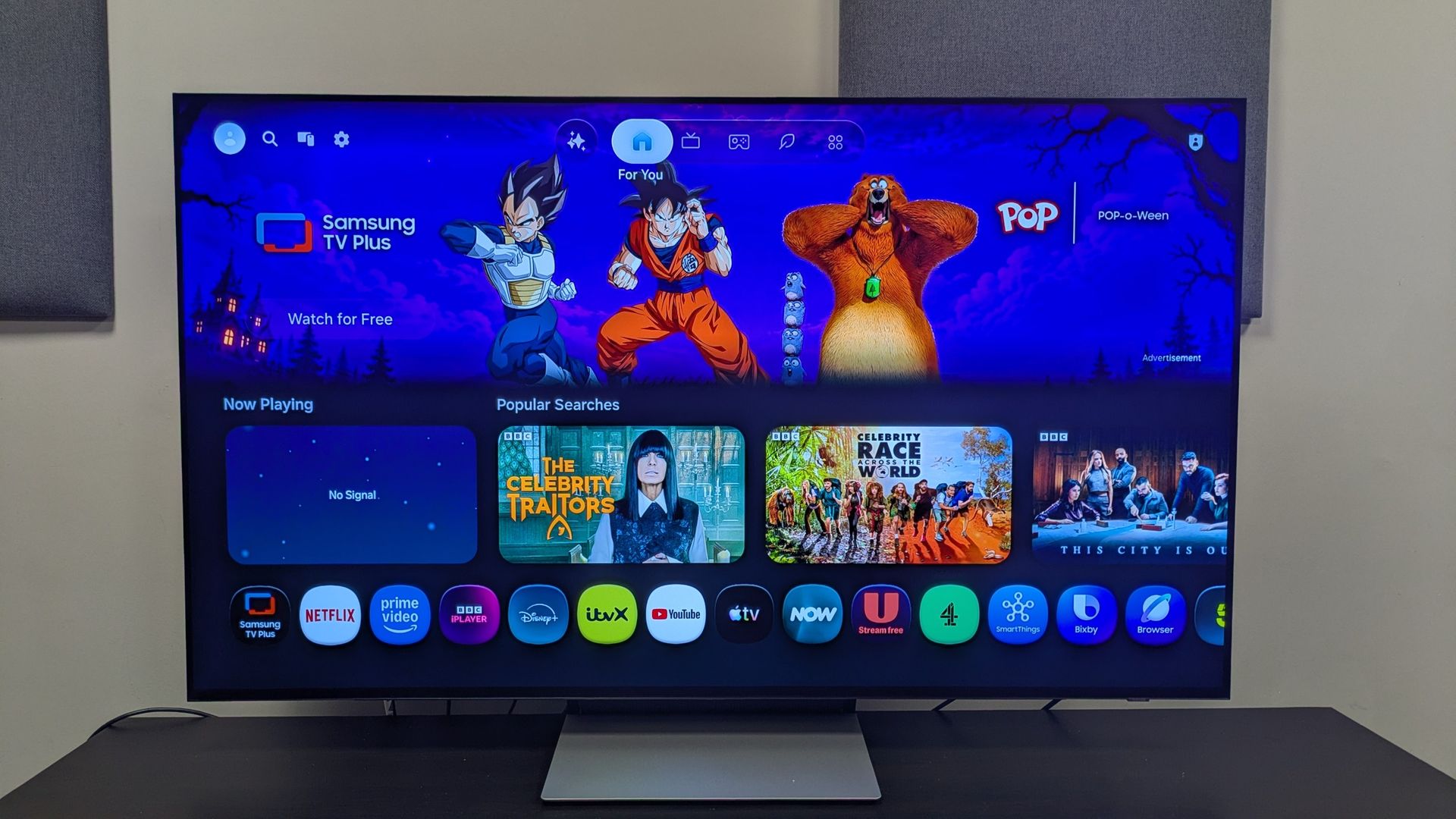
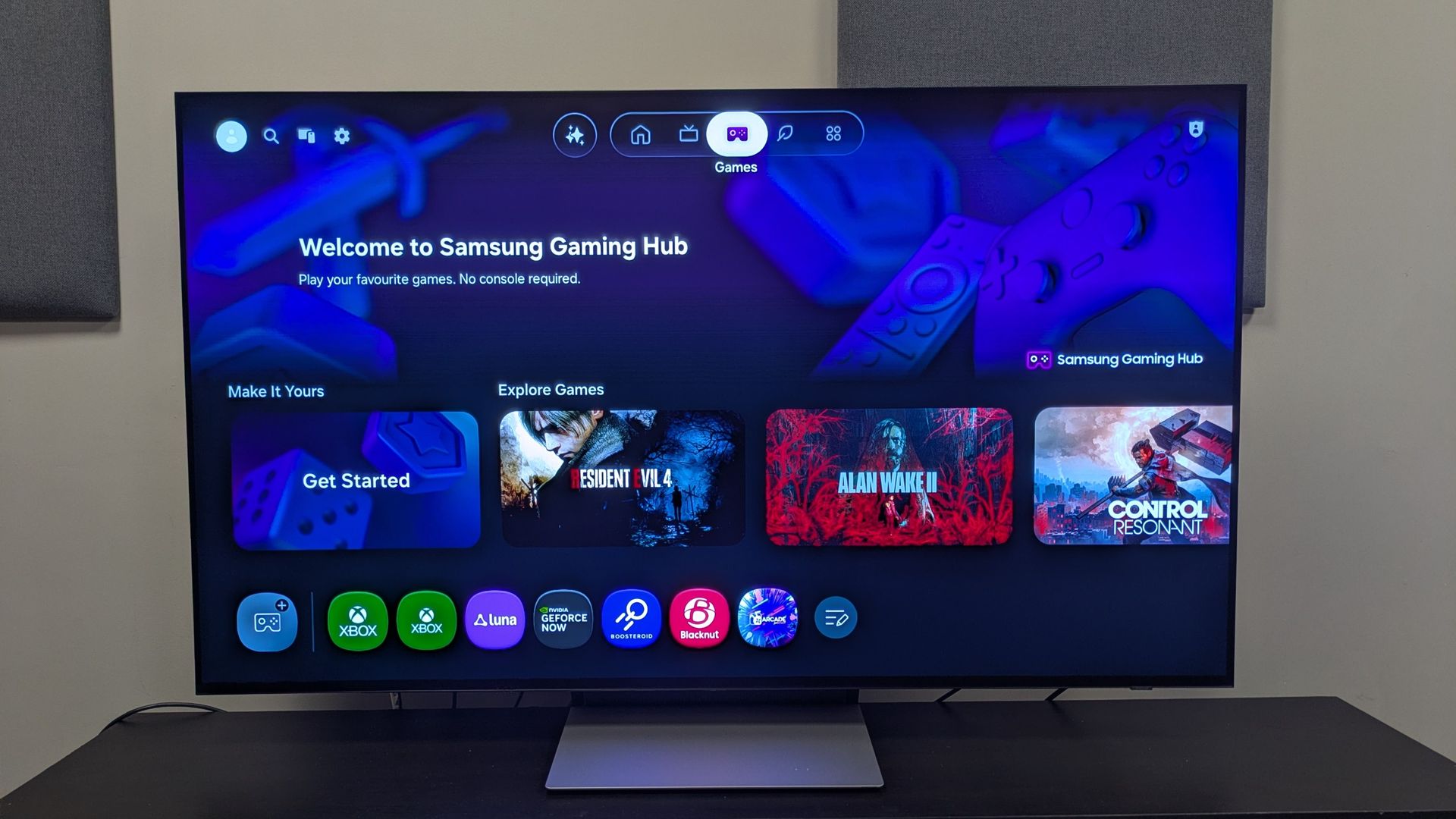
Samsung’s own Tizen smart TV platform is used in the S90H and is generally a good, easy-to-use interface with useful hubs to divide up particular apps. The Home hub houses all apps and content recommendations, while the Game hub, naturally, houses everything to do with gaming.
Like many smart TV platforms, Tizen’s home screen features banner ads that take up about half the screen, pushing apps further down the page. I also found that, at times, Samsung TV Plus would autoplay the show I previously had on when I was trying to go to different sources. I found this frustrating, but eventually the S90H played ball.
There are a good number of picture settings on offer that can really make a difference (Shadow Detail being one of them), and they’re fairly easy to find. Sound settings are a bit limited compared to other TVs I’ve tested. While the AI settings can help with this, they’re kept in a separate menu. Overall, Tizen is a serviceable smart TV interface, but doesn’t quite match up to LG’s webOS or Roku.
- Smart TV & menus score: 4 / 5
Samsung S90H review: Gaming
- Four HDMI 2.1 ports
- Full suite of features
- Ultra-low 9.2 ms input lag
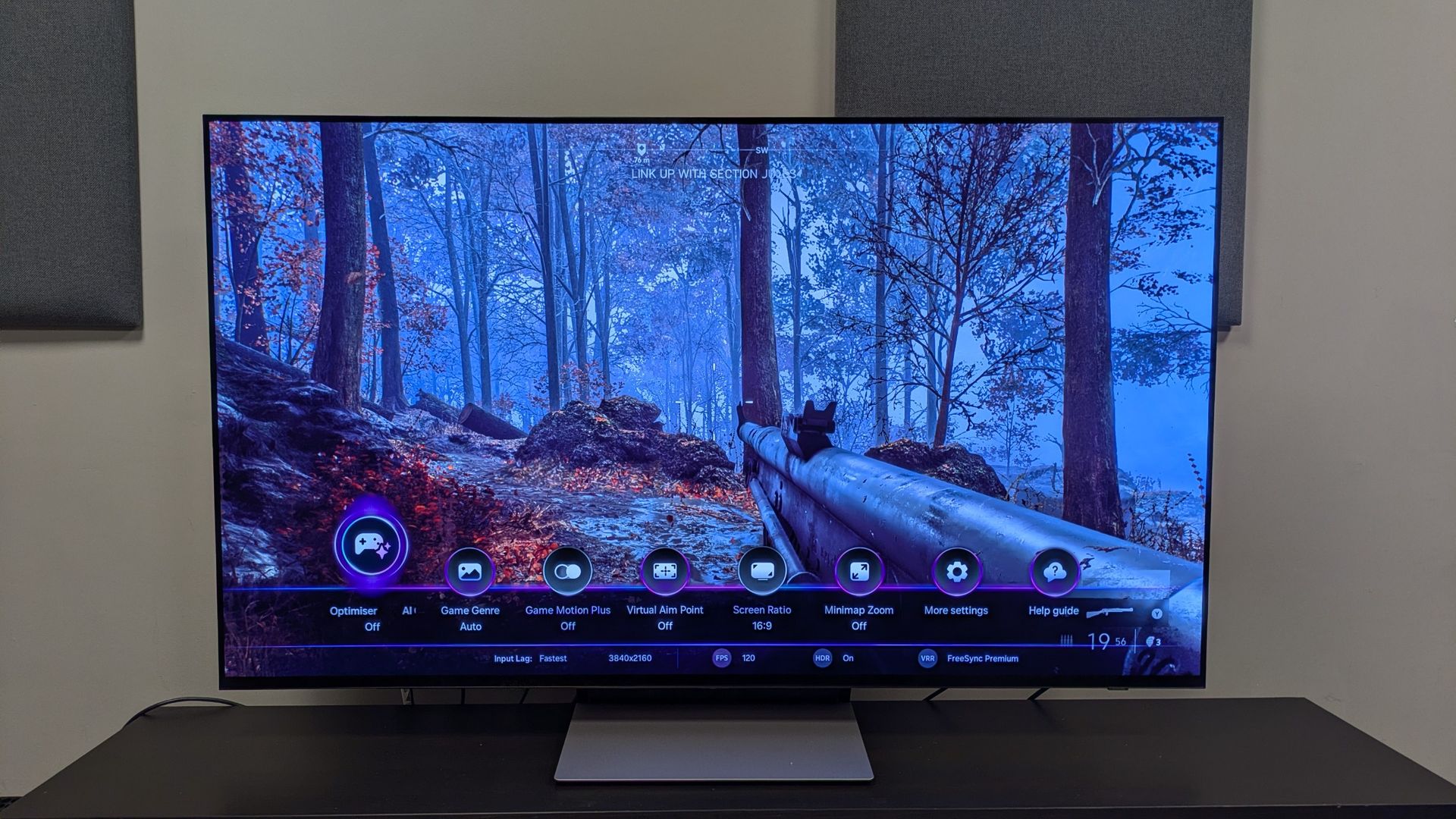
The S90H is well equipped for gaming, with four HDMI 2.1 ports that support 4K 165Hz, full VRR including AMD FreeSync and Nvidia G-Sync, ALLM, and HDR10+ gaming. It also has a Game hub where cloud gaming apps such as Xbox and Nvidia GeForce Now are housed, as well as links to Twitch streams.
The S90H’s input lag measured an ultra-low 9.2ms at 4K 60Hz and 4.8ms at 1080p 120Hz. This performance translated when I was actually testing gaming on the S90H, with ultra-smooth motion during Battlefield V. As I whipped around missions, the S90H easily rendered all the action during high-intensity battles as I targeted enemies and dodged enemy fire.
The S90H’s excellent picture quality did wonders for games too, delivering crisp textures, balanced contrast and bold colors, all of which could be seen in various missions during Battlefield V.
- Gaming score: 5 / 5
Samsung S90H review: Value
- Similarly priced to rival OLEDs
- Great performance and features
- Cheaper mini-LED with similar features available
The S90H covers pretty much every base you’ll need, and while it would be nice to have Dolby Vision supported, the picture quality is good enough to do without it. The 55-inch model I tested has an MSRP of $1,999 / £1,799 / AU$2,995.
Since its release in May 2026, prices for the S90H have fallen, and at the time of writing (November 2026), a 55-inch model costs $1,199 / £1,199 / AU$2,995. While this puts it at the same price as the C6 in the UK, LG’s model is cheaper in the US and Australia at $999 / AU$2,495. I don’t expect the S90H to be more expensive for long, however, as prices will likely level out the further we get into its life cycle.
There are budget mini-LED TVs, such as the TCL QM7L/C7L, available for less that deliver great performance and features in their own right, but right now, the S90H is probably one of the best-value OLEDs you can get.
- Value score: 4.5 / 5
Should you buy the Samsung S90H?
|
Attributes |
Notes |
Rating |
|---|---|---|
|
Features |
Full suite of features that covers nearly every base for movies and gaming |
5/5 |
|
Picture quality |
Stunning colors, strong contrast and realistic textures. Also great for bright-room viewing thanks to its glare free screen |
5/5 |
|
Sound quality |
Great detail and accuracy with punchy bass, but mid tones can sound muddled and sound could be wider |
4/5 |
|
Design |
Premium build with sleek design, ultra-thin frame |
4.5/5 |
|
Smart TV and menus |
Tizen is mostly good and easy to use, but has some quirks that can make it frustrating at times |
4/5 |
|
Gaming |
Full suite of gaming features with ultra-smooth performance to match: a top-notch gaming TV |
5/5 |
|
Value |
Fully specced mid-range OLED TV that might be pricier than rivals now, but prices will drop. |
4.5/5 |
Buy it if…
You want superb OLED picture quality
The S90H’s picture quality is excellent, delivering vibrant colors, powerful contrast, lifelike textures and great motion handling.
You want to watch OLED in a bright room
The S90H’s glare-free screen is effective at eliminating reflections in bright rooms, meaning challenging dark scenes can even be watched in brighter conditions
You want an OLED for gaming
The S90H is fully equipped for gaming and delivers razor-sharp performance with smooth gameplay and brilliant picture quality
Don’t buy it if…
You need Dolby Vision
Like all Samsung TVs, the S90H does not support Dolby Vision, which is used for streaming services, 4K Blu-ray and some gaming consoles.
You don’t want to set up your picture
The S90H delivers great picture quality, but you have to put in some work to get the picture just right, especially for darker scenes.
You want the best smart TV platform
Tizen is mostly a good smart TV platform, but I found there were some frustrations from time to time.
Also Consider
|
Samsung S90H |
LG C6 |
TCL QM7L/C7L |
Samsung S95H/S99H |
|
|---|---|---|---|---|
|
Price (55-inch)(current) |
$1,199 / £1,199 / AU$2995 |
$999 / £1,199 / AU$2,495 |
$699 / £849 / AU$1,395 |
$1,899 / £1,899 / AU$3,999 |
|
Screen type |
OLED |
OLED |
SQD mini-LED |
QD-OLED |
|
Refresh rate |
165Hz |
165Hz |
144Hz |
165Hz |
|
HDR support |
HDR10+, HDR10, HLG |
Dolby Vision, HDR10, HLG |
Dolby Vision, HDR10+. HDR10, HLG |
HDR10+, HDR10, HLG |
|
Smart TV |
Tizen |
webOS 26 |
Google TV |
Samsung Vision AI (Tizen) |
|
HDMI ports |
4 x HDMI 2.1 |
4x HDMI 2.1 |
4 (2 x HDMI 2.1) |
4x HDMI 2.1 |
LG C6
The S90H’s biggest rival, the C6 is LG’s mid-range 2026 OLED. It delivers similar excellent picture quality and features. The C6 is cheaper right now in some regions, but that could change soon. This one comes down to personal preference, although if you want an OLED for a bright room, the S90H is the better option.
Read our full LG C6 review
TCL QM7L/C7L
The TCL QM7L (US)/C7L (UK/Aus) is the brand’s mid-range SDQ mini-LED. While the S90H delivers better overall picture quality, the QM7L/C7L is better value for money, offering great picture quality and features for a fraction of the price.
Read our TCL QM7L review and TCL C7L review
Samsung S95H/S99H
The Samsung S95H (US/Aus)/S99H (UK) is the flagship OLED in Samsung’s lineup for 2026. It’s brighter and has more refined picture quality than the S90H, but is significantly pricier. The S90H is better value for money in terms of price vs performance, but the S95H/S99H is the best choice if you want elite OLED.
Read our Samsung S95H review and Samsung S99H review
How I tested the Samsung S90H
- Tested over a couple of weeks
- Tested using SDR and HDR sources in varying lighting conditions
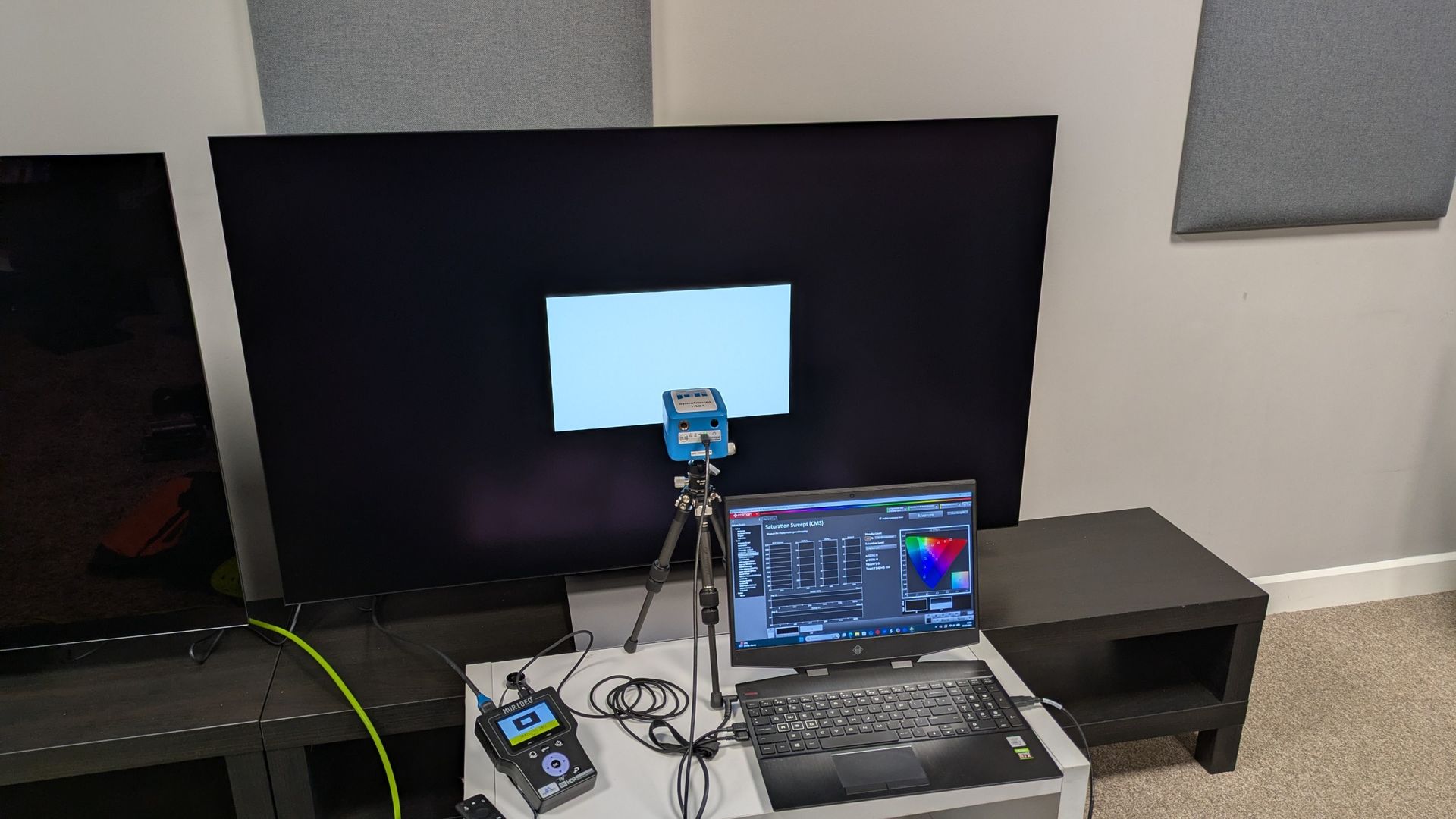
- Measurements taken using Portrait Displays’ Calman color calibration software
I first tested the Samsung S90H over a few days with casual viewing to establish its best picture modes, landing on Filmmaker and Movie modes for movies and TV shows and Standard for sports and daytime TV.
I then commenced subjective testing. I watched reference scenes from 4K Blu-ray and other sources to test the S90H’s picture quality, looking at color, contrast, detail, upscaling, textures, motion, and sound quality.
I then moved onto objective testing, taking measurements using specialized equipment. This included a Jeti Spectral 15VA spectroradiometer, profiled with a Klein K-10A colorimeter, a Murideo Six G 8K Metal test pattern generator, and Portrait Displays’ Calman color calibration software to record these measurements.
The first test I conducted was for brightness, measuring the S90H’s HDR and SDR brightness using 1-100% sized white window test patterns, with the focus being on peak (10%) and fullscreen (100%) brightness.
Next, I tested the S90H’s HDR color gamut coverage, focusing on UHDA-P3 (also known as DCI-P3) and BT.2020 color spaces.
I then tested the color and grayscale accuracy of the S90H in SDR, using the Delta-E averages (the margin of error between the test pattern source and what’s shown on screen).
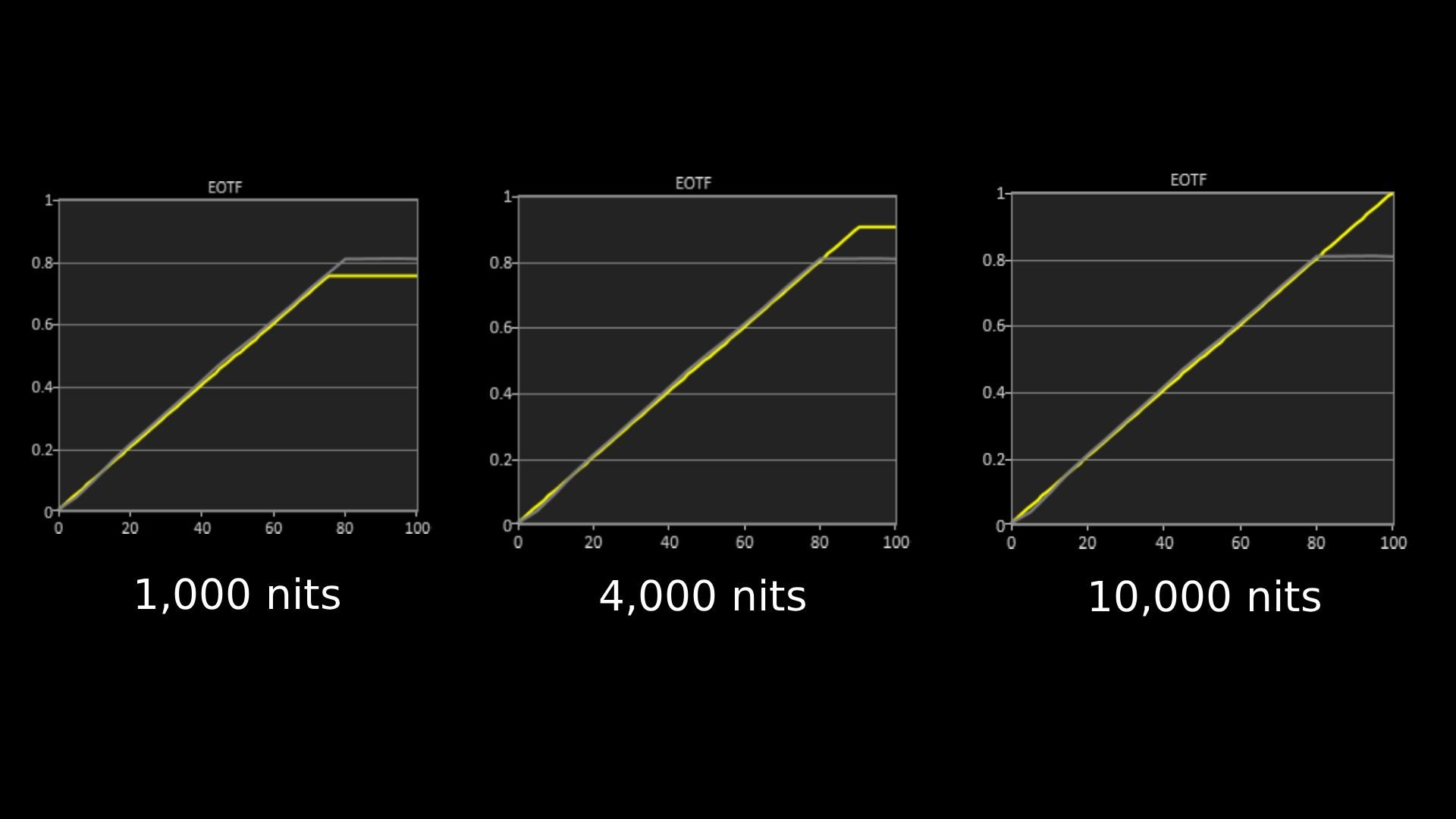
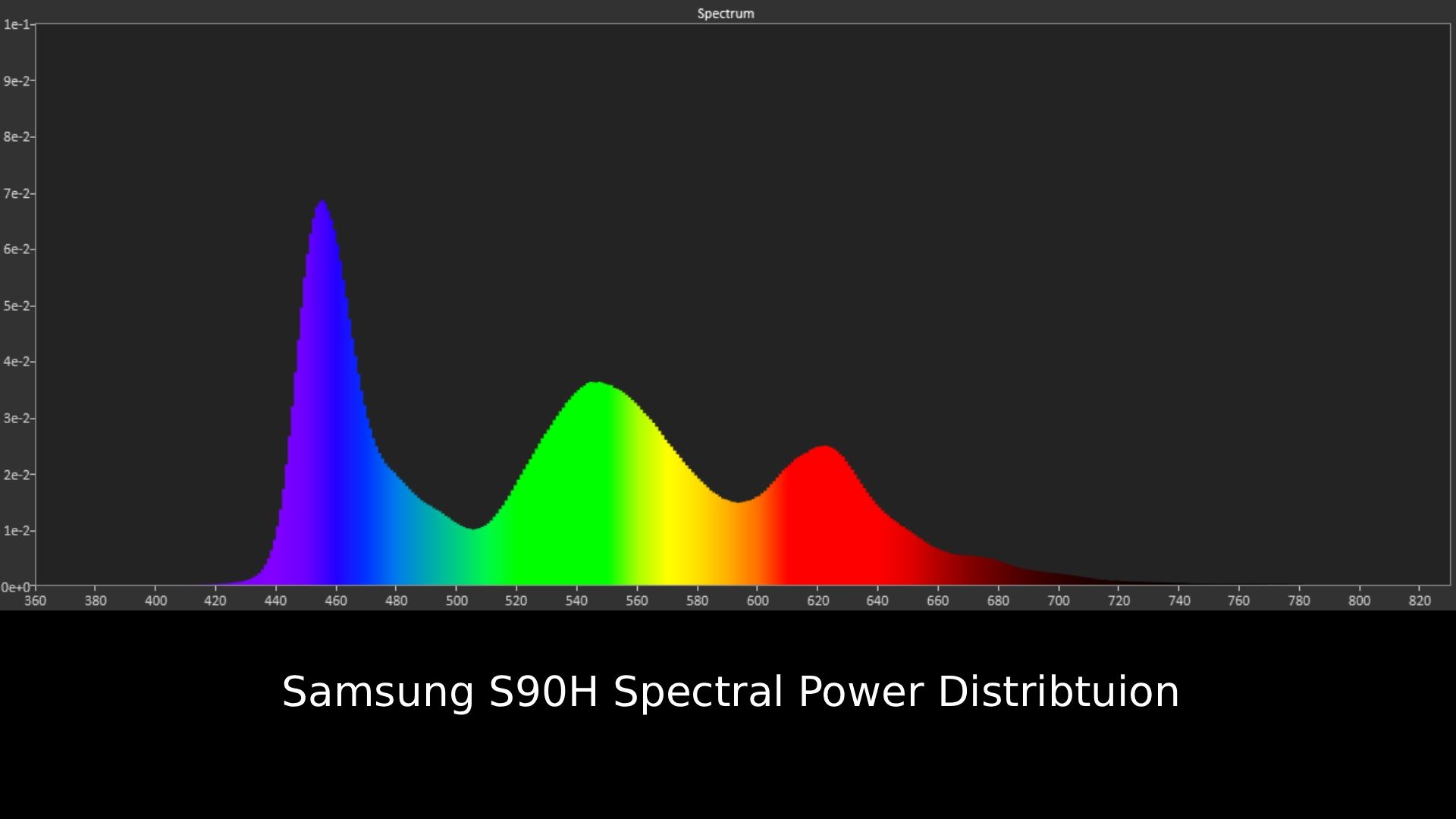
I also tested the S90H’s HDR EOTF in 1,000, 4,000 and 10,000 nits. This test shows its accuracy at both light and dark levels. I also measured the S90H’s Spectral Power Distribution, which demonstrates its color performance, using the Jeti spectroradiometer.
Finally, I tested the S90H’s input lag using a Leo Bodnar 4K HDMI Input Lag Tester, measuring 4K 60Hz and 1080p 120Hz speeds in milliseconds.
Read our in-depth overview of how we test TVs at TechRadar.
- First reviewed: November 2026
- Read TechRadar’s reviews guarantee
This articles is written by : Nermeen Nabil Khear Abdelmalak
All rights reserved to : USAGOLDMIES . www.usagoldmines.com
You can Enjoy surfing our website categories and read more content in many fields you may like .
Why USAGoldMines ?
USAGoldMines is a comprehensive website offering the latest in financial, crypto, and technical news. With specialized sections for each category, it provides readers with up-to-date market insights, investment trends, and technological advancements, making it a valuable resource for investors and enthusiasts in the fast-paced financial world.