
At a glance
Expert’s Rating
Pros
- Automates data-broker removal requests
- Broad coverage of public and non-public data brokers
- Clear dashboard for tracking removal progress
Cons
- Some discovered profiles couldn’t be independently inspected
- Removals can take weeks or months
- Ongoing subscription costs add up
- Past ties to the data-broker industry may raise trust concerns
Our Verdict
OneRep simplifies the process of removing personal information from data-broker sites, with a straightforward dashboard and easy tracking. It’s a worthwhile option for anyone who values convenience over the cost of doing the work themselves.
Price When Reviewed
This value will show the geolocated pricing text for product undefined
Best Pricing Today
Price When Reviewed
From $8.33 per month
Best Prices Today: OneRep
You don’t have to share much personal information online for it to end up in the hands of data brokers. These companies gather information from public records and other sources, compiling it into searchable profiles that can reveal your home address, phone number, and even the names of your relatives.
Tracking down and removing that information yourself is tedious, especially when dozens of sites may have your details. OneRep promises to make the job easier by finding your information and handling removal requests on your behalf. I tested the service against my own digital footprint to see how much work it could save me—and whether it could actually make my information disappear.
How OneRep works
OneRep searches data-broker sites for your personal information, submits removal requests on your behalf, and follows up when brokers don’t respond or comply.
The service works with two types of data brokers. Public brokers, commonly called people-search sites, make personal profiles available online. OneRep scans these sites for matching records and requests their removal. Non-public brokers, meanwhile, share personal information with advertisers and other businesses without making it openly searchable. Because OneRep can’t inspect their records directly, it sends opt-out requests to these companies after obtaining your consent.
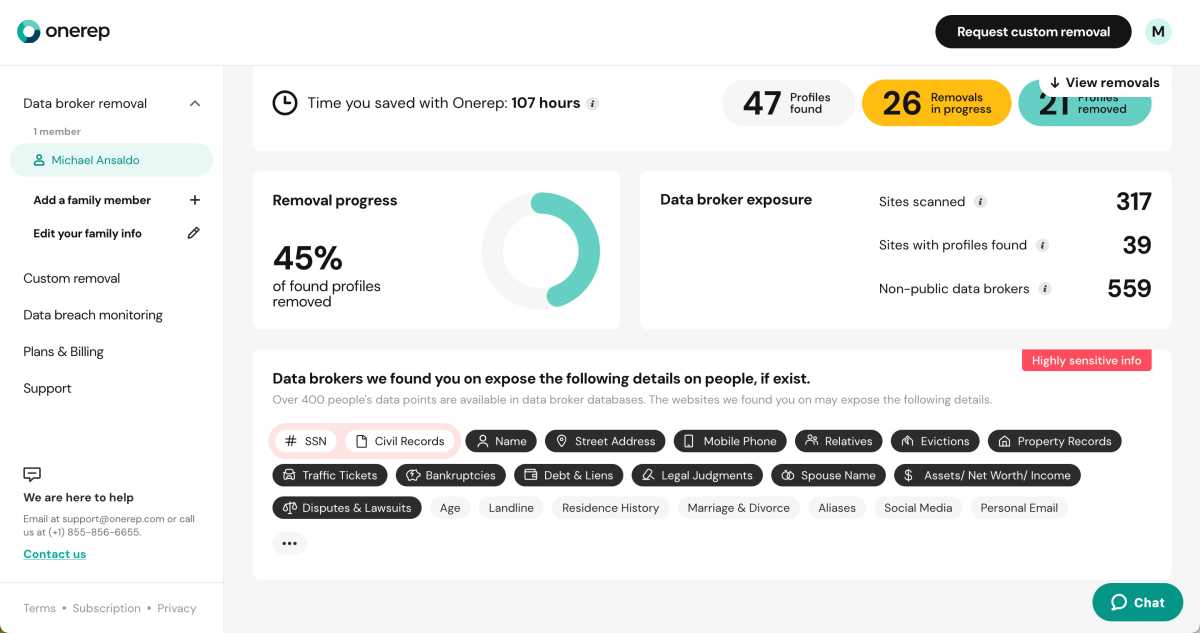
OneRep’s dashboard shows removal progress, the number of profiles discovered, and the data brokers covered by the service.
Michael Ansaldo/Foundry
Removing a profile doesn’t necessarily mean it’s gone for good. Scrubbing your data from these sites can feel like bailing water out of a leaky boat because data brokers continually collect fresh information and can recreate deleted profiles. To address this, OneRep rescans covered people-search sites monthly and submits new removal requests when records reappear.
OneRep offers four subscription plans. Individual coverage costs $14.95 per month or $8.33 per month with annual billing. Family coverage for up to six people costs $27.95 monthly or $15 per month annually. Both plans cover 317 public people-search sites.
The Individual Pro and Family Pro plans expand coverage to 876 brokers, including 559 non-public ones. They cost $29.95 and $55.95 per month, respectively, or $15.95 and $29.95 per month with annual billing. Pro subscribers also get expert assistance and unlimited custom removal requests for brokers outside OneRep’s automated coverage. Those requests must involve data brokers, however. OneRep won’t remove information from government records, news websites, or social media platforms.
You can run a free scan to see where your personal information appears before subscribing. OneRep also offers a five-day free trial of its removal service, though you’ll need to provide payment information and cancel before the trial ends to avoid being charged.
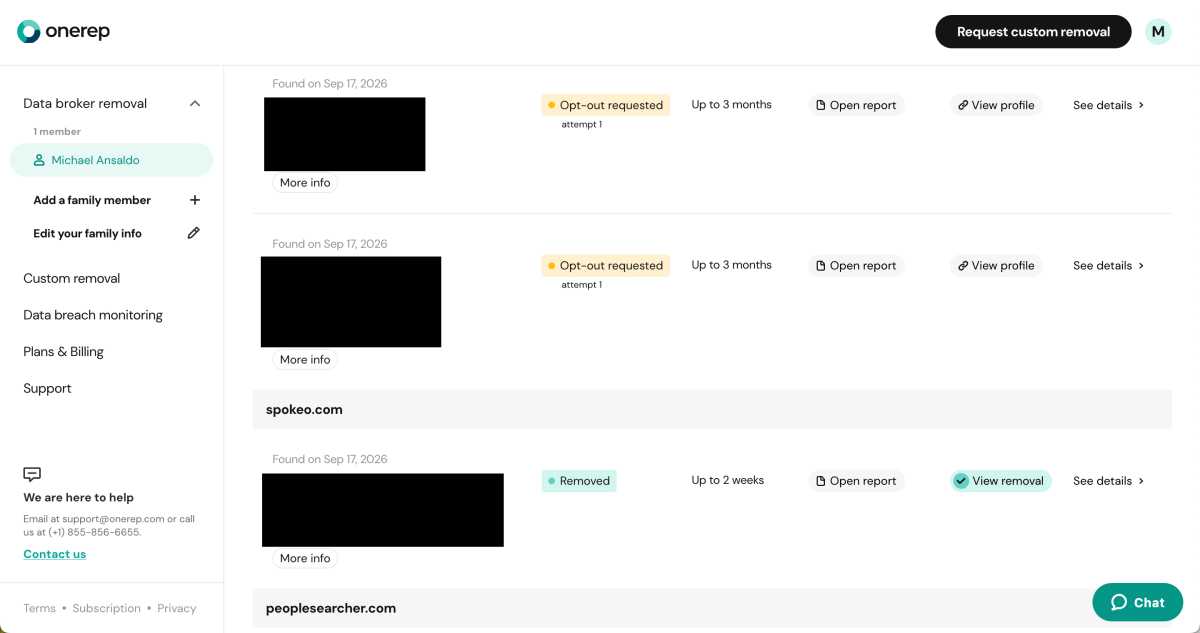
OneRep lets you track removal requests for individual data brokers, including their current status, estimated processing times, and links to the discovered profiles.
Michael Ansaldo/Foundry
Because OneRep requires access to sensitive personal information, the company’s own privacy practices are worth considering. The company has faced scrutiny over its ties to the data-broker industry. In 2024, security journalist Brian Krebs reported that founder Dimitri Shelest had created numerous people-search businesses. Shelest acknowledged retaining an ownership stake in Nuwber, a data broker. The revelations prompted Mozilla to announce it was ending its partnership with OneRep.
A OneRep representative told me that Nuwber has since shut down and Shelest no longer holds an ownership stake in any data broker or people-search business. The company maintains that it has never shared customer information with those businesses. OneRep announced that it completed a SOC 2 Type II audit in 2025, which assessed its security and confidentiality controls over time.
Getting started with OneRep
To start using OneRep, you have to enter your name, date of birth, and contact information. You can also add previous addresses, alternate names, and additional phone numbers or email addresses. It sounds counterintuitive to hand a service the same information you’re asking it to remove, but providing enough details helps distinguish your records from those of people with the same or similar names.
The dashboard gives you a running picture of OneRep’s progress. At the top, a summary shows how many profiles OneRep has discovered, how many removals are underway, and how many have been completed. It also displays your overall removal percentage and an estimate of the time you would have spent removing the records yourself. Another section shows how many sites OneRep has scanned and how many contain profiles matching your information.
Further down, you can examine the findings broker by broker. Each entry identifies the personal information OneRep discovered, along with the current removal status and estimated processing time. You can also follow links to view the exposed profile, open a sample report showing the types of information a broker collects, or get instructions for removing the record yourself.
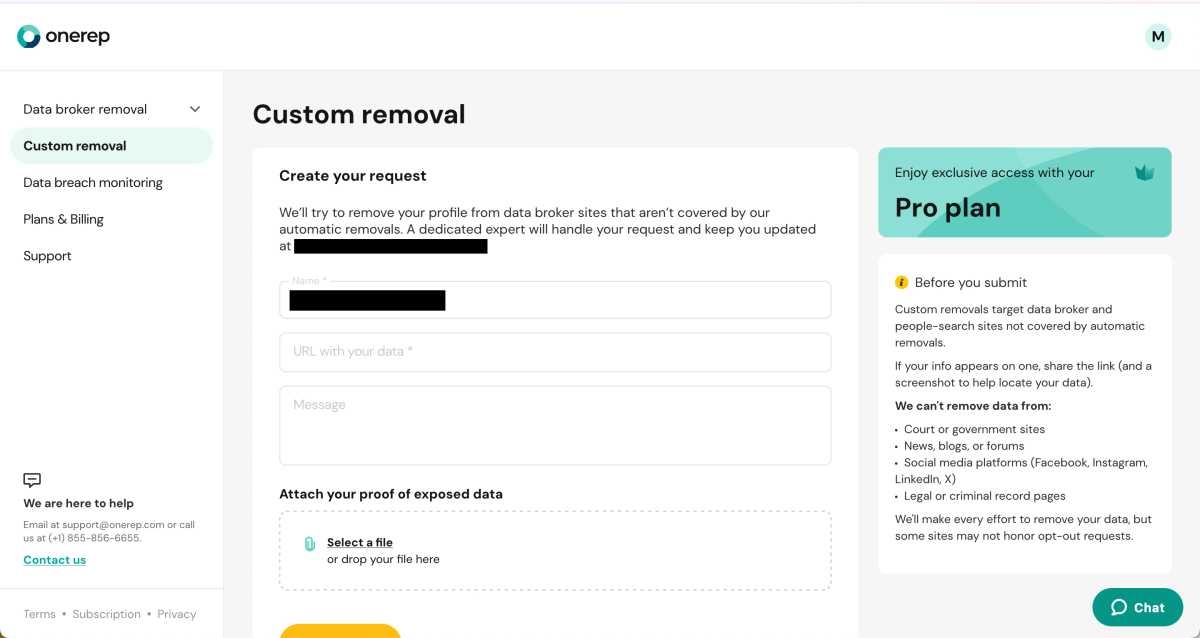
OneRep’s Pro plans let you submit custom removal requests for data-broker sites not covered by its automated service, with assistance from a dedicated expert.
Michael Ansaldo/Foundry
OneRep requires separate authorization before contacting non-public brokers. You’ll need to agree to share identifying information, potentially including your date of birth, so these companies can locate your records. OneRep also creates a temporary email address to handle their responses without exposing your personal email address. Once I gave my consent, the dashboard showed requests processing across 559 non-public brokers.
Removing my personal information
OneRep’s initial scan turned up 47 profiles containing my personal information across 39 people-search sites. Along with current and former addresses, the records included phone numbers, email addresses, and names of relatives. Some of the information was outdated, but much of it was accurate.
One Spokeo listing was particularly revealing. The profile appeared to belong to my deceased father, who shared my name, and listed his age rather than mine. But it also contained my phone number and email address, along with several addresses where I’d lived. One was my childhood home, which I hadn’t lived in since 1990. The mixed-up profile illustrated how data brokers can combine information about different people into a single record, potentially exposing someone’s contact information and address history to people searching for someone else.
OneRep lets you inspect the records it finds, though the links weren’t always helpful. The Spokeo link opened the actual profile, while a link to BeenVerified took me to its homepage. From there, I had to go through the site’s regular search process, which eventually asked me to pay to view the report. I declined, so I couldn’t independently check the information OneRep had found.
Once my removal requests started processing, I checked the dashboard periodically for updates. After a week, OneRep reported that it had removed six of the 47 profiles, with the remaining 41 still in progress. By day 12, that number had climbed to 21 removals, or 45 percent of the total records found. That was encouraging progress, given that OneRep’s estimated removal times ranged from days to months.
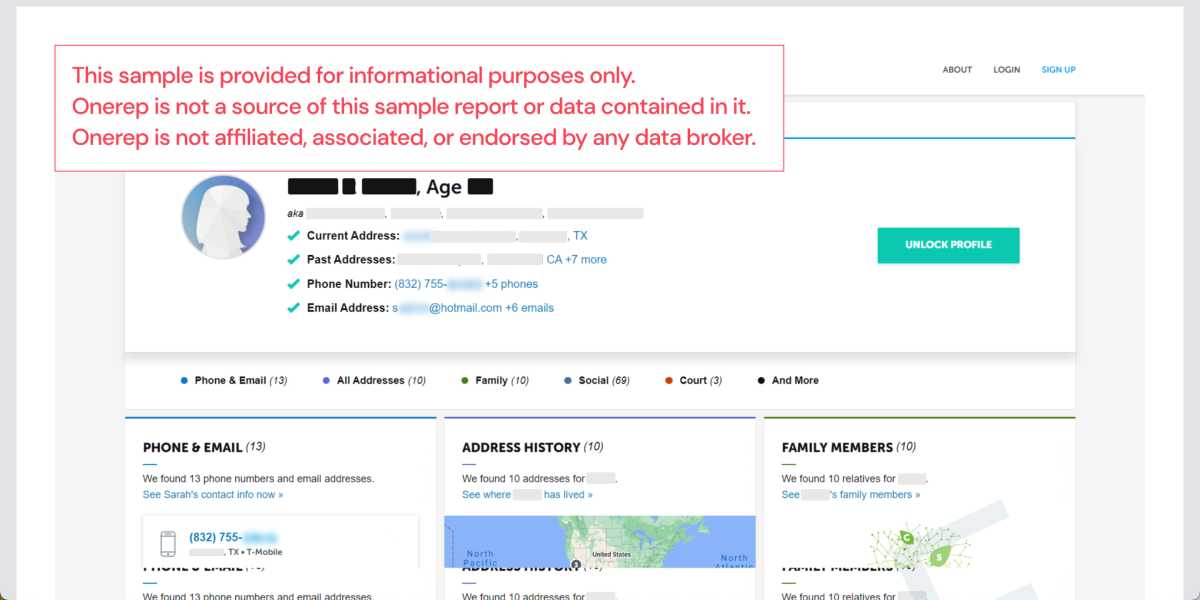
OneRep’s sample reports show the types of personal information data brokers may expose, including contact details, address history, and family relationships.
Michael Ansaldo/Foundry
I checked two of those completed removals myself. Clicking the removal link for National Public Data opened a page confirming that the record had been removed. PeopleWin presented a less definitive result: A search for my name still returned nine profiles, but none belonged to me. Both findings were consistent with OneRep’s reported results, though the National Public Data confirmation was more convincing.
The outstanding requests weren’t necessarily a cause for concern. Each broker has its own removal procedures and response times, and OneRep may need to make repeated attempts before a record disappears. Data removal is a long game, and I’ll need to keep an eye on the dashboard over the coming weeks to see how many more removals the service completes.
OneRep also includes data breach monitoring, which identified 23 incidents associated with my primary email address. The feature draws on the data breach tracking service Have I Been Pwned and provides details about each exposure, including what information was compromised. Clicking through to the recommendations brought me to OneRep articles offering general security advice rather than guidance tailored to the individual incident. It’s a convenient addition to OneRep’s dashboard, though you can get much of the same information and free breach alerts directly from Have I Been Pwned.
Is OneRep worth it?
OneRep is a good choice for anyone who wants to reduce their online exposure without handling dozens of opt-out requests themselves. My early results were encouraging, though I’d want to see how many more removals OneRep completes before judging its long-term effectiveness.
The subscription cost is worth considering, particularly since keeping your information off data-broker sites may require ongoing monitoring and payments. Whether that expense is justified largely comes down to how much time and effort you’re willing to spend protecting your privacy.
If you’re comfortable handling opt-outs yourself, you can save money by using free removal tools and following brokers’ instructions. But if you’d rather leave the work to someone else, OneRep offers a convenient alternative. I’d recommend starting with the standard Individual plan unless you specifically need Pro’s expanded broker coverage.
This articles is written by : Nermeen Nabil Khear Abdelmalak
All rights reserved to : USAGOLDMIES . www.usagoldmines.com
You can Enjoy surfing our website categories and read more content in many fields you may like .
Why USAGoldMines ?
USAGoldMines is a comprehensive website offering the latest in financial, crypto, and technical news. With specialized sections for each category, it provides readers with up-to-date market insights, investment trends, and technological advancements, making it a valuable resource for investors and enthusiasts in the fast-paced financial world.