
Nvidia is pouring billions into AI chip production while gamers grapple with painful GeForce prices. But even if Jensen Huang’s successor wanted to shift some of that immense manufacturing muscle back toward gaming, making more GeForce cards isn’t as simple as freeing up space at a chip factory.
Nvidia designs its chips, but TSMC manufactures most of the silicon, while companies like SK Hynix, Samsung, and Micron supply memory. Nvidia’s AI accelerators typically rely on high-bandwidth memory (HBM) and sophisticated packaging, while GeForce cards use consumer GPU-specific GDDR memory and different packaging. There’s some overlap in the underlying manufacturing resources, sure, but these aren’t interchangeable production lines.
Dr. Ian Cutress, chief analyst at More Than Moore, describes semiconductor manufacturing as assembling a complete “matched set” of components. Every piece needs to be ready before a product can ship, which means Nvidia could have plenty of AI silicon waiting on HBM without freeing up a lick of useful manufacturing capacity for making more GeForce cards.
“Typically vendors have to make wafer orders from people like TSMC and wait six months from start of manufacturing to end,” Cutress told me. That’s six months just to get the silicon made, never mind lining up the right memory, packaging, and everything else needed to build a finished graphics card. Even if Nvidia decided to prioritize GeForce production tomorrow, those extra GPUs wouldn’t materialize overnight.
Nvidia spent decades pushing graphics memory technology forward, but that’s hardly what memory manufacturers are obsessing over these days.
“When I speak to memory vendors, there are only two words on their mind. HBM and DDR (or LPDDR),” Cutress says. “We never hear them talk about GDDR.”
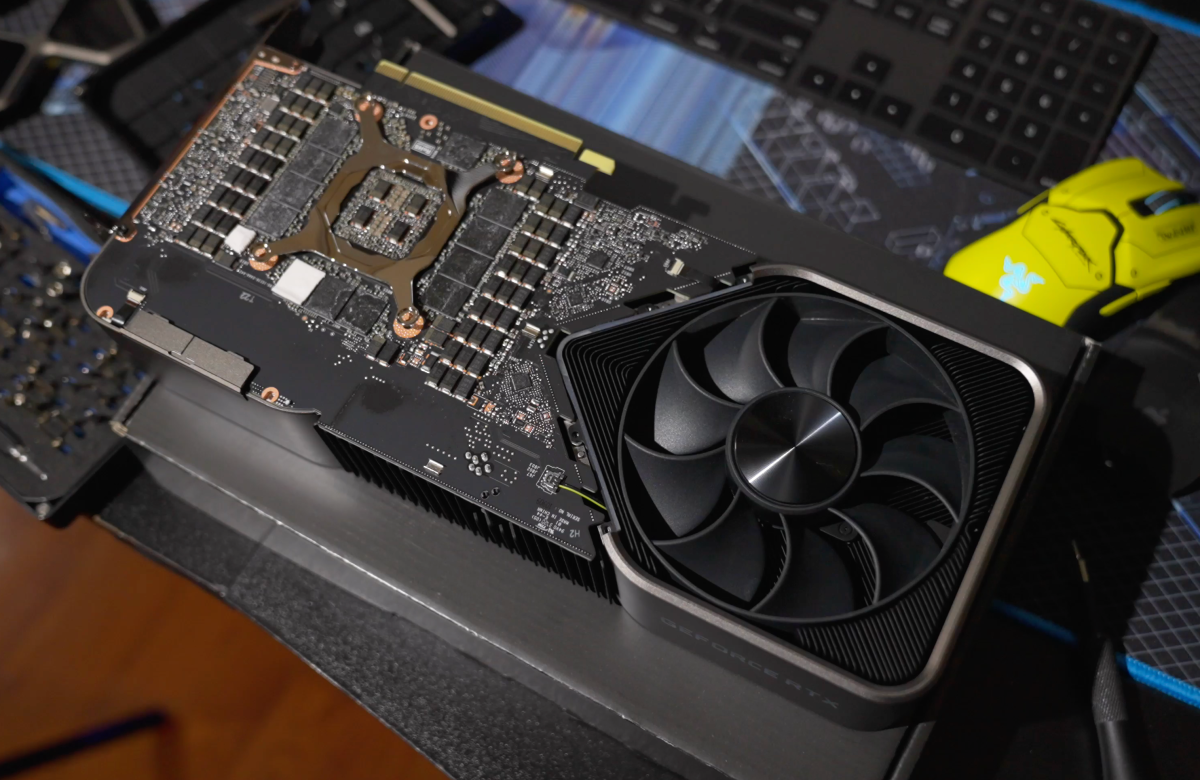
A disassembled RTX 3090 Founders Edition showing off its GDDR6 memory. The more recent RTX 50-series is onto an advanced version of GDDR7.
Thiago Trevisan/IDG
GDDR isn’t necessarily disappearing or in short supply (though Cutress isn’t sure that the next generation of faster GDDR8 memory will arrive this decade after developing at breakneck speeds over prior generations), but it’s startling how little the memory technology that helped build Nvidia’s gaming empire comes up in Cutress’s conversations with the companies making it.
Don’t just take mine or Ian’s words for it — look at Nvidia’s spending commitments. In its August financial filing, the company disclosed $279 billion in supply and manufacturing-capacity commitments, mostly supporting its data center business. In October, Nvidia announced another AI manufacturing expansion, including a $1.1 billion advance supporting semiconductor testing facilities.
Nvidia could absolutely make more GeForce cards, but it would take additional orders, coordinated component supplies, and months of planning. That’s a tougher investment to justify when AI hardware is bringing in vastly greater rewards, especially with Nvidia already committing billions to its expansion.
Jensen Huang may be gone, but the manufacturing decisions he made aren’t going anywhere. His successor can give GeForce all the love in the world; getting more graphics cards onto store shelves requires convincing an entire supply chain to follow along.
This articles is written by : Nermeen Nabil Khear Abdelmalak
All rights reserved to : USAGOLDMIES . www.usagoldmines.com
You can Enjoy surfing our website categories and read more content in many fields you may like .
Why USAGoldMines ?
USAGoldMines is a comprehensive website offering the latest in financial, crypto, and technical news. With specialized sections for each category, it provides readers with up-to-date market insights, investment trends, and technological advancements, making it a valuable resource for investors and enthusiasts in the fast-paced financial world.