
Minimum PC game system requirements are damn near useless. Sure, they’ll tell you what hardware you need to get a game running, but whether it’ll actually run well is anybody’s guess. Valve is finally doing something about it, putting real-world performance data on Steam store pages so gamers can see what frame rates other people are getting before plunking down their hard-earned cash, starting with the Steam Deck.
Valve is pushing Steam beyond Windows and conventional PCs. Figuring out how games will run on all that new hardware is another headache entirely.
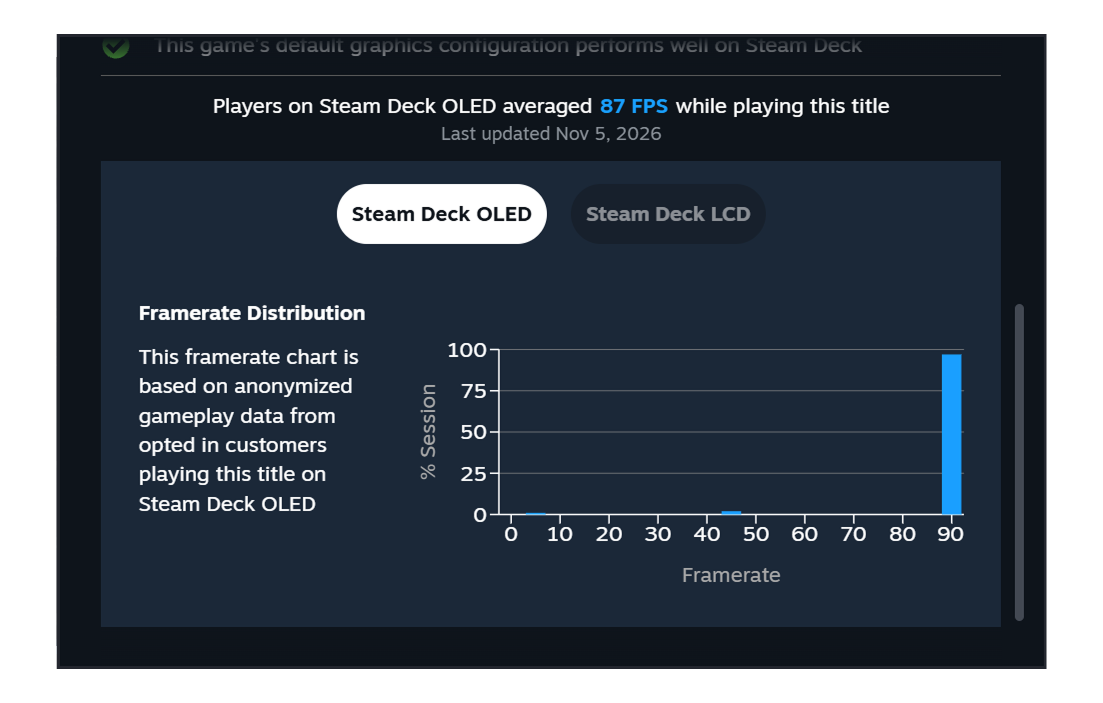
Valve announced this week that Steam now displays average frame rates for thousands of Steam Deck games, collected anonymously from players who opt in to sharing performance data (“a majority of Steam Deck players”). You’ll find the numbers under Steam Deck Compatibility > Learn more on supported store pages, alongside an expandable histogram showing how frequently games hit different frame rates. Verified, Playable, and even Unsupported games are included.
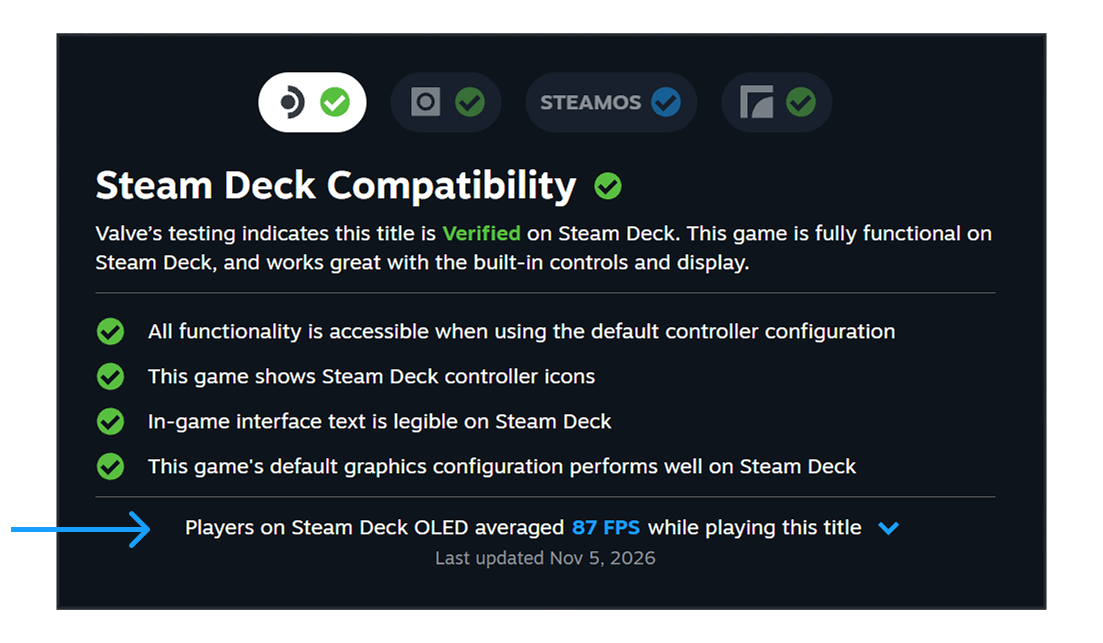
As Ars Technica notes, Cyberpunk 2077 and Skyrim: Special Edition both carry Steam Deck’s coveted Verified badge, but player data shows the former typically hovering around 30 to 40 fps while the latter cruises along at 50 to 60 fps. Even Assassin’s Creed Syndicate, officially Unsupported, approaches 60 fps on Steam Deck OLED. Compatibility badges aren’t designed to measure frame rates alone, of course, but that’s exactly why these newly surfaced numbers can be so helpful. The histogram shows how performance samples are distributed rather than burying everything beneath a single average. Valve doesn’t normalize individual graphics settings, and none of this replaces proper frame-time analysis, but I’ll take actual performance data over a vague badge any day.
After months of brutal supply headaches, the 512GB Steam Deck OLED now costs $789, while the 1TB model skyrocketed to a pearl-clutching $949. That’s $240 and $300 more than before, respectively, for the same hardware. Taking your existing PC game library anywhere remains a fantastic proposition. Swallowing those prices is in a nightmare year for the PC is something entirely different.
Steam’s bigger performance play
PCWorld’s Michael Crider reported back in April that Valve was giving developers access to real-world Steam Deck performance information, and he practically begged the company to put those numbers on store pages. Wish granted!
Mike also spotted evidence of something even more ambitious lurking in Steam’s code: a frame-rate estimator designed to predict how games perform on specific PC hardware configurations.
Valve explicitly calls the new Steam Deck charts a “stepping stone toward providing framerate data for more devices than just Steam Deck,” and it’s already asking desktop Steam beta users to contribute anonymized frame-rate data. If you’ve ever tried to figure out whether a hot new game will run decently on your particular PC’s CPU and GPU combo, you instantly understand how useful that could be. Generic system requirements rarely tell you anything, and finding benchmarks for something resembling your setup can be an utter crapshoot.
Getting reliable estimates from desktop PCs is a much nastier problem than collecting Steam Deck numbers. Steam Decks have set hardware configurations like game consoles do. But two gaming rigs with identical CPUs and GPUs can perform wildly differently depending on resolution, graphics settings, upscaling, drivers, and memory configurations. It’s been an impossible egg to crack thus far, but Steam has millions of gamers running practically every hardware combination imaginable, with the software needed to collect performance information already installed.
Developers obviously test their games, but Valve could eventually build something they can’t easily replicate: a continuously updated picture of how those games perform on the messy frankensteined-together masses of PCs that people actually own. Pull it off, and Steam might finally tell you something useful about how a game will run on your PC before you buy it.
Further reading: Valve escaped Windows. Now Steam is breaking free of the PC itself.
This articles is written by : Nermeen Nabil Khear Abdelmalak
All rights reserved to : USAGOLDMIES . www.usagoldmines.com
You can Enjoy surfing our website categories and read more content in many fields you may like .
Why USAGoldMines ?
USAGoldMines is a comprehensive website offering the latest in financial, crypto, and technical news. With specialized sections for each category, it provides readers with up-to-date market insights, investment trends, and technological advancements, making it a valuable resource for investors and enthusiasts in the fast-paced financial world.