
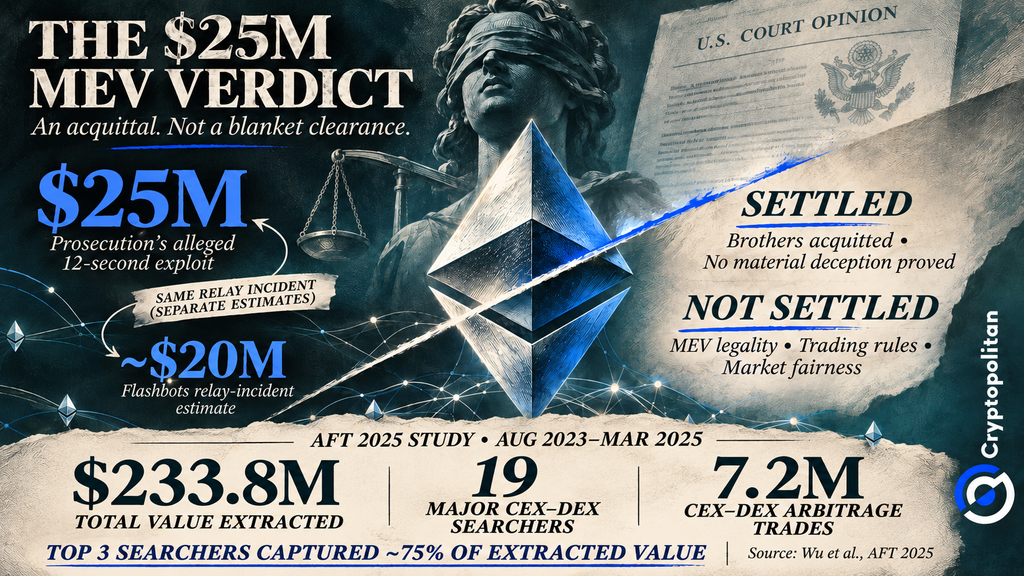
On November 16, US District Judge Jessica Clarke found Anton and James Peraire-Bueno not guilty in a case linked to an alleged Ethereum exploit worth $25 million. According to her ruling, the jury concluded that the prosecutors had not proven the material misrepresentation needed to establish wire fraud claims. Although this ruling puts an end to the matter, it does not clarify the legality of other MEV strategies. MEV (maximal extractable value) is profit gained by inserting, excluding, or reordering transactions within a blockchain block.
Why the deception charge collapsed
In 2025, a jury could not reach a verdict after four weeks of testimony. Clarke’s inquiry was then directed towards the brothers’ bait orders. The transactions mentioned had been completed, rather than withdrawn. They were also conducted without guaranteeing that other trades would be included in a group or follow a particular order. Prosecutors could not find any trading rules that would require the mentioned guarantees.
According to Clarke, acquitting the brothers does not mean that she is endorsing their trading methods. She asserted:
“The question before the court is not whether the Peraire-Buenos’ conduct was right or moral, or even whether it violated uncharged crimes…”
How Omakase drained the sandwich bots
The brothers used a program called Omakase to lure sandwich bots with bait trades. A sandwich bot is an automated trader that places orders before and after someone else’s pending trade to profit from the price swing. Once the bots responded, the brothers exploited a relay flaw to view private transaction bundles and replace the bots’ trades. Prosecutors said the 12-second operation yielded $25 million.
Flashbots’ post-mortem analysis estimated the losses from the exploit to about $20 million. It attributed the exploit to an MEV-Boost relay that released private transactions even after getting a bad block header. The flaw has since been fixed. The $20 million losses reported by Flashbots was for the same exploit described by the prosecutors, and is not an additional loss.
What the acquittal does not settle
The acquittal of the Peraire-Bueno brothers does not imply that each MEV strategy is now legal. In her ruling, Clarke distinguished between Ethereum and regulated exchanges, where written rules can forbid deceptive orders. Such rules can impose obligations on traders that the prosecutors failed to demonstrate in the Peraire-Bueno brothers’ case. Other MEV legal cases may be resolved differently, especially if traders acted in accordance with clear rules of the exchanges or violated other laws.
DeFi advocates worried that the prosecution could turn unwritten expectations about validator behavior into criminal duties. Coin Center argued that Ethereum’s technical checks establish whether a validator followed protocol rules, not whether the validator treated other traders fairly.
As Cryptopolitan reported, the DeFi Education Fund also tried to submit a brief. The group warned that uncertain criminal liability could discourage developers and push DeFi activity overseas. Prosecutors opposed the filing, saying it added nothing relevant to the pending acquittal motion. Both groups wanted clearer legal boundaries so developers and validators could understand their risk of criminal prosecution.
Why institutional staking is exposed
Uncertainty over MEV rules also matters to institutions that stake Ether. BlackRock’s SEC-filed prospectus says its iShares Staked Ethereum Trust ETF uses staking service providers and will stake Ether only when the sponsor considers the legal and regulatory risks acceptable. The filing also warns of slashing, an Ethereum penalty that can cost validators staked Ether for violating consensus rules, such as submitting conflicting attestations.
Slashing is separate from the alleged MEV-related fraud examined in the brothers’ case. Institutional funds therefore face two different concerns: potential losses from validator penalties and uncertainty over the laws governing trading activity.
MEV’s cost to traders, and who controls the blocks
ESMA warned in 2025 that MEV can move value from users to extractors and undermine market fairness. Existing safeguards remain inadequate.
A separate AFT study tracked $233.8 million extracted from 7.2 million CEX-DEX arbitrage trades by 19 searchers. Three captured about 75% of the value.
For global markets, the question is whether clearer trading rules and stronger block infrastructure can curb those costs without shutting out decentralized competition.
Don’t just read crypto news. Understand it. Subscribe to our newsletter. It’s free.
This articles is written by : Nermeen Nabil Khear Abdelmalak
All rights reserved to : USAGOLDMIES . www.usagoldmines.com
You can Enjoy surfing our website categories and read more content in many fields you may like .
Why USAGoldMines ?
USAGoldMines is a comprehensive website offering the latest in financial, crypto, and technical news. With specialized sections for each category, it provides readers with up-to-date market insights, investment trends, and technological advancements, making it a valuable resource for investors and enthusiasts in the fast-paced financial world.