
Wagyu operator PerpetualCow has pledged to personally refund investors affected by the 99.8% plunge of XMR1 on Hyperliquid.
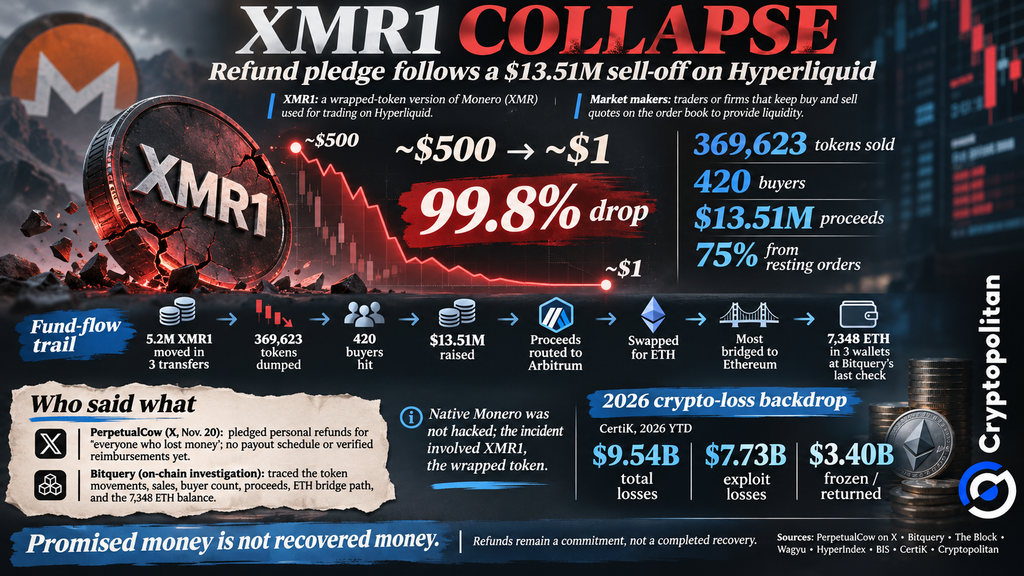
On November 20, Wagyu operator PerpetualCow pledged to personally refund investors affected by the 99.8% plunge of XMR1 on Hyperliquid. Bitquery tracked $13.51 million in trades related to the dump. The figures show the seller’s receipts and not confirmed losses that the investors incurred. No payment plan or verified payments have been announced yet.
XMR1 is a wrapped token version of Monero (XMR) enabling users to transact via Wagyu’s one-for-one bridge. At the time of writing, the website of this service said that the platform was temporarily unavailable.
From market makers to everyone who lost money
At first, PerpetualCow claimed that market makers incurred the majority of losses since they kept buying XMR1 in the course of the sell-off. Market makers are traders or firms that post buy and sell quotes to keep trading active.
He subsequently broadened his pledge concerning refunds to “everyone who lost money.” PerpetualCow declared that he would be responsible for the refunds at his own cost before launching Wagyu again. However, he did not provide any timetable for those actions.
Post-mortem of the $13m XMR hack:
It’s WORSE than I thought.
Turns out that the entire hosting provider of https://t.co/skXiWey4Fb got hacked with everyone’s data + internal server files today.
The XMR1 deployer key was held on an OLD server on there that I DELETED, but…
— PerpetualCow.hl (@PerpetualCow) November 20, 2026
What Bitquery traced, and what it did not
Bitquery reported on November 20 that three transfers, totaling 5.2 million XMR1, had occurred and were completed from the deployer account to a newly created address. The receiving address sold 369,623 tokens to 420 different buyers, generating $13.51 million from XMR1 at the same time that it fell from around $500 to $1.
After making the sale of the tokens and receiving the money from it, the seller transferred the proceeds to Arbitrum, exchanged them for ETH, and moved almost all of them to Ethereum. As per a follow-up from Bitquery, there were still 7,348 ETH left in the three wallets. About 75% of the $13.51 million came from buy orders already on the market.
Although the transactions are visible on-chain, information on the cause of the incident remains unclear. PerpetualCow alleged that someone stole the deployer key and pledged to refund those affected. Bitquery tracked the fund movements but was not able to determine how the deployer key was obtained. The Block also clarified that the incident affected wrapped XMR1 and not native Monero.
The deleted server and the Icelandic host
PerpetualCow claimed the stolen key had been stored in files or logs on a deleted server at Icelandic hosting provider 1984. On November 20, DV reported that 1984 and Iceland’s cybersecurity team, CERT-IS, had confirmed a sophisticated cyberattack. The company suspended its services in response.
However, neither 1984 nor CERT-IS confirmed that the breach was connected to the XMR1 incident.
Thin liquidity and the wrapped-token tradeoff
Beyond the suspected key theft, the XMR1 sell-off raised concerns about liquidity on Hyperliquid. HyperIndex found that median order-book depth had fallen 82% across the exchange’s smaller markets, compared with 61% on Binance and 78% on OKX. When fewer orders are available to absorb a large sell-off, market makers face greater losses.
The incident also highlights the risks of wrapped tokens. A July Bank for International Settlements bulletin warned that cross-chain bridges make transactions easier but introduce new security and operational risks. If PerpetualCow’s account is confirmed, Wagyu’s stolen key would be an example of that vulnerability.
Promised money is not recovered money
The wider crypto market continues to face substantial security losses. According to CertiK, losses reached $9.54 billion in 2026, including $7.73 billion from exploits. Another $3.40 billion was classified as frozen or returned, although frozen funds do not necessarily reach victims.
A previous NEAR Intents incident shows how recovery can unfold differently. Cryptopolitan reported that the attacker returned the full $3.8 million after negotiations, following an earlier promise to reimburse affected users.
Wagyu has yet to reach that point. PerpetualCow has promised refunds, but there is still no confirmation that XMR1 holders have received any money.
Don’t just read crypto news. Understand it. Subscribe to our newsletter. It’s free.
This articles is written by : Nermeen Nabil Khear Abdelmalak
All rights reserved to : USAGOLDMIES . www.usagoldmines.com
You can Enjoy surfing our website categories and read more content in many fields you may like .
Why USAGoldMines ?
USAGoldMines is a comprehensive website offering the latest in financial, crypto, and technical news. With specialized sections for each category, it provides readers with up-to-date market insights, investment trends, and technological advancements, making it a valuable resource for investors and enthusiasts in the fast-paced financial world.