
Two studies conducted in November have determined the amount of cryptocurrencies subject to a possible future quantum threat: around 42 million ETH and 7.16 million BTC. These are not figures indicating thefts that are taking place right now. Rather, they show the extent of the upgrades the entire industry must do to ensure its security.
The main question for industry participants such as exchanges, custodians, and investors is the expenses connected with these upgrades, as well as its implications for transaction fees, liquidity, and market confidence.
What an exposed public key actually means
When a user first initiates an Ethereum transaction, they provide enough data in their digital signature for someone to derive their public key from the transaction data. The public key can be mathematically linked to the private key which is required to approve the transactions made by the user. In research conducted by the University of Pittsburgh and Chicago-based security firm SeQure, the researchers have identified a potential risk associated with this connection between the public key and private key. A powerful quantum computer can use Shor’s algorithm to reverse engineer the keys and steal funds from the user’s wallet.
Accounts that have never signed transactions are less vulnerable. As Ethereum explains, these accounts’ addresses show only a hash of their public keys.
The threat of compromised private keys can already be witnessed as the proof is visible even before quantum computers are introduced. An August 2026 USENIX study has recorded monetary losses related to compromised keys and other misuse of blockchain addresses.
Why the ETH and BTC estimates aren’t the same yardstick
The Ethereum and Bitcoin estimates are not directly comparable. Researchers used different methods to measure how much cryptocurrency is exposed to future quantum attacks.
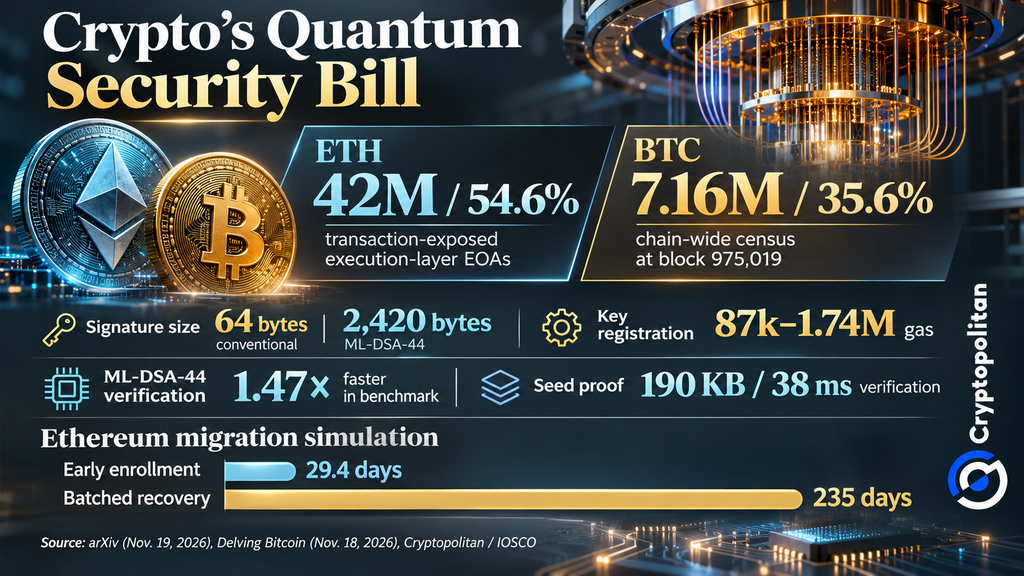
The Ethereum study focused on externally owned accounts (EOAs), which are controlled by private keys rather than smart contracts. Accounts that have revealed their public keys through transactions hold around 42 million ETH. This represents 54.6% of the ETH on Ethereum’s execution layer.
With regard to Bitcoin, a census published on November 18 investigated the blockchain up to block 975,019. It found that around 7.16 million BTC are retained in transactions with exposed public keys or spending scripts. This represents 35.6% of the total unspent Bitcoins.
According to Glassnode, a blockchain analytics firm, the amount of Bitcoin vulnerable to future quantum attacks has increased from 6.04 million BTC in May to 7.12 million BTC on November 10.
Ethereum’s two-speed migration, in days
Given that millions of ETH are in accounts with exposed public keys, Ethereum has to find ways to move these funds to quantum-resistant storage as quickly as possible. How quickly the network can move the funds may depend on when account owners act.
The Pittsburgh-led study proposes allowing users to register quantum-resistant keys before Ethereum retires its current signature system. Those who miss the deadline could still recover their accounts by providing cryptographic proof of ownership using their wallet’s recovery phrase.
The researchers simulated the migration of 4.45 million accounts holding at least 0.1 ETH. If all owners registered early, the migration would take 29.4 days. If everyone opted for recovery after the deadline, the process would take 235 days.
The main constraint was the space available in each block. Each recovery proof required about 190 KB of data but took only 38 milliseconds to verify.
The goal of the Ethereum roadmap is to achieve complete quantum resistance by December of 2029. To improve the speed of realization of this goal, Ethereum developers talked about downsizing the Hegotá upgrade in the meeting held on November 19.
Bitcoin’s draft fix is narrower by design
Bitcoin is considering a more gradual approach to quantum protection. The proposed BIP-360 introduces Pay-to-Merkle-Root, a new way to secure bitcoin without exposing public keys when funds are received.
However, public keys could still be revealed when users spend their bitcoin. Protecting transactions from quantum attacks while they await confirmation would require additional changes to Bitcoin’s signature system.
Coinbase, which says it holds around 12% of Bitcoin’s supply, has suggested a gradual transition that would allow users to transact using either conventional or quantum-resistant signatures.
Where the cost actually shows up
One of the biggest challenges in adopting quantum-resistant signatures is their size. A conventional elliptic-curve signature requires about 64 bytes. ML-DSA-44, a standardized quantum-resistant alternative, requires 2,420 bytes.
Larger signatures do not necessarily take longer to verify. In one benchmark, ML-DSA-44 verification was 1.47 times faster than Ethereum’s conventional ECDSA signature verification.
Registering new keys, however, could be costly. As Cryptopolitan reported, research tests on Ethereum recorded registration costs ranging from 87,000 to 1.74 million gas units.
On November 19, the International Organization of Securities Commissions warned that larger signatures could reduce network capacity and raise transaction fees. One experimental Solana testnet recorded a roughly 90% drop in transaction processing capacity. However, the results do not necessarily reflect how Solana’s main network would perform.
Financial institutions also have a lot of work to do. The risk assessment done by the European Banking Authority in November revealed that just 8% of the banks surveyed have successful plans for transition to quantum-resistant cryptography.
For exchanges and custodians, the challenge extends beyond upgrading their security systems. Moving large amounts of cryptocurrency at the same time could drive up settlement costs. Market liquidity could also suffer if substantial holdings become temporarily inaccessible.
If you’re reading this, you’re already ahead. Stay there with our newsletter.
This articles is written by : Nermeen Nabil Khear Abdelmalak
All rights reserved to : USAGOLDMIES . www.usagoldmines.com
You can Enjoy surfing our website categories and read more content in many fields you may like .
Why USAGoldMines ?
USAGoldMines is a comprehensive website offering the latest in financial, crypto, and technical news. With specialized sections for each category, it provides readers with up-to-date market insights, investment trends, and technological advancements, making it a valuable resource for investors and enthusiasts in the fast-paced financial world.