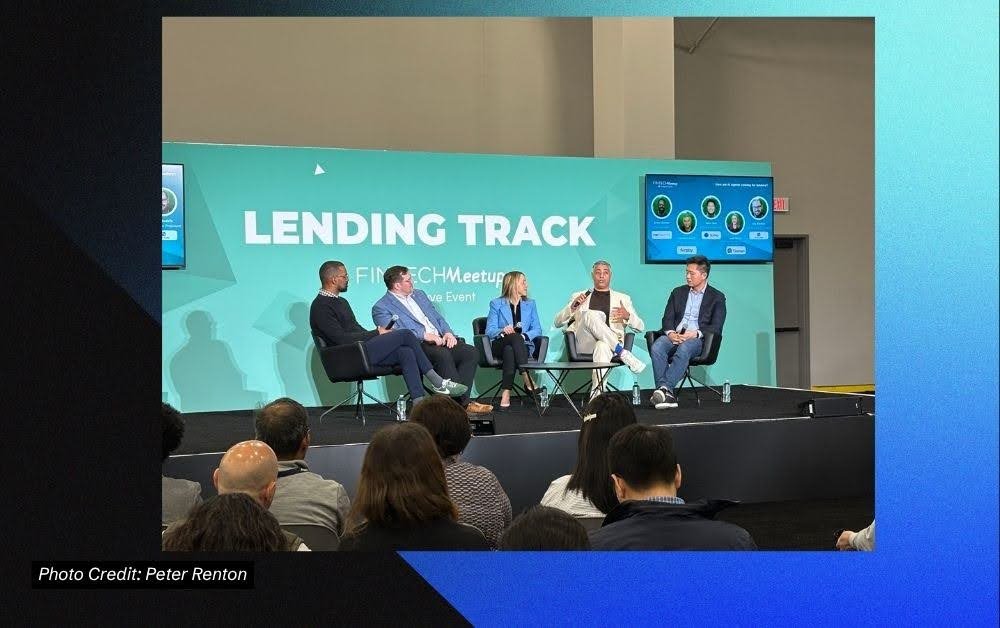
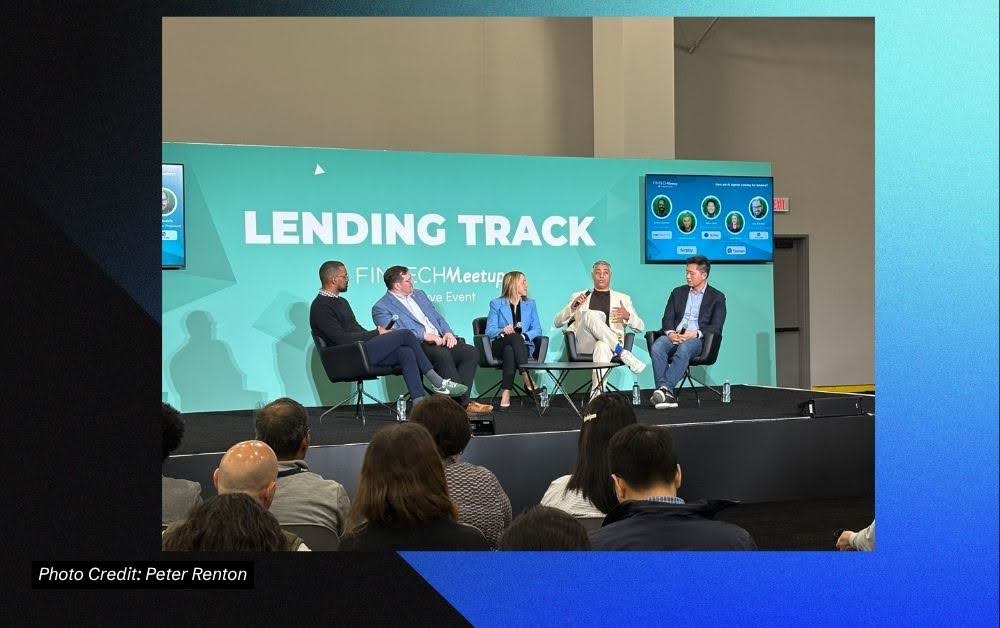
Last week, I spent three days in Las Vegas attending Fintech Meetup and it was an epic show. Most of my time was consumed by the Lending Track, because I organized it, but I also caught some of the keynotes, did a breakfast Table Talk, and, of course, had plenty of one-on-one meetings.
As you can imagine, there was talk of AI everywhere but it was interesting to me that there was less talk of the potential of AI and much more talk about the practical realities of AI. Of course, the expo floor was filled with companies touting the latest AI solutions but in the conversations I had, people have moved on from the hype to a focus on what AI can do for my bank, credit union or fintech today.
Cash Flow Underwriting Has Arrived
On the lending track, there was probably more talk about cash flow underwriting than there was even about AI. For years, cash flow underwriting has been the technology that was always about to go mainstream. At this event, it was clear the “about to” phase is completely over and lenders of all stripes have gone from looking to doing.
“I’m not certain that cash flow data should be characterized as alternative data at all,” said Jason Rosen, the CEO of Prism Data, who has been building cash flow infrastructure since 2016. He’s right. Analyzing a borrower’s income, expenses, and savings to assess creditworthiness isn’t alternative, it actually predates the credit score. What’s (relatively) new is automating it at scale using open banking data and machine learning.
The latest generation of cash flow scores now outperforms traditional credit scores on a standalone basis and improves underwriting accuracy by roughly 30% when layered on with bureau data. The insight that landed hardest in the room was that these data sources are genuinely orthogonal: cash flow captures real-time ability to pay, while the bureau captures historical propensity to pay. They measure different things entirely.
Three forces converged to bring this moment. Open banking APIs matured. Compliance teams recognized that cash flow data corrects for historical bias in traditional scoring. And the predictive power became undeniable. Three of the top five US fintech lenders are now using cash flow scores as a primary underwriting input. Banks and credit unions are moving through pilots fast. Post-origination is the next frontier: real-time cash flow analytics for credit line management, cross-sell, and early collections intervention.
The Applicants Have Changed
One of the sessions that I moderated, was a case study titled, What separates winning fintech lenders from the rest? with Joe Breeden, the CEO of Deep Future Analytics. He has spent three decades studying what makes lending portfolios succeed or fail. His message was blunt: the borrowers applying for credit today are not the same borrowers who were applying five years ago, and most lenders have not adjusted.
“Adverse selection has been extraordinarily bad,” he said of the last two to three years. “The applicants have shifted. They’re not the usual applicants.” The mechanism is intuitive once you hear it. When interest rates doubled in 2022, the financially savvy borrowers, the ones who pay attention to pricing, stepped back. They remembered the lower rates. They didn’t like the rate increases. What remained was a pool of applicants who are less rate-sensitive, less financially sophisticated, and ultimately riskier at the same FICO scores.
The scale of the impact is striking. “A 720 is performing like a 670 because you don’t have those savvy borrowers in the market,” said Breeden. That’s roughly 50 FICO points of adverse selection. And it doesn’t show up in traditional performance metrics until it’s too late (this is another place where cash flow underwriting can make a big difference). Breeden drew a direct line to 2006, when he saw the same pattern emerge and forecasted ten-fold loss increases two to three years out for institutions that didn’t adjust. Some of those institutions no longer exist.
This is not a theoretical risk. It is a portfolio management reality happening right now, and the lenders who understand it are already repositioning.
AI Agents to Make Loan Applications Disappear
Another one of my favorite sessions was, How are AI agents coming for lenders? Now, this one, given the title did have more of a future focus than the other sessions and it was illuminating to hear the panel of AI experts debating how AI agents are reshaping the lending experience from origination to servicing. The central tension was between speed and control. Agents are already processing documents, conducting outbound collections calls, and performing underwriting, but the governance frameworks designed for traditional models don’t fit systems that produce ideas and recommendations rather than scores.
The panel agreed that lending is moving toward intent-based experiences where consumers declare what they want and agents go execute, but disagreed on how fast brand loyalty will erode in that shift. One of the more striking real-world examples: Fifth Third Bank now requires the machine to underwrite every borrower before a human can deny credit, and it’s catching cases the humans miss.
But the quote that stuck with me was from Kareem Saleh, the CEO of FairPlay AI. When talking about the future of lending he said, “We will not apply for loans anymore. We will just declare intent.” He went on to describe the situation of a future car buyer who could say, “Buy me an SUV with a payment that’s less than 500 bucks a month” and your agent is going to go off and source that car and negotiate that deal and execute the financing. But we are likely several years away from that becoming mainstream.
Efficiency Gains in Small Business Lending
As someone who has long championed the SMB space, the session on whether it remains fintech’s “biggest missed opportunity” felt particularly personal. The speakers made a compelling case that small business lending remains fintech’s biggest unsolved problem not because the technology is missing but because the economics have been broken for years.
As Mickey Konson, CEO of Quantum Financial Technologies, shared, “the dominant fintech SMB product today is a 90-day loan at roughly 60% APR, a product that keeps businesses alive but doesn’t actually set them up for success.” Customer acquisition costs of 5 to 15% make it very difficult to offer affordable longer-term products, and the underwriting cost for a $50,000 loan is often not that different to a $5 million loan.
The panel was cautiously optimistic that AI is finally changing this math, collapsing qualification timelines from 30 days to hours, enabling agentic workflows that replace manual underwriting tasks at near-zero cost, and unlocking better risk precision through open finance and transaction data. Embedded lending addresses the distribution problem by meeting businesses where they already operate, but Konson pushed back on the idea that it alone is the answer. The real test, the panel agreed, is whether the industry will use these cost savings to offer products small businesses better lending products.
My favorite quote of the session was also from Konson, “A small business loan has all of the complexity of the commercial loan, but it has the margins of a consumer loan.” This perfectly encapsulates the challenges that small business lenders have had in building profitable businesses. But the work being done on the data layer shows tremendous promise as AI is well suited to work on the complexity issue.
While I spent the bulk of my time on the lending track, there was plenty of action in the four other stages. Stablecoins seemed to be talked about everywhere except on the lending stage and the Digital Assets Series was standing room only. There was a lot of talk about compliance across the show, with the recognition that, despite the more openness to innovation at the Federal level, now is not the time to skimp on governance.
A Revealing Conversation at the Breakfast Table Talks
One of the surprises for me was how useful the Table Talks sessions were. There were peer to peer discussions of around 10 people focused on one specific topic. I attended a breakfast Table Talks session on AI on the morning of day three and it was the highlight of the whole event for me.
It was great to have an unfiltered discussion (these were off the record) with people who were both using AI at banks and credit unions and those people who were providing AI solutions.
One attendee was the CTO of a credit union and he was completely focused on what AI can do to help his credit union grow. He is not even thinking about laying off anyone, he wants to see how he can use the technology to build deposits and provide more loans while also providing better support for his members.
There was a general agreement that layoffs in financial services due to AI efficiencies are premature and that the promised savings are not coming as quickly as expected. But there remained an excitement about the future of AI implementations and the transformations that will be possible.
Meetings, Meetings and More Meetings
The real differentiator of Fintech Meetup is its meetings program. It is the biggest and best program in the industry and it didn’t disappoint. The double opt-in meant that the meetings were only with people who were genuinely interested in each other and in 15 minutes you could easily ascertain whether a deeper conversation was warranted.
Even in the afternoon of day three the meetings area was humming. I spoke to several people over the course of the three days who raved about the meetings program, including one new fintech founder, who said the three days he spent at Fintech Meetup were the best three days of his career.
After sixteen years covering this industry, and several dozen large fintech events, I know how to ascertain the mood of an event. What felt different this year was the lack of hype, particularly among the attendees. While the expo floor was teeming with AI companies offering the latest in transformational Agentic AI, the typical attendee was not buying the hype.
The mood has flipped from “isn’t this tech amazing” to “how can this actually help the operations of my business today.” This flipping point is not somewhere ahead of us. It was in the room this past week.
The industry hasn’t lost its ambition, it has simply found its pragmatism. In 2026, the question is no longer “What is possible?” but “What is profitable?”
Last week, I spent three days in Las Vegas attending Fintech Meetup and it was an epic show. Most of my time was consumed by the Lending Track, because I organized it, but I also caught some of the keynotes, did a breakfast Table Talk, and, of course, had plenty of one-on-one meetings. As you can imagine, there was talk of AI everywhere but it was interesting to me that there was less talk of the potential of AI and AI, Fintech, Home, News, Popular
This articles is written by : Nermeen Nabil Khear Abdelmalak
All rights reserved to : USAGOLDMIES . www.usagoldmines.com
You can Enjoy surfing our website categories and read more content in many fields you may like .
Why USAGoldMines ?
USAGoldMines is a comprehensive website offering the latest in financial, crypto, and technical news. With specialized sections for each category, it provides readers with up-to-date market insights, investment trends, and technological advancements, making it a valuable resource for investors and enthusiasts in the fast-paced financial world.