
Algorand has emerged as an early standout in the crypto market’s latest quantum security debate after a recent Google Quantum AI paper highlighted the blockchain as a live example of post-quantum cryptography being deployed on a network.
The attention came as the paper sharpened concerns around Bitcoin and Ethereum, two networks whose size, age, and design choices could make any future migration to quantum-resistant infrastructure slower and more complicated.
Against that backdrop, Algorand’s quieter work on Falcon digital signatures, state proofs, and key rotation suddenly looked less like a niche technical experiment and more like a practical head start.
The shift in attention helped lift Algorand’s token sharply over the past week, with traders treating the Google paper as validation of work already underway on the network.
According to CryptoSlate’s data, ALGO, the blockchain network’s native token, is one of the top performers over the past week, gaining around 50% to rise to $0.12 as of press time. Notably, the price performance came less than a week after the token fell to an all-time low of $0.08.
Algorand’s quiet quantum computing lead over Bitcoin and Ethereum
Algorand’s advantage over Bitcoin and Ethereum is narrower than the recent enthusiasm suggests, but it is also more concrete than what many larger chains can currently show.
In its paper, Google described Algorand as an example of real-world deployment of post-quantum cryptography on an otherwise quantum-vulnerable blockchain.
The distinction was important. It did not say Algorand had solved the problem end-to-end, but it did point to a network that had moved from theory into live implementation.
Algorand’s core consensus and built-in transactions still rely on Ed25519, which remains vulnerable in a sufficiently advanced quantum scenario.
However, the network has already deployed Falcon digital signatures for smart transactions and state proofs, the cryptographic attestations used to verify blockchain state across chains. It has also made Falcon verification available as a primitive for developers building on the Algorand Virtual Machine, giving the ecosystem a working set of tools rather than just a roadmap.
The network executed its first post-quantum-secured transaction in 2025, a milestone that set it apart from many larger rivals that are still debating design paths, governance trade-offs, and implementation timelines.
Algorand also allows users to rotate the private keys associated with their accounts, a feature that does not eliminate the underlying threat but could make future migrations more manageable.
That combination, live transaction capability, developer tooling, state-proof support, and native key rotation, is what turned Algorand into a focal point as the paper circulated through the market.
In a sector where many conversations around quantum risk remain theoretical, Algorand could point to infrastructure already in production.

Bitcoin and Ethereum face quantum computing risk
For Bitcoin, the concern is not only whether quantum computers will eventually be able to derive private keys from public information, but also how much of the network’s legacy footprint would be difficult to migrate in time.
The paper said a quantum computer with fewer than 500,000 physical qubits could crack the elliptic-curve cryptography protecting Bitcoin wallets, a far lower threshold than earlier estimates that ran into the millions.
Google’s own most advanced chip, Willow, remains far below that level, but the revised estimate has intensified scrutiny of how much Bitcoin could be exposed if the technology advances faster than expected.
The burden is particularly acute because some of Bitcoin’s oldest addresses keep public keys visible on-chain.
The paper cited an estimated 6.7 million BTC in older Pay-to-Public-Key addresses, including coins long associated with Bitcoin creator Satoshi Nakamoto.
Even outside those legacy wallets, the migration challenge is politically and technically heavy for a network that prioritizes backward compatibility and moves cautiously on base-layer changes.
Quantum risk, in Bitcoin’s case, is as much a governance and coordination problem as it is a cryptographic one.
Meanwhile, Ethereum’s exposure to the same quantum computing risk is somewhat broader.
Once an Ethereum user sends a transaction, the public key tied to that account becomes permanently visible on-chain. The paper said that this leaves the top 1,000 Ethereum wallets, holding roughly 20.5 million ETH, exposed under a sufficiently advanced quantum attack.
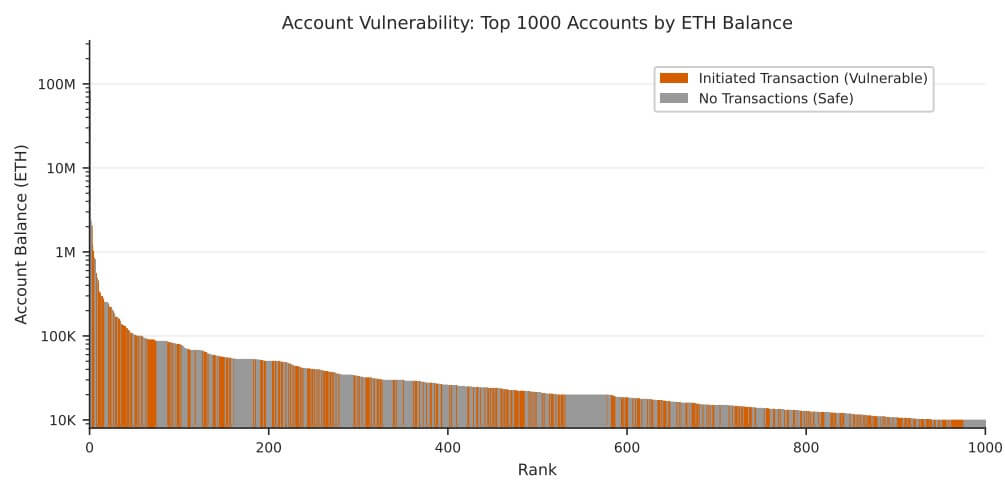
It also identified at least 70 major contracts with administrator keys visible on-chain, which ultimately control far more than the ETH they directly hold, including stablecoin minting authority and other system-critical permissions.
Moreover, the attack surface extends beyond wallets and contract administrators.
Ethereum’s proof-of-stake validator set, major Layer 2 networks, and parts of its data-availability architecture all rely on cryptographic components the paper described as vulnerable.
According to the paper, roughly 37 million ETH is staked, and much of Ethereum’s transaction load now flows through rollups and bridges that inherit assumptions from the base layer.
That means any serious post-quantum migration would have to reach not only users and validators, but also the network of applications and scaling systems built around them.
The post Algorand just jumped 50% after a Google flags quantum risk for Bitcoin and Ethereum appeared first on CryptoSlate.
Algorand has emerged as an early standout in the crypto market’s latest quantum security debate after a recent Google Quantum AI paper highlighted the blockchain as a live example of post-quantum cryptography being deployed on a network. The attention came as the paper sharpened concerns around Bitcoin and Ethereum, two networks whose size, age, and
The post Algorand just jumped 50% after a Google flags quantum risk for Bitcoin and Ethereum appeared first on CryptoSlate. Featured, Market, Quantum, Technology, TradFi, Trading, ALGO, Algorand, Bitcoin, ethereum
This articles is written by : Nermeen Nabil Khear Abdelmalak
All rights reserved to : USAGOLDMIES . www.usagoldmines.com
You can Enjoy surfing our website categories and read more content in many fields you may like .
Why USAGoldMines ?
USAGoldMines is a comprehensive website offering the latest in financial, crypto, and technical news. With specialized sections for each category, it provides readers with up-to-date market insights, investment trends, and technological advancements, making it a valuable resource for investors and enthusiasts in the fast-paced financial world.