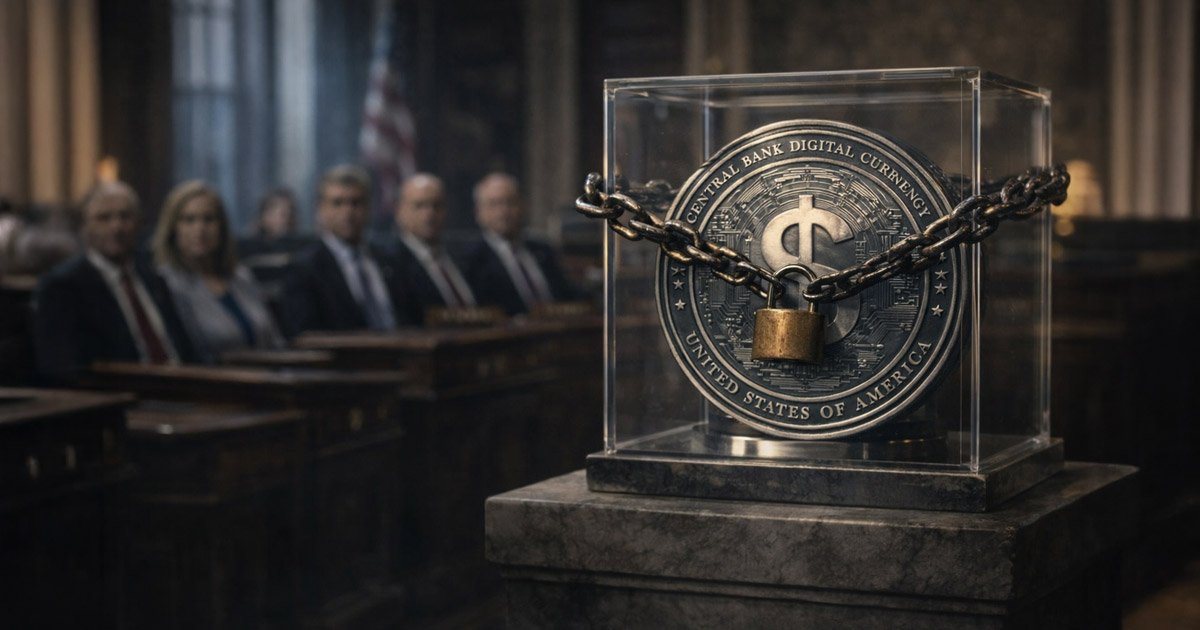
Washington has spent years talking about a US CBDC as a distant possibility. It was an abstract policy idea, safely contained inside white papers and partisan messaging. But then the Senate put a number on it and made it very real.
On March 2, senators voted 84-6 to invoke cloture on the motion to proceed to H.R. 6644, a broad housing and banking package that would bar the Federal Reserve from issuing a CBDC until the end of 2030.
Only six senators voted no. Cory Booker voted present, and nine senators did not vote.
That margin meant that a CBDC stopped being a crypto-policy side fight. CBDCs are now at the center of every Senate-floor fight over privacy, state reach, and control.
The procedural caveat still matters to the legal reading of the vote. March 2 wasn’t the final passage, and the roll call doesn’t prove that the six holdouts actually support a Fed digital dollar.
However, it shows that a Senate supermajority was comfortable advancing a package that includes anti-CBDC language.
The six holdouts, and what their votes actually show
The six senators who voted no were Ron Johnson of Wisconsin, Mike Lee of Utah, Chris Murphy of Connecticut, Rick Scott of Florida, Tommy Tuberville of Alabama, and Chris Van Hollen of Maryland.
All of them voted against moving H.R. 6644 forward at that stage, inside a package that stretches well beyond digital-money policy.
- Ron Johnson (R-Wis.). Wisconsin Republican first elected in 2010. Johnson’s Senate biography centers on manufacturing, fiscal policy, and oversight work, and he has held senior roles on Budget and investigations-related committees.
- Mike Lee (R-Utah). Utah Republican first elected in 2010. Lee has built much of his public identity around constitutional structure, civil liberties, and limits on federal power, which makes his inclusion in this six-senator bloc especially notable in a fight over state control of money.
- Chris Murphy (D-Conn.). Connecticut Democrat and one of only two Democrats in the March 2 no bloc. Murphy is better known nationally for foreign policy and gun legislation than for crypto or payments debates, which leaves room for multiple readings of his vote absent a direct office explanation.
- Rick Scott (R-Fla.). Florida Republican and former governor, elected to the Senate in 2018. Scott’s vote stood out because anti-CBDC politics have often found a particularly friendly home among Florida Republicans.
- Tommy Tuberville (R-Ala.). Alabama Republican elected in 2020. Tuberville still carries the “Coach Tuberville” nickname from his long football career, and he joined the small group that broke from the larger Senate wave on March 2.
- Chris Van Hollen (D-Md.). Maryland Democrat and the second Democrat in the no bloc. Van Hollen serves on the Senate Banking Committee, which gives his vote added weight inside a package that blends housing, finance, and CBDC language.
H.R. 6644’s size and breadth are the reason a simple ideological scorecard doesn’t quite fit here.
The anti-CBDC provision sits inside the “21st Century ROAD to Housing Act,” and the substitute amendment goes well beyond digital currency.
The package includes housing-supply and affordability measures, disaster-recovery block grant structures, rural housing data, modernization provisions, and support aimed at manufactured housing communities.
In other words, none of these senators were voting on a single-question referendum on a Fed digital dollar, but on whether to move a much larger package onto the floor.
Why the CBDC language is bigger than the roll call
Still, the CBDC language is uncharacteristically direct.
The Senate amendment defines a CBDC as a digital asset denominated in US dollars, treated as US currency, carried as a direct liability of the Federal Reserve System, and widely available to the general public.
It then says the Fed Board or any Federal Reserve Bank may not issue or create such a currency, or a substantially similar digital asset, either directly or indirectly. The provision sunsets on Dec. 31, 2030.
That sunset date shows that Congress wants to fence off this issue for the rest of this decade, not settle the issue of digital dollars forever.
But the Fed’s own stance towards CBDC makes this entire effort almost obsolete.
The Federal Reserve has publicly said it made no decisions on issuing a CBDC. In a 2022 paper, it laid out strict requirements for any potential CBDC in the US, but noted that it doesn’t authorize direct Fed accounts for individuals.
A later research note repeated that point, saying that the central bank doesn’t intend to proceed with a CBDC without clear support from the executive branch and Congress, in the form of a specific authorizing law.
So, senators are now moving to block a form of money that the Fed says it has chosen not to issue and couldn’t issue on its own anyway. This makes the vote an effort to settle the ground rules early, while the idea of CBDCs is still abstract enough to shape and controversial enough to gain support.
When it comes to the effects this will have on the crypto industry, the interesting part starts here.
Every harder line against a government-backed digital dollar sends attention back toward private-sector dollar rails: bank deposits, tokenized deposits, exchange cash infrastructure, and stablecoins.
CryptoSlate has already tracked different pieces of that argument.
When the House passed its own anti-CBDC bill in 2024, it was an attempt to stop unelected officials from building a digital dollar without explicit congressional authorization. More recently, CryptoSlate’s report on whether stablecoins can become “CBDCs in disguise” pushed the debate one step further, arguing that private digital dollars can carry many of the same control levers people fear in a state-issued version.
Kraken gaining a direct link to Federal Reserve payment rails made the same point, but in operational terms: whoever controls access to dollar settlement controls far more than branding.
Access shapes speed, resilience, predictability, and competitive advantage. That’s part of the same Washington fight, only viewed from the infrastructure side rather than the Senate floor.
The same policy logic runs through the White House’s stablecoin timetable slipping and the Senate’s broader CLARITY Act gridlock. Washington is trying to decide what kind of digital-dollar system it wants, who gets to operate it, and how far federal control should reach into the machinery. The CBDC vote sits neatly inside that bigger struggle.
Then came the follow-through. On March 4, the Senate agreed to the motion to proceed by 90-8.
That second vote gave the March 2 result a second anchor point, as it showed it wasn’t just a one-day spike built around an 84-6 split. We can now see that the second vote is the proof of real floor momentum behind a package carrying anti-CBDC text.
While the six holdouts make this an interesting partisan debate, the bigger story is with the 84 who helped pull anti-CBDC language into the center of Senate politics, and with the broader message behind that vote. Washington wants the digital-dollar argument constrained before the Fed ever gets close to testing how far it can go.
The post The six senators who voted against the March digital dollar ban: Johnson, Lee, Murphy, Scott, Tuberville, and Van Hollen appeared first on CryptoSlate.
Washington has spent years talking about a US CBDC as a distant possibility. It was an abstract policy idea, safely contained inside white papers and partisan messaging. But then the Senate put a number on it and made it very real. On March 2, senators voted 84-6 to invoke cloture on the motion to proceed
The post The six senators who voted against the March digital dollar ban: Johnson, Lee, Murphy, Scott, Tuberville, and Van Hollen appeared first on CryptoSlate. Analysis, CBDCs, Featured, Regulation, CBDC, Congress, Digital dollar, fed, federal reserve, H.R. 6644, senate
This articles is written by : Nermeen Nabil Khear Abdelmalak
All rights reserved to : USAGOLDMIES . www.usagoldmines.com
You can Enjoy surfing our website categories and read more content in many fields you may like .
Why USAGoldMines ?
USAGoldMines is a comprehensive website offering the latest in financial, crypto, and technical news. With specialized sections for each category, it provides readers with up-to-date market insights, investment trends, and technological advancements, making it a valuable resource for investors and enthusiasts in the fast-paced financial world.