
Do you know what happens to the data and traces you leave behind on your PC and smartphone during your online activities? If not, you are in good company.
The majority of people fear losing track of their personal data. But instead of just burying your head in the sand, take back control.
Our guide takes a pragmatic approach: you should by no means give up online use, but rather bring back previously used services and functions from the cloud to your local IT at home.
After all, much of what you have set up online for convenience at some point can be replaced again with virtually no restrictions. Time to say goodbye to the cloud!
Windows without a Microsoft account, only log in to the apps
For some time now, Windows setup has required an online account with Microsoft; in fact, the company no longer wants you to be able to use your PC without one.
The online requirement not only affects data protection, but can also lead to problems if you want to use Microsoft apps with a second account. But you can do without it.
When reinstalling the operating system, the mandatory online link can be deleted using the command
oobebypassnro or a USB installation stick modified with Rufus.
Our online guide to how to use Windows 11 without a Microsoft account explains, in more detail, both ways to do this.
It’s also possible to switch from online to local login later. Important: Before permanently deleting the Microsoft account, it’s always a good idea to back up the documents, images, and other content stored in it.
Tip: Even if you use your computer with a local account, you don’t have to completely do without Microsoft apps that require an online account.
If you cannot use an app without logging in, first start to log in to it. In the next window, click on the Microsoft apps only option instead of Next and the system will continue to work locally.
The plural in “Apps” should be taken literally here, as signing in to a Microsoft app also applies to all other apps, including the cloud storage OneDrive.
To remove the apps-account link later, click on Accounts > Email and accounts in the Windows settings and on Remove > Yes under your online account on the right.
Secure access to all data at home without online storage
Cloud storage from Dropbox, Google, Microsoft and others is extremely practical because it synchronizes local files over the internet, making them available across all devices.
Everything is always up to date automatically and in the background. However, what happens to the data stored there is difficult to keep track of.
This is particularly true for the cloud-based image analysis of Google Photos, for example.
As an alternative to US providers, choose a cloud service that is guarantees personal data protections or one that is based in the EU that is subject to the strict European General Data Protection Regulation (GDPR).
Protection against unauthorized access to sensitive content—and therefore also against the cloud providers themselves—requires end-to-end encryption. It encrypts the files locally before they are transferred to the online server.
Unlike the previously popular Boxcryptor, Cryptomator also supports multiple cloud storages in parallel in the free version.
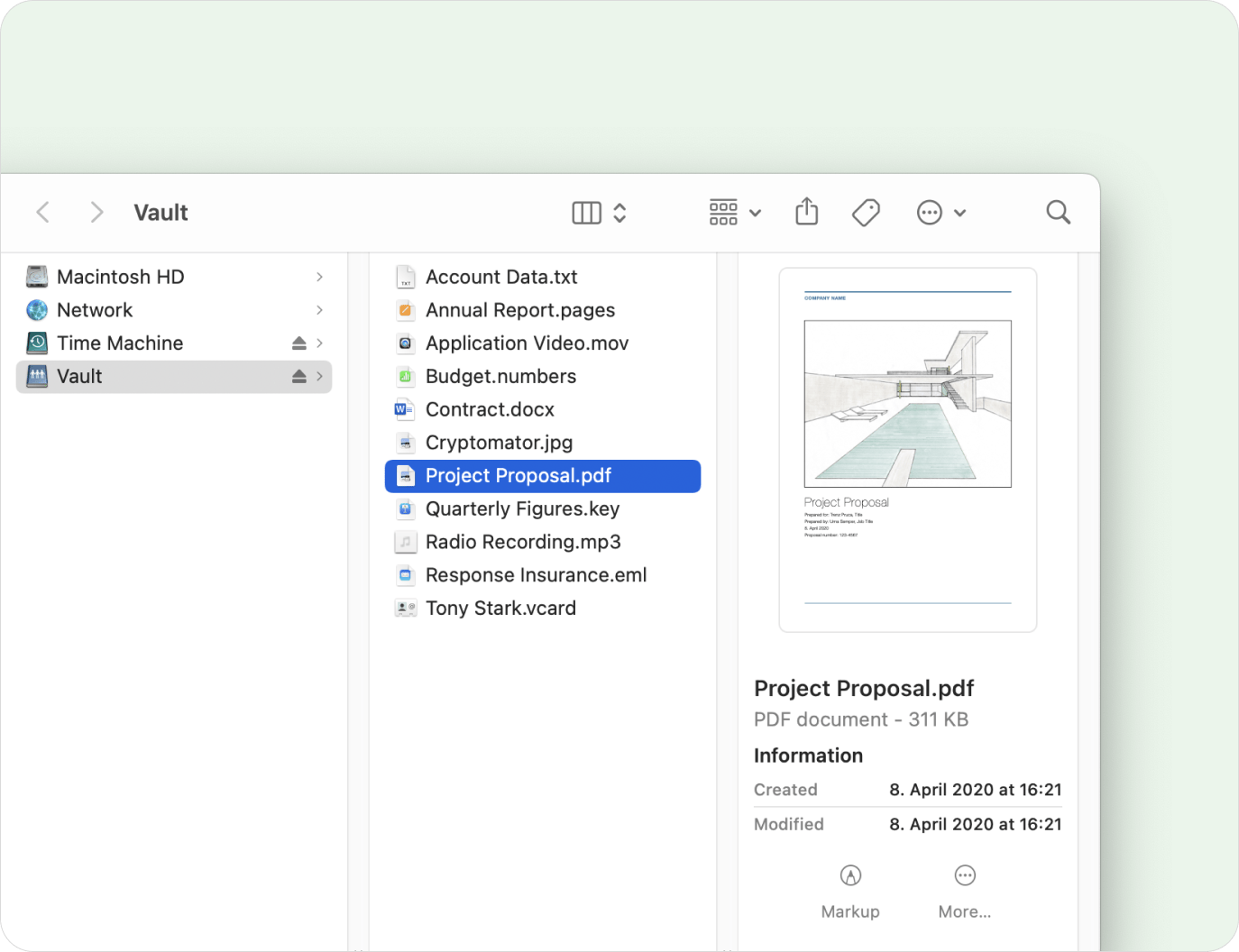
The open source tool Cryptomator can also be used to encrypt data in Dropbox, Google Drive, or Microsoft Onedrive cloud storage.
Cryptomator
The open source tool is easy to set up and use. To encrypt data stored online, select a directory in the cloud provider’s local synchronization folder as the storage location when setting up the vault.
You can also use a network hard drive (NAS) for online access to the data stored on it and the apps running on it.
The device manufacturers usually offer a separate option for NAS access without having to worry about firewall configuration or port forwarding.
Using a virtual private network (VPN), you can also remotely access the entire home network at home, including your smart home.
Upload photos from your mobile phone automatically on your computer without the cloud
What Microsoft offers for synchronizing smartphone images to a Windows PC beyond the clouds of Apple, Dropbox, Google, Microsoft and Co. is cumbersome, slow and therefore not very practical.
The classic transfer via cable works quickly, but not automatically. There’s no getting around plugging in the connection and transferring it on your mobile phone.
Tip: It is more convenient to transfer the recordings with the PC app Windows Photo Viewer using the “Import” function than via the file explorer.
In principle, wireless image transfer is also possible via Bluetooth. However, this is slow due to the large amounts of data involved, repeatedly falters, and is therefore not recommended.
You can find the function after pairing the PC and smartphone in the Windows settings under Bluetooth and devices > Devices > Send or receive files via Bluetooth > Receive files.
The faster WLAN alternative via the Smartphone Link app integrated in Windows again requires a Microsoft account though.
My Phone Explorer does this better; the tool transfers all images from the Android smartphone locally, offline, and quickly via WLAN. The prerequisite is that the mobile phone and Windows PC are on the same network (also via LAN cable) which thankfully, is practically always the case at home.
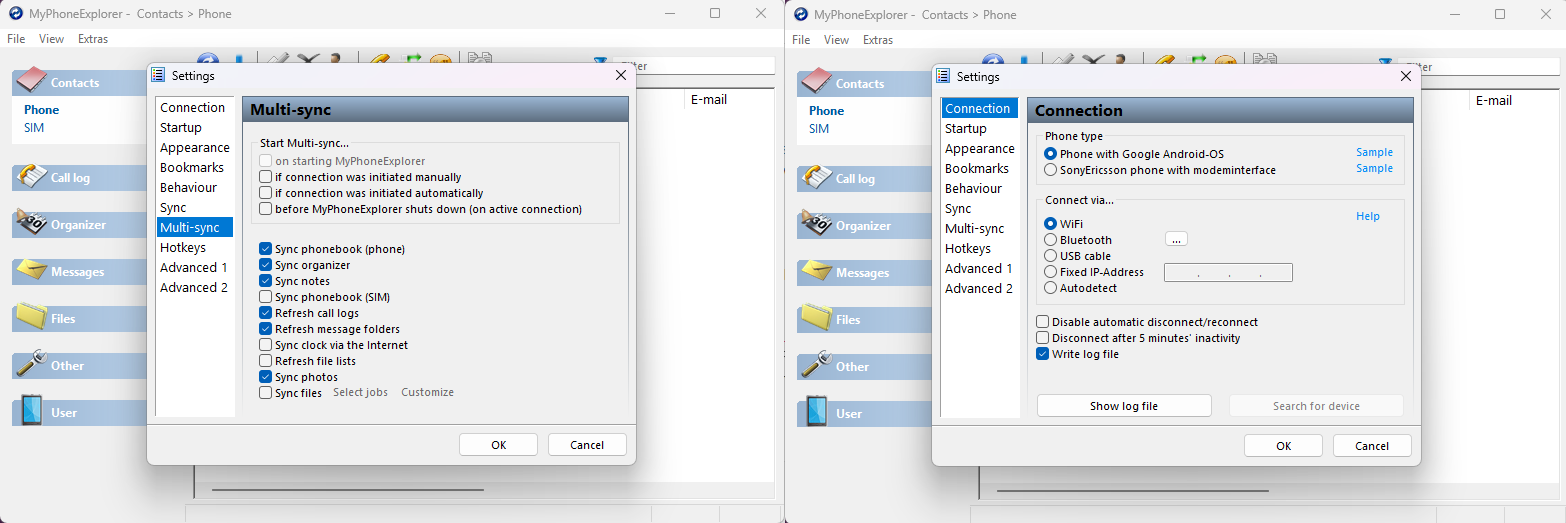
With just a few settings, you can configure the MyPhoneExplorer tool so that it automatically synchronizes new pictures from the smartphone to the Windows PC at home.
Sam Singleton
This is how it works: After installation on the computer, start My Phone Explorer and click on the blue Sync button.
In the setup wizard, activate the options Phone with Google Android-OS and WiFi and confirm with OK.
On the smartphone, install the My Phone Explorer Client app from the Google Play Store and authorize data access and display via other apps.
Start the mobile app and tap the QR code button in the top right-hand corner. Scan the QR code displayed on the PC in the setup wizard, authorize PC access to the phone and confirm again with OK.
The two devices are now permanently linked.
To use My Phone Explorer to automatically transfer your photos from the smartphone to the computer, click on File > Settings in the PC program.
Here you activate the the option on starting MyPhoneExplorer.
On the left under Multi-sync”, also activate the Sync photos entry and finish by clicking OK.
Every time you now start your computer, My Phone Explorer transfers the new photos to the picture directory on the local hard drive.
Further synchronization options can be found under Settings > Multi-sync > Sync files.
Streaming devices, fitness watches, surveillance cameras and more
Thanks to the apps provided by the device manufacturers, a network hard drive can be used for functions including playing locally stored music and videos.
Without a NAS, the media center software Kodi (formerly XBMC) is a good alternative. Kodi runs on various platforms, including Windows PCs and Raspberry Pi.
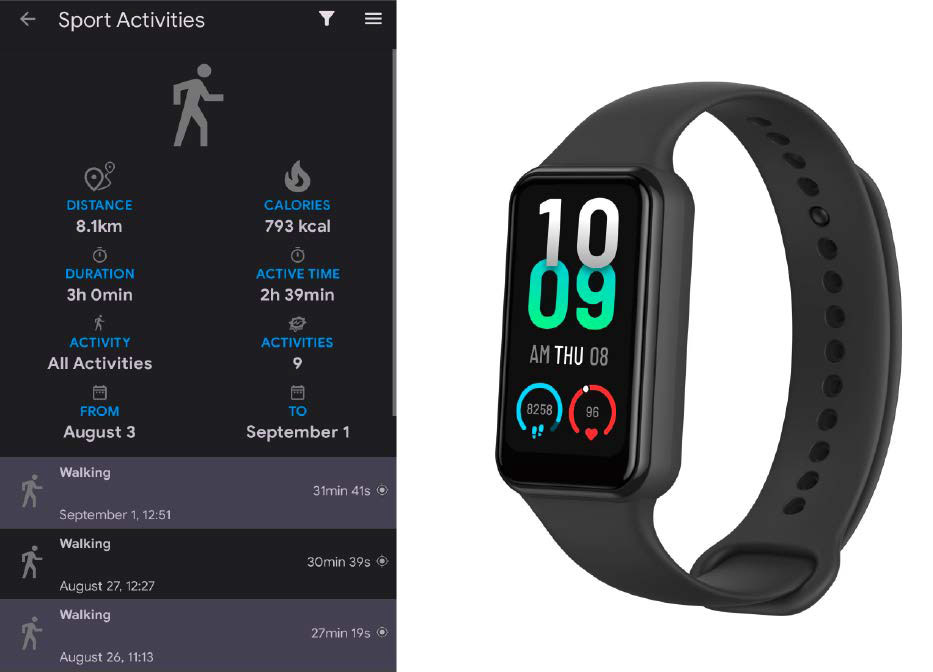
The Android app Gadgetbridge works entirely without the cloud and replaces the manufacturer apps of many sports, fitness and smart health devices such as the Amazfit Band 7 (right).
IDG
Whether smart home devices can be operated without the cloud depends on the specific device and manufacturer.
Surveillance cameras that record images and videos locally are available from Eufy, Reolink, and TP-Link, among others.
Many smart home or smart health devices, which involve particularly sensitive data, also work without a cloud, even though the manufacturer does not intend for them to do so.
On Android smartphones, the Gadgetbridge app replaces the official apps and therefore often replaces the cloud requirement.
Gadgetbridge processes all data locally on the mobile device and even allows you to change devices thanks to the import and export function.
Remember, the best way to avoid personal data on the internet is to not publish it in the first place, or at least to publish it sparingly.
Smartphones without Google
Because smartphones can now be used for almost everything and most people have them with them all the time, comprehensive user profiles can be created using the data collected: on interests, purchasing behavior, communication, movement, and much more.
“De-Googled” systems aim to prevent Android devices from sending data to Google so that you retain control over your data.
An easy-to-use alternative to the Google operating system is /e/OS.
The system offers its own app store and can be installed on over 200 phones, with the so-called Easy Installer available for some models.
There are even some smartphones with pre-installed /e/OS are also available to buy.
Another alternative—curiously only for Google’s own Pixel smartphones—is Graphene OS.
The current version is based on Android 15 and moves apps that require Google’s Play services and therefore extensive rights to the protected “Confidential profile” area.
If the confidential profile is only activated when necessary, the included apps do not run and therefore cannot send any data.
Both systems require some familiarization; their installation and operation are well documented on the Internet though if you wish to take the time to educate yourself.
This articles is written by : Nermeen Nabil Khear Abdelmalak
All rights reserved to : USAGOLDMIES . www.usagoldmines.com
You can Enjoy surfing our website categories and read more content in many fields you may like .
Why USAGoldMines ?
USAGoldMines is a comprehensive website offering the latest in financial, crypto, and technical news. With specialized sections for each category, it provides readers with up-to-date market insights, investment trends, and technological advancements, making it a valuable resource for investors and enthusiasts in the fast-paced financial world.