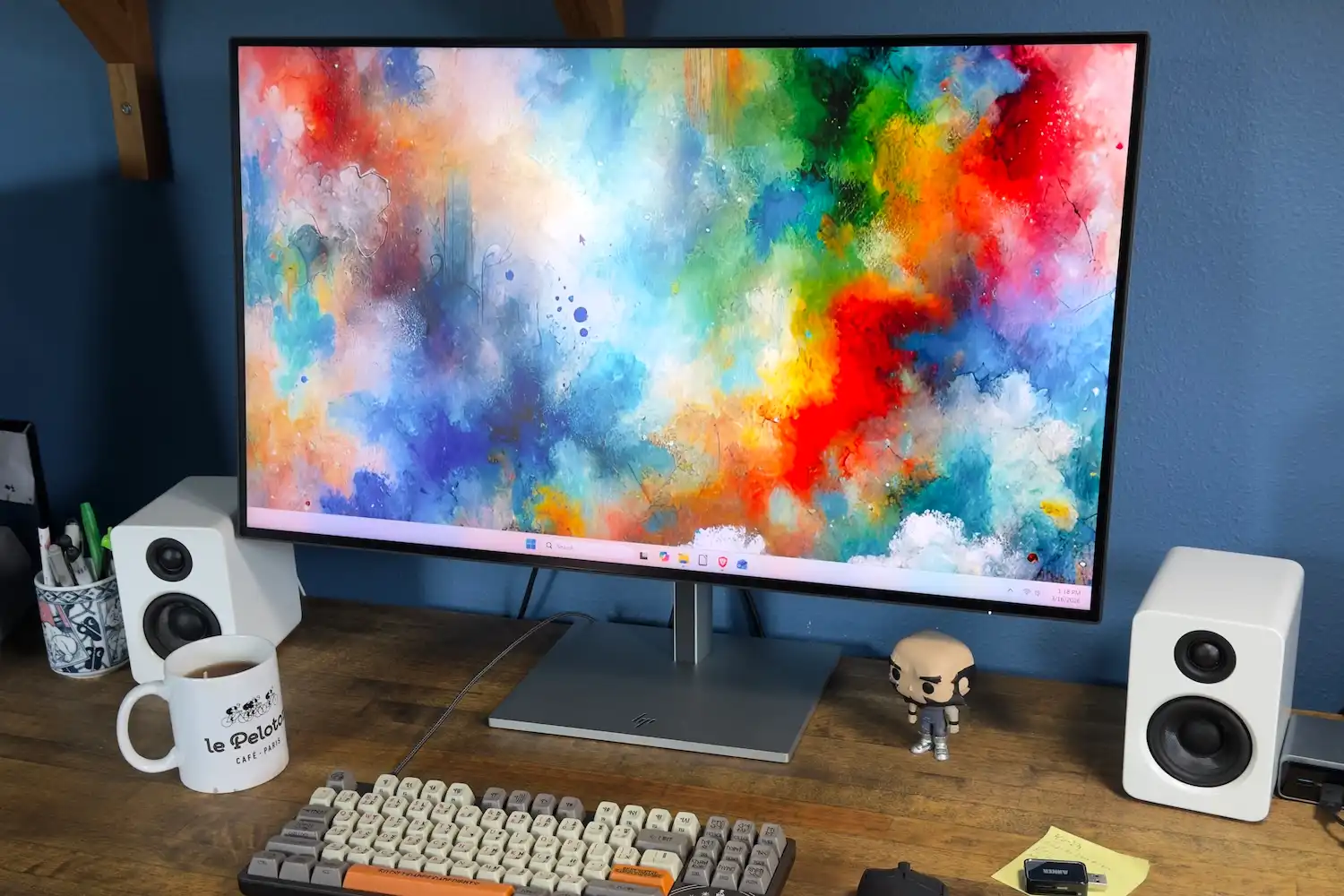

At a glance
Expert’s Rating
Pros
- Distinctive yet functional design
- Extensive connectivity including Thunderbolt 4
- IPS Black panel improves contrast ratio
- Exceptional color gamut and color accuracy
Cons
- Lacks image quality adjustments for gamma and color temperature
- Contrast ratio still limited vs. OLED alternatives
- HDR is available, but not ideal
Our Verdict
The HP Series 7 Pro is a functional, professional monitor that’s packed with connectivity and delivers good image quality, too.
Price When Reviewed
This value will show the geolocated pricing text for product undefined
Best Pricing Today
Price When Reviewed
$1,029
Best Prices Today: HP Series 7 Pro 732pk

A new type of monitor has emerged in this decade—the hub monitor. This type of monitor is packed with connectivity, often including Thunderbolt, that can greatly expand the options for a connected Windows laptop. The HP Series 7 Pro is a compelling new entry into this arena that has Thunderbolt 4, Ethernet, and four USB-A ports, among other features.
HP Series 7 Pro 4K Thunderbolt 4 (732pk) specs and features
The HP Series 7 Pro is a 32-inch 4K monitor with an IPS Black panel. This type of panel is a popular option for high-end professional monitors because it provides a boost to contrast while retaining the brightness and sharpness that IPS panels are known for.
- Display size: 32-inch 16:9 aspect ratio
- Native resolution: 3840×2160
- Panel type: IPS Black
- Refresh rate: 120Hz
- Adaptive sync: Yes, VESA MediaSync
- HDR: Yes, VESA DisplayHDR 400
- Ports: 1x Thunderbolt 4 / USB-C 40Gbps with up to 100 watts of Power Delivery and DisplayPort 1.4, 1x DisplayPort 1.4-in, 1x DisplayPort 1.4-out, 1x HDMI 2.0-in, 1x USB-C 5Gbps upstream with 15 watts of Power Delivery, 1x USB-B upstream, 4x USB-A 5Gbps downstream, 1x RJ-45 (Gigabit Ethernet)
- Audio: None
- Extra features: Ambient light sensor
- Price: $1,029 MSRP, $829 typical retail
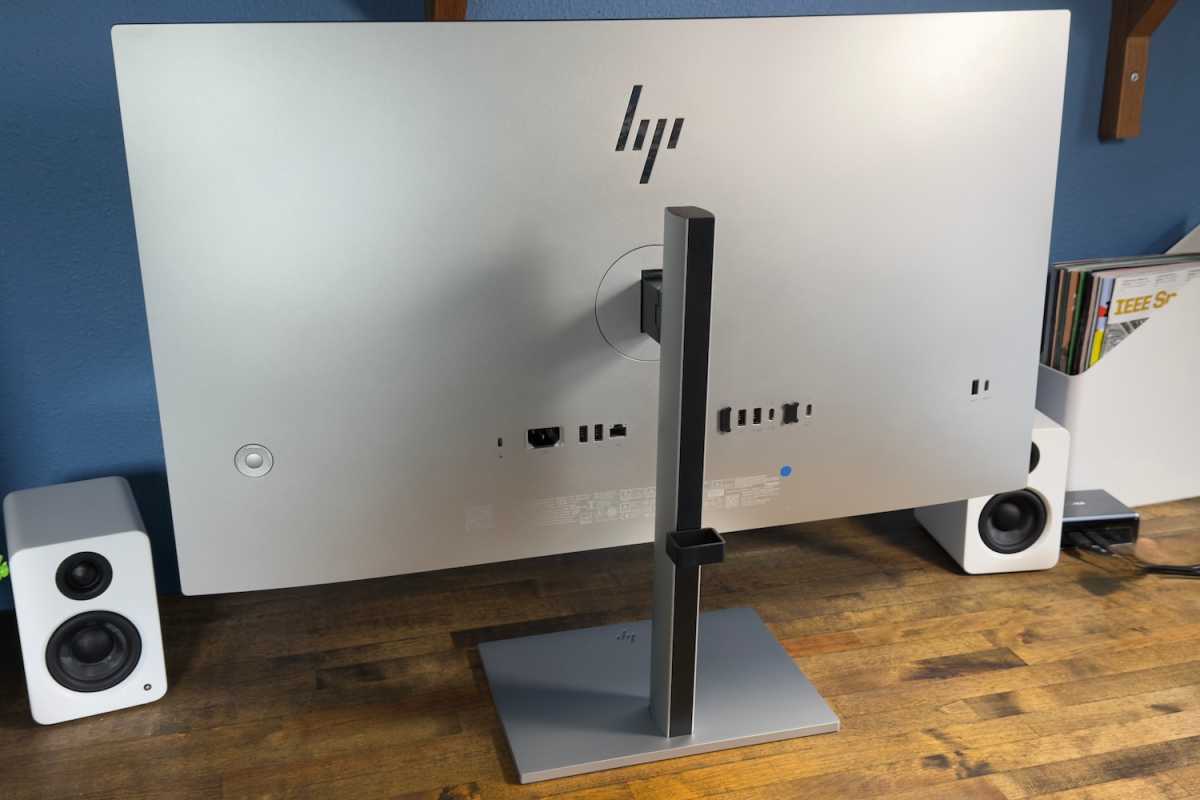
However, the real story is the monitor’s connectivity. The Series 7 Pro has a Thunderbolt 4 port that includes 100 watts of Power Delivery and DisplayPort 1.4. That makes the monitor a hub which includes a wealth of downstream connectivity including one USB-C, four USB-A, Ethernet, and DisplayPort-out.
The HP Series 7 Pro 732pk has a retail MSRP of $1,029. That’s identical to the Dell U3225QE and arguably a bit expensive for what HP offers. However, actual retail pricing tends to put the Series 7 Pro 732pk around $800 to $830, which is more competitive.
HP Series 7 Pro 732pk monitor design
The HP Series 7 Pro 732pk is a monitor built for professionals, but it defies the category’s design trends.
While the monitor is clad in the mundane silver plastics and metals common for this type of display, the Series 7 Pro 732pk spices up its look with an angular rear to the chassis and a sleek, slim stand with a handsome black strip down the middle. It’s more distinctive and exciting than a typical Dell Ultrasharp or BenQ P-Series display.
HP’s more distinctive design doesn’t reduce its functionality. The monitor has a wide, stable, yet flat stand base that doesn’t take up too much space on a desk. It also has a thin stand neck positioned towards the far end of the stand base. That makes the display easier to position on a narrow desk, as it prevents the display from being too close to you.
Matthew Smith / Foundry
The monitor provides extensive ergonomic adjustment, as well. It includes approximately 6 inches (150mm) of height and 90 degrees of swivel. It can tilt 26 degrees and rotate 90 degrees into portrait orientation. This is a wide range of adjustment, and it makes the 732pk a great pick if you often view your display from different angles.
A 100x100mm VESA mount is included for use with third-party monitor arms and stands, but it’s a bit different from usual. The default stand mount is not VESA compatible, so a bracket is included to provide it. That makes VESA mounting just a hair more complicated, though it’s still simple enough that attaching the monitor to a compatible mount should take no more than five minutes.
HP Series 7 Pro 732pk connectivity
The HP Series 7 Pro 732pk is a Thunderbolt 4 monitor, and its connectivity is undoubtedly the monitor’s most important single feature.
To that end, the monitor includes a Thunderbolt 4 port with USB-C, 40Gbps of data, 100 watts of Power Delivery, and DisplayPort 1.4. This single upstream port can feed all the downstream ports and expands the connectivity of a connected laptop while at the same time delivering enough power to charge most laptop PCs that lack discrete graphics.
Additional video input includes one DisplayPort 1.4 and one HDMI 2.0, for a total of three video inputs. The monitor also has a DisplayPort 1.4-out for daisy-chain connections. You can connect to the Series 7 Pro 732pk and then bridge that connection to a second DisplayPort monitor, which makes it possible to drive multiple DisplayPort displays with a single DisplayPort or Thunderbolt 4-out on your PC.
The monitor’s downstream connectivity includes four USB-A ports (with 5Gbps of data) and a USB-C port (also with 5Gbps, but also 15 watts of Power Delivery). There’s also a Gigabit Ethernet port. A KVM switch is included, too.
That’s a lot of connectivity. It bests the BenQ PD3225U, which includes Thunderbolt 3 and lacks Ethernet. Dell’s Ultrasharp U3225QE still has an edge, though, as it supports Thunderbolt-out, provides more data over the USB-A and USB-C connections (10Gbps), and has 2.5Gbps Ethernet. The Dell is sometimes more expensive at retail, however.
HP Series 7 Pro 732pk menus and features
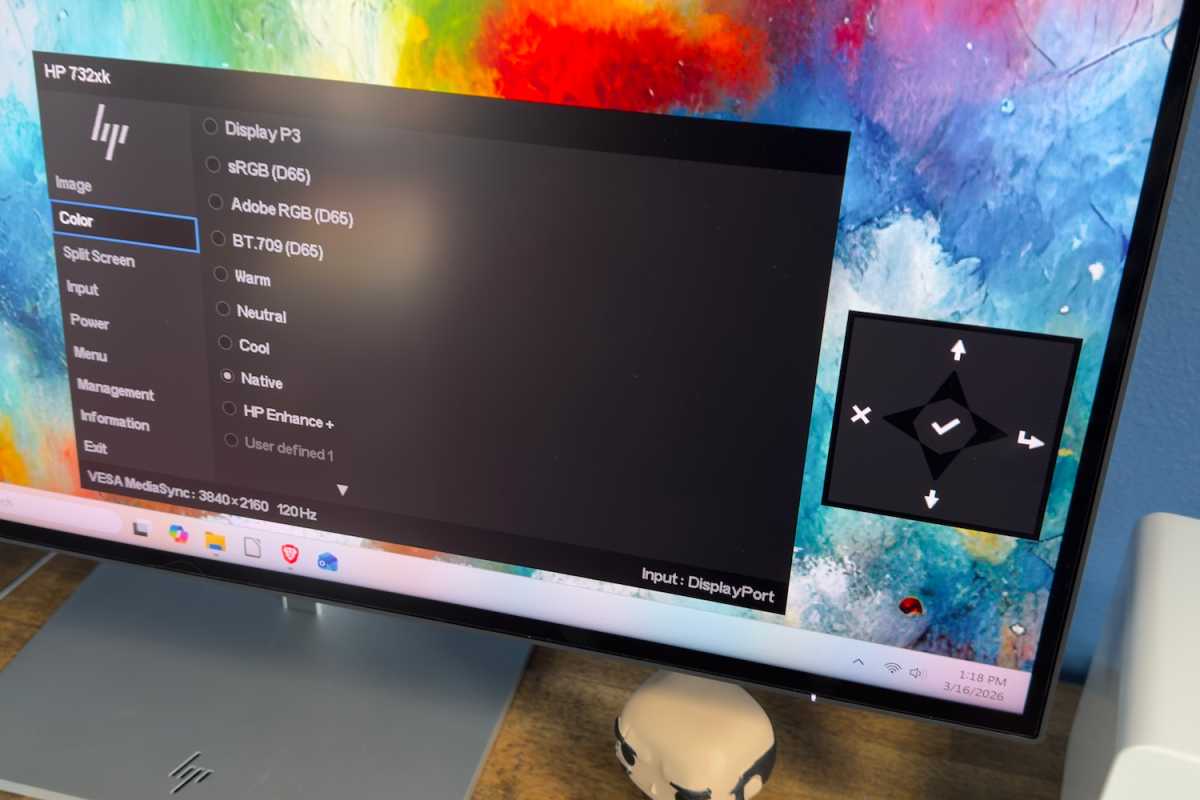
A D-Pad-style control tucked around the HP Series 7 Pro 732pk’s right flank provides access to the monitor’s on-screen menu system. This is unusual, as a lot of monitors have moved to using a joystick-style control, but it works fine. The power button left me scratching my head, though. It’s small and placed on the lower-right bezel away from the monitor controls, so it takes some effort to find it.
The menu system is logically arranged. Fonts are a bit small but bold, so I found them easy to read despite their size. HP provides a wide range of image modes which include Display P3, sRGB, AdobeRGB, and BT.709 presets.
Matthew Smith / Foundry
However, color customization is difficult. I couldn’t find any gamma modes. A couple color temperature modes are included, but they are color modes just like Display P3 and don’t allow independent adjustment. RGB color calibration is included, but that’s about it. I found the way the color controls work confusing and a dip into the monitor’s user guide didn’t help, as it’s thin on details, at least in this respect.
Most of the features found in the HP’s on-screen menu can also be controlled by HP’s Display Center software, which is available for both Windows and MacOS. It’s a decent software utility that, in addition to features found in the on-screen menu, also includes software color calibration. However, the range of image quality adjustment is still thin. RGB color can be adjusted but color temperature and gamma adjustments are not available.
HP provides an ambient light sensor, and it worked well in my testing. The level of brightness was often appropriate and I didn’t find transitions between brightness levels jarring. However, the monitor doesn’t offer any significant control over how the sensor works, other than the option to turn it off or on. I’d like to see more control—but most competitors with an ambient light sensor also have this limitation.
HP Series 7 Pro 732pk audio
The HP Series 7 Pro 732pk doesn’t include built-in speakers. This is a minor disappointment, as speakers can be useful for situations where a headset or headphones aren’t available.
HP Series 7 Pro 732pk SDR image quality
The HP Series 7 Pro 732pk has an IPS Black panel. This is a type of IPS panel that debuted a few years ago, and it’s a popular pick in high-end professional monitors. Though it’s still no match for OLED in contrast, it can deliver good brightness and sharpness. So, how does the 732pk stack up?
Matthew Smith / Foundry
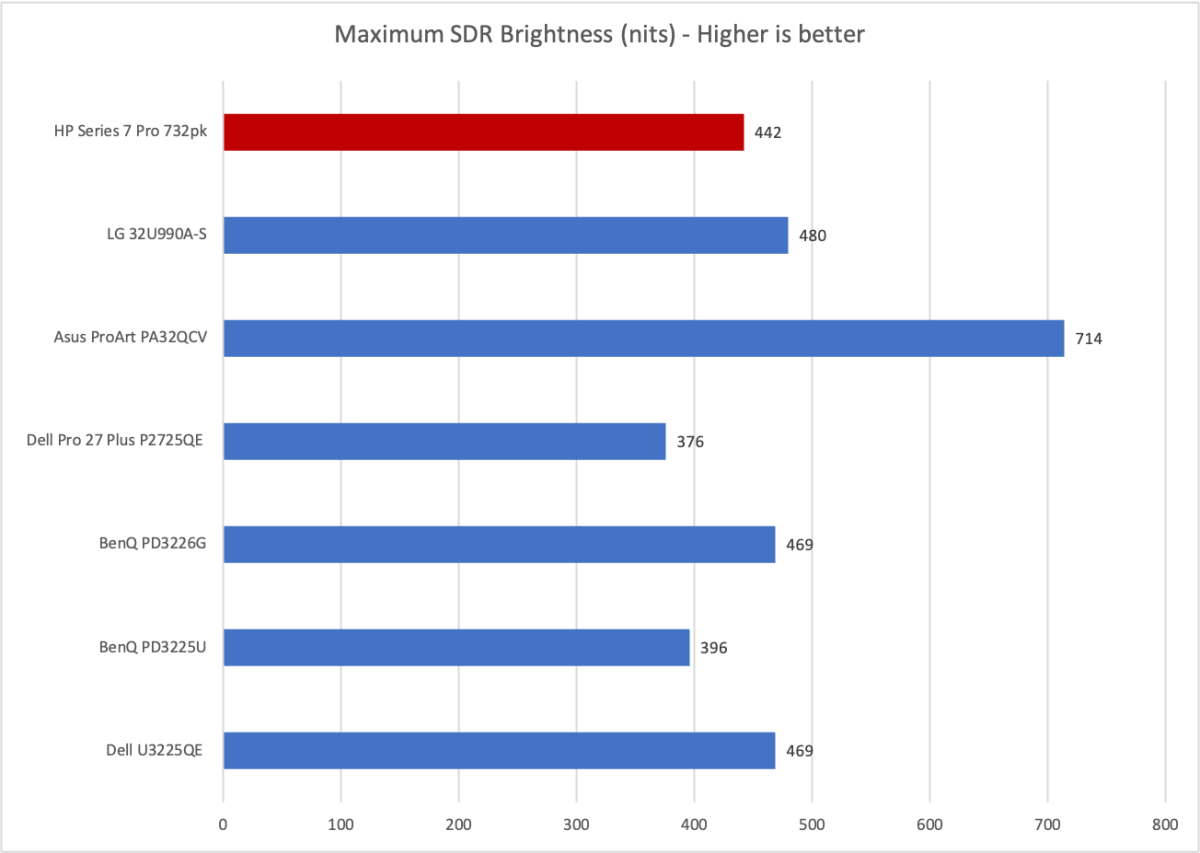
Well, the HP Series 7 Pro 732pk is certainly bright. Although not the brightest IPS Black monitor I’ve tried, the display’s maximum SDR brightness of 442 nits is nothing to scoff at.
This level of brightness is way more than what’s usually required and keeps the monitor viewable even in a room with sunlit windows or many overhead lights. That’s good news if you need to use the monitor in an office bullpen.
The monitor also has a matte finish, which reduces glare. These factors, combined with the ambient light sensor, make the HP look bright and vivid in most conditions.
Matthew Smith / Foundry
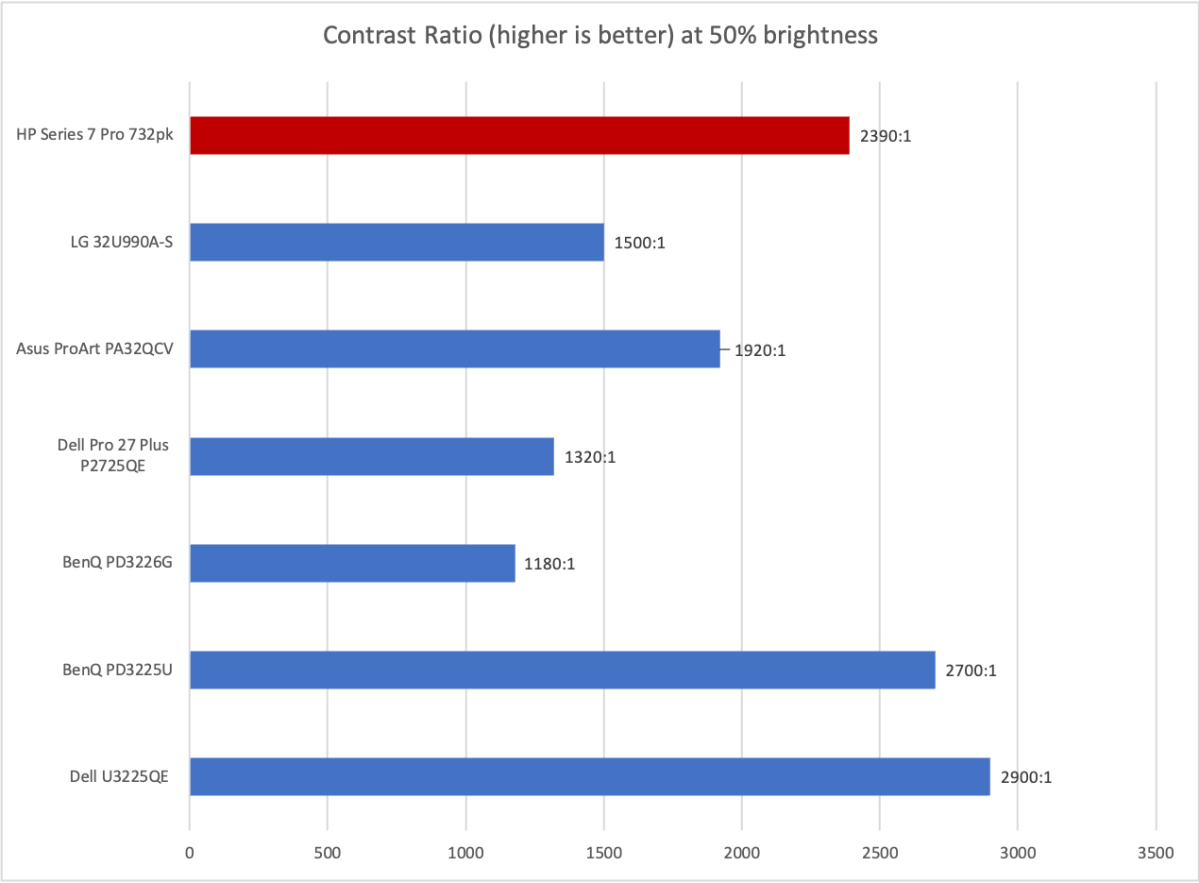
I measured a contrast ratio of 2390:1 at 50 percent of maximum brightness. That’s not a class-leading result, but it’s respectable, and outperforms the monitor’s quoted contrast ratio of 2000:1.
The improved contrast ratio provides a better sense of depth than most IPS displays. It also reduces the “IPS glow” effect which causes a hazy, washed-out look when viewing dark content in a dark room. But that problem is only mitigated—not eliminated. An OLED or VA panel monitor will still provide a better viewing experience in a dark room.
Matthew Smith / Foundry
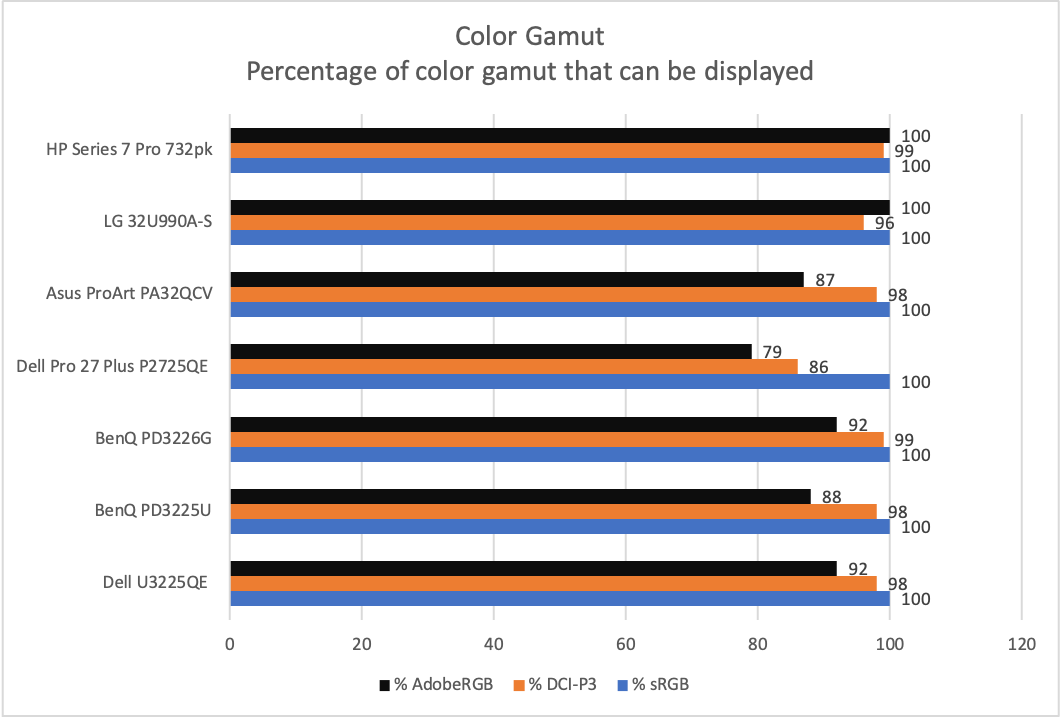
The Series 7 Pro 732pk has a wide color gamut that spans 100 percent of sRGB, 99 percent of DCI-P3, and 100 percent of AdobeRGB. That’s an excellent range and it puts the Series 7 Pro 732pk at the front of the pack in terms of color volume.
In fact, I think it’s worth thinking about what we’re looking at here. This monitor comes very close to achieving 100 percent color volume across sRGB, DCI-P3, and AdobeRGB. Five years ago that sort of performance wasn’t available to consumers at any price, nevermind under $1,000 retail. It’s a remarkable result.
Because of this, the HP is well suited to a wide range of creative professional work including video editing, photography, and digital art.
Matthew Smith / Foundry
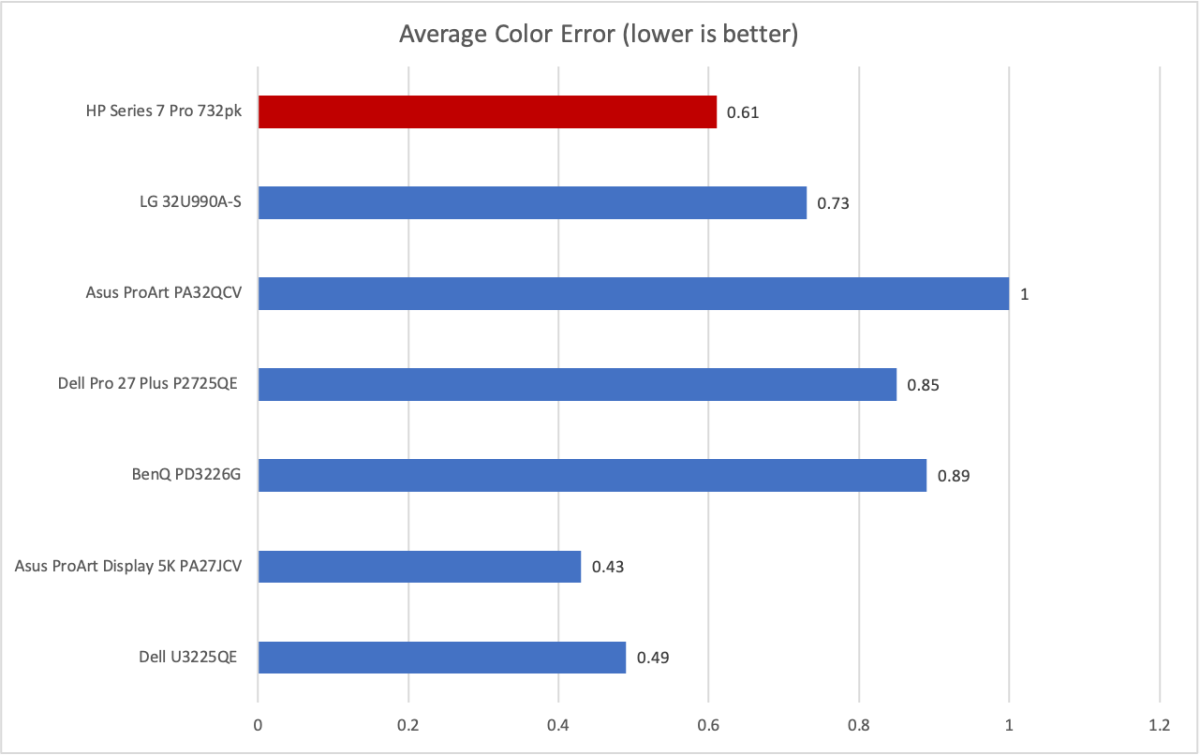
HP really delivers in color accuracy, as the Series 7 Pro 732pk had an average color error of just 0.61. As the graph shows, that is a top-notch result. The error was largest in cyan, with an error of 2.39, and lowest across the other colors. In practice, I found the display looked exceptionally lifelike and that content appeared as it should.
That’s helped by the monitor’s gamma performance. It delivered a gamma curve of 2.2, which is the target, and also had a color error below 1 in five out of six grayscale colors tested. In practice, this means content looks bright as intended and preserves good detail across grayscale.
Color temperature performance was weaker, though, as the monitor had a default color temperature of 7100K. That’s quite a bit cooler than the target of 6500K, and it means the default image looks a bit sterile. This can be adjusted, but the monitor lacks precise color temperature values in the monitor settings, so dialing in color temperature will require some effort.
Sharpness is another perk. The 32-inch IPS Black panel has a native resolution of 3840×2160. That works out to a pixel density of about 137 pixels per inch. Though obviously not as high-resolution as a smaller, 27-inch 4K monitor, the monitor still looks crisp. Only the most critical pixel peepers will find the monitor’s sharpness inadequate.
This monitor comes very close to achieving 100 percent color volume across sRGB, DCI-P3, and AdobeRGB. Five years ago that sort of performance wasn’t available to consumers at any price, nevermind under $1,000 retail.
HP Series 7 Pro 732pk HDR image quality
The HP Series 7 Pro 732pk supports HDR and is VESA DisplayHDR 400 certified. It’s also extremely bright in HDR with a maximum sustained brightness of 713 nits.
However, the monitor’s lackluster contrast is an issue. The monitor can’t become bright without also elevating the brightness of dark areas of the screen. As a result, the high brightness doesn’t provide the added detail and depth that you might expect, and HDR content often looks a bit dull and washed out.
The same is generally true of the monitor’s competition, though. Shoppers looking for great HDR need to consider an OLED or Mini-LED display, such as the MSI MPG 321URXW QD-OLED. Unfortunately, going that route also means you’ll have to abandon most of the Series 7 Pro 732pk’s connectivity. MSI’s OLED has a USB-C port with Power Delivery but the downstream connectivity is limited to a few USB ports.
HP Series 7 Pro 732pk motion performance
The HP Series 7 Pro 732pk isn’t a gaming monitor but it does provide a refresh rate of up to 120Hz and VESA MediaSync support. The 120Hz refresh rate boosts motion clarity and fluidity when compared to a 60Hz display.
As mentioned, the monitor supports VESA MediaSync for adaptive sync. This isn’t a demanding standard for adaptive sync. However, my AMD Radeon RX 7800 XT video card did detect the HP as a variable refresh rate monitor, and adaptive sync appeared to work without issue.
While these perks are appreciated, it’s important to keep in mind that IPS Black panels have a relatively slow pixel response time (HP lists five milliseconds gray-to-gray). By contrast, gaming displays typically have a pixel response time of one millisecond or less. The higher pixel response time means you’ll still notice a fair bit of ghosting behind fast-moving objects.
So, I wouldn’t recommend the Series 7 Pro 732pk for esports players, but I still appreciate that it offers some basic features useful for gaming and entertainment. That’s handy if you’re thinking about buying the display for use in a room that serves as your office by day and your gaming den by night. It also gives the Series 7 Pro 732pk an edge over competitors, many of which stick to 60Hz—though the Dell U3225QE also reaches a 120Hz refresh rate.
Should you get the HP Series 7 Pro 732pk?
The HP Series 7 Pro 732pk is a compelling entry into the high-end professional and office display arena. It’s similar in many respects to Dell’s U3225QE. The two are comparable in design, image quality, and overall feature set, though the Dell has more connectivity overall. HP strikes back in color gamut with a color volume that spans 100 percent of AdobeRGB and 99 percent of DCI-P3. On the whole, Dell’s U3225QE still earns my default recommendation due to its better connectivity, but the HP is an excellent alternative if you want an incredibly broad color gamut.
This articles is written by : Nermeen Nabil Khear Abdelmalak
All rights reserved to : USAGOLDMIES . www.usagoldmines.com
You can Enjoy surfing our website categories and read more content in many fields you may like .
Why USAGoldMines ?
USAGoldMines is a comprehensive website offering the latest in financial, crypto, and technical news. With specialized sections for each category, it provides readers with up-to-date market insights, investment trends, and technological advancements, making it a valuable resource for investors and enthusiasts in the fast-paced financial world.