
With the Core Ultra Series 3 “Panther Lake” laptop chips, Intel says it’s largely eliminating the “alphabet soup” of obtuse product suffixes that only nerds truly enjoyed — with one twist.
Now, the only truly weird aspect of Intel’s Core Ultra Series 3 processor lineup is a new “X” designation, so that what once was a Core Ultra 9 chip is now a “Core Ultra X9” chip. It’s all tied to the specific chip architecture that the new Panther Lake chips include, Intel explained.
For years, Intel has attached suffixes to its microprocessors that signal different attributes: a “Y” chip, for example, was an extremely low-power mobile chip, whatever that means. It’s so bad that Intel has even dedicated a page to the chip suffixes, which it’s maintained right through to the end of 2025.
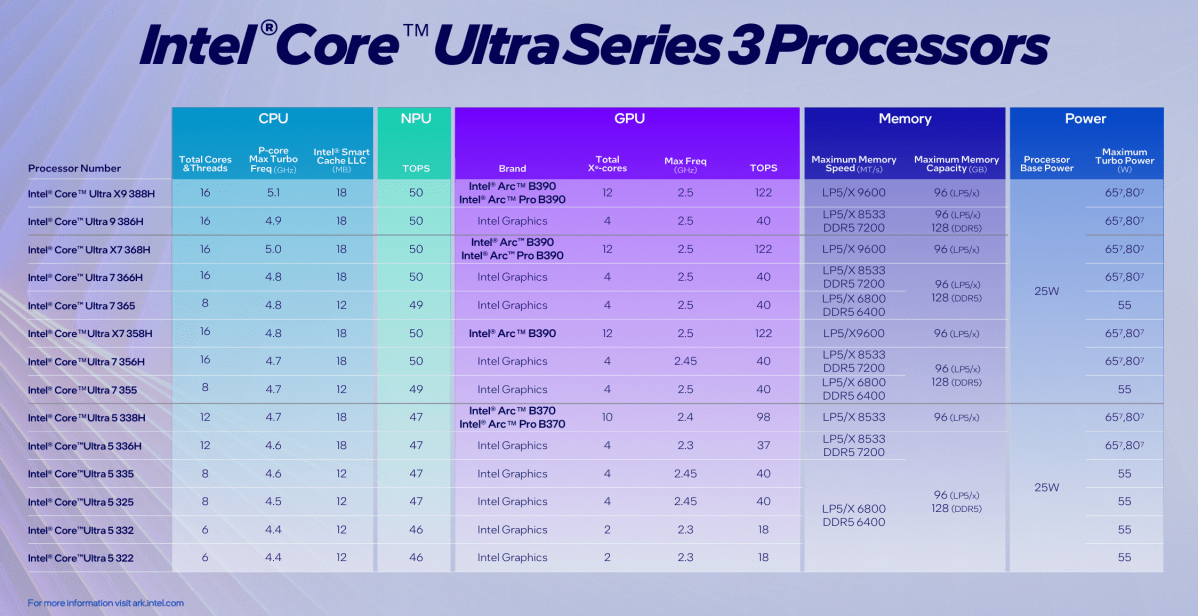
Intel
In this new lineup of fourteen mobile Intel processors, listed above, Intel has kept just the “H” suffix (“high performance optimized for mobile”) and eliminated everything else. The majority of chips Intel listed lack a suffix altogether.
What stands out are the Core Ultra X9 388H, the Core Ultra X7 368H, and the Core Ultra X7 358H. Look closely at the chip matrix above, though, and they all share a common attribute: 12 Xe3 Arc graphics cores. When a dozen Xe3 cores are combined, Intel calls that the Intel Arc B390. In one case, it uses ten instead: the B370.
Nish Neelalojanan, senior director of product management, client for Intel, said that retailers asked for the additional descriptor.
“In some retail feedback, there was strong retail feedback that our 12Xe [chip] is so good that they needed a easy way for customers walking in to be able to identify that…” Neelalojanan said. “So that is an easy way to identify that.”
What’s the difference between a Core Ultra Series 3 “H” processor and the others?
Intel originally broke up Panther Lake in to 8- and 16-core chips, but Intel isn’t actually saying which cores are performance, efficiency, or low-power efficiency cores. It’s sort of the same reason why the suffixes have largely disappeared, too; all of these new Core Ultra Series 3 chips all run at the same 25W base thermal design power. The “H”-series chips elevate the max TDP, however, offering more performance: 65 or 80 watts in some cases.
When I asked Intel’s representatives what differentiates a Core Ultra Sereis 3 chip from the “vanilla” chips without any suffixes, they huddled up. One problem: the list of “Panther Lake” processors that Intel provided to press doesn’t sum up all the attributes of each chip. In this case, two attributes not listed matter: cache size and core count.
According to Intel representatives, the base or “vanilla” Core Ultra Series 3 chips contain four performance cores, and four low-power efficiency cores. The “H” cores are everything else. Likewise, the base chips include 12 megabytes of the last-level “smart cache,” while the H chips include 18 megabytes. This information is coded into the suffix, but you can also search Intel’s Ark database for more information.
We still expect Intel to ship a Core Ultra Series 3 chip for gaming, though Intel declined to comment. That will return another suffix — the “HX” suffix — to the product lineup once again.
Updated at 9:47 AM PT with additional detail.
This articles is written by : Nermeen Nabil Khear Abdelmalak
All rights reserved to : USAGOLDMIES . www.usagoldmines.com
You can Enjoy surfing our website categories and read more content in many fields you may like .
Why USAGoldMines ?
USAGoldMines is a comprehensive website offering the latest in financial, crypto, and technical news. With specialized sections for each category, it provides readers with up-to-date market insights, investment trends, and technological advancements, making it a valuable resource for investors and enthusiasts in the fast-paced financial world.