In a post on its community blog today, Meta announced the timeline for the shutdown of Horizon Worlds for VR users. The Horizon Worlds app and related Events will disappear from Quest headsets by March 31, and VR users will no longer be able to use the social hub at all after June 15, 2026. Horizon Worlds will continue, Meta says, but only for mobile users.
“We are separating the two platforms so each can grow with greater focus, and the Horizon Worlds platform will become a mobile-only experience,” the company explained in the post. “This separation will extend across our ecosystem, including our mobile app.”
Horizon Worlds launched in 2021 as a VR-only platform where users could interact in a virtual space, but it was beset by early tech and design limitations (most famously, that user’s Metaverse avatars didn’t have legs). Still, at the time, the company hoped the Metaverse would ultimately attract over a billion users, and Horizon Worlds was seen as an integral part of it. Obviously, that didn’t happen—at its peak, Horizon Worlds‘ monthly user count was only around 200,000.
What happens to users’ digital purchases and creations?
Long-time Horizon Worlds users are surely asking what will happen to their in-world digital items. The good news is that your Worlds-specific purchases and creations won’t instantly be wiped; Meta says your digital items or currency will remain tied to your account. The bad news is you’ll only be able to access them through the mobile app in “mobile-optimized” worlds, so if a creator hasn’t updated their world for mobile, your items there may effectively become inaccessible.
After June 15, you will no longer be able to build or edit worlds in VR. Meta is encouraging the use of their web-based tools, but the immersive building experience that defined the platform is officially ending.
Meta is shifting focus from VR to AI
The change is part of an overall strategy shift from Meta, which will be funneling more resources into AI and smart glasses. In January, Meta shuttered its AAA VR game development companies, stopped updating its first-party subscription-based fitness app Supernatural, and laid off 1,500 people from its VR-division Reality Labs.
Even given all that, though, Meta says it’s not pulling out of the VR game altogether. In a blog post on Feb. 19, Samantha Ryan, the vice president of content for Reality Labs, promised Meta was “doubling down on VR,” but is nevertheless moving away from first-party development to focus on hardware, supporting third-party developers, and adding features to the Quest itself. “It’s no secret that we’re still in the hardware game,” Ryan wrote. “We have a robust roadmap of future VR headsets that will be tailored to different audience segments as the market grows and matures.”
The kinda sad end of Horizon Worlds
I poked around Horizon Worlds for when I got my Quest 3 headset a few years ago. “Oh, I can decorate a little house or meet people” I thought; then I logged out and never went back—I have a real house I can decorate, and I use VR because I don’t like people. But a few months ago, when it became clear that Meta was pulling away from the VR space it created, I got curious, strapped on the face computer, dusted off the old avatar, and went on a Horizon Worlds safari. I’m glad I did.
Going to Horizon Worlds feels eerie. It’s like visiting someone else’s dreams—specifically Mark Zuckerberg’s dream and the sub-dreams of Worlds’ volunteer creators. “The defining quality of the metaverse will be a feeling of presence…Feeling truly present with another person is the ultimate dream of social technology. That is why we are focused on building this,” Mark Zuckerberg said at Connect 2021, and he believed it enough to spend billions (maybe as much $25 billion) on his dream word, where nothing ever gets dusty and everyone is an endlessly smiling cartoon ready to funnel actual money to The Overseer for the latest digital sneakers.
Then there are the thousands of creators who spent countless hours building more than 10,000 worlds you can visit—nightclubs, basketball stadiums, restaurants, etc., though they’re almost all empty. As flashy as it looks, no one is lined up at the digital nightclub’s velvet rope. Horizon Worlds is a gigantic dead mall, a capitalist cathedral with no congregation, the ultimate liminal space.
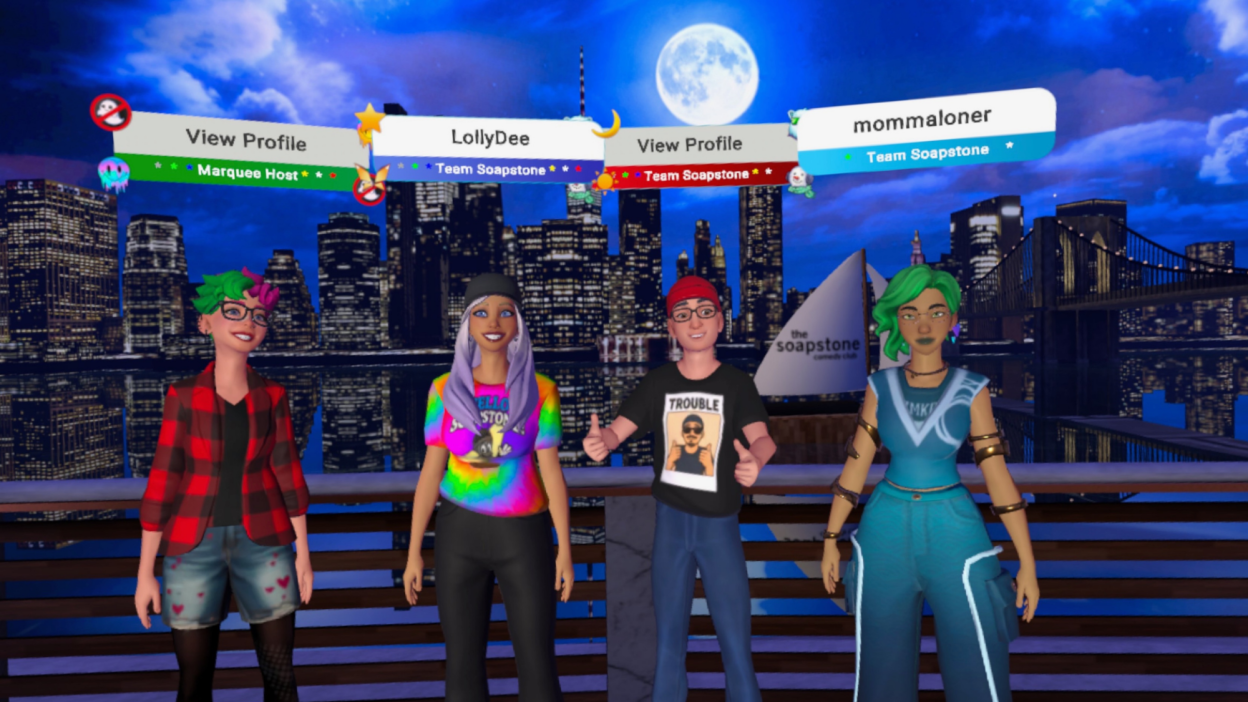
A vibe that strange is enough reason to visit, but there’s a genuine side to Worlds too. I eventually found a world where people conquered the unsettling nature of VR and created a real community. The Soapstone Comedy club is not huge, but it’s thriving, and it’s one of many spots where small groups have gathered in Horizon Worlds. There are conversation pits people use to meet up, nightly planned comedy shows, and a collection of friendly regulars to chat with. It grew from the ground up, too, just as Zuck predicted. Okay, the comedy is rarely funny. But the people are good.
Some Soapstoners are housebound and handicapped, and VR gives them opportunities the real world denies them. Some seem like weirdos who probably have trouble finding real life friends who can’t mute them at will. And some are regular people blowing off some steam after work. I’m sad for all of them—a comedy club on a phone screen just isn’t the same. So before the digital wrecking ball takes down the hang-out spots of all Horizon Worlds‘ remaining residents, you should stop in and say hi. There’s not much time left.
This articles is written by : Nermeen Nabil Khear Abdelmalak
All rights reserved to : USAGOLDMIES . www.usagoldmines.com
You can Enjoy surfing our website categories and read more content in many fields you may like .
Why USAGoldMines ?
USAGoldMines is a comprehensive website offering the latest in financial, crypto, and technical news. With specialized sections for each category, it provides readers with up-to-date market insights, investment trends, and technological advancements, making it a valuable resource for investors and enthusiasts in the fast-paced financial world.