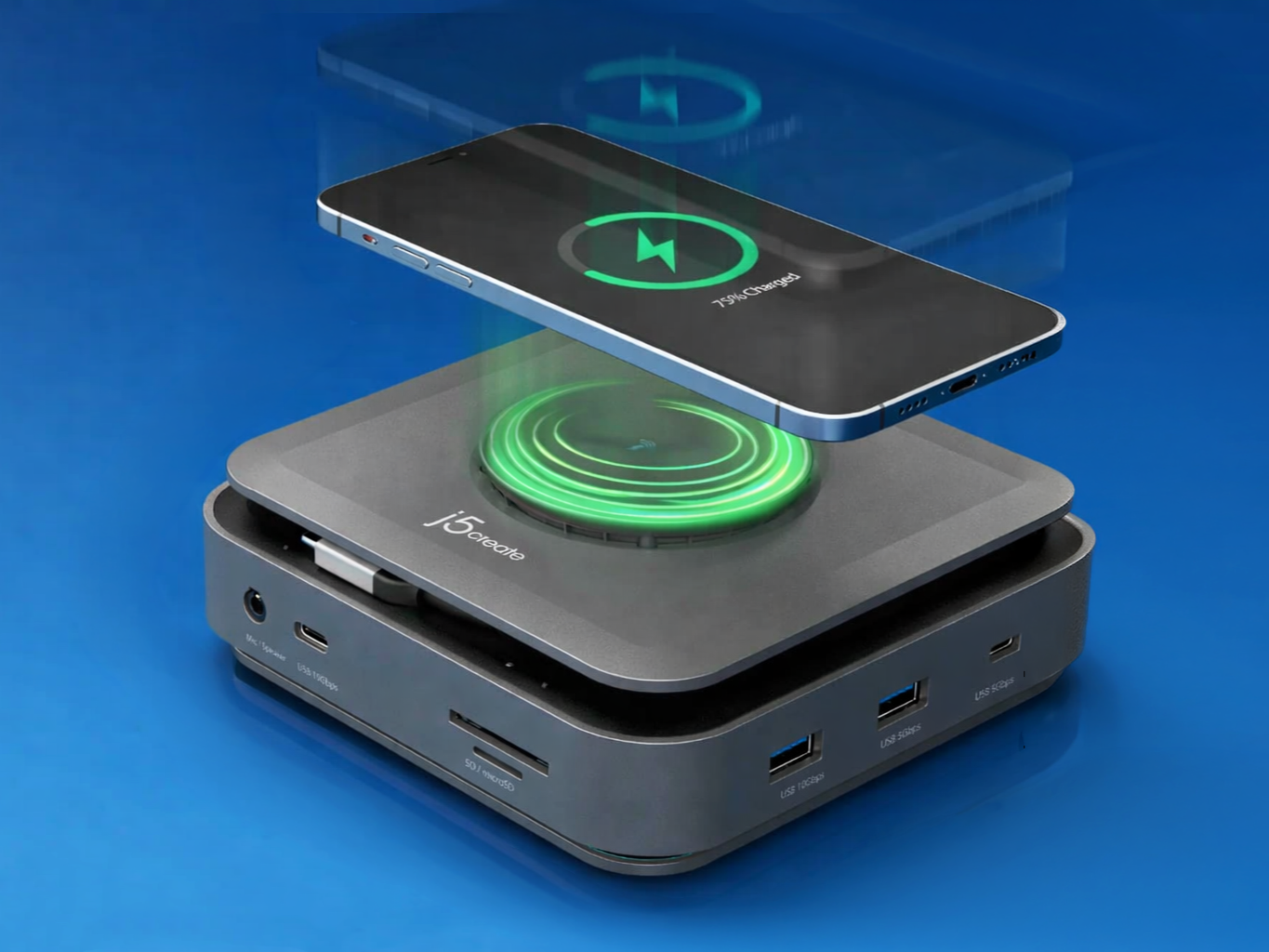
As I’ve come to value wireless charging on a smartphone more and more, I’ve been wondering why laptop docking stations generally don’t include the feature. A very few do, which I’ve listed here.
Why should you care? Well, smartphones are expensive! And for me, one pain point is the USB-C connection, now common across both iPhones and Android phones. If you hold on to a phone for a couple of years, you may find that the USB-C port eventually weakens to the point where it can’t hold a charging connection. Then it’s either time for a repair (which can cost over $100) or an entirely new phone.
Wireless charging won’t solve the inevitable battery wear that can afflict an older phone. But it certainly can solve the charging-port issue simply by bypassing the wired connection and feeding power wirelessly into the battery. Sure, there are lots of wireless chargers, which do nothing but charge a phone. But I honestly don’t understand why more laptop docking stations or USB-C hubs don’t make this a standard feature, as a dock’s long rectangular surface makes an ideal charging pad.
Fortunately, there are exceptions: These three docks can wirelessly charge your Android phone or iPhone while they’re sitting on your desk. I haven’t tested them personally (yet) but I’m tempted, especially the first two in the list — they just look so practical for the price.
Budget: Performance Master 10-in-1 USB-C Docking Station
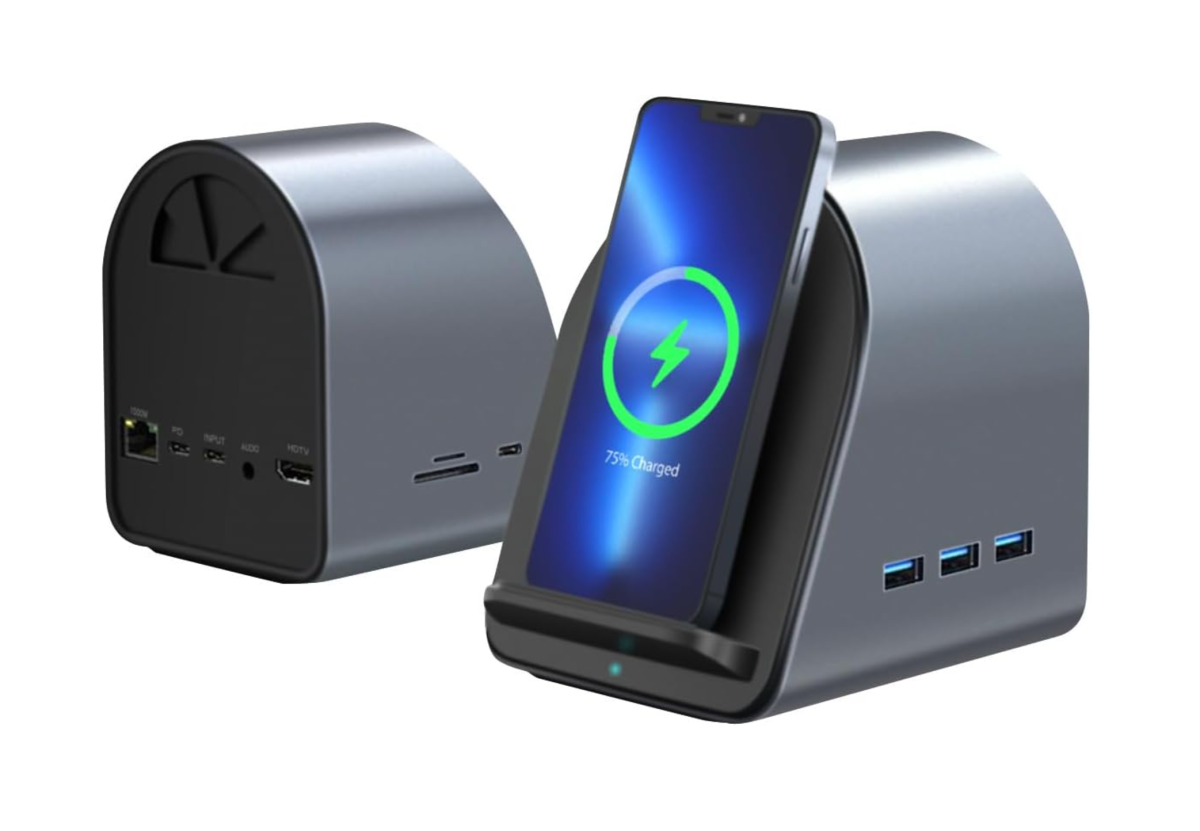
The $45.99 Performance Master 10-in-1 USB-C Multifunction Docking Station looks a bit like a headstone that you’d put on your desk, except with a tilted front that can balance a phone on the small protruding lip. This dock scrimps a little where wireless charging is concerned: 7.5W to an iPhone and 10W to an Android phone. (By comparison, the latest Samsung Galaxy 26+ can wirelessly charge at 20W and the base S26 at 15W, while the Apple iPhone 17 series can charge up 25W wirelessly.)
Amazon
Still, this dock has three USB 3.0 (5Gbps) ports, a USB-C port, an SD/TF card, and an HDMI port capable of 4K/60Hz video output, plus a headphone jack. It can deliver a rated 100W to your laptop, though in reality 90W or a little less sounds more reasonable.
There is a bit of a catch, though: This dock doesn’t supply the charger brick itself. You’ll have to have one handy.
Buy the Performance Master wireless charging dock for $45.99 at Amazon
Midrange: J5Create USB-C Dual 4K HDMI Docking Station
The wonderful thing about PC peripherals is that there are hundreds of companies, mostly operating out of Shenzhen, China. Some emerge from the fray and become successful, even if they’re new or otherwise somewhat unknown. J5Create is an example, and I spent some time on my own at CES 2026 simply looking at what they had to offer.
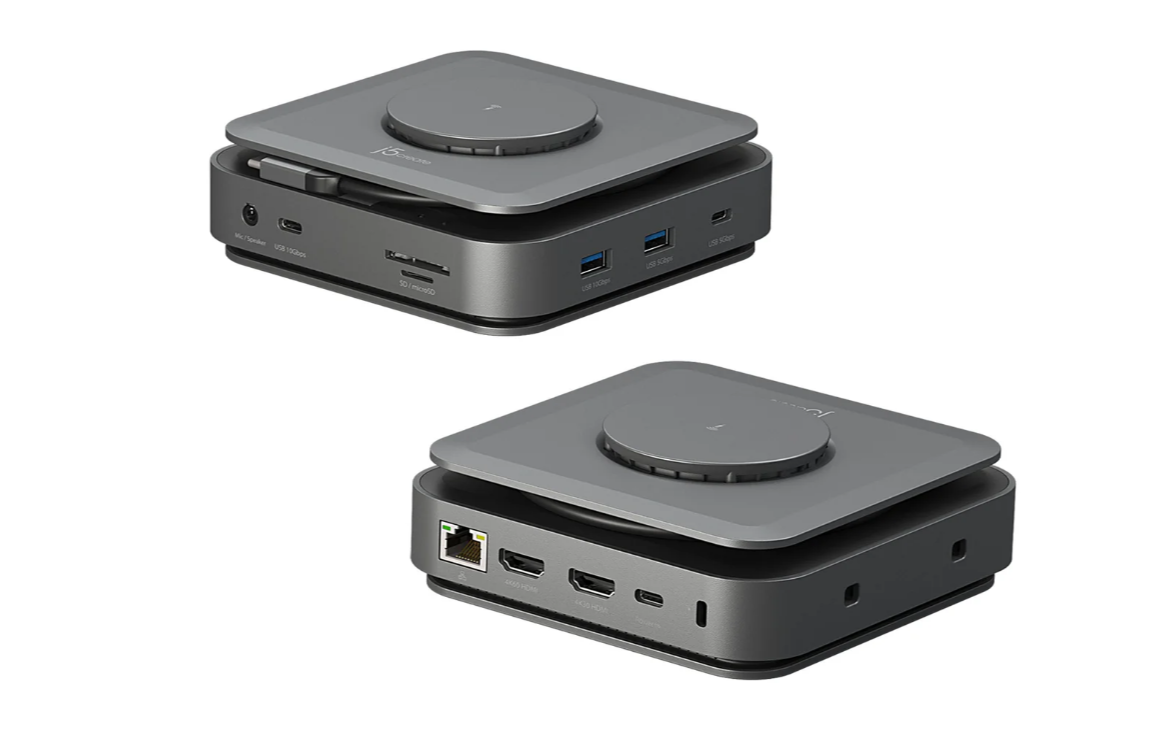
The J5Create USB-C dock ($119.99) is designed more like what I’d expect: It’s a squarish USB-C hub, with a circular wireless charging platform on top.
Amazon
This uses the Power Delivery 3.1 specification, capable of delivering 15W — not quite the fast-charging power that the latest flagship phones support, but not too bad either. J5Create says that it will pass up to 140W to your laptop, which if true is rather impressive. However, this dock does not include the power charger itself, an annoying trend here. Wireless charging also won’t work if that charger supplies less than 60W.
This dock (model JCD3199) is a 12-in-1 dock, with a pair of HDMI ports capable of 4K output. (J5Create rates one at 60Hz, and the other at 30Hz.) There are two USB-A and USB-C ports, one each at 10Gbps and 5Gbps, respectively. A microSD/SD card slot is also included.
Buy the J5Create USB-C Dual 4K dock at Best Buy for $119.99
Premium: Anker 675 USB-C Docking Station
Anker’s take on the wireless charging dock is less about a docking station and more about a monitor stand: The ports are actually clustered, hidden to one side. Anker devotes the remainder of the dock to a wide slab of aluminum that looks more like a workbench than a traditional laptop dock.
This dock isn’t cheap; it retails for $249.99, though it was on sale at press time for 32 percent off at Amazon, or $169.99.
Unfortunately, this dock is only rated for 10W (7.5W for iPhones) via the charging pad, too. It tries to make up for it with 45W through a pair of 10Gbps wired USB-C ports instead, along with 100W to the host. It does appear to include a charger, however.

Anker / Youtube
Otherwise, this 12-in-1 dock includes several familiar ports: 1 HDMI 2.0 output for a 4K60 display, gigabit Ethernet, three 10Gbps USB-A ports; and a UHS-1 (104MB/s) SD and microSD slot.
Honestly, $250 for these specifications looks a little overpriced, though you’re essentially buying a monitor stand, too.
Obviously, you can buy your own wireless charger or look for specialty deals, too. But if you’re looking to make use of your desk space as well as your dollar, an integrated charging dock might be a worthwhile investment. Shame that they’re so hard to find.
Buy the Anker 675 docking station with wireless charging for $169.99 at Amazon
So why don’t other docks include wireless charging?
Yes, there are at least three docks that include wireless charging. Why don’t the others?
I asked a few sources, and Manny Garcia, a product manager at Satechi, provided this response: “Most docks prioritize core docking performance—stable displays, fast data, Ethernet, and reliable laptop charging,” Garcia wrote in an emailed statement. “Adding wireless charging sounds simple, but it introduces tradeoffs that many manufacturers avoid.
“The biggest factors are cost and complexity (additional components, validation, and certification), thermals (wireless charging is less efficient and creates extra heat, which can lead to throttling or require more cooling), and real-world usability (coil alignment, thick cases, MagSafe accessories, and phone camera bumps can make charging inconsistent),” Garcia added.
“There’s also engineering risk: Docks contain high-speed electronics (USB/Thunderbolt, video, networking), and a wireless charger is a high-frequency transmitter that can make EMI/EMC compliance and internal layout harder,” Garcia concluded. “For many brands, it’s a better value proposition to keep the dock simpler and let users place a separate wireless pad wherever it works best.”
This articles is written by : Nermeen Nabil Khear Abdelmalak
All rights reserved to : USAGOLDMIES . www.usagoldmines.com
You can Enjoy surfing our website categories and read more content in many fields you may like .
Why USAGoldMines ?
USAGoldMines is a comprehensive website offering the latest in financial, crypto, and technical news. With specialized sections for each category, it provides readers with up-to-date market insights, investment trends, and technological advancements, making it a valuable resource for investors and enthusiasts in the fast-paced financial world.