We may earn a commission from links on this page.
Samsung’s Galaxy Watches have been able to measure your blood pressure for years now—theoretically. U.S. users just got access to the feature, in a phased rollout that finally reached my device. I’ll show you how to set it up, which is more complicated than you might think, and then discuss what we know about its accuracy.
![Samsung Galaxy Watch 8 (2025) 40mm LTE Smartwatch, Cushion Design, Fitness Tracker, Sleep Coaching, Running Coach, Energy Score, Heart Rate Tracking, Silver [US Version, 2 Yr Warranty]](https://lifehacker.com/imagery/product/01SaDS8WhrIK7Ar9JnrTqMM/hero-image.fill.size_autoxauto.v1753694578.jpg)
How to enable blood pressure readings on your Galaxy Watch
I spent all last week checking for software updates on my phone, watch, and app store, to no avail. Finally I got a card in my Samsung Health app (the one with the blue and green icon of a person running) inviting me to “keep track of your blood pressure.” This sent me to the app store to download a new version of the Samsung Health Monitor app (the one with the pinkish icon of a heartbeat).
Besides a Samsung Galaxy phone and watch, you’ll need two things to set up blood pressure monitoring: access to a blood pressure cuff (a wrist cuff from the drugstore is fine) and a cellular network connection (not wifi).
The mobile connection is so that Samsung can check that you really, truly are in a country where the company can legally offer blood pressure readings. This won’t be a problem for most of you, but my Samsung phone is a device I use exclusively for testing Samsung-related wearables, and thus I have never connected it to any cellular network. I also don’t have a physical SIM card in my regular phone to easily swap in, but fortunately I was able to find a SIM card to borrow for a few minutes. Once you set up the app, you can disconnect from the cell network and the feature will keep working.
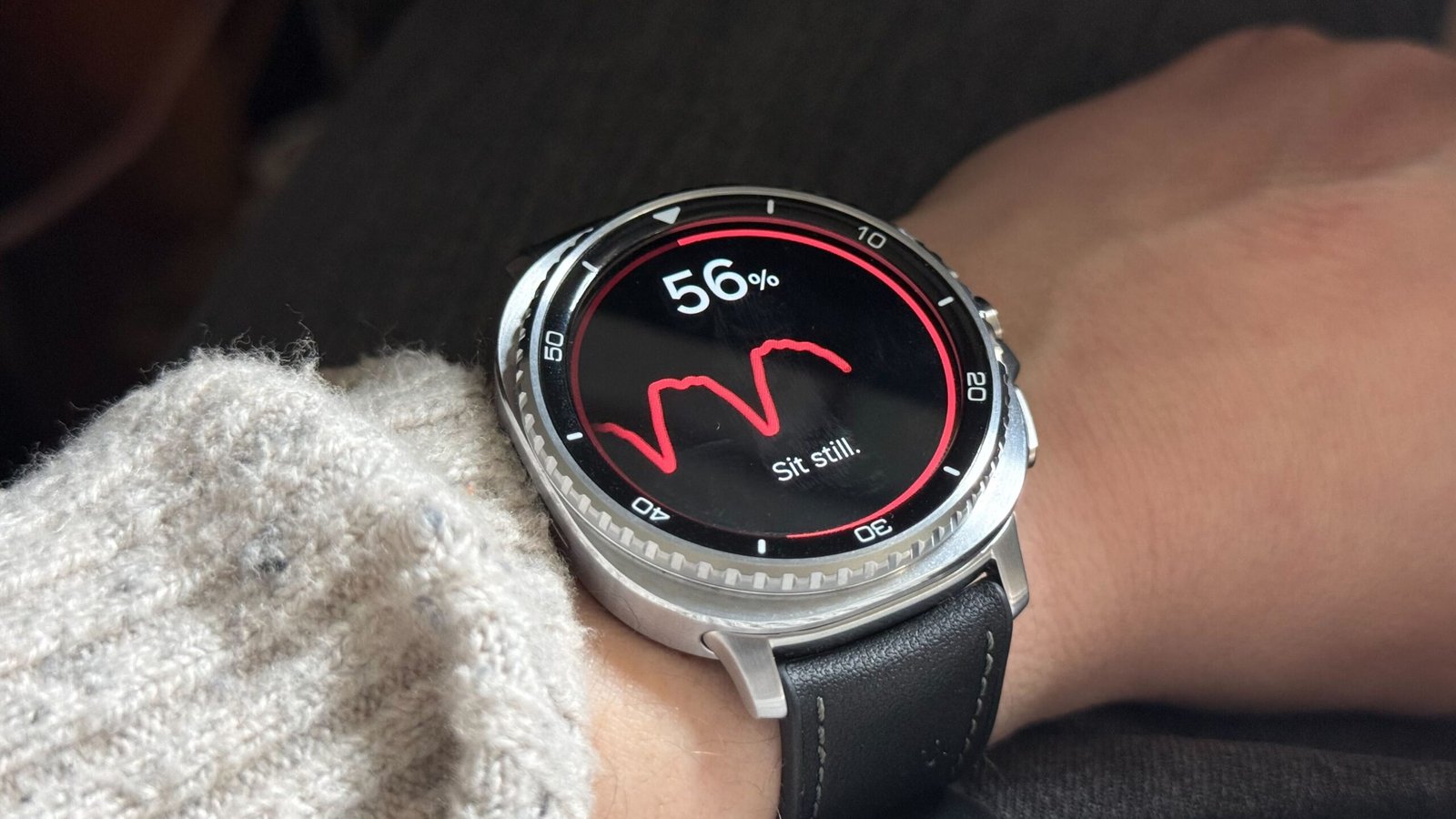
The blood pressure cuff is needed to calibrate the watch’s readings. Once you install the Samsung Health Monitor app and tell it you’re ready to calibrate, it will ask you to sit quietly and take three readings from the cuff. Before you start, the app warns you to avoid “exercise, bathing, alcohol, caffeine, and nicotine” for 30 minutes.
Many things can affect the accuracy of a blood pressure reading, so I already knew to sit with my feet uncrossed, not to have a full bladder, and to make sure I was sitting quietly for at least a few minutes before taking the reading. A screen that the Samsung app showed me after calibrating said that I was supposed to sit with my hands resting on a table for five minutes before taking readings.
Even though both readings are taken at the same time—the watch on one arm, your cuff on the other—you have to sit quietly until the watch is done. Moving around after the cuff finishes, but while the watch reading is still going, can result in a null result that requires you to redo the watch reading. The app didn’t recommend a waiting period between readings, but some blood pressure guidelines mention that you should wait about two minutes between readings.
Where to get a blood pressure cuff
Access to a blood pressure cuff is probably the most annoying part of the process for most people. You could use a blood pressure machine at a pharmacy, or ask a doctor (or, say, a nurse friend who has a sphygmomanometer) to do the readings for you.
But if you’re interested in tracking your blood pressure, it probably makes sense to get your own cuff anyway. A basic wrist cuff shouldn’t cost more than about $20-30 and you can grab one from Amazon or any pharmacy. I already had one of these, so that’s what I used.
Samsung recommends an arm cuff if possible, like this $49 model. These are supposed to be a bit more accurate than the wrist cuffs. Both types will inflate themselves and do the reading automatically, so you don’t need any special expertise to operate them, nor even any help to do the reading while you’re keeping an eye on your phone and watch.

Are the readings accurate?
While the blood pressure feature is new in the U.S., it’s been available in Europe and South Korea since about 2020. That’s enough time for several studies to have been done on Samsung’s technology. (It takes time to collect and publish data, so the newest Galaxy Watch models aren’t represented in the literature yet—but older Galaxy Watch models are.)
This Korean study from 2022 concludes that the Galaxy Watch blood pressure technology has a “systematic bias” toward the calibration readings. That means it will underestimate high blood pressure and overestimate low blood pressure. This is the same phenomenon I see Whoop MG users complain about—they say the device tends report blood pressure numbers that are similar to their last measurement that was taken without the device. At that point, is the device really adding anything?
The Korean Society for Hypertension released a position paper in 2021 with recommendations for consumer blood pressure technology. For smartwatches, it recommends scrupulously following the instructions for readings, which get a bit more detailed than the ones I mentioned above—check the paper itself for the society’s full recommendations. It also notes that there can be a few points’ difference between your right and left arms.
But more importantly, the society recommended against using smartwatch measurements for blood pressure for people who are pregnant or have any of a variety of health conditions, or are taking certain medications. The blood vessels change during pregnancy in ways that could confuse a smartwatch-based sensor. The other health conditions and medications mentioned are: “aortic valve insufficiency with wide pulse pressure, atrial fibrillation with considerable beat-to-beat variability, peripheral vascular disease with weak perfusion, diabetes, cardiomyopathy, ESRD, neurological disorders such as hand tremor, blood clotting disorder, or taking antiplatelet agents / anticoagulants.”
The society also said that smartwatch blood pressure readings aren’t reliable for a pressure below 60 mmHg or a systolic (top number) pressure above 160 mmHg, and may not be reliable enough for people who already have hypertension and need to monitor it. But after all those caveats, they speak favorably about the idea that people who want to measure their blood pressure from a watch are at least thinking about their blood pressure, and those who have hypertension may end up getting diagnosed earlier because they’re checking it regularly.
This articles is written by : Nermeen Nabil Khear Abdelmalak
All rights reserved to : USAGOLDMIES . www.usagoldmines.com
You can Enjoy surfing our website categories and read more content in many fields you may like .
Why USAGoldMines ?
USAGoldMines is a comprehensive website offering the latest in financial, crypto, and technical news. With specialized sections for each category, it provides readers with up-to-date market insights, investment trends, and technological advancements, making it a valuable resource for investors and enthusiasts in the fast-paced financial world.