We may earn a commission from links on this page.
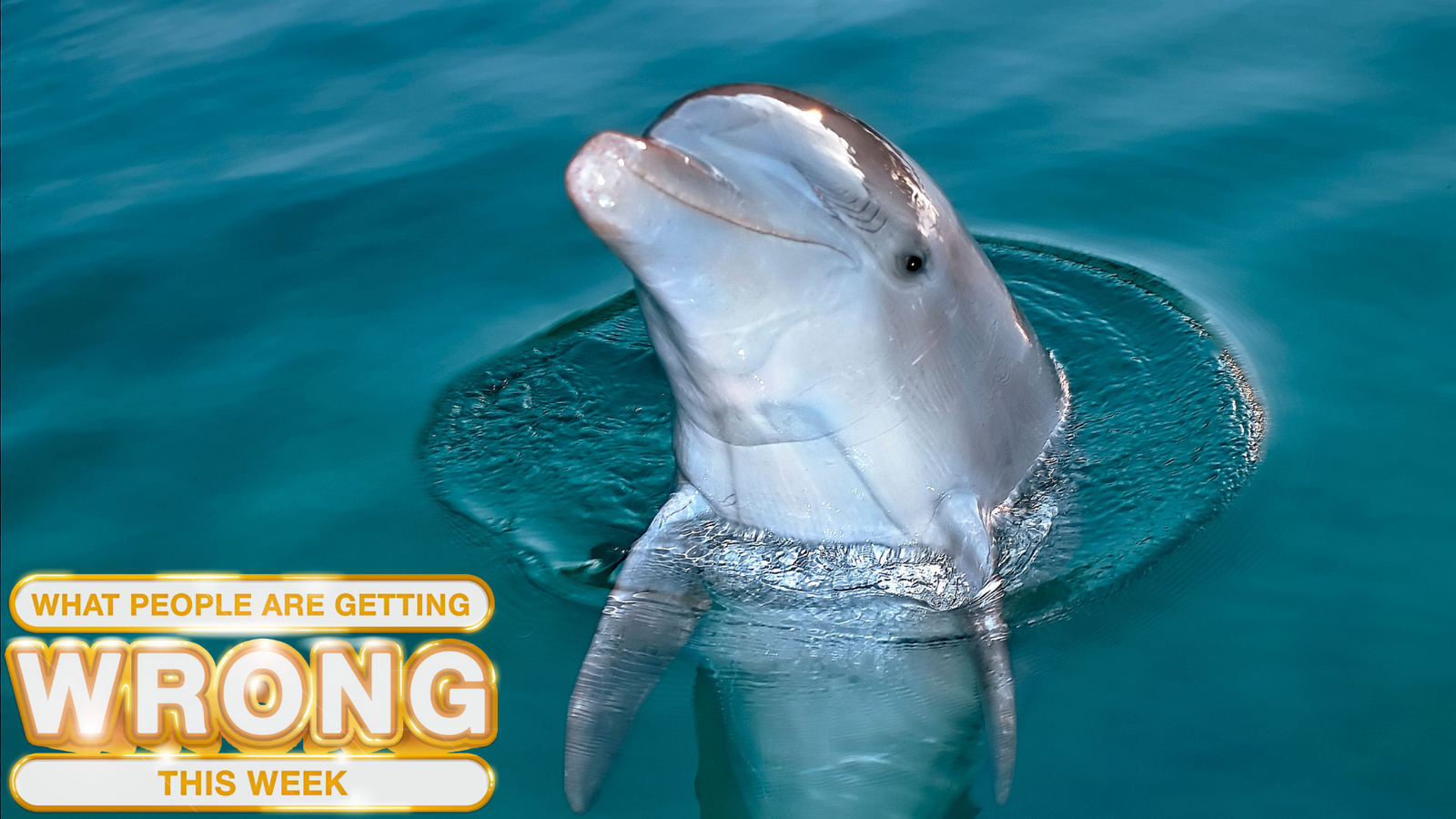
Breaking news out of Florida: Lee County deputies reportedly arrested a man recently on the beach near the Sanibel Causeway. The unnamed suspect was found dripping wet and drawing detailed diagrams in the sand. He told officials he’d been kidnapped by dolphins, pulled under the surface, and forced to build an underwater city. The man said the Head Dolphin, “Gerald,” communicated with him through clicks, and found some way to help him breathe for several days. You can get more details in this TikTok video that’s been viewed over five million times in the last few days:
It turns out, unsurprisingly, that this story is false: no one was arrested (why would they be arrested, even if this did happen?); the incident never occurred.
A patient dolphin expert debunks these and other dolphin claims
I talked with Justin Gregg of the Dolphin Communication Project to get to the truth about our aquatic pals (or nemeses?). Gregg is an animal cognition expert, a dolphin scientist, and the author of Are Dolphins Really Smart?. If anyone knows the truth about dolphins’ soggy cities, it’s Justin Gregg.
Stephen Johnson: Do dolphins use humans for construction projects in aquatic environments?
Justin Gregg: No. It’s insane. Absolutely not.
SJ: Do dolphins even live in underwater cities?
JG: No, that’s also insane. First of all, they don’t build anything. They don’t have thumbs.
SJ: Maybe that’s why they need to kidnap people.
JG: Look at it this way: Why do humans build shelters? Because it’s raining or whatever. Are dolphins protecting themselves from the rain? No. It’s already wet.
SJ: Okay, but should dolphins live in cities?
JG: Dolphins are not stationary animals. They have places to go and things to do. There would be no purpose to them having a city…everything about them is evolved to help them be free swimming animals that live in groups that swim around. It’s like asking, why don’t dogs fly?
SJ: Dolphins have sophisticated hunting behavior, right? They work together in groups to herd fish, for instance. Could they do that to kidnap a person?
JG: I don’t even know what “kidnap” would mean to a dolphin. Where would they be taking them and why? It’s weird.
SJ: Changing gears a bit: The dolphin in the story is named “Gerald.” Do you know him?
JG: Nobody knows Gerald, because Gerald does not exist.
SJ: So are you POSITIVE dolphins don’t live in underwater cities and call themselves Gerald?
JG: Yes, and if you ask any dolphin scientist, you will get the exact same answer. There’s no professor somewhere who’s going to say, “I’ve seen the city.”
Still, the fact that enough people believed the story that the sheriff’s office had to issue a statement denying it says something about the strange place dolphins hold in our cultural collective unconscious; if this story was about sea otters, no one would have believed it. Dolphins have been the center of conspiracy theories since the 1960s, when the world’s leading dolphin researcher ascribed superhuman powers to the sea mammals. And the kidnapping story is a little like something that actually happened.
Tião, Brazil’s murderous dolphin
Dolphins may not kidnap people, but they do occasionally get aggressive, and in 1994, a dolphin killed a guy in Brazil. Tião was what’s known as a “lone dolphin,” a dolphin who likes hanging around with humans instead of his fellow aqua-bois. Tião became a tourist attraction on the beach at Caraguatatuba, where people would swim with him, shove popsicle sticks in his blowhole, and try to pour beer in his mouth (yay, people!). In December 1994, two swimmers, Wilson Reis Pedroso and João Paulo Moreira, apparently took it too far. The pair were reportedly harassing Tião, and the dolphin broke Pedroso’s ribs and head-butted Moreira so hard the man died.
The dolphin seems to have gotten away with it, too. There was no trial. Tião swam around the town for a few months, as if to say, “I wish someone would,” then left during the summer of that year, most likely having rejoined a pod. Good for him.
John C. Lilly: the man behind the weird things people believe about dolphins
If you’ve ever wondered why your mushroom dealer has a dolphin tattoo on her ankle, you can thank one man: John C. Lilly. Lilly is the inventor of the sensory isolation tank, and the father of dolphin-based conspiracy theories. “He was a medical doctor who found out that dolphins had large brains,” Gregg said. “That was a big deal when it was discovered in the 60s. They started doing experiments and saying they’re pretty good at learning stuff, like dogs.”
But John Lilly took it further. Lilly believed dolphins were smarter than dogs, and smarter than humans. It was the 1960s, so Lilly’s ideas were taken seriously by serious people, at least at first. “He was beloved for a couple of years…he actually got a lot of money from the government, from NASA, to study dolphins, because he said, ‘if we can crack the code of dolphin language, we’ll be able to crack the alien code.'” according to Gregg.
Sex and drugs at the dolphin trap-house
Lilly took NASA’s money and built “The Dolphinarium,” a house on the island of St. Thomas with a partially flooded floor, so Lilly’s wife, Margaret Howe Lovatt, could live, eat, and sleep in the same space as a dolphin named Peter. The idea was to isolate the dolphin so it could only socialize with a person, then it would have to learn to talk. It didn’t, but Lovatt “fell in love” with the dolphin despite the language barrier. She eventually “seduced” (abused) the dolphin too, but only so it would focus on its English lessons, she claimed. Then John Lilly dosed it with LSD, because maybe that would do something? (According to Gregg, LSD doesn’t seem to work on dolphins, but you still shouldn’t give it to them. “You would run afoul the Marine Mammal Protection Act and be thrown in jail, so don’t do that.”)
Anyway, Lilly’s money ran out and the experiment was deemed a failure. Peter later, reportedly, died by dolphin suicide—dolphins are voluntary breathers, and Peter just decided not to one day. (I wouldn’t be surprised if being isolated and repeatedly abused for years by hippie mad scientists had something to do with it.)
Rather than questioning his premise, Lilly concluded that the barrier to inter-species communication wasn’t a lack of intellect, but a difference in dimensions. So he took a ton of ketamine in sensory deprivation tanks and talked to cosmic dolphins all day long.
(All of this detailed in John C. Lilly’s excellent book Man and Dolphin, which you should read at once.)
Dolphin research: back on track
The story of John C. Lilly is both hilarious and disturbing to me, but it’s a lot less enjoyable to dolphin researchers. “Lilly actually set back the study of dolphins by about 20 years, because everyone was afraid to say, ‘I study dolphins.'” Gregg said. “We’re all back on track now. Now you can study dolphins legitimately,” he added.
Military dolphins
Director Mike Nichols followed up his seminal masterpiece The Graduate with The Day of the Dolphin, a 1973 film in which the CIA co-opts the research of a John Lilly-like scientist to train a dolphin to assassinate the president. And it’s based on the tiniest bit of truth. The U.S. Navy’s Marine Mammal program has been training bottlenose dolphins and seals to detect mines since the 1950s. Meanwhile, in Russia, they reportedly affix dolphins with weaponized harnesses to take out enemy divers. For real. Although, as Gregg points out, “you could train a rat or a cat or a dog if you just strap the right dangerous weapon onto it and give it the right reward scheme.”
Other dolphin-related myths
Here’s a rapid-fire debunking of some other dolphin-related myths, many of which are covered in Gregg’s book Are Dolphins Really Smart?
-
Dolphins save drowning humans: There have been cases where dolphins seem to push drowning people toward shore, but we don’t know if they’re “saving” them. They could be obeying their natural pushing instinct—they push dead seals and logs around too. It’s probably survivorship bias: If a dolphin pushes you to shore, it’s a miracle. If it pushes you out to sea, you won’t be around to tell the story anyway.
-
Dolphins are peaceful: They can get aggressive with people. They sometimes attack porpoises for no reason we can discern.
-
Dolphins are smiling: That’s just how their jaws are shaped.
-
Dolphin echolocation can cure cancer: This has actually been studied and there’s nothing to it.
-
Female dolphins have corkscrew shaped vaginas: Wait, this one is true! Cool!
-
Dolphins are on the brink of extinction: To end on a positive note: While there are some species of dolphins that are in danger, particularly river dolphins, the iconic bottlenose dolphins are doing well, all things considered. Their status is “least concern,” meaning the population is stable and they number in the hundreds of thousands or millions globally.
This articles is written by : Nermeen Nabil Khear Abdelmalak
All rights reserved to : USAGOLDMIES . www.usagoldmines.com
You can Enjoy surfing our website categories and read more content in many fields you may like .
Why USAGoldMines ?
USAGoldMines is a comprehensive website offering the latest in financial, crypto, and technical news. With specialized sections for each category, it provides readers with up-to-date market insights, investment trends, and technological advancements, making it a valuable resource for investors and enthusiasts in the fast-paced financial world.