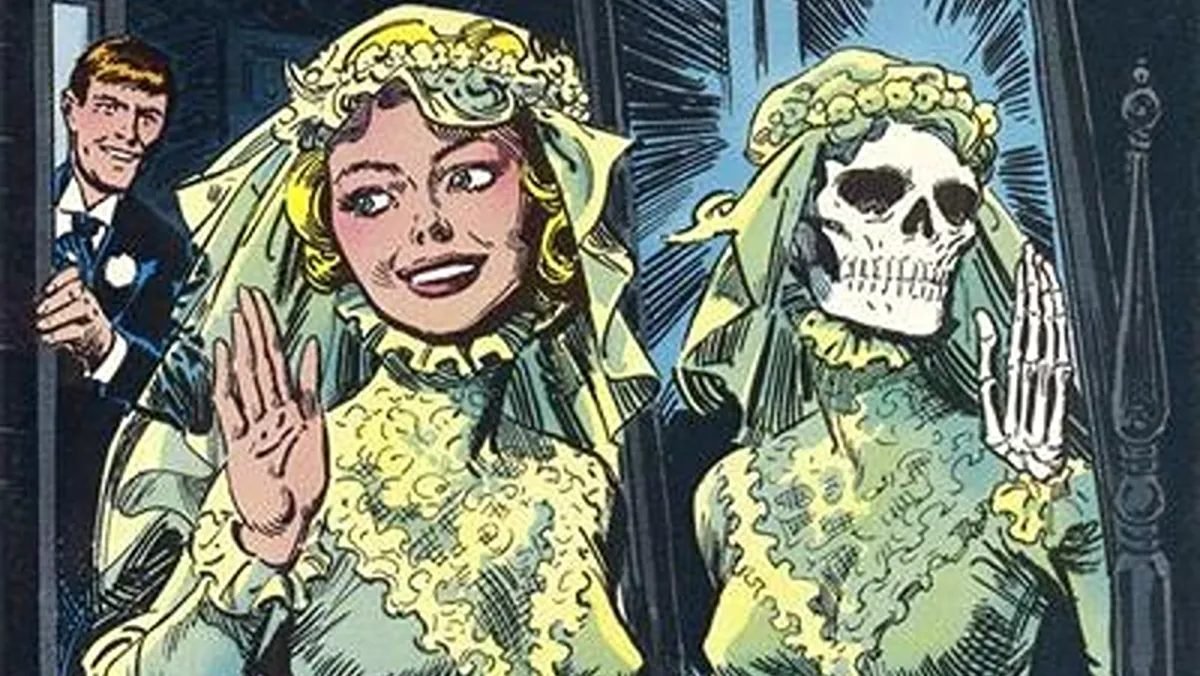
DC Comics is coming up on a century of publication. Over almost a hundred years, a business is bound to accrue a fair share of odd, outlandish ideas and business decisions. DC is proof of this, with plenty of wacky stories published throughout its history.
From supernatural and Western stories to characters that have fallen victim to the fading of time, DC has dipped its fingers into many pies over the years. Here are 9 comics you probably didn’t know that DC published.
1. Ghosts

DC’s Ghosts was a horror anthology, with each issue containing several illustrated short stories. Its subtitle was “True Tales of the Weird and Supernatural.” 112 issues were published from 1971 to 1982. It was a short run, but DC revived Ghosts for a Halloween issue under its “Vertigo” imprint in 2012.
Another very similar title that ran from 1968 to 1971 before a revamp in 1999-2000 and another in 2013 was The Witching Hour. This was yet another horror/supernatural anthology. The 1999-2000 version was picked up and re-released in 2024.
2. Kamandi: The Last Boy on Earth

Running from 1972-1978, Kamandi was a dramatic adventure comic befitting the time it was written in. It followed a boy after the Great Disaster wiped humans from the face of the earth, leaving behind a race of mutated man-like animals. The tagline? “Beasts who act like men, men who act like beasts.”
Here’s the synopsis of issue #1:
Kamandi avenges the death of his grandfather, who was killed by wolves, but is captured by a tiger named Caesar—who turns him over to dog-scientist Dr. Canus!
Definitely corny in a nostalgic way. This comic series was penned and drawn by the comic legend Jack Kirby. Kamandi was loosely based on Planet of the Apes, which was very popular at the time of its publication. You can own the entire comic run and have a weird piece of Kirby history.
3. Our Army At War (Sgt. Rock)

Our Army at War was a war anthology series that debuted the Easy Company, a fictional U.S. Army unit led by Sgt. Rock. It detailed their adventures during World War II, placing them in the midst of real-life events.
The series ran from 1952 to 1977. It was rebranded to simply Sgt. Rock in 1974, after an overwhelmingly positive reception to the character. Rock became such a fan favorite that the stories shifted from covering overarching war stories to focusing specifically on developing his character.
All American Men of War, and after its inception at Quality Comics, G.I. Comics were among other war-related series under the DC name. Now, DC is putting war stories together in its DC Finest collection and omnibuses.
4. Plop!

Dubbed “The Magazine of Weird Humor,” Plop! was DC’s attempt to keep up with its own success with the satire and dark humor of MAD Magazine. It ran for 24 issues from 1973-76.
Weird was not an understatement, especially looking at the covers. Each featured an odd (read: pretty unsettling) character or creature. These covers were detailed, too, even including minuscule comics and characters in the margins or background. The stories within were the juicy part, a collection of adventures that made dark or spooky situations hilarious. Plop! even had hosts who acted as narrators and broke the fourth wall.
Raphael Chang from Raph’s Retro Comics does a great job of explaining the series’ history in-depth:
5. Weird Mystery Tales

DC was on a kick of including the word “weird” in their titles for a while. Weird Mystery Tales was another collection of short horror stories, much like Ghosts and House of Secrets. Its short run began in 1972 and ended in 1975. Each issue included two to three standalone stories.
Almost certainly the world’s busiest man, Jack Kirby was responsible for the story and art in this one, too. The characters introduced tied back to other comics that would eventually become part of a shared universe with other Vertigo titles like The Sandman.
6. Claw The Unconquered

Claw The Unconquered is probably as 1970s as you can get, both in subject matter and portrayal. It certainly shows its age. I cropped the objectifying art from the first issue’s cover… you’re welcome.
Claw is just your average guy… everywhere besides his demonic, deformed right hand. Hence the name. He is a master swordsman and was given a glove to shield him from his hand’s influence and hide it. The claw itself was a curse passed down through generations after the hero’s ancestor trifled with a demon.
Claw’s original comic run only lasted three years, from 1975 to 1978. Luckily, though, DC didn’t forget about him. Claw had a brush with stardom when he made a cameo as an ally of Wonder Woman and Beowulf (the fictional hero from the 8th-ish-century epic poem) in 2003’s Ends of the Earth saga. Over the course of three comics, the ragtag team fights D’Grth, a demon-god, and kills him in a pretty gruesome way. He also appeared in Red Sonja/Claw: The Devil’s Hands, a 2006 miniseries, and proceeded to get his own limited run.
7. Richard Dragon, Kung-Fu Fighter

Richard Dragon was the Chuck Norris of DC. An 18-issue series, Kung-Fu Fighter was about a young thief-turned-martial-artist and his fellow Kung-Fu pupil. Each issue follows a classic adventure/action structure, with kidnappings, back-stabbings, mob bosses, and plenty of punching and kicking.
The characters actually appeared for the very first time in a 1974 paperback book before their comic run. Called Kung Fu Master: Dragon’s Fists, it was supposed to become a pulp series but was cancelled after the single novel. Instead, it saw the light in comic form after DC comissioned writer Dennis O’Niel to adapt the story.
A cool nugget for modern DC fans, Lady Shiva’s first appearance was in Kung-Fu Fighter‘s fifth issue. Bronze Tiger also debuted in the first issue.
8. The Sandman

Before one of Vertigo’s most popular comics was The Sandman in the 1980s, there were two characters who went by the same name but had very different stories. First was Wesley Dodds, a vigilante called the Sandman introduced in the 1940s. Dodds was a chemist who created a sleep gas to use on enemies during World War II, rather than simply killing them. He was a founding member of the Justice Society of America, which, during his time, included Doctor Fate, Hourman, Hawkman, and others. Unfortunately, Dodds never got his own run.
Instead, Jack Kirby co-wrote a revival of the character with a new name and backstory in 1974. Garrett Sanford was the Sandman, and this first official volume introduced the concept of a dream world, called the Dreaming, and Sandman’s abilities. The limited run only lasted six issues and followed the vigilante on dream/nightmare-related missions. All of this, of course, set up the character’s most popular revival in the late 1980s, which rewrote his story yet again.
9. Phantom Stranger

The coolest thing about the Phantom Stranger is that nobody actually knows much about him. There is conjecture around his origin story, with some believing he is a fallen angel, and others that he is a remnant of a previous universe or timeline. The character tends to appear and intervene in supernatural events, and has ties to plenty of other characters and happenings across DC’s universe.
He first appeared in 1952 in his own 6-issue series. The character then had a second volume starting in 1969 that lasted 41 issues. Volume 3 began in 1987 and only resulted in four new issues. In 2012, a fourth volume began and ran for 9 issues. Over the years, the Stranger appeared in everything from Hellblazer and The Spectre to Zatanna and even Justice League.
The post 9 Niche DC Comics You (Probably) Didn’t Know Existed appeared first on Nerdist.
This articles is written by : Nermeen Nabil Khear Abdelmalak
All rights reserved to : USAGOLDMIES . www.usagoldmines.com
You can Enjoy surfing our website categories and read more content in many fields you may like .
Why USAGoldMines ?
USAGoldMines is a comprehensive website offering the latest in financial, crypto, and technical news. With specialized sections for each category, it provides readers with up-to-date market insights, investment trends, and technological advancements, making it a valuable resource for investors and enthusiasts in the fast-paced financial world.