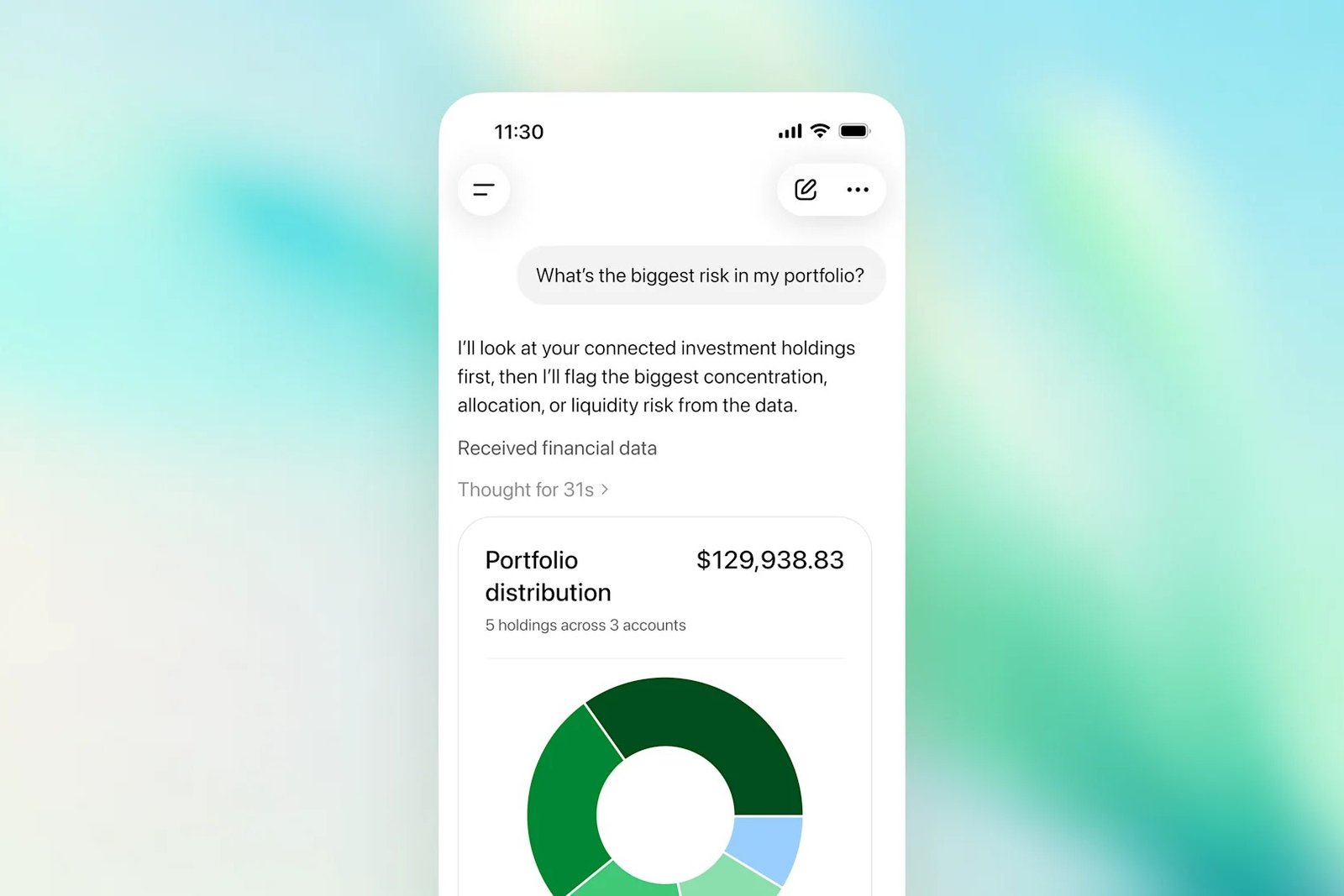
If there’s one area where LLMs excel, it’s plowing through reams of data and teasing out patterns, trends, and insights. So it’s not surprising that OpenAI is zeroing in on personal finance, with ChatGPT now capable of delving into our banking, checking, and investment accounts.
But I’m just not ready for it.
First, some background. Using a secure third-party platform called Plaid (support for Intuit is coming soon), ChatGPT Pro (and eventually Plus) users can enable integrations with more than 12,000 financial institutions, allowing ChatGPT to connect to and sync with a wide range of banking and investment accounts, from Bank of America and Charles Schwab to American Express and Robinhood. (By the way, more than 200 million users a month are already coming to ChatGPT with money questions, OpenAI says.)
Once connected, ChatGPT can use the data and transactions pulled from your various financial accounts for a dashboard that summarizes your current financial position, as well as for context in its conversations with you. ChatGPT will be able to generate more personalized responses to queries like “Have I been spending more recently,” “Help me come up with a plan to put away some money each month,” and “What did my recent vacation actually cost?” Those answers can come as standard text replies, tables, bar charts, pie charts—theoretically, you could get a quick snapshot of your financial position in just a few prompts.
But the idea of ChatGPT getting access to your bank accounts raises an immediate concern: Could it drain your accounts with one bad prompt or hallucination? On this point, we can relax. Even after granting access to your accounts, ChatGPT can only look at balances, transactions, investments, and debts; it can’t actually change anything, nor can it see your full account numbers.
OpenAI also says you can disconnect your various banking and investment accounts at any time, and that if you do, your associated financial data will be wiped from OpenAI’s servers within 30 days.
Things get dicier in a few other areas. While you can untether your financial account integrations in just a few clicks, any discussions you’ve had with ChatGPT about your finances will stay in those conversations unless you delete those specific chats manually. ChatGPT may also save “memories” about your finances, which you can manage and/or delete from the Finances page in the Settings menu.
More concerning is the fact that ChatGPT can use its financial discussions with you to train its models, unless you toggle off the “Improve model for everyone” setting in Settings → Data controls. You’ll definitely want to tweak that before using ChatGPT’s new personal finance integrations—all ChatGPT users should consider making that change.
Aside from the opt-out model training, it does feel like OpenAI has done everything mostly right when it comes to allowing ChatGPT to pick through our books. The account access is read-only, you can turn off the integrations (albeit with a brief lag time for getting your data wiped from OpenAI’s servers), and financial “memories” are stored in a centralized spot where they can easily be nixed.
There’s also the integrity of Plaid (the financial accounts gateway) to consider, but from all accounts it isn’t any more or less secure than Intuit, which I use to connect my banking and investment accounts to Quicken.
And yet, I’m not ready to throw open my books to ChatGPT. All those transactions in your banking and investment accounts paint an intimate portrait of who you are, what you do, and where your priorities lie. Yes, you can pick and choose which accounts you allow ChatGPT to see, but ChatGPT’s financial insights won’t be terribly useful unless you give it as much access as possible, and even a single credit card statement can pack a ton of personal details you may not want shared.
Could ChatGPT somehow run amok and release my financials to the world? That doesn’t seem likely, and we already know it can’t actually do anything with your accounts beyond examining them. But the way in which ChatGPT can “remember” your financials from previous conversations can be tough to track. (One option would be to confine financial discussions with ChatGPT to temporary chats, which are discarded once they’re closed.)
There’s also the issue of the quality of ChatGPT’s financial advice. OpenAI says that ChatGPT’s financial chats will default to GPT-5.5 Thinking—its most powerful reasoning model—and that it consulted with more than 50 finance professionals to grade ChatGPT’s performance.
Yet the substance of ChatGPT’s replies can be greatly influenced by the prompts we give it. Asking ChatGPT about recipes is one thing, but seeking financial advice is another—a misinterpretation or hallucination can have drastic outcomes.
Maybe I’m just being paranoid. I also realize that when it comes to finances, the privacy ship has pretty much sailed. (What does Bank of America know about me, anyway?) Still, I’m leery of connecting my bank accounts to ChatGPT. Perhaps I’ll be singing a different tune in a year, but I’m just not there yet.
This articles is written by : Nermeen Nabil Khear Abdelmalak
All rights reserved to : USAGOLDMIES . www.usagoldmines.com
You can Enjoy surfing our website categories and read more content in many fields you may like .
Why USAGoldMines ?
USAGoldMines is a comprehensive website offering the latest in financial, crypto, and technical news. With specialized sections for each category, it provides readers with up-to-date market insights, investment trends, and technological advancements, making it a valuable resource for investors and enthusiasts in the fast-paced financial world.