Exciting discoveries in particle physics are one of those things that it can be easy to get blase about. Some people get caught up in the obvious excitement, while others yawn: “Oh, you found the Higgs Boson, just like Higgs predicted. Call me when you have something new.” Well, if you’re in category B, prepare to yawn while the rest of us break out champagne, because it looks like we’ve finally found the glueball.
The glueball has got to be one of the oddest particles to fall out of the Standard Model. It’s not a fundamental particle, but its makeup contains no quarks– those itty bits that make up protons and neutrons– nor any leptons like electrons or muons. No, the glueball is a hadron made entirely of baryons: specifically, gluons, the force-carrying particles of the strong nuclear force. It’s also been called gluonium or a gluon-ball, but glueball is more fun.
Try and imagine a proton without any quarks. Remember that inside the proton there are three quarks, held together with force-carrying gluon particles. If you have zero quarks, but enough of those gluons tangled up in the right ways, and you get a tangible, if short lived particle. That’s the glueball, a neutral particle that will decay almost immediatly in to Pions. It works because gluons have ‘colour charge’– the strong nuclear force’s answer to electric charge.
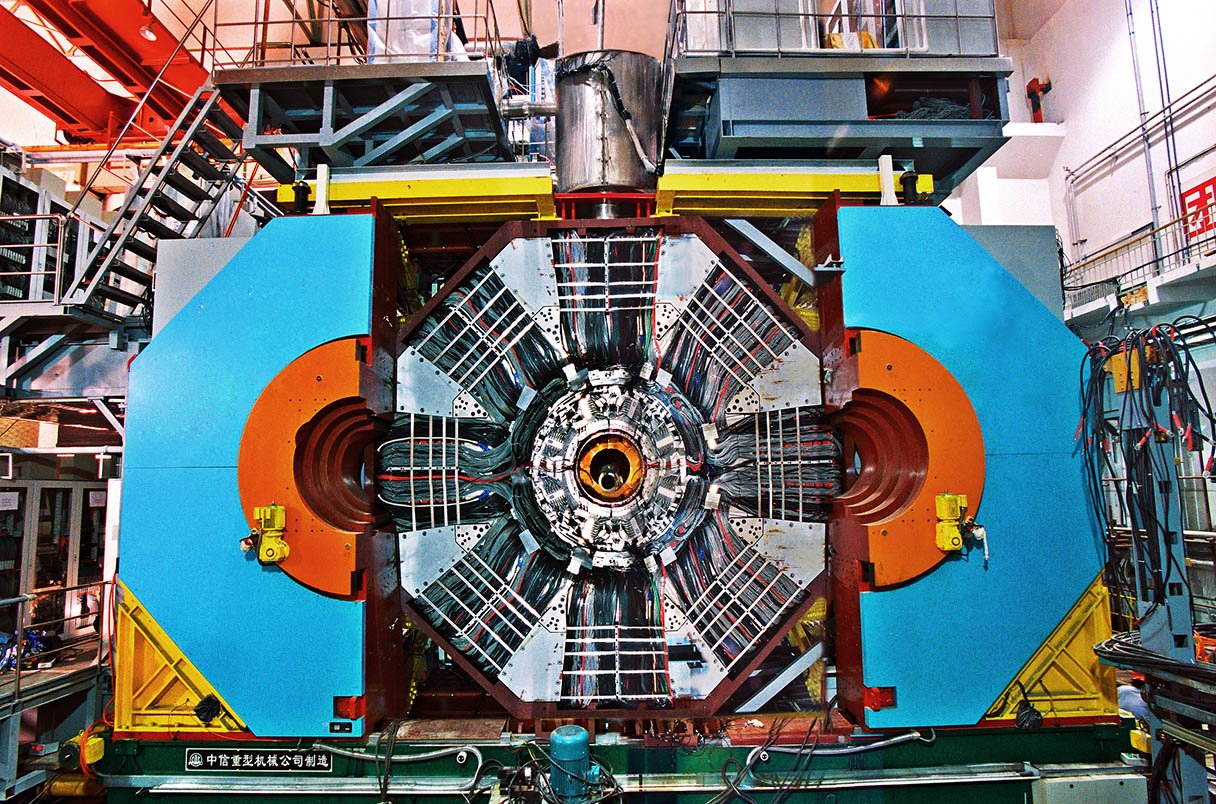
It’s also one of those things that will probably never be seen in nature: odds are, even in the hottest collisions, you’re going to get a quark or two mixed up with your gluon soup. That’s okay; the gluonic state is what we’ve been looking for. As long as the particle is mostly gluons, and behaves as the Standard Model predicts it should, physicists are inclined to call it good enough. The latest candidate to hit “good enough” is X(2370), which fell out of a collision in the Beijing Electron–Positron Collider II (BEPC II), as detected by the Beijing Spectrometer III (BES III). The paper hit ArXiv at the end of July. It’s taken the collaboration this long to make sure of what they were looking at, as they sorted through the terabytes of data an instrument like this generates.
Is this likely to affect you in any way? No. It confirms what we already thought we knew about the universe, and the particle itself is too short-lived to ever exist outside of some very extreme– mostly man-made– environments. On the other hand, it’s an excuse to celebrate scientific discovery, and we’ll take any of those we can, just like when the Muon Magnetic Moment measured in at the expected value, or neutrinos transmuted elements in exactly the way the models said they would. Besides, if we’re really lucky this result will turn out not to be a glueball, but something new and interesting. Then even the most jaded nerds will have reason to celebrate.
Header image: The Bejing III Spectrometer, BESII.
This articles is written by : Nermeen Nabil Khear Abdelmalak
All rights reserved to : USAGOLDMIES . www.usagoldmines.com
You can Enjoy surfing our website categories and read more content in many fields you may like .
Why USAGoldMines ?
USAGoldMines is a comprehensive website offering the latest in financial, crypto, and technical news. With specialized sections for each category, it provides readers with up-to-date market insights, investment trends, and technological advancements, making it a valuable resource for investors and enthusiasts in the fast-paced financial world.