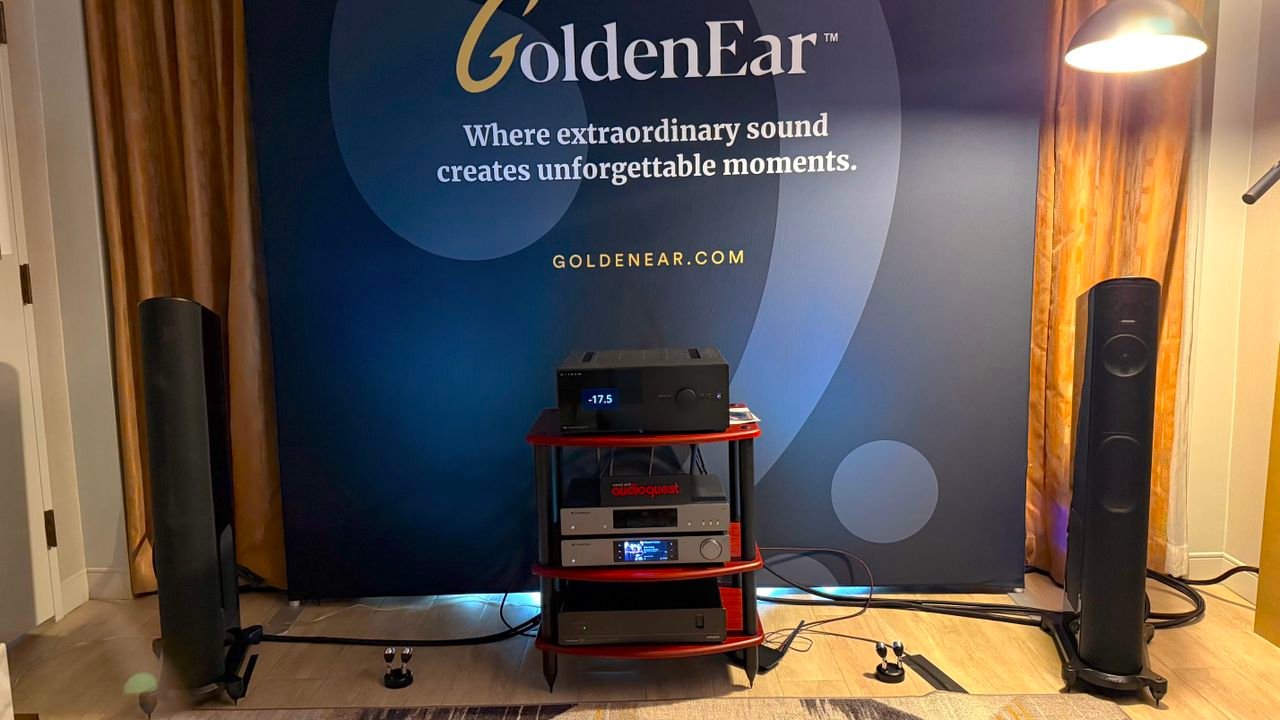
The concept of a hybrid speaker is rare, but not necessarily unique. However, what hybrid means when it comes to the Goldenear T44 is unparalleled. That’s because this speaker, along with its big brother, the T66, is both a powered and a passive speaker. All the best stereo speakers that I’ve come across have been one or the other, but not both.
If you’re not familiar, a passive speaker used to be the standard in homes 20 years ago (and a lot further back too). And when it comes to audiophile-level Hi-Fi, it still is. These speakers connect via speaker cables to an external amp that provides all the power and through which the audio signal is sent (whether directly or through additional hardware). You cannot use them without an amp.
Powered speakers (and their active cousins, where each driver receives its own dedicated amp unit), have become the more popular type of speaker with the advent of portable and bluetooth speakers. Powered designs integrate amplification so that all you need to do is give your speakers a power source, whether there’s a battery that needs to be charged or they just need to be plugged into the wall. But you don’t need a separate amp, because it’s all inside the speaker. Just connect your phone and you’re off to the races.
So, why make a set of speakers where half of the frequency range is already powered and the other half is not? For the Goldenear T44 (and the T66), it’s the listening experience. By using a 56-bit DSP-controlled Class D amplifier for the low-end, the T44 allows for a few things.
First, the low end will always have that quick, dynamic response that one should expect from a strong solid state amp. And second, by removing responsibility for the low-end from your external amp, it puts much less stress on that equipment, which is especially important if you’re using a tube amp. By removing the low-end from the tube amp, the Goldenear T44 can extend the life of your tubes.
The flexible sound
If you’ve never spent any time in the audiophile world, it can be an intimidating and expensive one — the Goldenear T44 themselves retail for $5,000 (about £3,700 / AU$7,070) a pair. And that’s without that external amp needed for the high end — you should be aware that using different amps with speakers will affect the way they sound. If you get deep enough into this world, you’ll come across bickering about which cables sound the best.
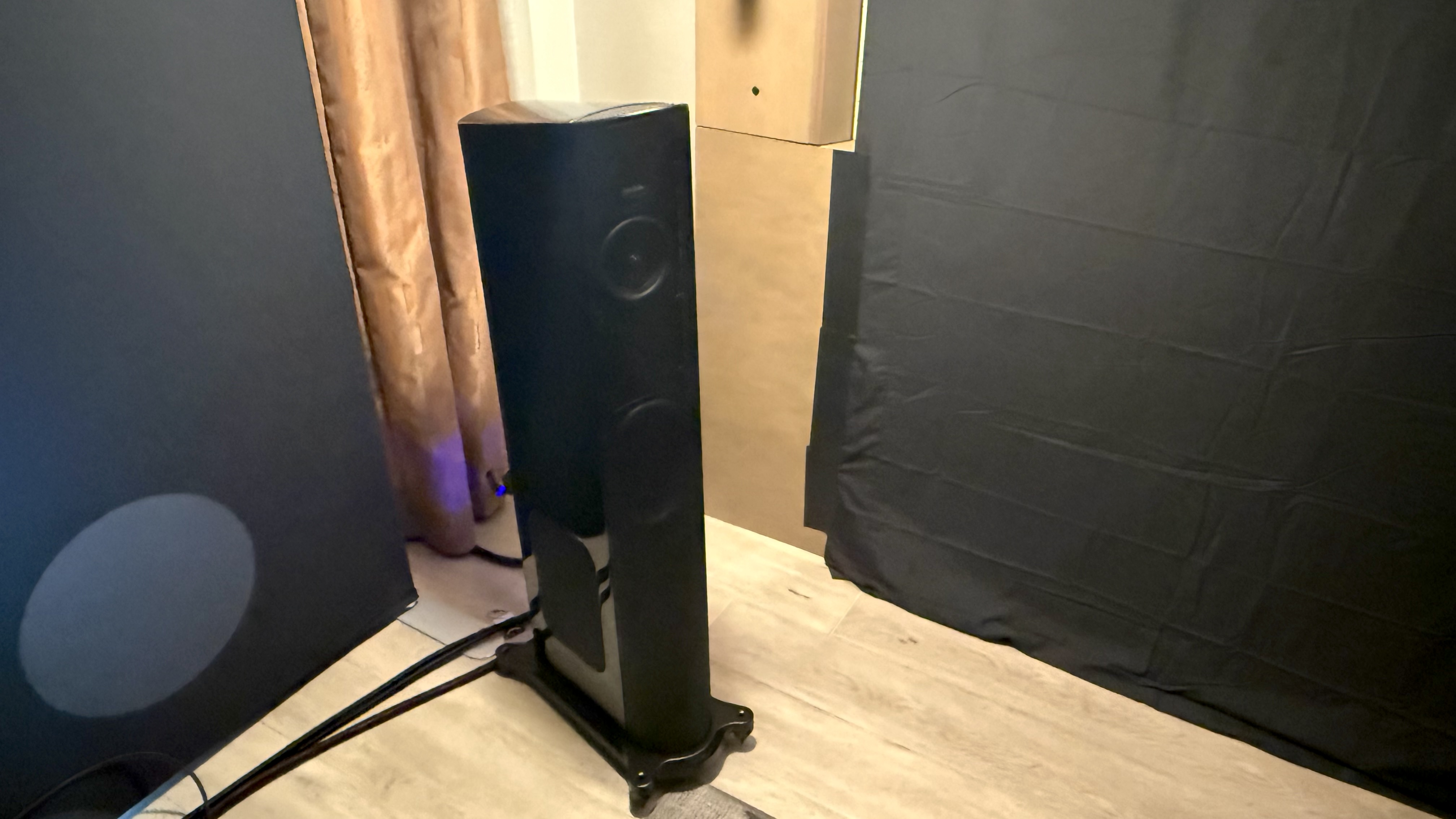
Because of that, being able to play around with different amps to change the sound of the top end of the Goldenear T44, specifically the sound that’s coming out of the High-Velocity Folded Ribbon tweeter (basically the same as an AMT tweeter) and the 4.5-inch mid-range driver, allows for a level of flexibility that’s just not available with other speakers.
If you want a very clean, detailed sound, you can pair them with all sorts of solid state amps, whether it’s another Class D one like what Goldenear uses to power the 5 x 9-inch bass driver (there are also two passive radiators to help with the low end) or maybe a Class A or A/B one. You can even bi-wire whichever amp you choose.
Or you can get a tube amp to add some of that sweetness, even harmonic distortion, to give a softer, more laid back sound to the high-end, while still retaining that punch in the low end. Plus, there’s a subwoofer level control so you can adjust the balance between the internal and external amp.
The drivers themselves are pretty special
Regardless of what amp you use, the fact that Goldenear uses a folded ribbon for its tweeter means exceptional detail – I’ve always found tweeters like this (again, similar concept to an AMT tweeters) means that you will be able to hear incredible nuance in the high-end. When I’ve seen speaker lines upgrade to AMT tweeters, it’s always been an improvement.
The woofer for the low-end is also fairly different. It’s a rectangular, long-throw driver that is able to move more air without needing a wider cabinet. These speakers measure less than eight inches wide. That’s not a lot of space for a big woofer. And being a planar speaker, it uses a flat diaphragm as opposed to the traditional cone, which minimizes the amount of distortion in the low-end.
To give you an idea of what these drivers do, the frequency range goes from 32Hz to 25kHz.

Become a TechRadar Insider by simply clicking ‘Join Now’ at the top of this page. Have a question? Please email membership@techradar.com
My experience with the Goldenear T44
I admit that I’m pretty new to Goldenear, but the company has a strong pedigree. It was started by Sandy Gross in 2010, one of the original founders of Polk Audio and also of Definitive Technology, and is now part of PML Sound International (Martin Logan, Paradigm, Anthem).
So, when I got a chance to sit and listen to the Goldenear T44 at this year’s Audio Advice Live, I really didn’t know what to expect. But I was more than pleasantly surprised. Kacey Musgraves’ Slow Burn sounded both intimate and epic with the way the T44 handled both her vocals, the guitar, and ethereal pads, while Ghost Rider’s Make Us Stronger hit hard in the low end for just a couple examples.
While I didn’t get a chance to hear the Goldenear T44 through multiple amps (this little listen was powered by one from Anthem), I can see how separating the highs and lows really open up what you can do with these speakers. I think if you’re looking for something different with the ability to blend sounds, the Goldenear T44 should be at the top of your list.
This articles is written by : Nermeen Nabil Khear Abdelmalak
All rights reserved to : USAGOLDMIES . www.usagoldmines.com
You can Enjoy surfing our website categories and read more content in many fields you may like .
Why USAGoldMines ?
USAGoldMines is a comprehensive website offering the latest in financial, crypto, and technical news. With specialized sections for each category, it provides readers with up-to-date market insights, investment trends, and technological advancements, making it a valuable resource for investors and enthusiasts in the fast-paced financial world.