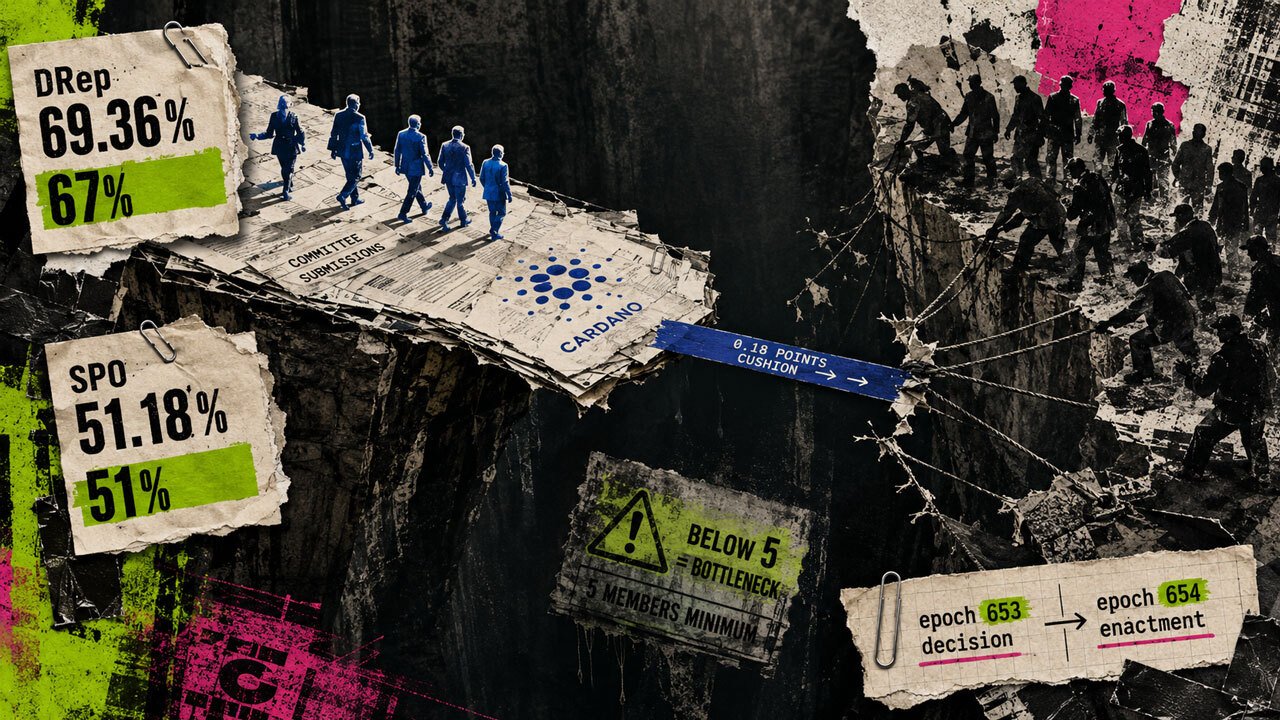
Cardano’s 2026 Constitutional Committee renewal had crossed both voting thresholds in a pre-boundary snapshot on Sept. 1, but formal ratification still waited for the epoch change. The narrow margin on the stake pool side exposed how non-participation can become an effective veto in the network’s on-chain governance.
Cardano divides governance authority among delegated representatives, stake pool operators, and the Constitutional Committee.
DReps vote with ADA delegated to them, SPOs represent block-producing stake pools, and the committee reviews the constitutionality of actions that require its approval. For an update to the committee’s own membership, DReps and SPOs vote while the committee does not.
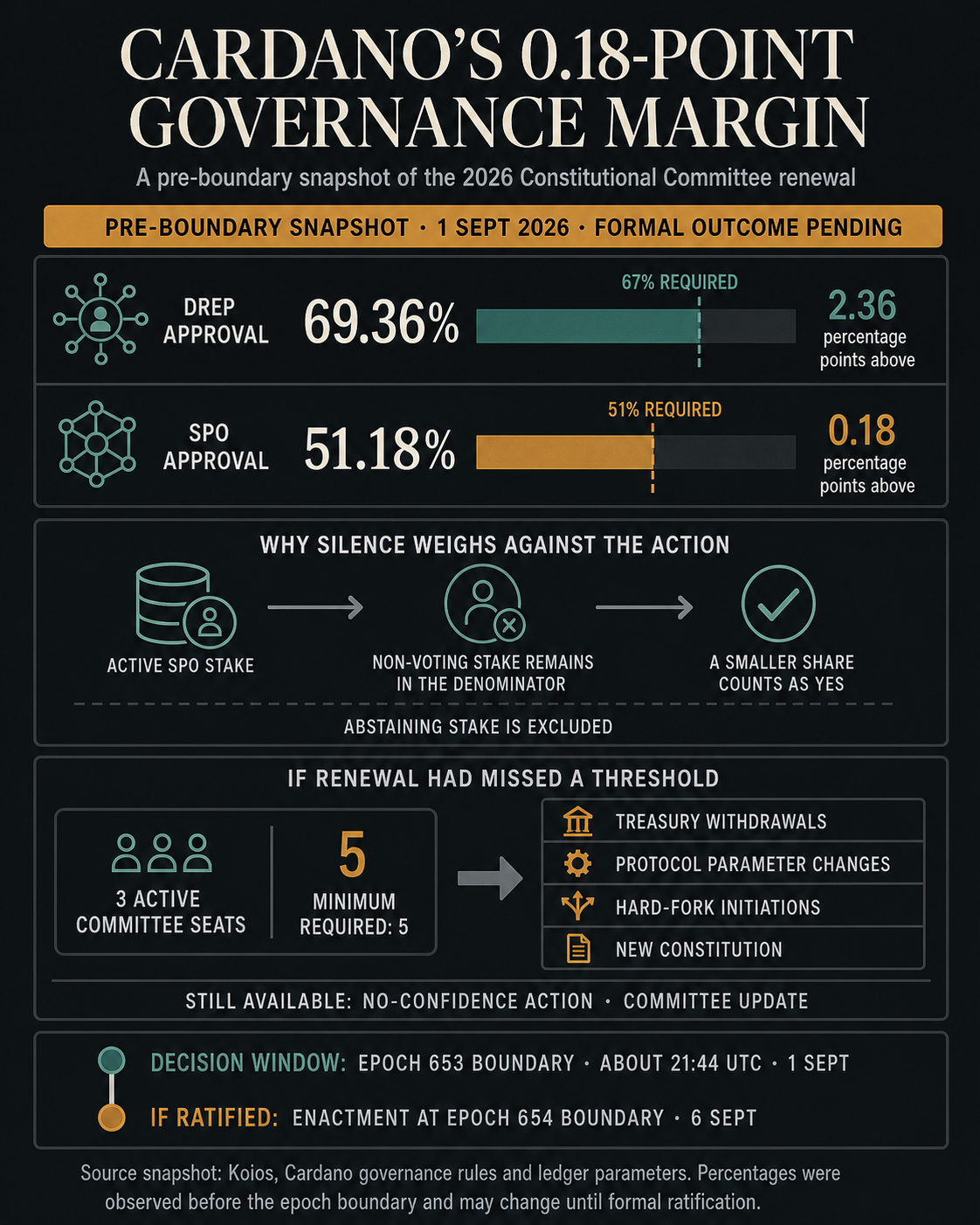
A synchronized Koios voting snapshot retrieved at about 09:59 UTC showed DRep support at 69.36% against a 67% threshold. SPO support stood at 51.18% against a 51% requirement, leaving a margin of 0.18 percentage points at that observed moment.
The proposal’s on-chain record still showed no ratification, enactment, or expiration, and the Koios chain tip remained in epoch 652. The decision was due at the boundary into epoch 653 at about 21:44 UTC on Sept. 1.
| Measure | Pre-boundary snapshot | Requirement or timing |
|---|---|---|
| DRep approval | 69.36% | 67% threshold met |
| SPO approval | 51.18% | 51% threshold met |
| Formal outcome | Pending in epoch 652 | Decision at epoch 653 boundary |
| Enactment if ratified | Pending | Epoch 654 boundary on Sept. 6 |
The thresholds come from Cardano’s epoch-652 protocol parameters, while Cardano’s governance overview and CIP-1694 set out the division of voting authority.
The key mechanism sits inside the SPO denominator. The Cardano Developer Portal’s governance rules say stake behind a pool that does not cast a ballot remains against ratification in the effective calculation. The pool has not submitted an explicit No, but its uncast stake still makes the Yes threshold harder to reach.
Abstention follows a different path. Explicit abstentions and stake assigned to alwaysAbstain are removed from the effective calculation.
The Koios breakdown separated roughly 2.008 million ADA of explicit SPO No votes from about 5.316 billion ADA in the total No or default-No side of the calculation. The gap indicates that non-participating stake created most of the drag on approval.
The four committee seats due to lapse raise the stakes of that denominator rule. Those seats remain valid through epoch 653 and expire as epoch 654 begins on Sept. 6. Without an enacted renewal, the committee would fall to three active members, below the minimum of five.
The five-seat line
Voting closes as epoch 652 ends, and ratification is assessed at the boundary into epoch 653. If the update is ratified there, it is scheduled to enact one epoch later at the start of epoch 654, the same boundary at which the four current seats lapse. The action page and a ledger-focused chronology align those two events.
A committee below its five-member minimum could not supply the approval required for new treasury withdrawals, protocol parameter changes, hard fork initiations, or a new constitution. The Cardano ledger implementation treats an undersized committee as lacking the voting threshold needed for actions that require committee approval.
No-confidence and update-committee actions would remain available because the committee does not vote on them. The cited protocol rules describe a ratification bottleneck affecting specified governance actions.
If the threshold-crossing snapshot held through the epoch boundary and the ledger ratified the action, the immediate three-seat bottleneck would be avoided. The vote would still leave a governance lesson: SPO approval rested just 0.18 percentage points above the line after billions of ADA in non-voting stake weighed against passage.
Intersect had warned that failed renewal could interrupt governance continuity and may affect progress toward Dijkstra, Cardano’s next hard-fork program. Cardano has separately described the constitutional preparation required for Dijkstra.
Those sources frame a timeline impact as a risk rather than a confirmed delay.
At the latest synchronized pre-boundary snapshot, late voting had moved the renewal above both thresholds. Its razor-thin SPO margin still demonstrated the force of Cardano’s participation rule: when uncast stake remains in the denominator, governance silence can decide whether the network’s decision-making machinery keeps moving.
The post Cardano clears key voting thresholds for constitutional committee renewal by 0.18% margin appeared first on CryptoSlate.
The pre-boundary vote shows how non-participating SPO stake can weigh against renewal even without an explicit No.
The post Cardano clears key voting thresholds for constitutional committee renewal by 0.18% margin appeared first on CryptoSlate. DeFi, Featured, Governance, Technology, Cardano
This articles is written by : Nermeen Nabil Khear Abdelmalak
All rights reserved to : USAGOLDMIES . www.usagoldmines.com
You can Enjoy surfing our website categories and read more content in many fields you may like .
Why USAGoldMines ?
USAGoldMines is a comprehensive website offering the latest in financial, crypto, and technical news. With specialized sections for each category, it provides readers with up-to-date market insights, investment trends, and technological advancements, making it a valuable resource for investors and enthusiasts in the fast-paced financial world.