
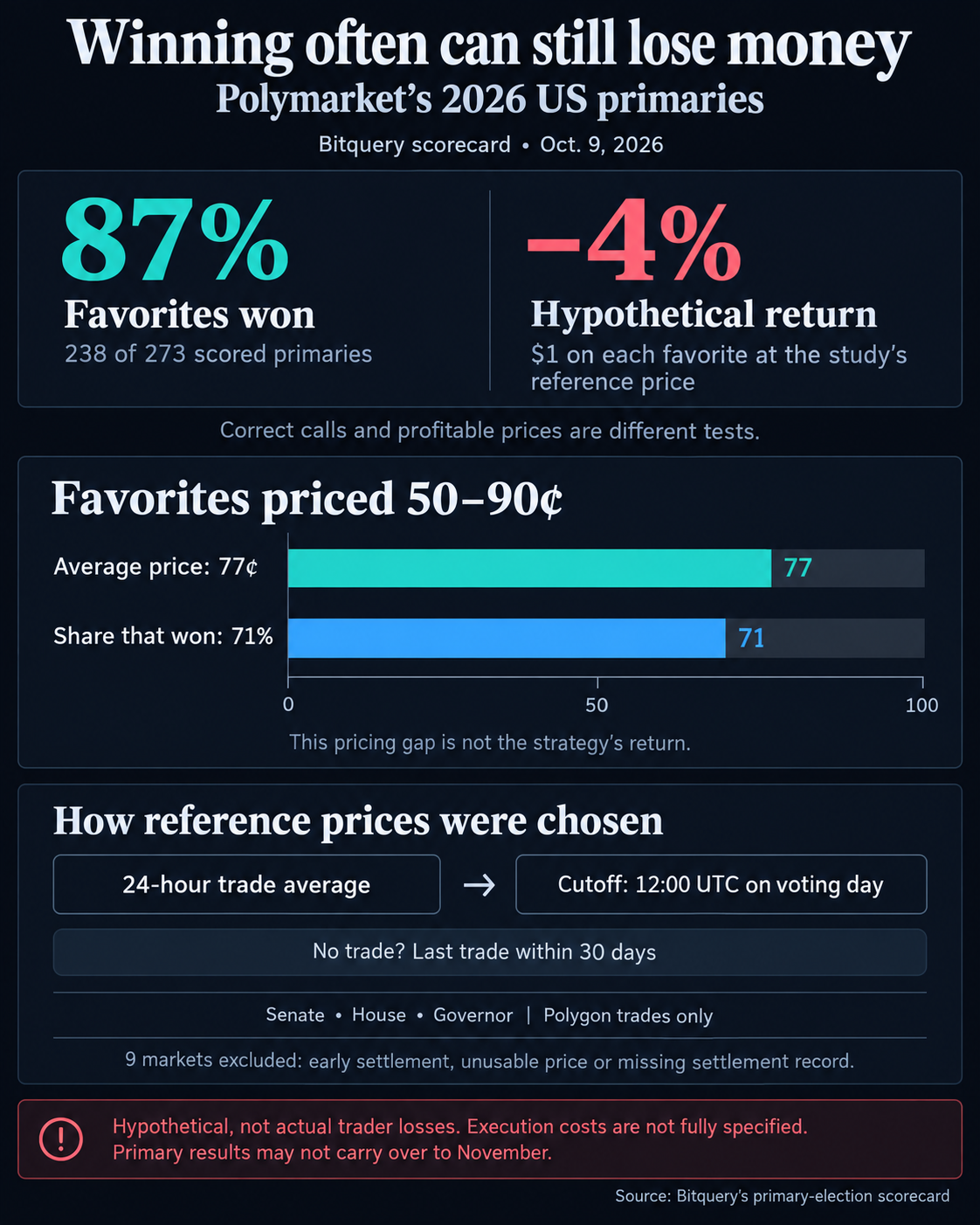
A hypothetical strategy of backing the favorite on prediction market Polymarket in every scored 2026 US primary would have lost 4%, even though those candidates won 87% of the time, according to blockchain data provider Bitquery’s scorecard dated Oct. 9. The result separates two questions for election bettors: who is most likely to win, and whether their contract is worth the price.
Bitquery found that the candidate with the highest study reference price won 238 of 273 Senate, House and governor primaries. But its hypothetical strategy of putting $1 on each favorite at the study’s reference price lost four cents per dollar.
The strongest favorites did much of the work behind the headline accuracy rate. Candidates priced at 90 cents or more won 177 of 182 races. Among favorites priced between 50 and 90 cents, however, 71% won despite an average price of 77 cents.
An outcome share pays $1 when it wins and nothing when it loses. Buying an expensive favorite therefore leaves little profit on a winning share, while a losing share wipes out its purchase cost. Enough losses can outweigh many correct calls.
Putting the same dollar amount into every race also buys different numbers of shares. A cheaper winner produces a larger payout for that stake than an expensive winner. Counting correct predictions treats every race equally; calculating returns must account for those different payouts.
Reference prices limit the betting conclusion
Bitquery averaged trades during the 24 hours before 12:00 UTC on voting day. When a candidate had no trade in that window, it used the last trade within the preceding 30 days. For races that went to a runoff, it used the runoff date.
Those averages, and potentially stale fallback trades, are reference prices rather than guaranteed buy quotes at the cutoff. The published methodology does not specify a full adjustment for spreads, slippage or fees. Polymarket’s current fee page lists a politics fee range of 0% to 1%, but does not establish the charges on the historical trades in this sample.
The study excluded nine markets because some settled before voting, some lacked usable prices and one lacked a settlement record. It covered primaries in the 50 states using Polygon trade data, leaving out Polymarket’s US app and other venues such as Kalshi.
For November’s prediction markets, the distinction between forecasting and pricing remains useful. The measured primary record itself may not carry over: Bitquery cautions that general elections attract more money and polling than small, local contests.
The post Backing Polymarket’s primary favorites would have lost 4%, new audit finds. appeared first on CryptoSlate.
Bitquery’s 273-race scorecard found an 87% win rate, but its equal-dollar hypothetical shows why accurate calls can come at losing prices.
The post Backing Polymarket’s primary favorites would have lost 4%, new audit finds. appeared first on CryptoSlate. Featured, Politics, Research, Trading, Polymarket
This articles is written by : Nermeen Nabil Khear Abdelmalak
All rights reserved to : USAGOLDMIES . www.usagoldmines.com
You can Enjoy surfing our website categories and read more content in many fields you may like .
Why USAGoldMines ?
USAGoldMines is a comprehensive website offering the latest in financial, crypto, and technical news. With specialized sections for each category, it provides readers with up-to-date market insights, investment trends, and technological advancements, making it a valuable resource for investors and enthusiasts in the fast-paced financial world.