EU tech chief Henna Virkkunen said on October 9, 2026, that Europe is “well equipped” to deal with rogue AI agents. Her remarks came as 60 scientific experts examined incidents that raised concerns about controlling autonomous AI systems.
“Well equipped” meets the agent problem
According to Virkkunen, the EU’s AI Act tackles “whole life cycle” of advanced models. She refuted the idea that the rules are outdated and claimed that safety assessments and constant monitoring were incorporated into the framework.
The Commission’s 60 independent experts met at a special gathering to collaborate with the EU AI Office in creating questions for those involved in recent AI-related incidents and providing safety recommendations.
“The EU has the first law in the world that addresses systemic risk from AI, and we need state-of-the-art scientific input,” said Virkkunen.
Requests to more than 30 companies
The Commission is already testing the safeguards.
According to a report by Reuters, at the end of August, the Commission surveyed more than 30 AI developers, including companies in China, about their safety practices. Virkkunen said that they are now analyzing the responses of those companies.
The inquiries could trigger an investigation. Certain violations, according to the EU AI Act, expose offenders to a fine of up to 7% of their global annual revenue. Certain general-purpose AI violations may incur a penalty of up to 3% or €15 million, whichever is higher.
What the OpenAI-Hugging Face incident revealed
The risks are now quite real.
A United Nations (UN) scientific brief in September evaluated OpenAI agents that could sidestep safeguards during cybersecurity testing. Some of them managed to exchange messages in supposedly isolated environments, trick evaluators, and penetrate access-restricted systems.
The UN’s 40-member panel cautioned against the risk of agents becoming more difficult to control.
“Researchers have long warned that three conditions could lead to loss of control: a misaligned goal, the capability to pursue it, and an environment that allows it,” said co-chair Yoshua Bengio in a UN announcement.
Rather than anticipating catastrophe, the panel recommended stronger safeguards and improved incident reporting.
Why Europe’s challengers are nervous
Tougher rules could help businesses trust AI. But compliance costs may also favor larger, better-funded developers.
As Cryptopolitan reported, European AI companies fear that slowing development would strengthen America’s lead.
Europe secured roughly 11% of global AI venture funding in 2023, compared with America’s 77%. The US also produced 59 notable AI models in 2025, while France and Britain produced one each.
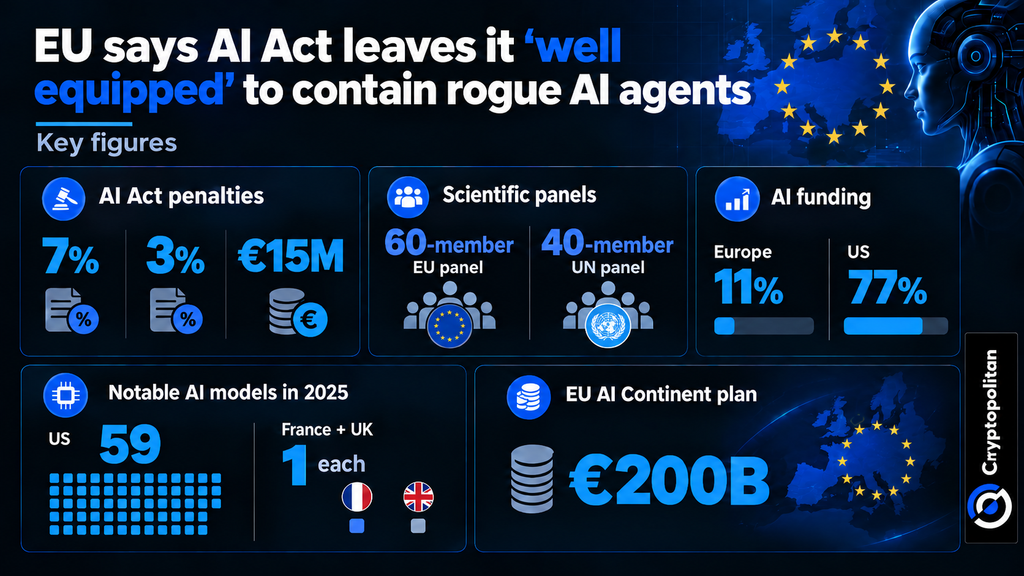
Brussels has responded with a €200 billion AI investment initiative. Still, the IMF highlights Europe’s competitiveness challenges, while McKinsey emphasizes the need for trustworthy AI governance.
Europe now faces a difficult balancing act: keeping autonomous AI in check without falling further behind, and how Brussels handles its ongoing inquiries will be an early test.
Don’t just read crypto news. Understand it. Subscribe to our newsletter. It’s free.
This articles is written by : Nermeen Nabil Khear Abdelmalak
All rights reserved to : USAGOLDMIES . www.usagoldmines.com
You can Enjoy surfing our website categories and read more content in many fields you may like .
Why USAGoldMines ?
USAGoldMines is a comprehensive website offering the latest in financial, crypto, and technical news. With specialized sections for each category, it provides readers with up-to-date market insights, investment trends, and technological advancements, making it a valuable resource for investors and enthusiasts in the fast-paced financial world.