
Breaking
Bumble is in advanced talks to go private in a deal worth about $1 billion, Reuters reported on Monday, October 12, 2026. Ithaca Holdings is the prospective buyer. The talks come as Bumble tries to win back users with AI. Neither company has confirmed a deal. Both declined to comment. Still, Bumble shares surged roughly 50% to $3.80 that Monday, their biggest one-day percentage gain on record. A $1 billion price tag for a $14 billion debut Founded by Whitney Wolfe Herd in 2014, Bumble went public in 2021 at a valuation of about $14 billion. Five years later, the proposed price tells a very different story. Paolo Pescatore, an analyst for PP Foresight, said the potential agreement is proof of Bumble’s difficulties, adding that: Going private looks less like a strategic masterstroke and more like an admission that Bumble’s current strategy is failing. The numbers a buyer would inherit Bumble’s Q2 results indicate the reasons for the investors’ concerns. Its revenue declined by 15.2% year-over-year to $210.5 million. The number of paying users also dropped by 16.4% to 3.2 million. Bumble reported a net loss of $127.9 million of which $169.3 million were impairment charges, even though the adjusted EBITDA represented $72.9 million. The slide started earlier. In 2025, the company registered a near 10% drop in revenue that amounted to approximately $966 million, while its paying user base declined by more than 11% to approximately 3.7 million. Bumble Revenue and Paying Users Decline in 2025 and Q2 2026 Industry fatigue, or a Bumble problem Bumble’s competitor, Match Group, appears to be doing better as revenue fell only 1% to $853 million in the second quarter. Meanwhile, net income increased by 36% to $171 million. Tinder also showed signs of improvement. Daily active users dropped by only 4% year-on-year, which was the smallest decline in the last 10 quarters. Hinge’s revenue has increased by 22%. Match aims to bring Hinge’s annual revenue to $1 billion by 2027. Dating-app fatigue remains a challenge. But Match’s results suggest Bumble’s issues range beyond just the users getting bored with swiping. Bumble vs Match Group Q2 2026: Revenue, Profit and User Trends Can AI pull users back, or push them away Bumble hopes its AI-led Bumble 2.0 can change that. The redesign brings richer, chapter-style profiles and the possibility of swipe-free dating. Its March unveiling helped send shares up more than 40%. Wolfe Herd had earlier floated AI dating concierges, as Cryptopolitan reported. Whether users want that help is less clear. A peer-reviewed study suggests confidence in algorithms can encourage AI dating adoption. Yet an SSRN working paper reported 54% fewer usage minutes and 62% fewer app openings among the AI adopters studied. Those findings do not represent all daters. At the same time, less expensive AI will make companion chatbots more attractive than dating apps. However, the use of these chatbots raises privacy and security issues, as noted by the Congressional Research Service. The opportunity remains substantial: Grand View Research estimates a $10.7 billion global dating-app market in 2026, reaching $17.9 billion by 2033. The challenge is converting AI features into users who stay, pay, and trust the platform Micah Abiodun | usagoldmines.com
October 13, 2026

Ontology mainnet back after 41-hour halt, vulnerability still undisclosed Randa Moses | usagoldmines.com

Ontology has re-enabled its mainnet after around 41 hours without blocks.

The team said no funds from the network were lost but has not yet named the ecosystem project or the vulnerability behind the shutdown.

A security warning froze block production at 16:43 UTC on October 10

The layer-one network stopped producing blocks on October 10 around 16:43 UTC. A pressing warning about a project running on the chain set off the halt, Ontology’s announcements said.

The team coordinated with most of its consensus nodes to halt the new blocks. Transactions stopped settling.

Ontology framed its move as a precaution against a potential threat to network assets. It did not say what project the alarm was triggered by, or what the weakness was.

Block production resumed at around 09:57 UTC on October 12. The restart notice did not specify anything else and cited “a security incident involving an ecosystem project.”

In the meantime, Bitget and Coinone of South Korea suspended deposits and withdrawals of Ontology-network assets.

“Ontology’s core infrastructure remains safe, with no funds lost from the Ontology network itself,” the Ontology team wrote on X. The freeze was described as a move with consensus nodes “to support the investigation and mitigate potential risks.”
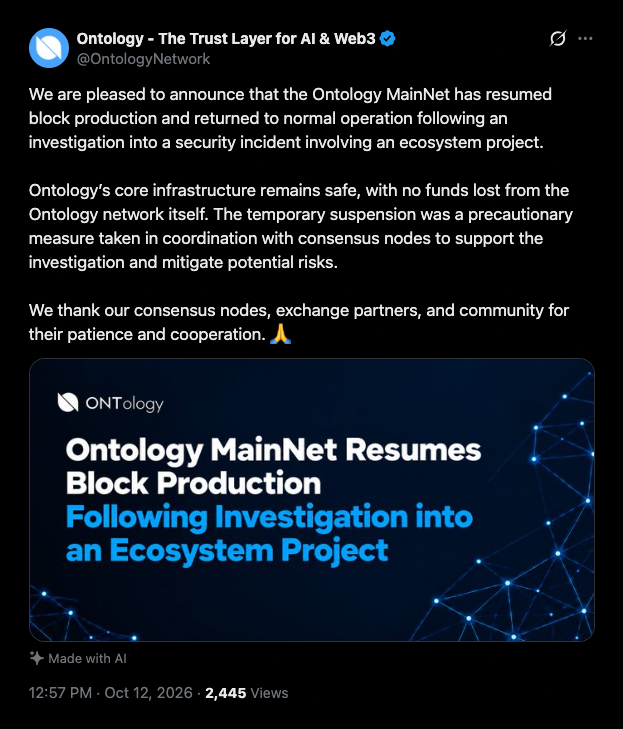
Ontology restarts after 41 hours without naming the flaw.
Ontology’s restart announcement posted by @OntologyNetwork on X on October 12, 2026.

The statement only addresses the network’s current status, not the unnamed project or its users’ funds. There was no technical write-up accompanying the restart notice.

Ontology uses a consensus method called Verifiable Byzantine Fault Tolerance, or VBFT. VBFT blends staking and coordinated validation and allows participating nodes to jointly stop the network if the operators judge the risk to be high enough.

The team labeled the October halt a precautionary pause

Ontology already took a pause in 2026. The confirmed malicious activity started as a security alert on August 31, was remediated and required a mandatory software upgrade before operations resumed around September 2.

Ontology then compelled all sync nodes to upgrade to version 3.1.5.

This time Ontology called the stop a precautionary pause. It has not reported any compromise of the protocol itself.

On August 30, Cronos validators halted block production to curb an exploit on the Tectonic lending market.

A hacker pumped the TONIC token about 100 times in 20 minutes and used it to borrow money. Cryptopolitan reported that about $75 million was exposed, but only about $6 million made it to Ethereum before the chain was frozen.

Cronos operators undid between 10,000 and 11,000 blocks, which erased about two hours of history. In August and September, security issues caused outages at ICON, Injective, and MultiversX as well.

MANTRA shut down its network in August due to an incident that wasn’t made public. Transactions stopped and OM balances were frozen.

Don’t just read crypto news. Understand it. Subscribe to our newsletter. It’s free.


This articles is written by : Nermeen Nabil Khear Abdelmalak

All rights reserved to : USAGOLDMIES . www.usagoldmines.com

You can Enjoy surfing our website categories and read more content in many fields you may like .

Why USAGoldMines ?

USAGoldMines is a comprehensive website offering the latest in financial, crypto, and technical news. With specialized sections for each category, it provides readers with up-to-date market insights, investment trends, and technological advancements, making it a valuable resource for investors and enthusiasts in the fast-paced financial world.

You Missed

Bumble is in advanced talks to go private in a deal worth about $1 billion, Reuters reported on Monday, October 12, 2026. Ithaca Holdings is the prospective buyer. The talks come as Bumble tries to win back users with AI. Neither company has confirmed a deal. Both declined to comment. Still, Bumble shares surged roughly 50% to $3.80 that Monday, their biggest one-day percentage gain on record. A $1 billion price tag for a $14 billion debut Founded by Whitney Wolfe Herd in 2014, Bumble went public in 2021 at a valuation of about $14 billion. Five years later, the proposed price tells a very different story. Paolo Pescatore, an analyst for PP Foresight, said the potential agreement is proof of Bumble’s difficulties, adding that: Going private looks less like a strategic masterstroke and more like an admission that Bumble’s current strategy is failing. The numbers a buyer would inherit Bumble’s Q2 results indicate the reasons for the investors’ concerns. Its revenue declined by 15.2% year-over-year to $210.5 million. The number of paying users also dropped by 16.4% to 3.2 million. Bumble reported a net loss of $127.9 million of which $169.3 million were impairment charges, even though the adjusted EBITDA represented $72.9 million. The slide started earlier. In 2025, the company registered a near 10% drop in revenue that amounted to approximately $966 million, while its paying user base declined by more than 11% to approximately 3.7 million. Bumble Revenue and Paying Users Decline in 2025 and Q2 2026 Industry fatigue, or a Bumble problem Bumble’s competitor, Match Group, appears to be doing better as revenue fell only 1% to $853 million in the second quarter. Meanwhile, net income increased by 36% to $171 million. Tinder also showed signs of improvement. Daily active users dropped by only 4% year-on-year, which was the smallest decline in the last 10 quarters. Hinge’s revenue has increased by 22%. Match aims to bring Hinge’s annual revenue to $1 billion by 2027. Dating-app fatigue remains a challenge. But Match’s results suggest Bumble’s issues range beyond just the users getting bored with swiping. Bumble vs Match Group Q2 2026: Revenue, Profit and User Trends Can AI pull users back, or push them away Bumble hopes its AI-led Bumble 2.0 can change that. The redesign brings richer, chapter-style profiles and the possibility of swipe-free dating. Its March unveiling helped send shares up more than 40%. Wolfe Herd had earlier floated AI dating concierges, as Cryptopolitan reported. Whether users want that help is less clear. A peer-reviewed study suggests confidence in algorithms can encourage AI dating adoption. Yet an SSRN working paper reported 54% fewer usage minutes and 62% fewer app openings among the AI adopters studied. Those findings do not represent all daters. At the same time, less expensive AI will make companion chatbots more attractive than dating apps. However, the use of these chatbots raises privacy and security issues, as noted by the Congressional Research Service. The opportunity remains substantial: Grand View Research estimates a $10.7 billion global dating-app market in 2026, reaching $17.9 billion by 2033. The challenge is converting AI features into users who stay, pay, and trust the platform Micah Abiodun | usagoldmines.com