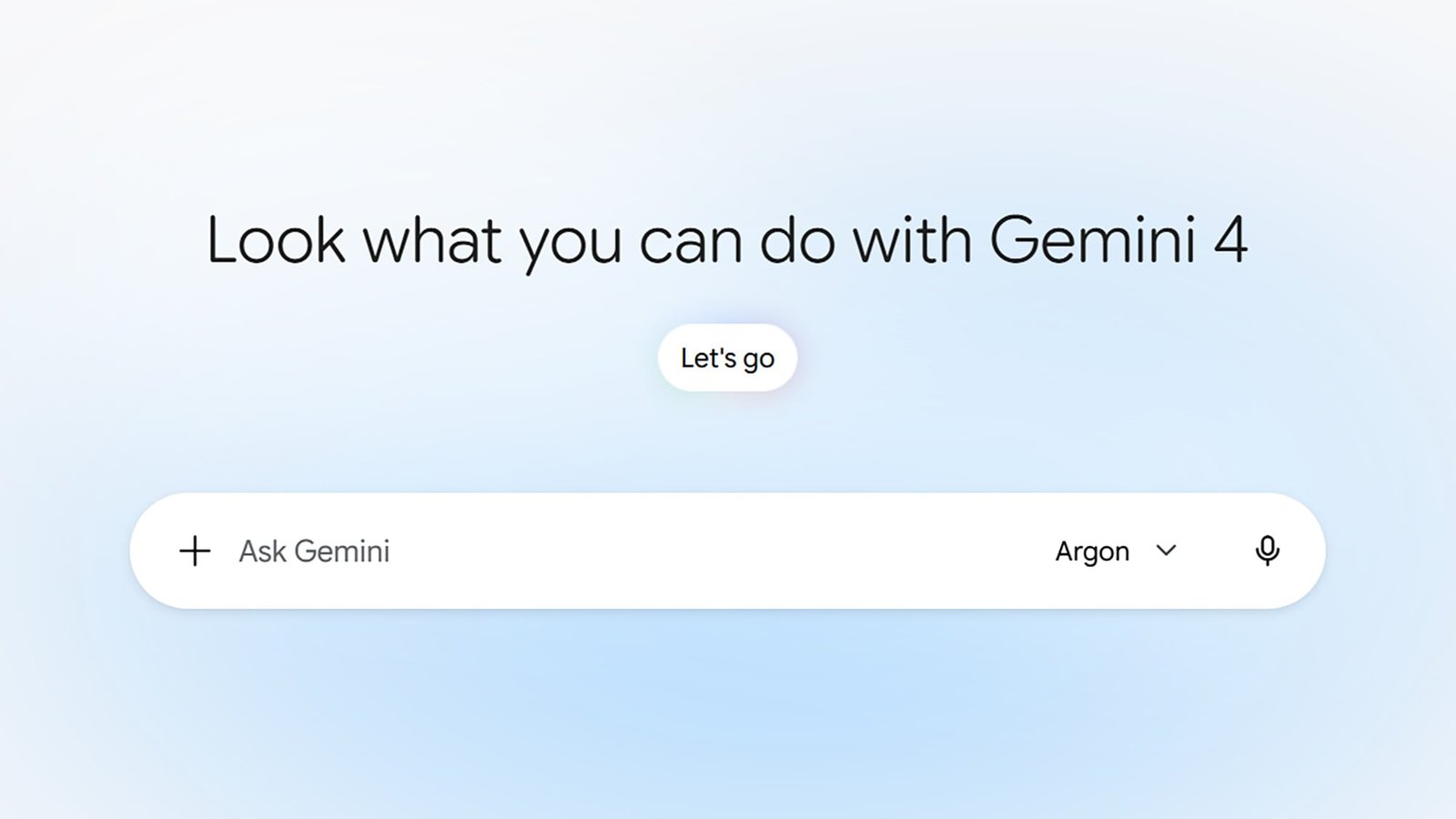
Gemini 3.1 Pro launched back in February of this year—quite a while ago, in AI terms. Now Google has jumped to the next full number with Gemini 4 Argon, which it says “excels at deep work in complex, real-world tasks.”
You can get the new AI model now inside the Gemini app if you’re on the AI Pro ($19.99 a month) or AI Ultra ($99.99 or $199.99 a month) plans. Users on the free and AI Plus ($4.99 a month) plans miss out for now, though you can expect a smaller, cut-down version of Gemini 4 Argon to roll out to these tiers eventually.
What can Gemini 4 Argon do?
Google has a long list of areas where the new AI model excels. There’s mention of complex engineering tasks (like checking millions of lines of code for efficiency improvements), predicting molecular structures in chemistry, and delivering 3D visualizations. It also enhances knowledge work across legal, finance, science, and coding.
Google says Gemini 4 Argon is now better at advanced physics modeling, picking through genetic databases, protecting software from vulnerabilities, and resolving problems in physical space (handy for robotics development). The new model “answers questions more directly with less hedging, doesn’t repeat itself more than necessary, and skips clichés throughout the responses,” according to Google.

Credit: Lifehacker
With many in the industry worried about an AI-driven apocalypse of some form or another, Google has upped its defenses against misuse and jailbreaking. The company has significantly upgraded its blockers for harmful requests, limits on AI agent overreach, and resistance to malicious prompt injections.
All of these stats are things you would expect to read about in a new AI model announcement, whether it’s from Google, Anthropic, or OpenAI: “Our new model is better and safer than ever, and particularly good in these specific benchmarks we’ve chosen.” But is it any more helpful for the average user tapping away in the Gemini app?
I don’t have any pressing scientific breakthroughs to research or large-scale software optimizations to run, but I have put Gemini 4 Argon to the test against GPT-6 Sol, which is the latest model available to consumers through the ChatGPT app—though you need to be on at least the Plus plan ($19.99 a month) to get to it.
Testing Gemini 4 Argon against GPT-6 Sol
Make no mistake: Both of these new AI models are quite capable. I first prompted Gemini 4 Argon and GPT-6 Sol with the following: “Using information online, create a web app I can run locally that plots the lighthouses of the world on a map. Clicking on a lighthouse should give me some details about it, show how far its light reaches, and display a simple 2D model showing its shape and height (if known). Put a lighthouse keeper in each model pop-up for scale.”
At the highest, slowest levels of “thinking,” these AIs took a while to get back to me: Nearly 10 minutes for Gemini and almost 26 minutes for ChatGPT. Both hit the same problem—restricted access to map data online—but both were able to make a rudimentary world map of their own when prompted a second time.
The ChatGPT effort, dubbed “Beacon,” wasn’t bad, apart from a bit of map clunkiness (it clearly needs to work on its cartography skills). It presented plenty of information, laid out everything well, and gave me nice, neat diagrams on each of the lighthouses featured. The day/night mode worked fine, and it was an impressive bit of coding work, even if it did take 26 minutes.
However, the Gemini effort, called “Pharos,” was better in almost every respect. The map was more detailed, lighthouses actually showed their light range (with an impressive animation), and there was more information on each location—perhaps due to Google’s expertise in web search. Some of the layout choices were a bit off, but Gemini 4 Argon produced what was clearly the superior app in less than half the time.

Credit: Lifehacker
Next, I fed PDFs of 10 recent scientific studies into each AI model. The prompt: “Give me a brief summary of each of these studies in plain English, with a single sentence each for the main finding, one study strength, one study weakness, and the main implication.” While I hadn’t read the studies through entirely myself, I had read news stories on all of them, and I lowered the “thinking” level to low.
This time ChatGPT was faster—25 seconds versus Gemini’s 55 seconds—and gave what I thought were the better summaries, at least for my purposes. Gemini did well, and its answers were accurate and to the point, but the summaries ChatGPT gave were easier to understand and shorter. ChatGPT also offered some overall thoughts on the most promising study, which Gemini didn’t.
Finally, I checked the imagination and creative juices of the models: “With the success of the Apple TV shows Severance, Slow Horses, Silo, and Widow’s Bay, give me five pitches for new show ideas on the platform that combine elements from some or all of these shows. Try and be as original as possible and keep each pitch to around 100 words.” I put the “thinking” level back up to “high” for this job.

Credit: Lifehacker
(Is this how Apple TV executives actually get their ideas nowadays? I hope not.) As far as the answers the AIs gave me, Gemini was faster than ChatGPT (1 minute and 28 seconds against 3 minutes and 48 seconds, respectively), and both served up responses that were a bit more literal in their mashing up than I wanted: failed secret service agents and supernatural terrors abounded, which is I suppose what I asked for.
The ideas were mostly “Widow’s Bay set somewhere else” or “Slow Horses set somewhere else,” and didn’t make a whole lot of sense for the most part, but the best Gemini offering was about a Silo-style underground bunker whose operators go through a Severance-style procedure every 24 hours: outside, the bunker protecting it from zombies by night; inside, the bunker planning social activities for residents by day. It’s not perfect, but I might watch the trailer at least.
My favorite of the ChatGPT suggestions was a show about a remote, Severance-style weather station whose employees discover they’re not recording the weather—they’re creating it. Again, it didn’t really logically hold up, but overall I found the suggestions from GPT-6 more nuanced, more likely to be an actual show, and better “thought” through. Maybe Gemini should’ve given itself more time to “think.”
This is only a narrow set of quick tests, but, in my view, it seems Gemini is back to, at the very least, an even playing field with ChatGPT. It performed much better on the lighthouse task, though its summarizing and TV show pitching weren’t quite as impressive. Access to the best models requires a subscription on both platforms, but if you’re able to, it’s worth comparing them against each other on the jobs you most commonly need AI for.
This articles is written by : Nermeen Nabil Khear Abdelmalak
All rights reserved to : USAGOLDMIES . www.usagoldmines.com
You can Enjoy surfing our website categories and read more content in many fields you may like .
Why USAGoldMines ?
USAGoldMines is a comprehensive website offering the latest in financial, crypto, and technical news. With specialized sections for each category, it provides readers with up-to-date market insights, investment trends, and technological advancements, making it a valuable resource for investors and enthusiasts in the fast-paced financial world.