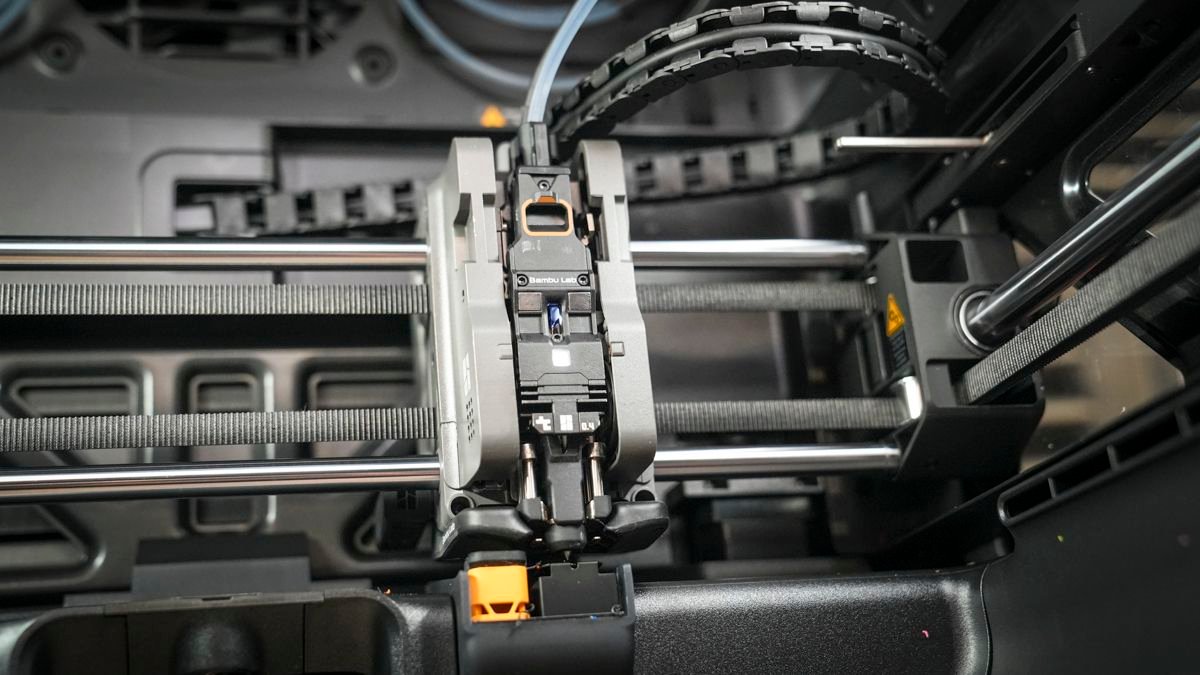
- Three teams are attempting the fastest battery-powered RC quadcopter record in Cape Town today, using drones built on Bambu Lab H3C and H2C printers
- The official record is 657.59 km/h, set by the Bells in December 2025, though Biggs’s uncertified runs have already averaged 685 km/h
- Only the airframes are printed, and Bambu Lab has not said whether Guinness witnesses will attend or what build rules apply
Three teams of makers from three countries are aiming for the Guinness World Records title for the fastest battery-powered remote-controlled quadcopter, flying drones built on Bambu Lab’s new H3C and H2C 3D printers as part of the company’s Let’s Make It Fund program.
The number to beat is 657.59 km/h (408.60 mph), set on December 11, 2025, by Cape Town father-and-son duo Luke and Mike Bell, who are also among today’s challengers.
They will be joined by Australian aerospace engineer Ben Biggs and John Xu, an MIT mechanical engineering student living in Boston.
A number on the board, three teams, and one very fast target
Guinness’s rules for this category are narrower than their “fastest drone” moniker suggests: the aircraft must have four separate fixed rotors providing lift and thrust; tiltrotors fall under a different category, and commercially available models are excluded, so every contender must be a prototype or a heavily modified one-off.
Speed is not a single flat-out pass either: the drone flies back and forth along a measured course, and the runs in opposite directions are averaged to cancel out the wind.
The record has moved quickly too: According to Guinness, the Bells first set it at 480 km/h in 2024 and pushed it to 580 km/h in June 2025. Biggs then took it with his Blackbird at around 626 km/h (389 mph) in late 2025, before the Bells snatched it back with the Peregreen V4. The official figure has therefore climbed roughly 37% in under two years.
The Bells arrive as both holders and hosts. Luke Bell, an engineer and YouTuber, built the V4 with his father, and printed its airframe on Bambu Lab’s H2D as one multi-material piece in PETG, PA6-CF, and TPU, then sanded and polished it. Bell said the printer’s larger build volume and dual-nozzle system made it possible to print the body as one continuous piece.
The pair have since worked with the H2C as well: in July, Luke used one alongside an H2D to build the multirotor that set a Guinness endurance record of 4 hours, 21 minutes and 39 seconds on a single charge.
Biggs is the man with the fastest numbers and the thinnest paperwork. Flying with Aidan Kelly under the Drone Pro Hub banner, he has made a habit of answering every Bell record. “So, we couldn’t have that!” he said in one video after losing the crown, as New Atlas reported. In early 2026, his Blackbird hit 690 km/h on a downwind pass and averaged about 661 km/h. In May, the pair posted a 685 km/h (426 mph) two-way average with a 730 km/h (453 mph) peak. Both runs beat the official figure, and neither sadly counted because no professional observer was present.
Xu is the wild card. Bambu Lab’s announcement says little beyond his studies and location, and there don’t seem to be any published speed runs under his name, making his drone, team, and target speed an interesting dark horse for now.
On the teams’ own telemetry, the record has already fallen twice this year. Biggs’s May average sits about 27 km/h, or roughly 4%, above the Bells’ certified figure. The obstacle has been logistics rather than physics, and DroneXL argues that the real gap is getting certified observers and timing equipment to a remote paddock on a calm day.
A scheduled, sponsored event in one location could close that gap, which may be the most useful thing Bambu Lab brings to the table. The company, however, does not state whether a Guinness-accredited witness will be on hand.
Cape Town’s weather and Bambu Labs both have a say here
Weather will also play a large part here: Late spring and early summer are prime southeaster season in Cape Town, with November through February the city’s windiest months. The setting might suit the Bells here, as they set the current record on a farm near Melkbosstrand, north of Cape Town, in December, and Luke Bell told the Cape Argus that the V4 needed about 30 test flights over five months of tuning.
The contest is not happening in a vacuum, however: Bambu Labs’ H3C went on sale on November 3, just 23 days before the attempt, priced at $2,499 for the AMS Combo. It is Bambu Lab’s first third-generation desktop printer, with nine independent tools that swap in about six seconds and heat to 350°C. TechRadar’s H3C review awarded it an Editor’s Choice badge while cautioning that its mixed-nozzle printing still feels like “a technology in development.”
The older H2C uses Bambu Lab’s Vortek system to swap between six interchangeable hotends, and TechRadar’s H2C review flagged premium pricing and more moving parts than its siblings.
The driving force behind this is the Let’s Make It Fund, launched in December 2025 with grants of up to $300,000 and two to five projects selected each quarter. Bambu Lab frames it as an investment in makers, “not as a PR stunt,” and asks only that recipients document their journey. All3DP reported that payments arrive in stages as agreed milestones are met to Bambu Lab’s satisfaction.
Drones are close to home for the company, too: CEO Ye Tao previously ran DJI’s consumer drone department before co-founding Bambu Lab with fellow DJI engineers. Win or lose, today puts a three-week-old printer in front of exactly the audience that cares about high-performance printed parts, which is a large part of the point.
If conditions cooperate, the most likely outcome is a new certified figure above 657.59 km/h. Whose name goes next to it is harder to call; Biggs has the raw numbers, Xu is an unknown quantity, and the Bells’ local knowledge and certification track record make them hard to bet against.
This articles is written by : Nermeen Nabil Khear Abdelmalak
All rights reserved to : USAGOLDMIES . www.usagoldmines.com
You can Enjoy surfing our website categories and read more content in many fields you may like .
Why USAGoldMines ?
USAGoldMines is a comprehensive website offering the latest in financial, crypto, and technical news. With specialized sections for each category, it provides readers with up-to-date market insights, investment trends, and technological advancements, making it a valuable resource for investors and enthusiasts in the fast-paced financial world.