At a glance
Expert’s Rating
Pros
- Small thumb drive form factor
- Both Type-A and Type-C connectors
- Affordable
- 10Gbps performance with everyday operations
Cons
- Writes slow to a crawl off secondary cache
- Connector covers aren’t captive
Our Verdict
For everyday write operations, this versatile (Type-A/C) thumb drive SSD delivers the goods. But it’s slow as molasses (on a very cold day!) when it runs out of secondary cache.
Price When Reviewed
This value will show the geolocated pricing text for product undefined
Best Pricing Today
Price When Reviewed
500GB: $66.44 I 1TB: $104.44 I 2TB: 188.44
Best Prices Today: Addlink P50 thumb drive SSD

I’ve seen quite a few USB thumb drives lately sporting dual Type-A/Type-C connectors on either end — it’s become a popular way to assure connectivity across the largest number of devices.
The Addlink P50 reviewed here is another such tiny, lightweight beastie that performs around the 10Gbps median — with normal amounts of data. However, write speed drops drastically (an understatement) when it runs out of secondary cache.
Read on to learn more, then see our roundup of the best external drives for comparison.
What are the Addlink P50’s features?
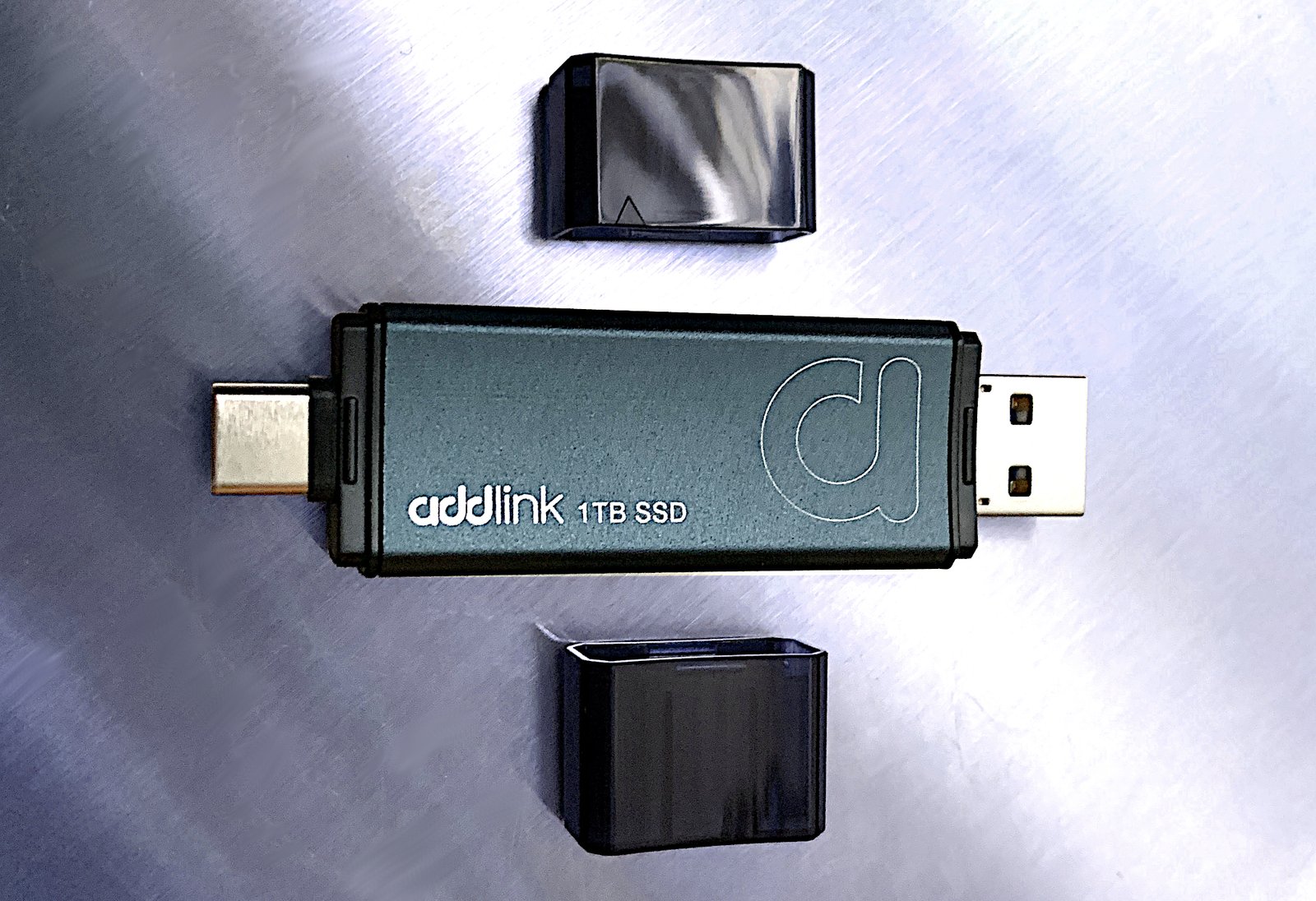
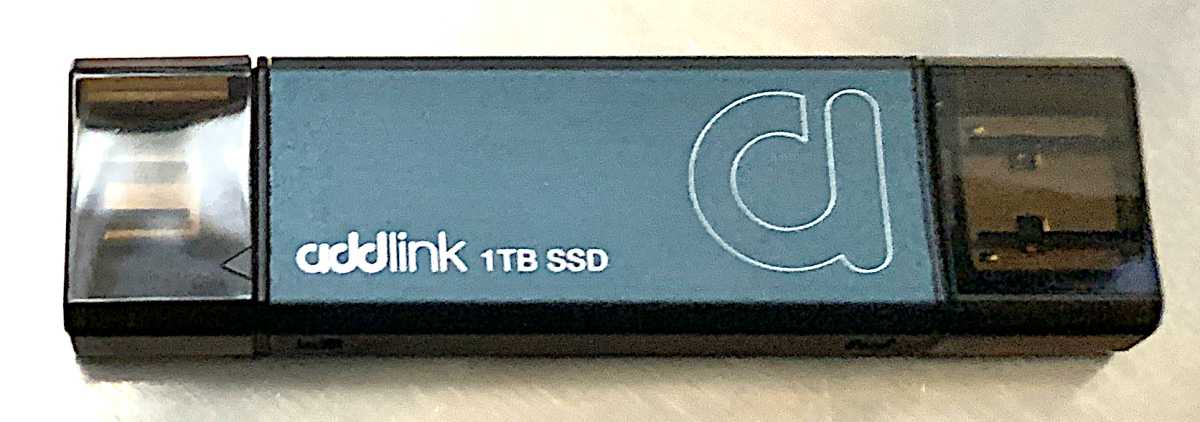
The P50 is a USB 3.2 10Gbps (Gen 2) thumb drive with a Type-A connector on one end and a Type-C connector on the other. Both are covered by removable end caps to protect the connector/s not in use.
The P50 is 3-inches in length, 0.75-inches in breadth, and roughly 0.4-inches in thickness. Weight is 16 grams (0.6 ounces). Our unit was rendered in steel blue with brown tinted end caps.
If I have any complaint about the solidly constructed P50, it’s that the end caps aren’t captive — i.e., they’re very easy to misplace. At least for hasty, forgetful folk such as myself.
Addlink warranties the P50 for three years, which is the norm for affordable external storage. No TBW rating (terabytes that may be written before read-only) was provided, but given the light-duty role, the drive should hold up for a decade at the very least.
How much is the P50?
At the time of this writing, the P50 was $66.44 in the 500GB capacity, $104.44 for the 1TB version we tested, and $188.44 at the 2TB level (Amazon). That’s about what you’ll pay for the 10Gbps competition.
Why the 44 cents when not a percentage discount? Couldn’t tell you. But no doubt, a calculator was involved.
How fast is the Addlink P50?
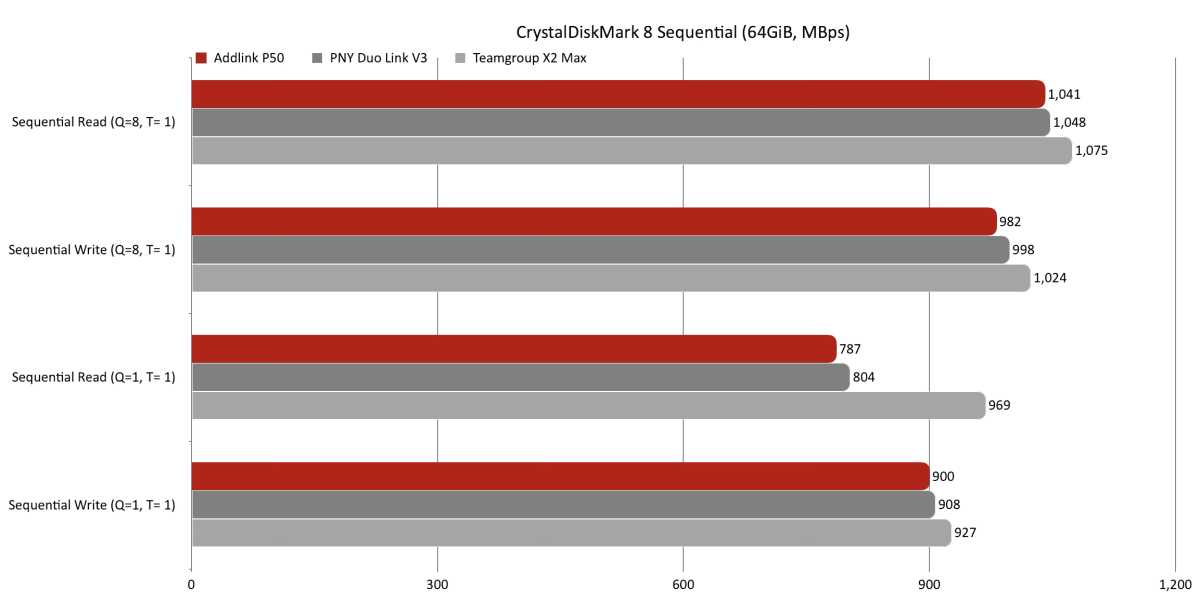
For normal operations, the P50 is largely on par for a 10Gbps USB SSD/thumb drive. That said, the only 10Gbps drive (including all types) it actually beat overall was the 1TB PNY Duo Link V3, and it didn’t do so by very much.
The P50’s CrystalDiskMark 8 sequential throughput numbers were good, if not up to the 2TB Teamgroup X2 Max’s.
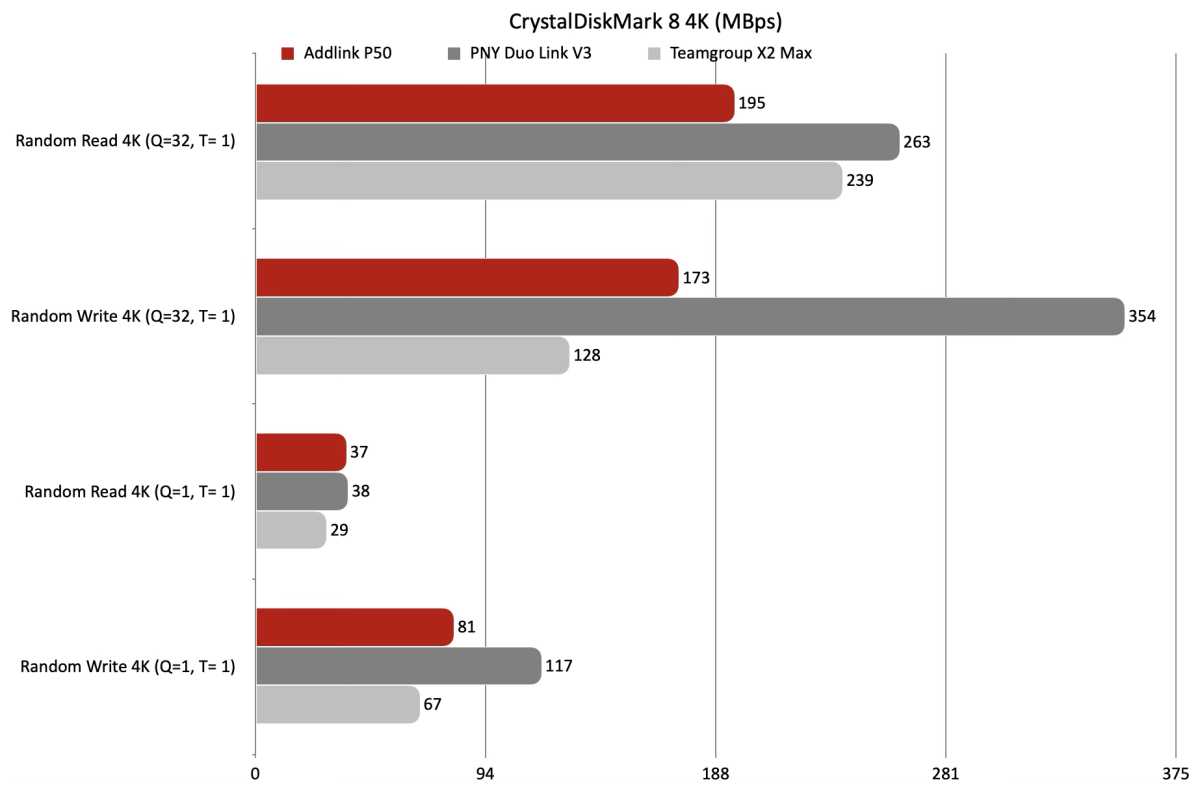
CrystalDiskMark showed the one area where the P50 really lagged behind the Duo Link V3 — random ops. Then again, so did the X2 Max.
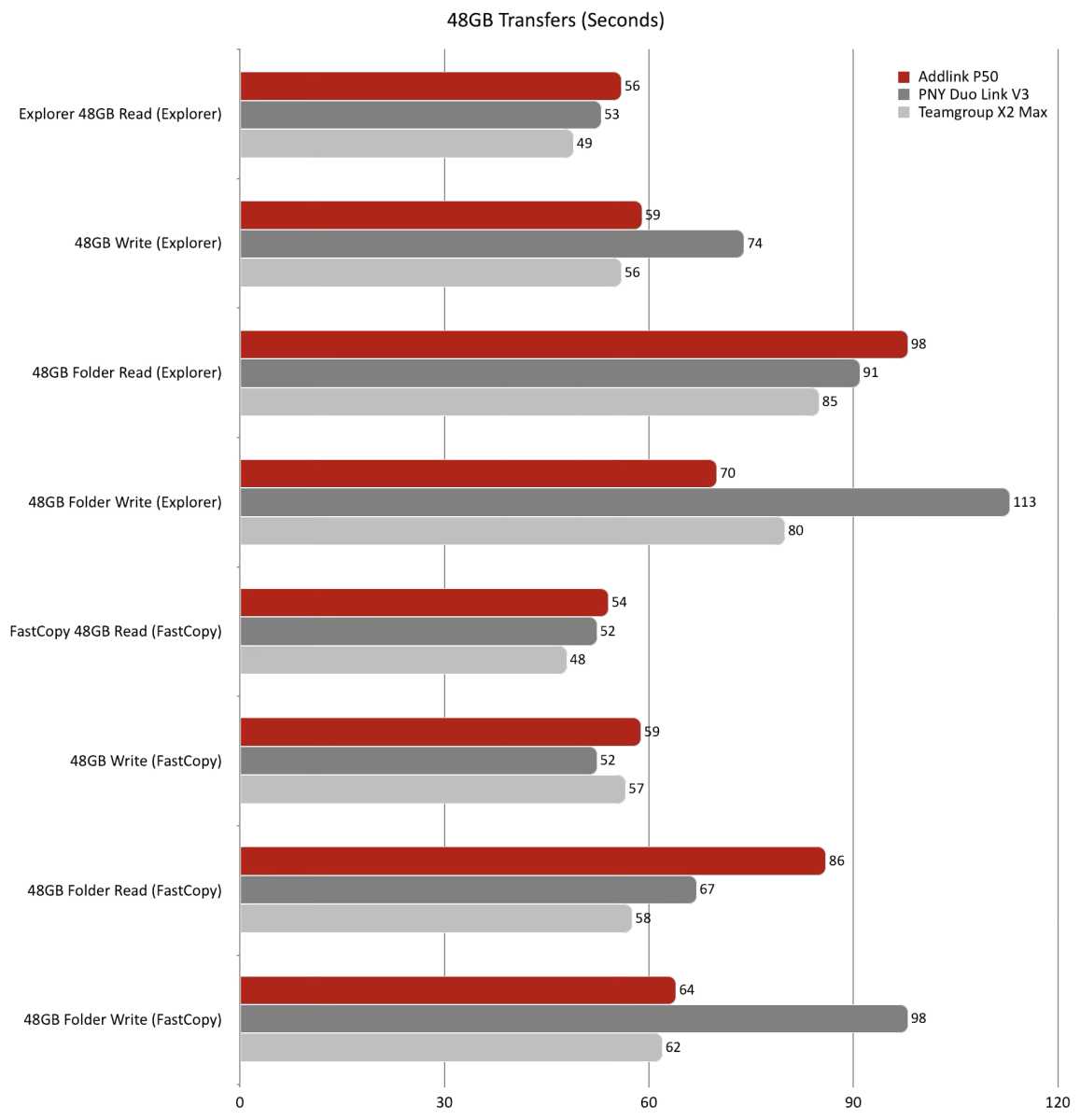
With normal large transfers (48GB is about a dozen 1080p, full-length movies), the P50 was within spittin’ distance of the X2 Max and sometimes the Duo Link V3 — depending on the test.
Note that if you’re not using the time-saving FastCopy, you should be, though it’s of far more benefit with internal NVMe.
The Addlink P50 shares a not-so-wonderful trait with the PNY Duo Link V3 — it’s dead slow once it runs out of secondary cache.
It took about eight minutes for the P50 to write the first 270GB of our 450GB file. Not bad for 10Gbps. However, it then took the better part of two hours to write the remaining 180GB. Argh!
Write speed during this second phase hovered around 25MBps. Occasionally bubbling up to around 70MBps, but not for very long and often dropping to 5MBps.
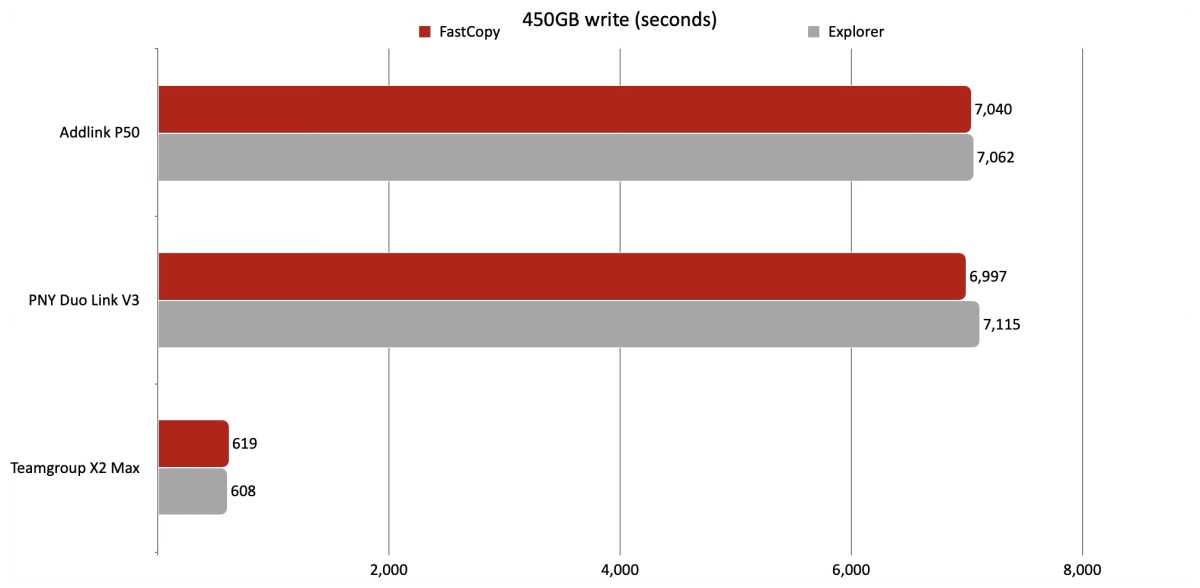
Though the Teamgroup X2 Max was a 2TB drive, even off-secondary-cache speed only dropped to around 675MBps — far faster than either of the other two drives shown.
Further illustration of the 1TB P50’s yin and yang performance is shown below. It’s good (for 10Gbps) until it’s most decidedly not.
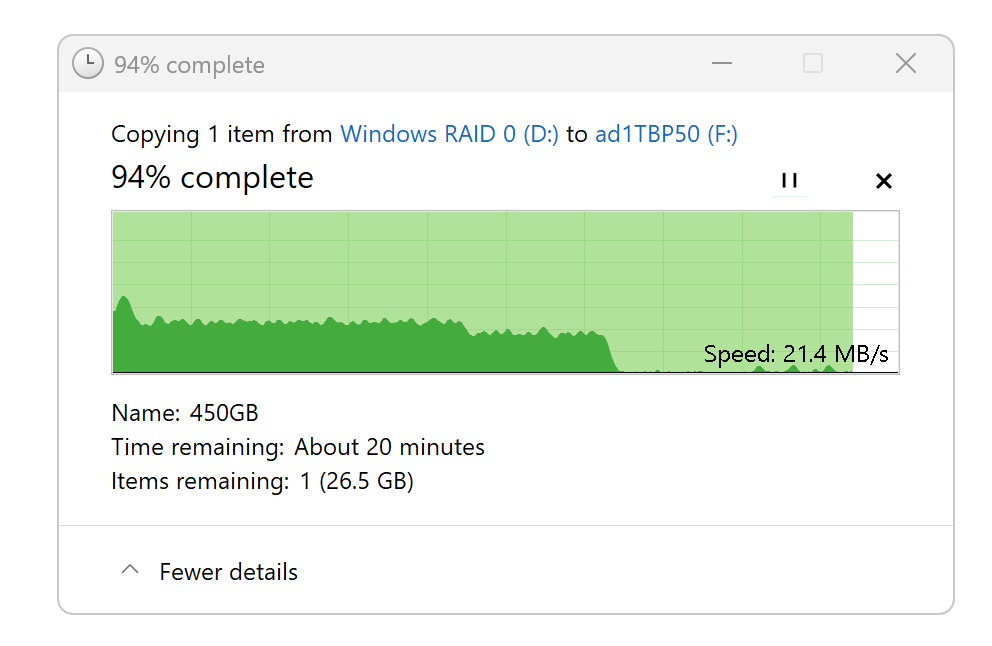
Overall, for the vast majority of users and nearly all normal write operations, the P50 is just fine. But if you want to fill it every time you use it, get something else. You might consider the 2TB version for more time on secondary cache; don’t opt for the 500GB version that will run out of secondary cache in half the time shown above.
Should you buy the P50?
For light-duty storage and transport, the P50 is fine. However, despite the Addlink hype about AI and 4K video, prosumers looking to offload hefty amounts of content should look elsewhere (X2 Max). Or at least to the 2TB version, which won’t run out of steam as quickly.
How we test
Drive tests currently utilize Windows 11 24H2, 64-bit running off of a PCIe 4.0 Samsung 990 Pro in an Asus Z890-Creator WiFi (PCIe 4.0/5.0) motherboard. The CPU is a Core Ultra i5 225 feeding/fed by two Crucial 64GB DDR5 5600MHz modules (128GB of memory total).
Both 20Gbps USB and Thunderbolt 5 are integrated into the motherboard and Intel CPU/GPU graphics are used. Internal PCIe 5.0 SSDs involved in testing are mounted in an Asus Hyper M.2 x16 Gen5 adapter card sitting in a PCIe 5.0 slot.
We run the CrystalDiskMark 8.04 (and 9), AS SSD 2, and ATTO 4 synthetic benchmarks (to keep article length down, we report only the former) to find the storage device’s potential performance. Then we run a series of 48GB transfer and 450GB write tests using Windows Explorer drag and drop to show what users will see during routine copy operations, as well as the far faster FastCopy run as administrator to show what’s possible.
A 25GBps two-SSD RAID 0 array on the aforementioned Asus Hyper M.2 x16 Gen5 is used as the second drive in our transfer tests. Formerly the 48GB tests were done with a RAM disk serving that purpose.
Each test is performed on a NTFS-formatted and newly TRIM’d drive so the results are optimal. Note that in normal use, as a drive fills up, performance may decrease due to less NAND for secondary caching, as well as other factors. This issue has abated somewhat with the current crop of SSDs utilizing more mature controllers and far faster, late-generation NAND.
Our testing MO constantly evolves and these results may not match those from previous articles. Only comparisons inside the article are 100% valid as those are gathered using the current hardware and MO.
This articles is written by : Nermeen Nabil Khear Abdelmalak
All rights reserved to : USAGOLDMIES . www.usagoldmines.com
You can Enjoy surfing our website categories and read more content in many fields you may like .
Why USAGoldMines ?
USAGoldMines is a comprehensive website offering the latest in financial, crypto, and technical news. With specialized sections for each category, it provides readers with up-to-date market insights, investment trends, and technological advancements, making it a valuable resource for investors and enthusiasts in the fast-paced financial world.