
AI search has moved from a test to a daily habit. Millions of people now ask ChatGPT, Gemini or Claude a question before they open a search box. This article looks at the numbers behind that shift.
The data comes from studies by Pew Research Center, Similarweb, Ahrefs, Adobe, SE Ranking and others. Each figure names its source and the month it was measured. Where two studies disagree, both are shown.
The numbers cover four areas: how many people use each tool, how fast each one is growing, what happens to clicks on Google, and how much traffic AI sends to websites. Most figures are from 2026.
One caution applies throughout. Many studies come from companies that sell SEO or AI tracking tools, and each one counts something different. Treat the figures as a guide to direction, not as exact totals.
How many people use ChatGPT, Gemini and Claude?
ChatGPT leads on every usage measure in the data. OpenAI said in September 2026 that ChatGPT has more than 1.2 billion weekly users. That is up from more than 900 million in February 2026 and 800 million in October 2025.
Google reports its numbers differently. The Gemini app has 950 million monthly active users, according to Google in July 2026. Google also said AI Overviews has more than 2.5 billion monthly users, and AI Mode passed 1 billion in May 2026.
These figures do not measure the same thing. OpenAI counts weekly users, while Google counts monthly users. A weekly count is the stricter test, so the real gap between the two may be smaller than the raw numbers suggest.
| Measure | Figure | Source |
|---|---|---|
| ChatGPT weekly users | More than 1.2 billion | OpenAI, Sep 2026 |
| Gemini app monthly users | 950 million | Google, Jul 2026 |
| AI Overviews monthly users | More than 2.5 billion | Google, May 2026 |
| AI Mode monthly users | More than 1 billion | Google, May 2026 |
| US adults who use any AI chatbot | 49% | Pew Research Center, Jun 2026 |
Survey data shows who is using what. Pew Research Center found in June 2026 that 44% of US adults use ChatGPT. That is up from 34% in 2025 and 18% in 2023.
Gemini came second at 24%, and Claude was at 6%.
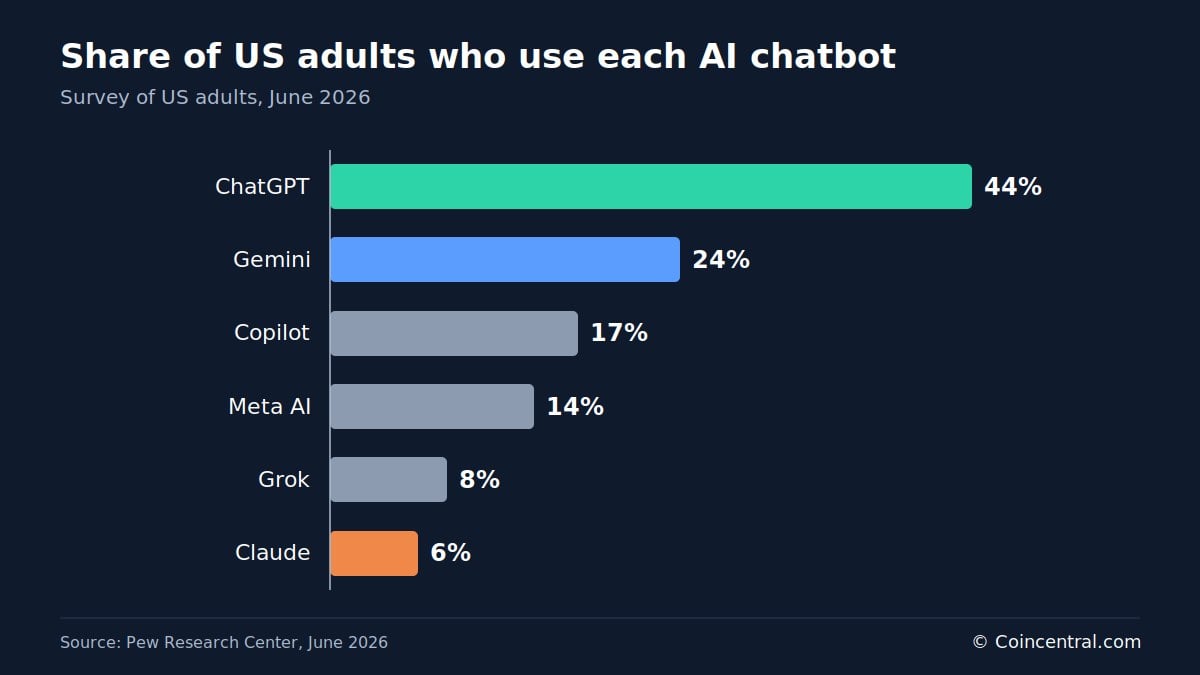
Age makes a large difference. Pew found that adults under 50 are about twice as likely as older adults to use ChatGPT, at 57% against 28%. About a quarter of US adults use an AI chatbot every day, and 12% use one several times a day.
Young people lead the trend. Pew reported in February 2026 that 64% of US teens say they use AI chatbots. Among teens, 57% have used a chatbot to search for information.
Which chatbot gets the most web visits?
ChatGPT drew 56.4% of global AI chatbot website visits in September 2026, according to Similarweb data. That equals about 5.9 billion visits. Gemini was second with 25.0%, or about 2.6 billion visits.
Together, those two sites took more than 80% of all chatbot web traffic. Claude ranked third with 9.6%, or roughly 1.0 billion visits. That is more than DeepSeek, Grok, Copilot and Perplexity combined.
The shares cover desktop and mobile web visits only. They leave out app use, API use and AI built into other products. Copilot, for example, shows 1.5% because only visits to its own website are counted.
| Chatbot | Visits, Sep 2026 (millions) | Share, Sep 2026 | Share, Oct 2025 | Change (points) |
|---|---|---|---|---|
| ChatGPT | 5,899 | 56.4% | 71.8% | -15.4 |
| Gemini | 2,615 | 25.0% | 13.6% | +11.4 |
| Claude | 1,004 | 9.6% | 2.3% | +7.3 |
| DeepSeek | 356 | 3.4% | 4.1% | -0.7 |
| Grok | 241 | 2.3% | 2.8% | -0.5 |
| Copilot | 157 | 1.5% | 2.0% | -0.5 |
| Perplexity | 94 | 0.9% | 2.5% | -1.6 |
Visit counts are estimates calculated by Visual Capitalist from Similarweb’s published shares.
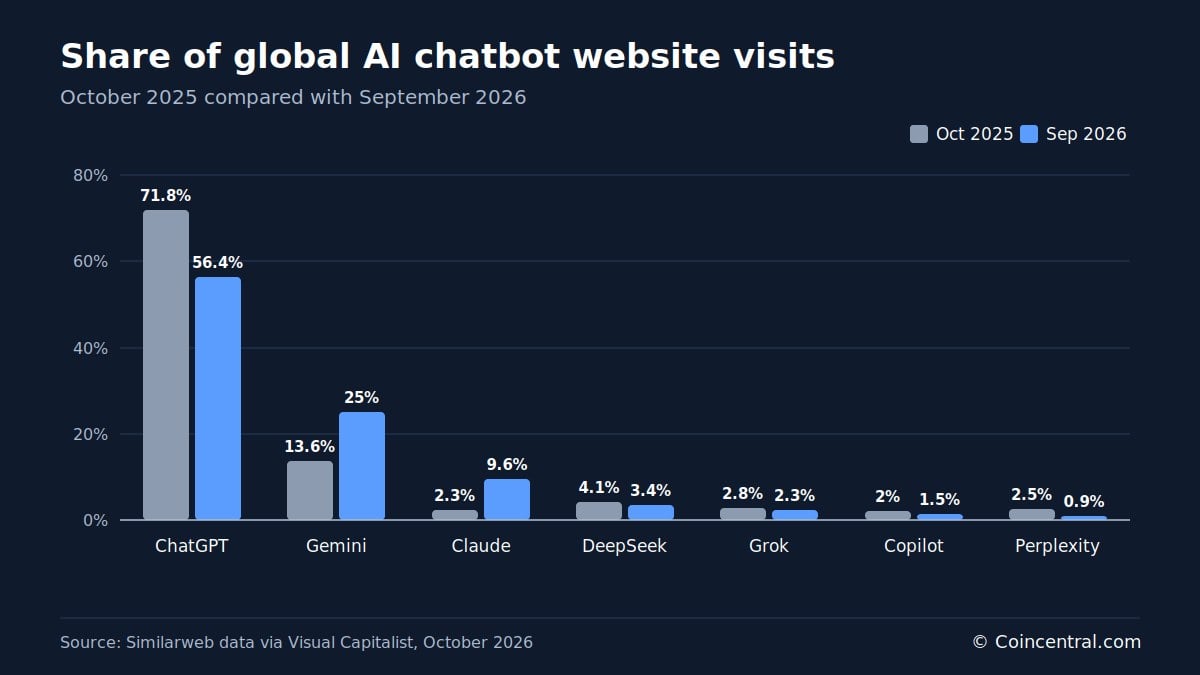
A year earlier the picture was different. In October 2025, ChatGPT held 71.8% of visits, Gemini 13.6% and Claude 2.3%, which put Claude in fifth place. Gemini and Claude were the only major chatbots to gain share over the year.
The four smaller rivals lost ground. DeepSeek, Grok, Copilot and Perplexity together fell from 11.4% to 8.1% of visits.
Other data sets point the same way. BCG, using Similarweb data for six European markets, reported that ChatGPT’s share of chatbot visits fell from about 90% in late 2024 to 57% in May 2026. In that month Gemini held 27% and Claude 10%.
Which chatbot is growing fastest?
A falling share does not mean falling traffic. ChatGPT’s website drew about 5.9 billion visits in September 2026, up from 5.7 billion in January. Its rivals simply grew faster.
Over the past year, Gemini’s monthly visits rose roughly 2.5 times, from 1.1 billion to 2.6 billion. Claude’s rose about sixfold, from 157 million to 1.0 billion.
| Chatbot | Earlier visits | Sep 2026 visits | Change |
|---|---|---|---|
| ChatGPT | 5.7 billion (Jan 2026) | 5.9 billion | About +4% |
| Gemini | 1.1 billion (a year earlier) | 2.6 billion | About 2.5 times |
| Claude | 157 million (a year earlier) | 1.0 billion | About 6 times |
Source: Similarweb data via Visual Capitalist. The earlier period differs for ChatGPT.
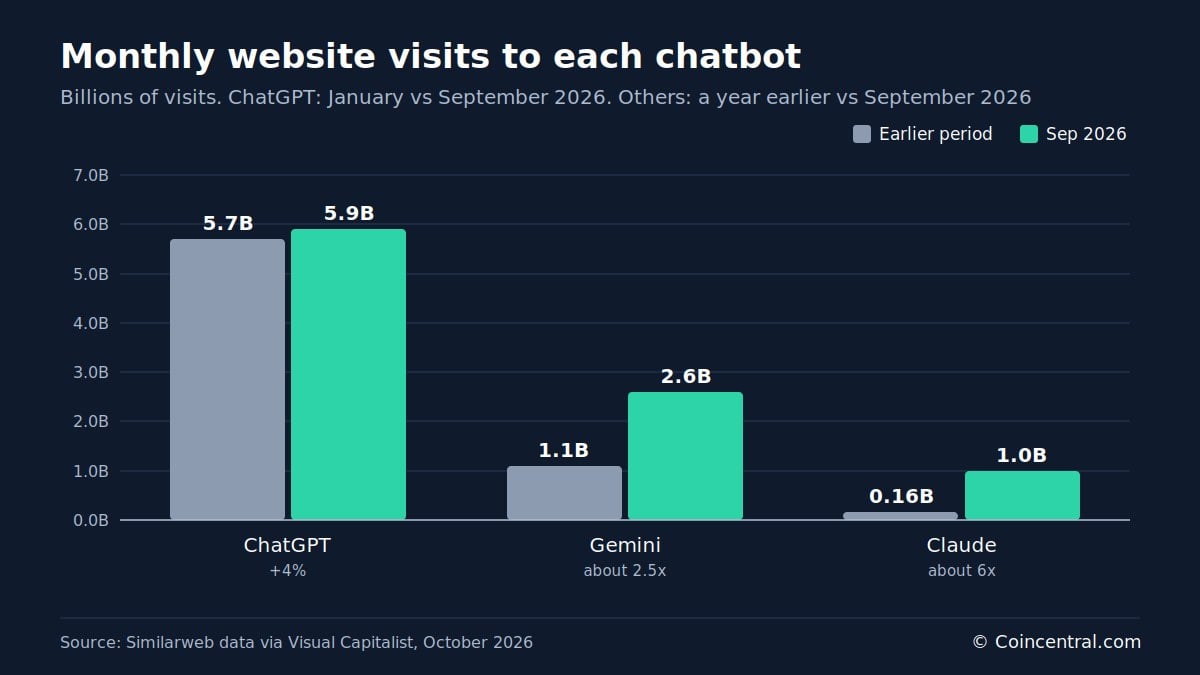
Visual Capitalist links Gemini’s rise to Google’s launch of Gemini 3 in late 2025. By the end of that year, the Gemini app had passed 750 million monthly active users, up from 650 million a quarter earlier.
Claude’s rise sped up in early 2026. Anthropic ran Super Bowl ads in February that promoted Claude as ad-free, around the time ChatGPT began showing ads to free users. Claude later reached the top spot on the US App Store, and its share of chatbot visits hit 8.0% by April.
Since April, ChatGPT’s share has recovered from 53.7% to 56.4%. Gemini’s slipped from 26.7% to 25.0%, while Claude kept climbing to 9.6%.
Separate Similarweb data shows Claude’s app monthly active users grew about 1,318% between June 2025 and May 2026. That was the fastest growth of any major assistant. Across all generative AI sites, visits averaged 9.5 billion a month, up 70% in a year.
Estimates of user counts vary widely. One 2026 roundup lists Claude at 18.9 million monthly users, yet the same list shows 968 million monthly web visits. User counts and visit counts measure different things, so they should not be compared directly.
How do marketers and everyday users use them?
Marketers pick tools differently from the general public. A September 2026 Ahrefs survey of 301 marketers found that Claude was the most used AI tool, at 83.2%. ChatGPT followed at 75.7% and Gemini at 57.9%.
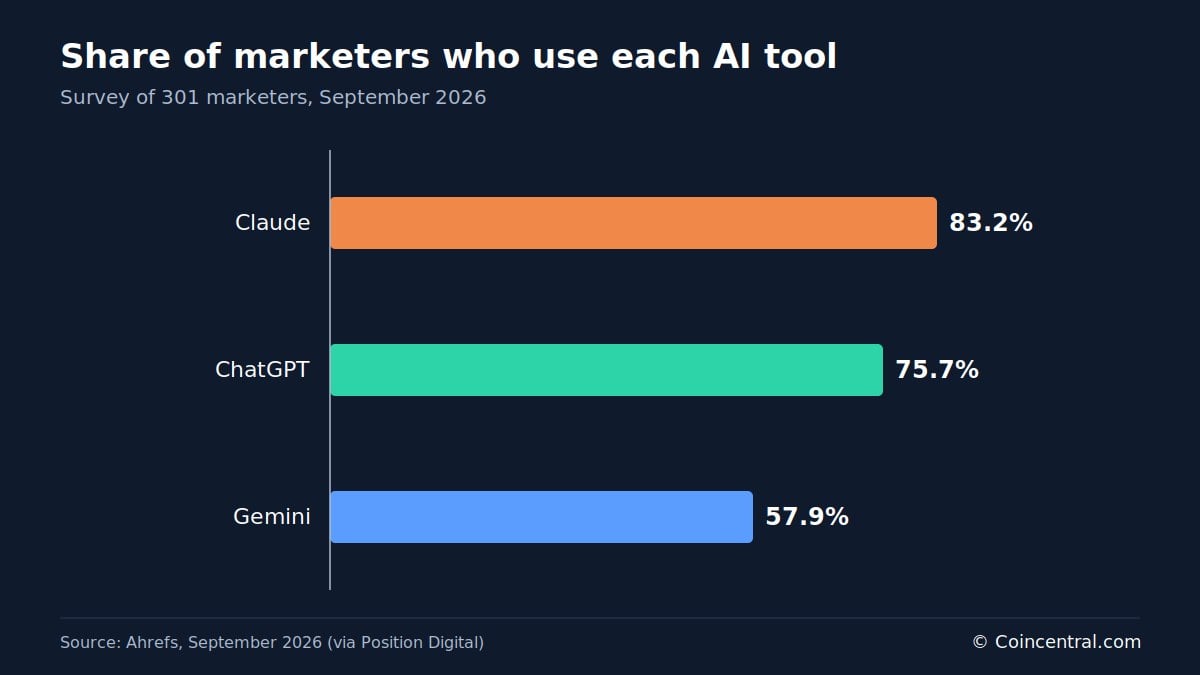
The same survey found that 93% of marketers use AI to help create content, up from 87% a year earlier. Of those who use it, 85% say they produce content faster. Only 2.5% say it slowed them down.
The most common tasks are brainstorming topics (78.6%), creating outlines (76.4%), improving content (75%) and editing (70%). The fastest growth is in specialist work. Data analysis rose from 28% to 60%, image creation from 19% to 43%, and keyword clustering from 23% to 45%.
Everyday use looks different. A study by OpenAI, Duke and Harvard researchers sorted ChatGPT messages into three types. About 49% were asking for information or advice, 40% were asking it to do a task, and 11% were expressing views or feelings.
| ChatGPT measure | Figure | Source |
|---|---|---|
| Messages that are “asking” | 49% | OpenAI, Duke and Harvard, Sep 2025 |
| Messages that are “doing” | 40% | OpenAI, Duke and Harvard, Sep 2025 |
| Messages that are “expressing” | 11% | OpenAI, Duke and Harvard, Sep 2025 |
| Share of messages seeking information, Jul 2024 | 14% | OpenAI, Duke and Harvard, Sep 2025 |
| Share of messages seeking information, Jul 2025 | 24% | OpenAI, Duke and Harvard, Sep 2025 |
| Messages unrelated to work, Jun 2025 | 73% | NBER, Sep 2025 |
Using AI to look things up is growing fast. Pew found in 2026 that 42% of US adults use chatbots to gather information. About 38% of employed adults use them for work tasks.
News is a small but rising use. The Reuters Institute found that weekly use of chatbots for news rose from 7% to 10% across markets in a year. People aged 18 to 24 were three times as likely as those over 55 to use them for news, at 17% against 5%.
Trust is a limit. Only 20% of people worldwide trust news from AI chatbots, according to the Reuters Institute. In a Fractl survey, the share of consumers who said AI was more helpful than traditional search fell from 82% in 2025 to 54% in 2026.
How often do Google AI Overviews appear?
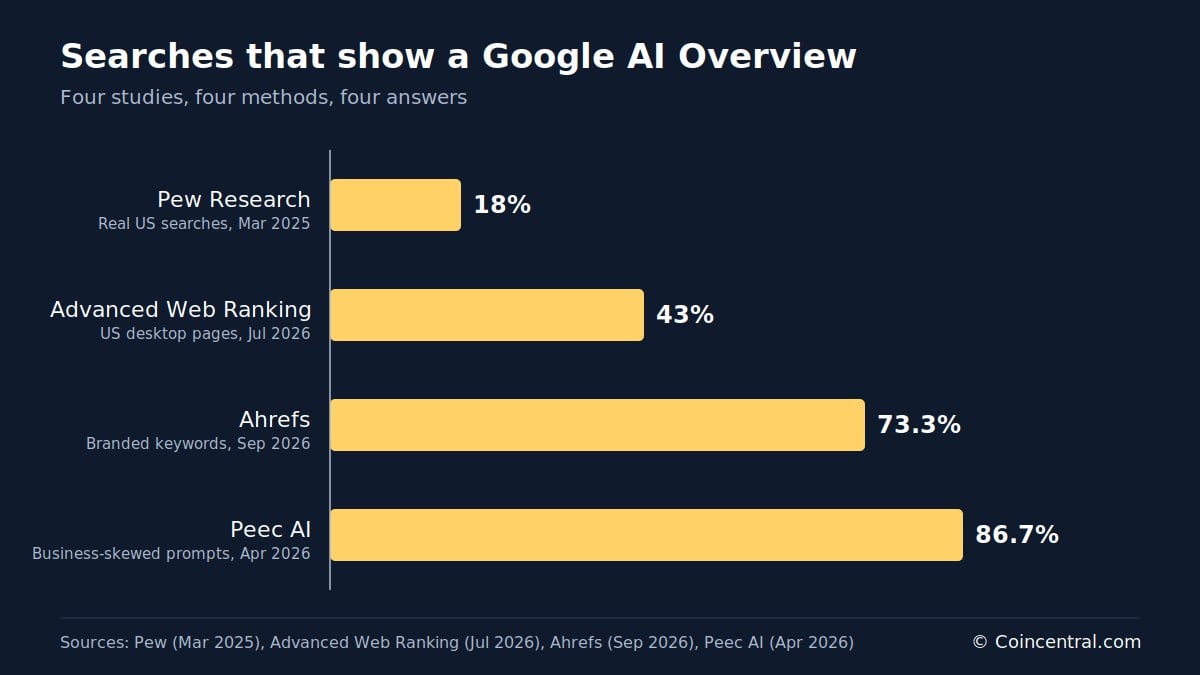
Studies give very different answers. The share of searches that show an AI Overview ranges from 18% to 86.7%, depending on who did the counting and what they counted.
The gap comes from method. Pew counted real searches by 900 US adults.
Advanced Web Ranking tracks a broad keyword panel. Ahrefs looked at branded keywords, and Peec AI tracks prompts that its customers chose, which lean toward business topics.
| Study | Period | What was measured | Searches with an AI Overview |
|---|---|---|---|
| Pew Research Center | Mar 2025 | 68,879 real searches by 900 US adults | 18% |
| Advanced Web Ranking | Jul 2026 | Tracked US desktop results pages | 43% |
| Ahrefs | Sep 2026 | Branded keywords, US desktop, monthly average | 73.3% |
| Peec AI | Apr 2026 | 500,000 customer-tracked prompts, business-skewed | 86.7% |
Broader keyword studies land lower. Ahrefs found AI Overviews on 21% of keywords across 146 million results pages in November 2025. Conductor found 25.11% of 21.9 million US searches produced one in a four-week sample.
Query length matters. Pew found that 8% of one- or two-word searches produced an AI summary, against 53% of searches with ten words or more. About 60% of searches that began with a question word produced one.
Intent matters too. Seer Interactive found that 36% of informational queries showed an AI Overview, against 8% of commercial queries and 5% of transactional ones.
Comparison queries triggered one 95.4% of the time. Ahrefs found that shopping queries triggered one only 3.2% of the time.
Location also changes the result. Peec AI measured coverage of 91.4% in the US, 91.7% in the UK and 75.6% in Germany. In France it was 0%, because Google does not serve AI Overviews or AI Mode there.
What do AI answers do to clicks?
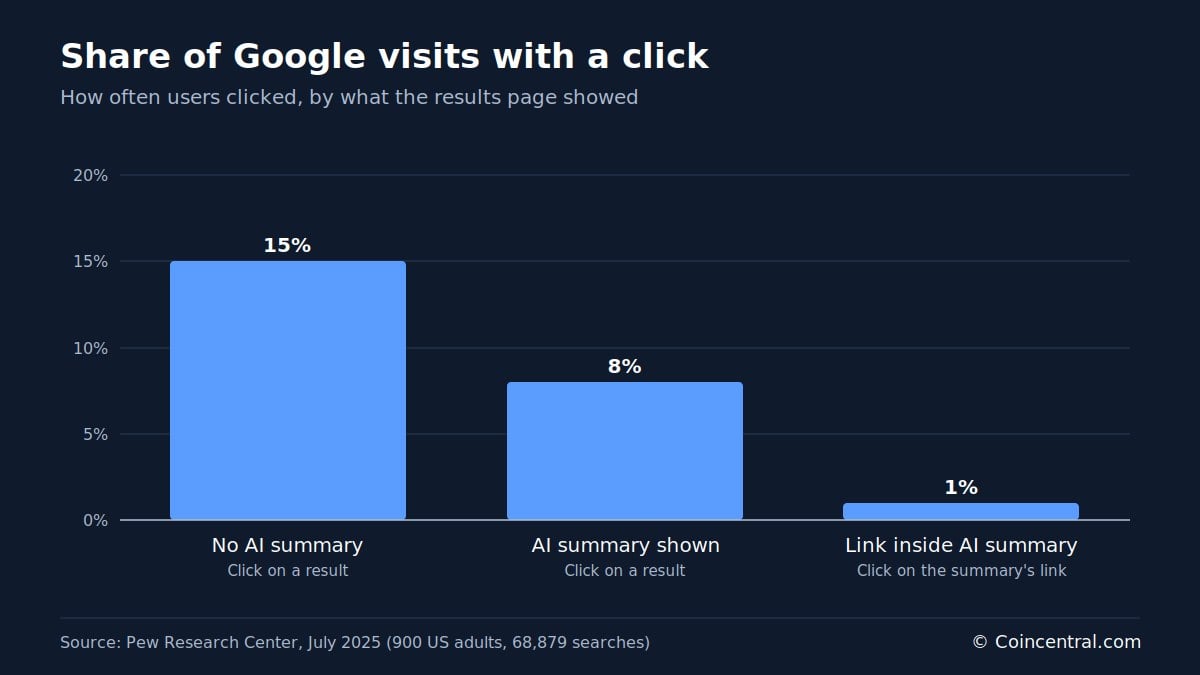
Clicks fall when an AI summary appears. Pew Research Center tracked real browsing and found that users clicked a traditional result in 8% of visits with an AI summary. Without one, the figure was 15%.
Links inside the AI summary itself drew a click in only 1% of visits. Users also ended their browsing session on 26% of pages with an AI summary, against 16% of pages without one.
Other studies find drops of a similar size. Ahrefs measured a 58% lower click-through rate for the top-ranking page when an AI Overview was present, across 300,000 keywords in December 2025. Advanced Web Ranking found that AI Overviews cut the position 1 click-through rate on US desktop by 52%, from 20.02% to 9.69%.
| Study | Measure | Result |
|---|---|---|
| Pew Research Center (Jul 2025) | Click on a result, with vs without AI summary | 8% vs 15% |
| Ahrefs (Feb 2026) | Change in CTR for the top-ranking page | 58% lower |
| Advanced Web Ranking (Sep 2026) | Position 1 CTR, US desktop | 20.02% to 9.69% |
| Seer Interactive (Nov 2025) | Informational queries with an AI Overview, Jun 2024 to Sep 2025 | 1.76% to 0.61% |
| Seer Interactive (Apr 2026) | Same type of query, Dec 2025 to Feb 2026 | 1.3% to 2.4% |
| Malte Landwehr meta-analysis (May 2025) | Average effect across more than 15 studies | 40% lower |
The picture is not all one way. Seer Interactive found that click-through on AI Overview queries recovered from a low of 1.3% in December 2025 to 2.4% in February 2026, in a larger sample of 53 brands. Brands cited inside an AI Overview also got a 35% higher organic click-through rate than brands that were not cited.
The size of the effect is still debated. A meta-analysis of more than 15 studies found results from a 19% gain to an 85% loss, with an average of 40% lower clicks. Google has said that total organic click volume from Search has been relatively stable, though it gave no numbers.
Zero-click behavior is also rising. SparkToro found that 68.01% of US Google searches ended without a click from January to April 2026. Only 0.34% of those searches moved on into AI Mode.
Which sources do ChatGPT, Gemini and Claude cite?
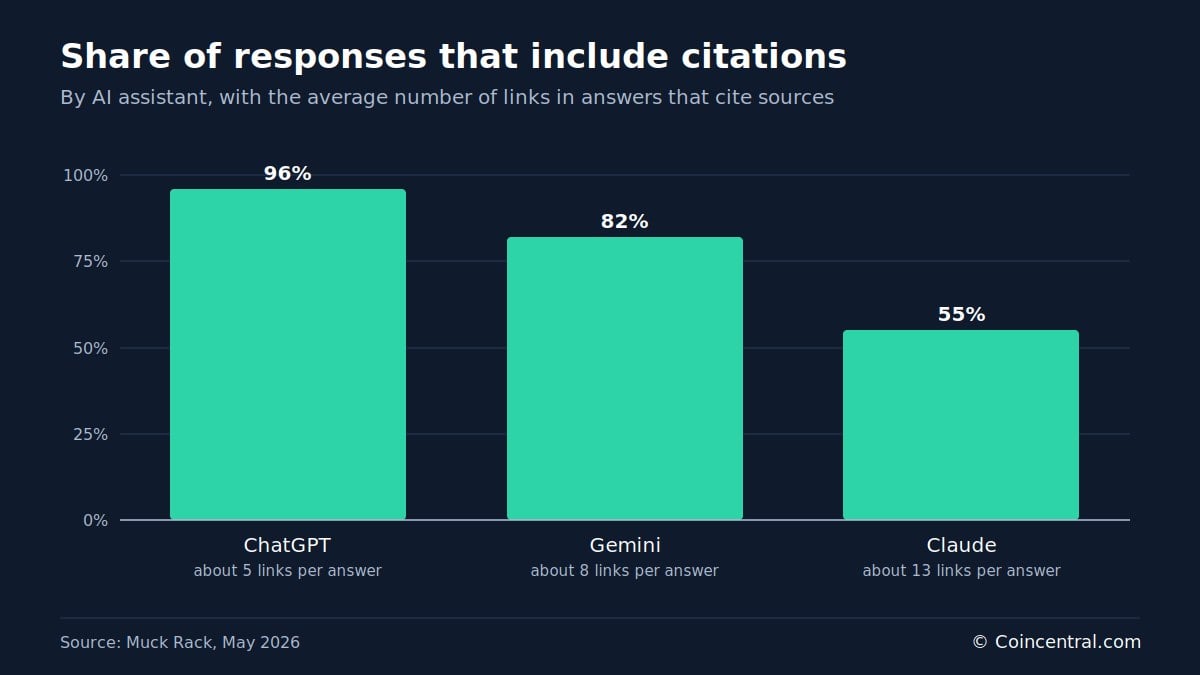
The three assistants handle sources in different ways. Muck Rack found in May 2026 that ChatGPT cites a source in 96% of responses, with about 5 links each. Gemini cites in 82% of responses with about 8 links, and Claude in 55% with about 13.
So ChatGPT cites most often, while Claude cites least often but packs in the most links when it does. Each assistant also has a favorite. ChatGPT’s most cited domain is Wikipedia, Claude’s is PubMed Central and Gemini’s is Reddit.
| Assistant | Responses with citations | Links per cited answer | Most cited domain |
|---|---|---|---|
| ChatGPT | 96% | About 5 | Wikipedia |
| Gemini | 82% | About 8 | |
| Claude | 55% | About 13 | PubMed Central |
Source: Muck Rack, May 2026.
Journalism is a major source for all of them. Muck Rack found that journalism makes up about 27% of AI citations, while paid and advertorial content makes up 0.3%. About 84% of the links AI assistants cite come from earned media rather than a brand’s own pages.
Across engines, Reddit leads. Peec AI found that Reddit was the first or second most cited domain on all five platforms it measured in March 2026. The top ten across 30 million US sources were Reddit, YouTube, LinkedIn, Wikipedia, Forbes, G2, Yelp, Facebook, Medium and TechRadar.
Citing a source and naming a brand are not the same thing. A Growth Memo study of April 2026 found that ChatGPT cites sources 87.0% of the time but names brands in only 20.7% of answers. Gemini does the reverse, naming brands in 83.7% of responses but citing a link only 21.4% of the time.
Those rates differ from Muck Rack’s because the studies used different prompts. Growth Memo also found that only 2% of cited URLs appear across AI Overviews, ChatGPT and Perplexity. About 91% of citations appear in just one engine.
How much traffic do AI platforms send, and does it convert?
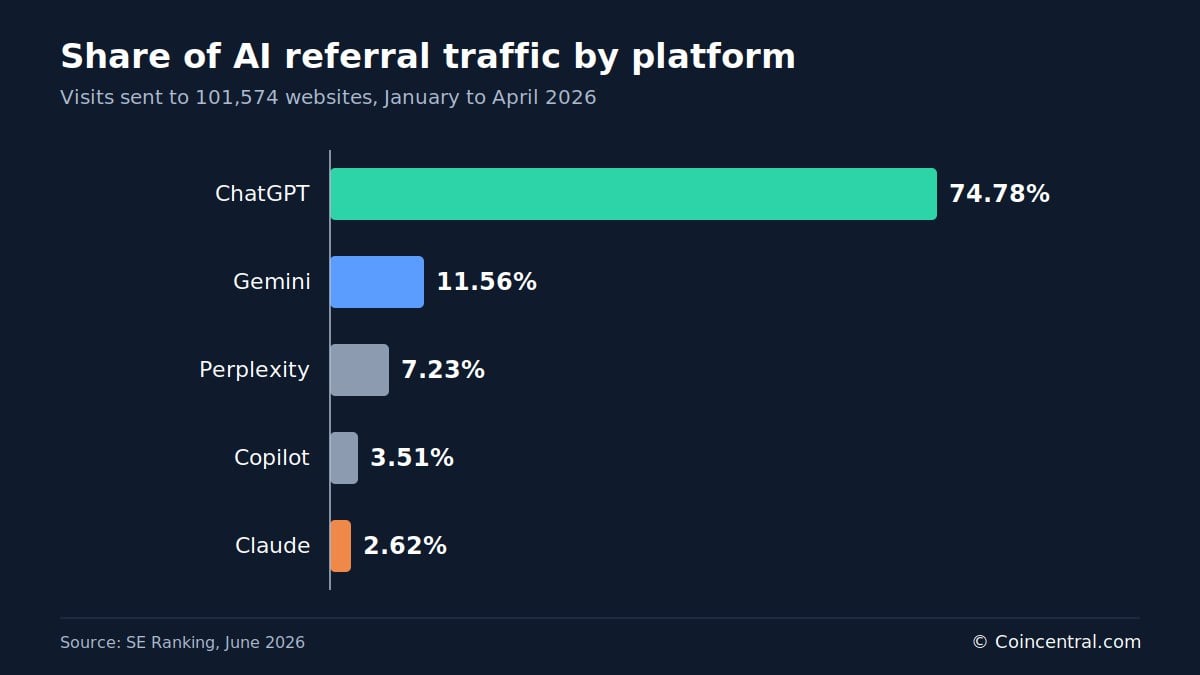
AI platforms send a small share of website traffic. SE Ranking found that they sent 0.32% of all traffic from January to April 2026, up from 0.24% in 2025. The data covers 101,574 sites.
ChatGPT sent 74.78% of that AI traffic. Gemini sent 11.56%, Perplexity 7.23%, Copilot 3.51% and Claude 2.62%. Statcounter data for April 2026 gave a similar order: ChatGPT at 78.16%, Gemini at 8.65% and Claude at 2.91%.
Google still sends far more. Ahrefs found that Google sent 190 times more traffic to websites than ChatGPT across 76,000 sites. In August 2026, across 112,309 sites, Google sent 24.24% of all visits and AI assistants combined sent 0.41%.
Total usage tells the same story. Datos found that AI tools made up 1.83% of US desktop activity in the second quarter of 2026. Traditional search made up 10.52%.
The volume is growing quickly. Similarweb found that AI platforms sent an average of 770.7 million referral visits a month between June 2025 and May 2026, up 117.4% from the year before.
Visitors from AI tend to convert better. Adobe found that AI-referred visitors to US retail sites converted 54% better than other visitors in May 2026, and brought 53% more revenue per visit. A year earlier, in March 2025, AI traffic converted 38% worse.
| Source | Finding on conversion |
|---|---|
| Adobe (Jun 2026) | AI-referred retail visitors converted 54% better than other visitors |
| Similarweb (2026) | AI referral conversion of 11.4% against 5.3% for organic search |
| Exposure Ninja (2026) | AI search converted at 14.2% against 2.8% for Google; Claude highest at 16.8% |
| Seer Interactive (Jun 2025) | ChatGPT 15.9%, Perplexity 10.5%, Claude 5%, Gemini 3%, Google organic 1.76% |
These studies use different sites, periods and definitions of a conversion, so the platform rankings do not match.
What the numbers show
ChatGPT leads in users, web visits, citations and referral traffic. Its share of chatbot visits has fallen from 71.8% to 56.4% in a year, but its traffic is still growing.
Gemini has gained the most ground in reach, helped by Google’s place in search. Claude is the smallest of the three but the fastest growing by visits, and it is the top choice among marketers in the Ahrefs survey.
Google remains the main source of traffic for websites. AI platforms send about one visit in a hundred or less, though those visits appear to convert well. The data is changing quickly, and studies often disagree, so it is best to check the date and method behind any figure.
Sources
- AI search statistics for 2026 (GSC Wizard)
- 594 AI Search Statistics for 2026 (Malte Landwehr)
- Ranked: The Most Used AI Chatbots in 2026 (Visual Capitalist)
- AI Search Statistics 2026: The Numbers Marketers Need This Month (Passionfruit)
- 100+ AI SEO Statistics & Insights That Matter for 2026 (Position Digital)
- 2026’s AI Search Statistics Every CMO Should Know (Exposure Ninja)
- 123 AI Search Statistics October 2026 (BlazeHive)
The post AI Search Statistics for 2026: ChatGPT vs Gemini vs Claude appeared first on Blockonomi.
This articles is written by : Nermeen Nabil Khear Abdelmalak
All rights reserved to : USAGOLDMIES . www.usagoldmines.com
You can Enjoy surfing our website categories and read more content in many fields you may like .
Why USAGoldMines ?
USAGoldMines is a comprehensive website offering the latest in financial, crypto, and technical news. With specialized sections for each category, it provides readers with up-to-date market insights, investment trends, and technological advancements, making it a valuable resource for investors and enthusiasts in the fast-paced financial world.