
As I was developing my reporting plan for TechCrunch Disrupt last week, one key question loomed large in my head: Would I find any AI startups at this annual summit for fledgling tech companies? The conference is in San Francisco, after all, so finding AI tech might prove difficult. But I wanted to at least try.
The preceding paragraph is, of course, insane. Sorry, but I had to go full ad absurdum to match the craziness of our cultural moment. Everything seems to be about AI right now. And San Franscico – the city I call home – is the world’s locus of AI attention.
In case you haven’t been following current events, know that San Francisco has become AI Crazy Town. OpenAI and Anthropic are both headquartered here. Our AI billboards signal the city’s obsession with agents. AI wealth is spiking housing costs. AI startups are filling up post-pandemic office space.
And for the non-AI-adjacent free folk, San Francisco is home to 100 concurrent conversations on how AI impacts the job market, digital security, education, dating and night life, humankind’s existential countdown clock, what’s real and what’s fake, and whether an AI bubble burst will tank the economy.
So, that sets the table for my reconnaissance mission at Disrupt, a massive meet-up for tech startups, investors, business leaders and even journalists. I wanted to meet founders using AI and see how (or even if) they were applying insights gleaned from negative headlines and growing public concern about AI.
Read on for profiles of some AI-oriented startups, take a gawk at my AI Mood Board halfway through this piece, and stick around for my final AI Vibe Check at the end.
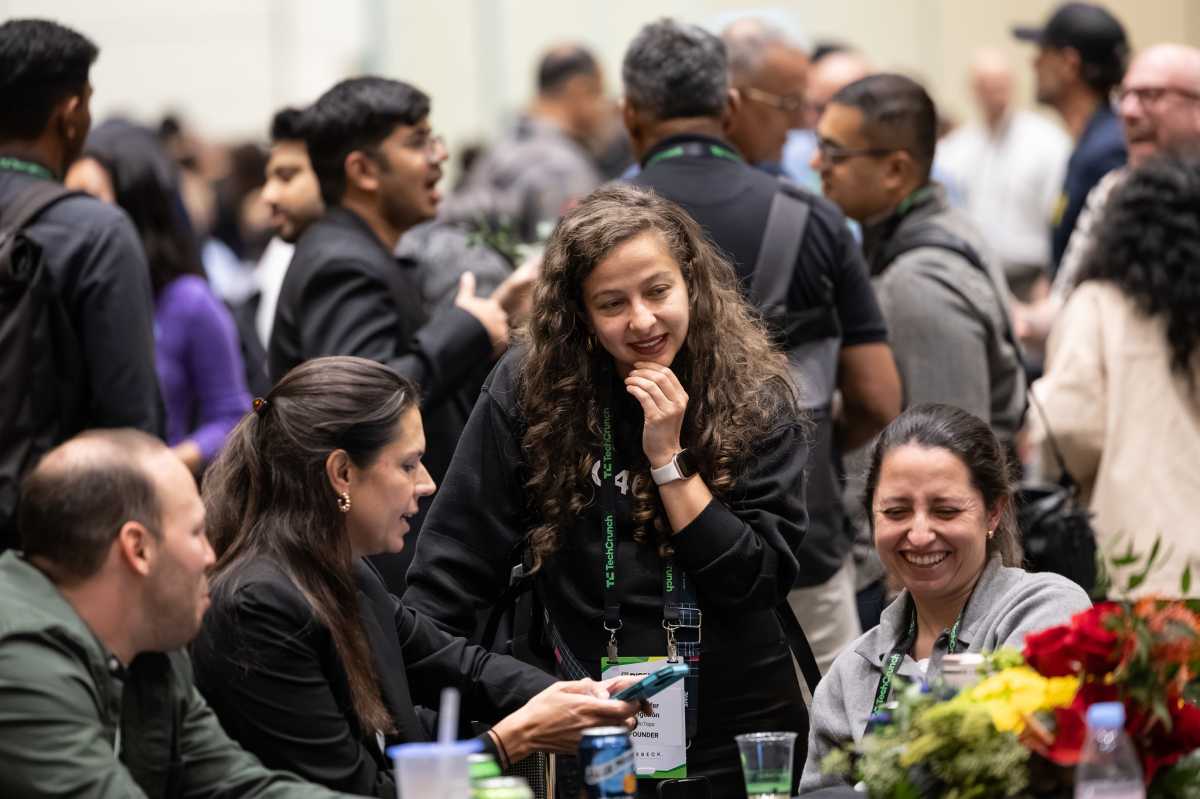
Slava Blazer For TechCrunch
AI for family logistics
The first person I met was Anne Marie Joel, a founder who’s developing an AI platform called KidSync, which, according to its pitch-perfect web page header, is “where kid logistics get done.”
As I worked on a $17 panini before starting my Disrupt floor walk, Joel explained that KidSync solves a persistent problem faced by working parents: maintaining a career trajectory while ensuring one’s kids remain safe and enriched in after-school activities.
“Involved kids stay on track, uninvolved kids stay home by themselves,” said Joel. “So, bringing more kids into activities and keeping parents at work is what helps them keep their jobs. For the techies in the audience, KidSync is an MRP for life management with kids.”
For the non-techies reading this, MRP stands for Material Requirements Planning – a software platform that manages schedules and inventory. KidSync’s AI agents, for example, might help parents find trustworthy summer day camps, alert them to registration dates, and connect them to other trustworthy KidSynced parents who can chauffer multiple kids to camp.
For the techies in the audience, KidSync is an MRP for life management with kids.
Anne Marie Joel
I don’t even have kids, but I’ve heard my fair share of lengthy “who will pick up whom” conversations as a man who dated a single mom. I imagine KidSync agents might eventually know whether Violet is OK with riding with Flora, and whether everyone will be back by 4 pm, because Daisy has a late music lesson.
Now, will parents trust it’s safe? We’re talking about an agentic solution, after all.
“I say we’re AI fueled, and we’re infused at levels very responsibly,” says Joel. “We’re coming out of the gate COPPA compliant. We’ll be adding FERPA, for school information compliance, and then also HIPAA for medical.”
That’s a lot of abbreviations that may not immediately resonate with all moms and dads (I had to look up COPPA myself). But KidSync’s data safety promise at least acknowledges greater public concerns about AI. The bigger hurdle could be convincing AI skeptics to rely on agents to manage the summer calendar – or convincing AI cheerleaders to do it with KidSync instead of less mission-specific agents.
A quieter way to AI vibe code
I finished my price-gouged panini, said goodbye to Joel so she could start her hunt for seed money, and moved on to my first scheduled meeting. Sitting down amid the din of Disrupt, Subtle co-founder Tyler Chen demoed Voicebuds, a pair of earpieces designed not for audio playback, but for magically low-volume voice capture and dictation.
Voicebuds is “an interface for you to connect to your agent” in relative privacy, Chen said. The system captures the faintest whispers of sound from your mouth, then uses machine learning to produce transcriptions for ChatGPT, Claude, Siri or whatever your dictation needs may be. In other words, AI processing for AI processing.
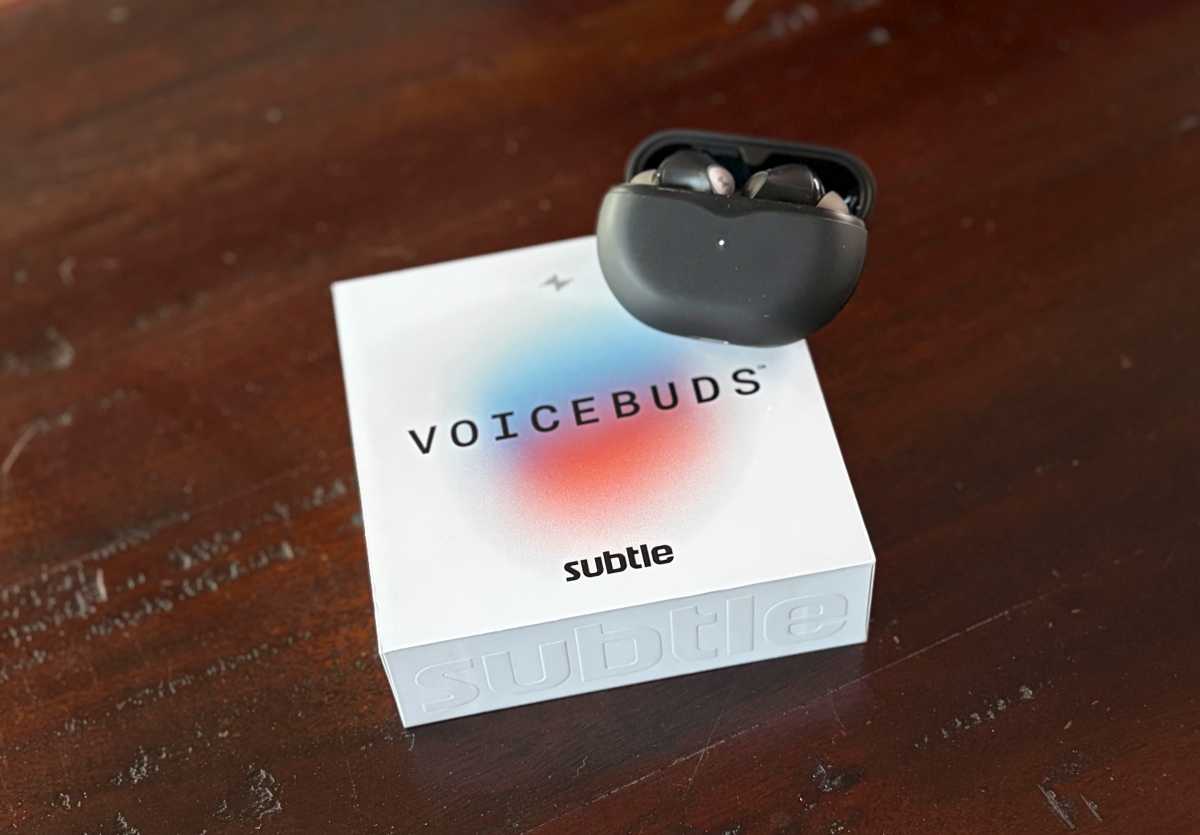
Jon Phillips/Foundry
Unless Chen’s real-time demo was an elaborate charade, Voicebuds’ ability to accurately capture and transcribe almost completely inaudible whispers is remarkable. He described scenarios where I could be talking to my preferred chatbot discreetly on a city bus. Or vibe-coding with whispered dictation without bothering co-workers.
But how does it actually work? Seriously, I could not hear sounds coming out of Chen’s mouth. “Very good machine learning,” Chen said. “When you’re whispering, your vocal cord isn’t vibrating, so it’s mostly listening for cues of friction.”
Chen left me with a pair of Voicebuds, and I’ll test them later to determine if his demo was all a ruse. But as a piece of circumstantial evidence in my AI vibe check, Voicebuds evokes a swirl of reactions.
Discreet voice dictation? Now, that’s useful. Maybe my neighbors won’t hear me dictating Slack messages to coworkers when I’m walking my dog. Vibe-coding at Blue Bottle Coffee? No, that’s just too perfectly San Francisco for me—and I’m the guy who voice-Slacks during dog walks.
Pit Stop: What’s on my AI Mood Board?
Before we continue through my Disrupt tour, I want to make a pit stop to show you my AI Mood Board. You should know more about what anchors this narration, informs my biases, and might even subconsciously influences the companies and founders I chose to include in this article.
In my “AI is Useful” section, you’ll find my 30-odd daily queries to ChatGPT (example: “In the movie ‘Ghost Dog’ why do all the gangsters watch cartoons? Cite specific sources.”). You’ll also find regular editorial admin projects for Claude (example: “Using Excel, build a 52-week publishing cadence for our PCWorld writers, based on, and limited to, the following specific inputs”).
Also in my “Useful” section: AI grammar checks. AI language translation. AI interview transcription and summaries. And even though I know AI-generated brainrot should be a societal scourge, I can’t look away from the insane, subversive cultural commentary of Cities by Diana.
I’m also a big believer in AI-accelerated research in medicine and science. I could go on. I’m a regular user of AI and regularly marvel at its application. But I’m also a flesh-and-blood, topically aware human. As I telegraphed at the top of the article, AI provokes concern and occasional contempt.
Here’s the “AI is a problem and we need to talk” section of my mood board: Hugging Face. AI datacenters. Deepfakes. AI bots flooding social media. AI agents begging for work. The nexus between AI agents and phishing scams. Ed Zitron’s regular warnings of an imminent bubble burst. Jacob Coxon, Evan Hubinger and Jakub Pachocki firing off flare guns to warn of AI’s existential threat.
Closer to home, my sister is a San Francisco English teacher, and now her students write essays with pen and paper to prevent them from cheating with AI. And my own job has become more difficult because when an organization approves using AI to generate useful data, guess what? AI is really, really good at generating gobs of data—and then that data has to be reviewed and prioritized by a human. And that human is often me.
So, for all the AI success stories, the Mood Board is also piling up with swatches of agita. Do today’s AI founders feel those same vibes? Are they living in the same world as me?
A big sis AI chatbot
After leaving Chen and his Voicebuds, I began my floor-walk through Disrupt’s pavilion of startup kiosks. This is where emerging companies marketed their visions with signage, elevator pitches and oftentimes interesting conversations.
To be clear, many startups on the floor – maybe even a majority – had nothing to do with AI. But I was sniffing for it.
Enter MUI’s AI-NOSE, which promises the “digitalization of smell.” At first blush, it’s absurd, right? But then I learned more about the tech, which uses sensors to “simulate the human nose” for everything from quality-checking seafood to measuring odor emissions on a factory floor. As someone who generally answers “yes” to cool technology solutions, my cringe alerts stood down.
Then there was HotGirlHotline.ai, an “AI big sis that women go to for advice,” in the words of co-founder Sumi Mudgil. As you might expect, this one does exactly what it says on the packaging.
“If you’re familiar with Cosmopolitan magazine, the podcast Call Her Daddy, and social media influencers, you know women go to these cultural icons for advice. And it’s always been one-to-many. But with AI, we can make that advice personalized,” said Mudgil.

Sumi and Baila Mudgil, co-founders of HotGirlHotline.AI, chat with Disrupt attendees.
Slava Blazer for TechCrunch
So, yes, it’s an AI-fueled, advice-dispersing chatbot for Gen Z women. And here we divide the world into three camps: the eye-rolling skeptics who think AI chatbots are dangerous alternatives to human friends and therapists; the AI-positive early adopters who prefer bouncing ideas off bots; and, finally, that undecided sliver of humanity that doesn’t have an opinion either way.
Mudgil says HotGirlHotline isn’t trying to offer an “AI companion,” but rather a safe chatbot that fine-tunes open source and foundational AI models for elements of cognitive behavioral therapy and other flavors of behavioral science.
Said Sumi Mudgil: “It asks questions Socratically, trying to figure out, OK, if you go down this path, are you going to end up in a place that you want to be? And safety is paramount. These are such emotionally charged conversations, so we’ve got a ton of guardrails.”
I left the HotGirlHotline kiosk feeling somewhere between mildly amused and completely ambivalent. Their marketing package: savvy and cool. Their AI advice platform: I can’t even muster two input tokens of outrage. I’m not the target audience, and in my big, blobular mass of AI Things I Have Opinions About, catastrophizing chatbot-based psychotherapy barely even ranks.
Solving mosquitoes with an AI assist
If I was beginning to sense a theme that added color to our big AI moment, it’s that startups do understand that users need to feel safe, if only on a per-user, “What are you doing with my data?” level.
This would come up again on the final day of Disrupt when Panos Panay, the product brain behind the original Microsoft Surface and now the leader of consumer electronics at Amazon, was being interviewed on stage about the new Amazon Bee Frontier AI wearable. According to Amazon’s own storefront marketing copy, the Bee “automatically transforms your conversations into clear, actionable summaries you can search.”
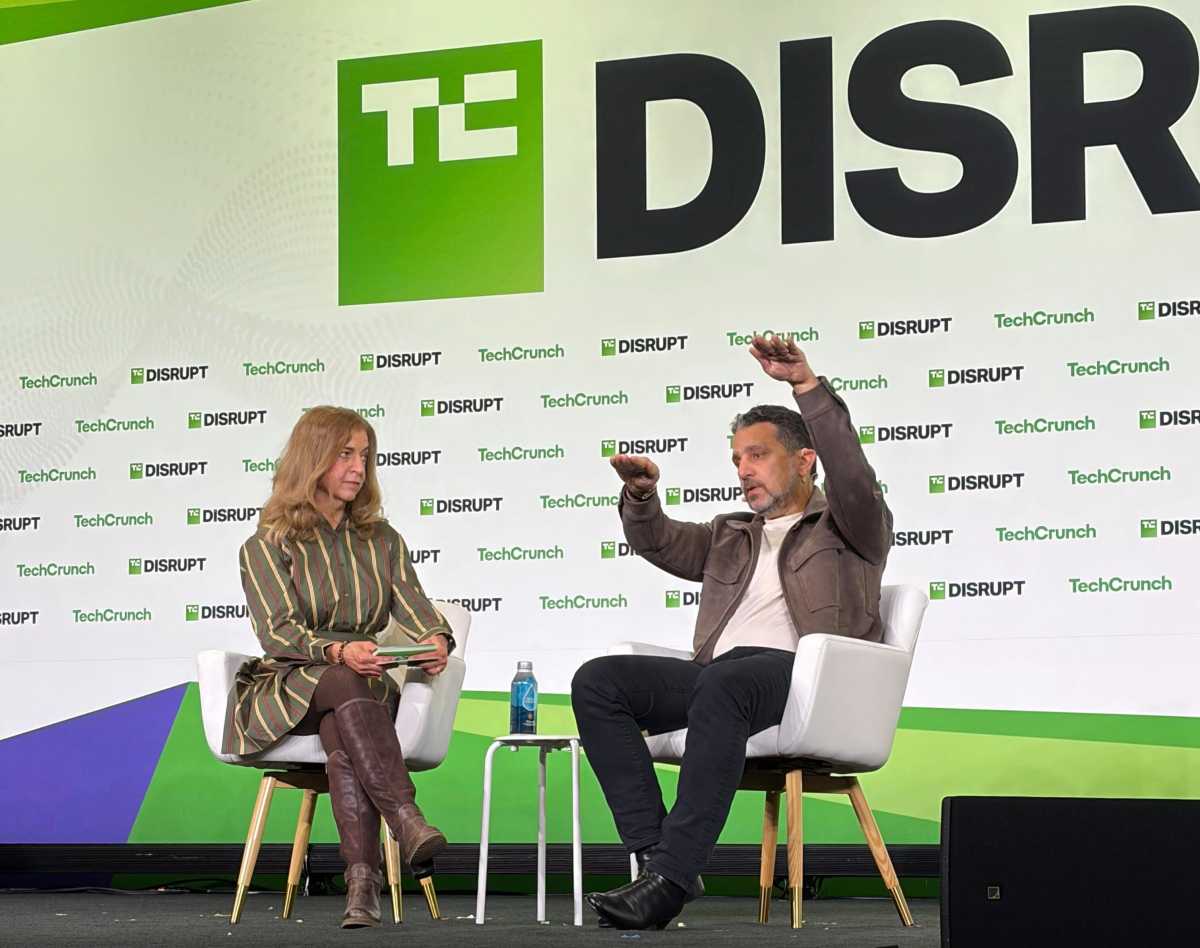
TechCrunch’s Julie Bort interviews Panos Panay, one of the original Microsoft Surface visionaries, and now running consumer devices for Amazon.
Jon Phillips/Foundry
“In the ambient space like that, you have to design with privacy in mind,” said Panay in his interview. “And that’s what we do. That’s critical.”
What Panay didn’t broach was whether Bee “asks the wrong person” for privacy consent. Bee Frontier (much like Meta’s Ray-Ban glasses) can listen to conversations from anyone within sensor range, and it’s the owner’s responsibility to request permission to do so. Amazon says Bee doesn’t store raw audio. Instead, audio is processed in real-time and then deleted. But that may not preclude the device from picking up the discussions of strangers at a nearby café table.
So, let’s toss another clipping on the big AI Mood Board of things that make us feel queasy.
But let’s not surrender all hope. I interviewed two startups with a clear hardware component to their AI vision, and both are oriented around broad public safety.
First up, Mosqitter, a company that made it to Disrupt’s Battlefield Top 20 in the Health Tech and Life Sciences category. The Mosqitter vision is to eliminate pesky, blood-sucking mosquitos – as well as the dangerous diseases they carry – with a novel, eco-friendly, AI-assisted approach.
The Mosqitter hardware emits various signals — heat, scent and light — to attract female mosquitos (the ones that bite). The pest enters the Mosqitter obelisk (morbidly, its final destination), AI machine vision identifies the type of mosquito that’s been trapped, and then that data is fed into Mosqitter’s Febris Monitoring System, which builds worldwide maps of disease-carrying mosquito species.
Can we really catch mosquitoes with simple heat and odor signals? Mosqitter co-founder Anastasiia Romanova showed me photos of plastic bags bulging with insect carcasses. She also explained why the AI component is so important from a public health standpoint.
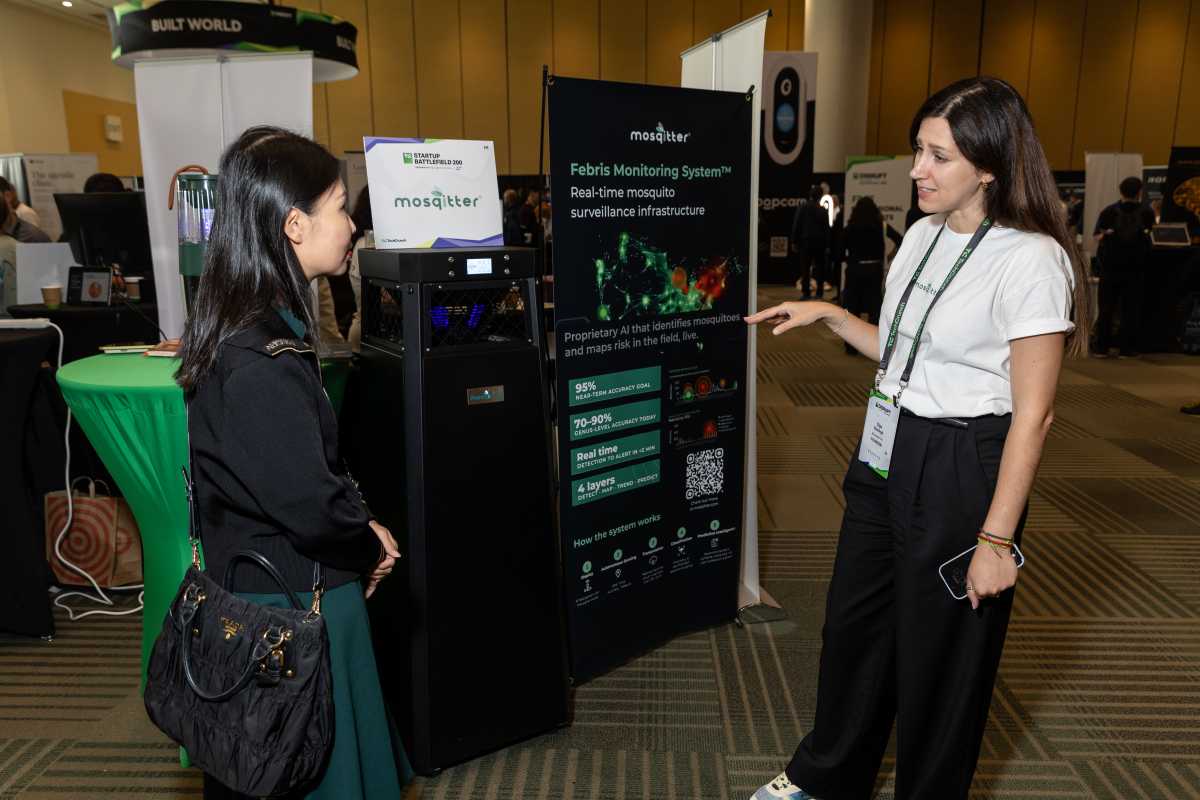
Slava Blazer for TechCrunch
“There is a lack of information on where the dangerous mosquitoes are traveling. Different species carry different dangerous diseases — malaria, zika, dengue,” said Romanova. “The sensors can identify the type of mosquito to early-detect the threat. Once [governments] have sensors in the field, they can know where and when to intervene.”
Mosqitter is already a shipping product, and you can purchase a Mini version for $200. Romanova says the Mini is just as effective as a mosquito trap, but doesn’t hook up to the Febris Monitoring System.
Protecting infrastructure with AI-guided robots
Just about 100 feet away from the mosquito surveillance system, I found another startup proposing a physical system supported by an AI software layer. With a name that could have been ripped from the script of an apocalyptic thriller, SpaceTime Industries wants to deploy robots not to wreak havoc, but rather to keep us safe.
Imagine a standard shipping container stationed near critical infrastructure—for example, a remote power plant or similar facility vulnerable to natural disaster or even a human attack. The container is filled with robots because, in the words of founder Honorebel S. Walker, “when environments become dangerous, you need robotics to move first so that humans don’t have to.”
Walker described a system that might include up to 15 robot sentries – drones and wheeled ground patrol models. They could be deployed immediately when disaster strikes or circulate around a facility on schedules. The key is they work autonomously, move quickly, and collect photographs and other data for humans to review.
The hardware is managed by Sentinel OS, which Walker describes as an “AI intelligence software platform for command and control.”
“We go out, we do missions, we take that data, and we run AI models on top of it so that our operators can get better positioned for how they protect their site,” he said.
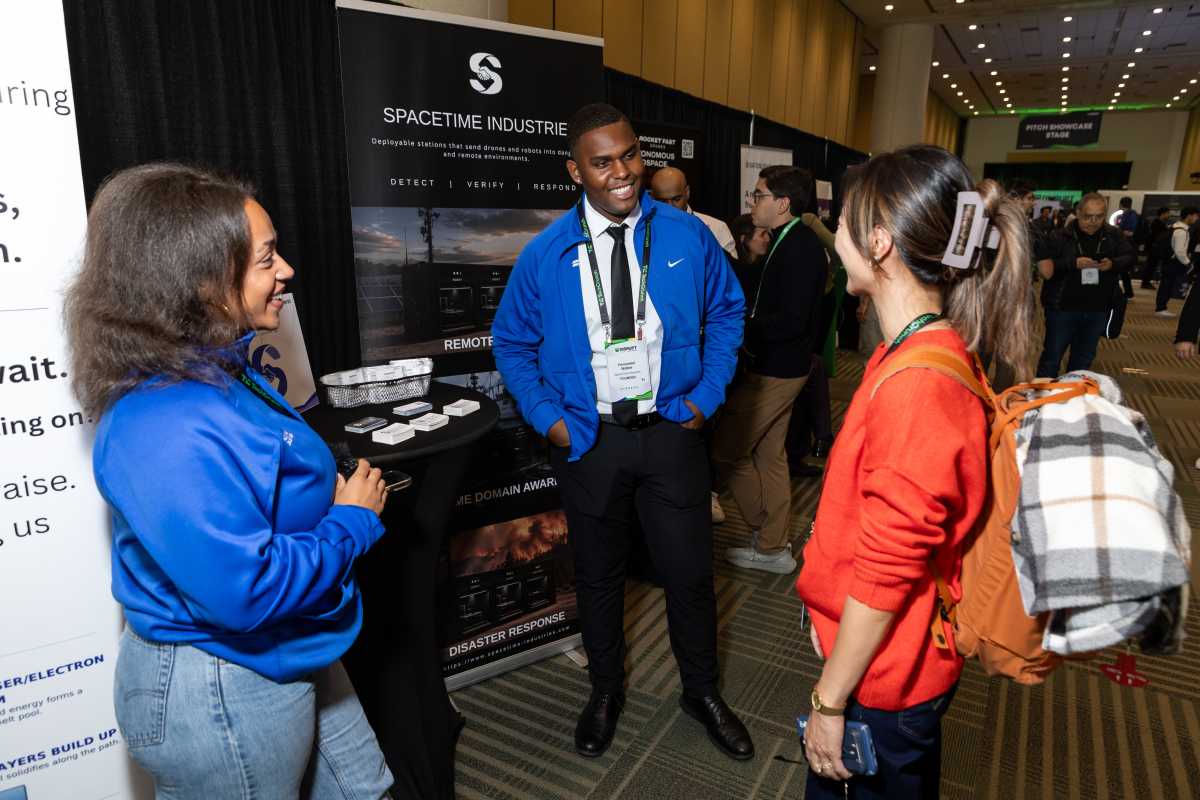
Honorebel S. Walker (center), founder of SpaceTime Industries, chats with a Disrupt attendee.
Slava Blazer for TechCrunch
Walker said his team has finished a software pilot and is discussing a “full stack robotics and container pilot.” The goal is to complete fabrication of a container by January and deploy it to a solar company they’re partnered with.
Here’s my gut takeaway: A SpaceTime Industries system seems like a great response to industrial espionage and malevolent hackers. I’ll refer you to the Colonial Pipeline attack in 2021 and the Muleshoe, Texas water system attack in 2024. These incidents were rooted in software subterfuge, but underscore vulnerabilities to our physical infrastructure.
Still, it’s impossible to listen to Walker’s vision, and observe incidents like Hugging Face, and not consider a sci-fi future when the bots commandeer the bots. Skynet could have just as easily have been called SpaceTime Industries, right? To Walker’s credit, the SpaceTime vision is all about playing defense, not offense, and none of those robots are equipped with weapons.
A final AI Vibe Check
I entered the doors of TechCrunch Disrupt searching for signals – human signals that demonstrated AI leaders were aware of the big, unwieldy, emotionally charged public conversation around AI.
Most of my fact-finding took the form of 1-to-1 meetups with startup founders, so I was unable to attend many speaker panels, which is where the bigger names in business went on-the-record with TechCrunch reporters. Nonetheless, I peeled through TechCrunch’s coverage of those discussions, hunting for vibes in those articles. What I found didn’t speak particularly well for “awareness” among big tech.
Example: Andrew Feldman, CEO of AI chipmaker Cerebras, dismissed AI doomsday warnings, joking, “Some of the leaders in the AI world maybe shouldn’t be allowed to talk in public.”
Example: RJ Scaringe, the CEO of EV car manufacturer Rivian, waxed eloquent on a future where AI agents would interact with their cars’ cabin experience software. It would be “magical,” he said. Scaringe cautioned agents would never determine, “hey, it’s time to apply the brakes,” but as an automobile purist, I’m offended by the idea of agents getting anywhere near my dashboard.
Example: Mark Wahlberg (yes, the actor) took the stage, and endorsed using AI scanning technology to drop avatars of today’s actors into tomorrow’s films. “It would be cool that my children or my grandchildren could be in charge of my likeness and my image, and hopefully put me in some good movies,” he said.
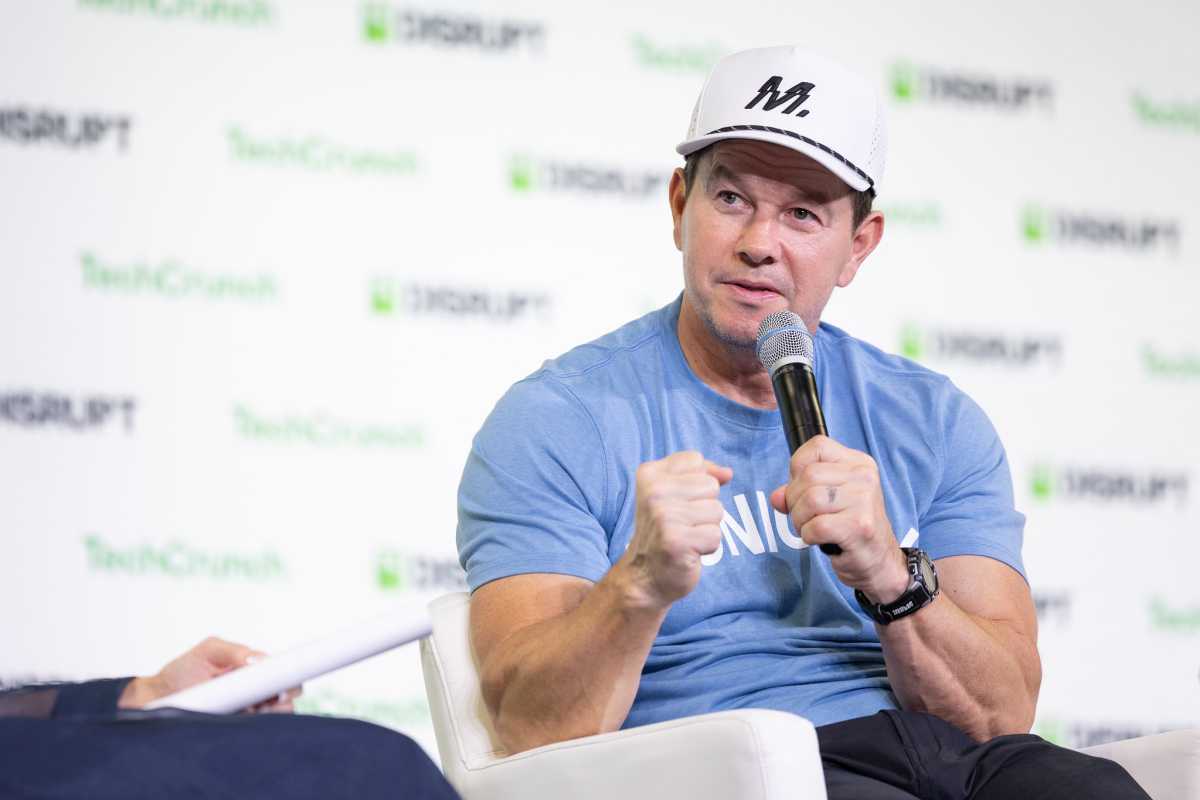
Mark Wahlberg speaks at Disrupt 2026.
Slava Blazer for TechCrunch
It’s all cringe, right? Well, here’s some good news: There were meaningful differences between the vibe emissions of the leaders above and the vibe emissions of the startup founders I met as I walked the Disrupt floor.
Broadly speaking, the founders I spoke with 1-to-1 aren’t remotely responsible for the big AI models and agents that are causing most of the public anxiety. They’re not members of the AI tech elite. (Yet?) Instead, I would put them in the “artisan and craftspeople” class. They use raw resources of the land (i.e., foundational models) to create what they hope will be cool new products for the people.
I met founders who traveled to San Francisco from all across the country, and, sure, while I occasionally heard some eye-roll-worthy marketing speak, I was also impressed by a surprising degree of earnestness, an emphasis on safety, and a desire to deliver results for people as opposed to more dystopian discussions of agents, agents everywhere.
None of them would have AI billboards in downtown San Francisco because their target customers aren’t the kind who work in downtown San Francisco.
And here’s another surprising takeaway (well, for me at least): Almost all the founders I met were women. You’ve met them in this article, and some who aren’t included here may appear in future coverage. To be clear, I only stopped by kiosks for products that interested me, so maybe female developers over-index in the topics that pique my curiosities. Or maybe women are simply on the leading edge of whatever AI is about to become.
She’s not a founder, but video creator Angel Wen captured the AI vibes of Disrupt 2026 quite well: young, earnest, ambitious, and saturated in AI development tools. We had a random encounter at a booth for high-tech office chairs, and she shared her Instagram, which is packed with tool demos, tips and an eye-popping project about getting ahead in the San Francisco AI scene.
Wen didn’t seem aware of the larger public conversation around a potential AI bubble burst, so I pointed her to some podcasts by Chris Hayes, Ezra Klein and Kara Swisher. Nor did the startup founders I interviewed ever refer to any single outrage swatch on my AI Mood Board. After Disrupt ended, I followed up for reactions to emerging public opinion about AI—concerns about datacenters, Hugging Face, and the AI doomsday threat.
Their answers? They stressed product safety, but the replies were notably anodyne. No one acknowledged the depth of public concern, and their answers circled back to messaging befitting a founder looking to build a business.
I think my most reassuring AI vibes came from Sit Sense founder Justin Scott. His company makes an “automated medical recliner” that helps reposition patients in the chair to avoid pressure injuries and promote blood flow.
I asked Scott to describe his AI angle. “We actually don’t have an AI angle right now,” he said. “We have a solution and don’t need to the overcomplicate the solution by adding AI.”
This articles is written by : Nermeen Nabil Khear Abdelmalak
All rights reserved to : USAGOLDMIES . www.usagoldmines.com
You can Enjoy surfing our website categories and read more content in many fields you may like .
Why USAGoldMines ?
USAGoldMines is a comprehensive website offering the latest in financial, crypto, and technical news. With specialized sections for each category, it provides readers with up-to-date market insights, investment trends, and technological advancements, making it a valuable resource for investors and enthusiasts in the fast-paced financial world.