
In an essay published on November 23, Amazon Web Services (AWS) CEO Matt Garman has stressed that emergency shutdowns alone are not sufficient to control autonomous AI agents. What companies need to do is create safeguards to stop AI agents from doing things they should not do in the first place.
As businesses give AI agents more freedom to operate, cloud providers and cybersecurity firms are competing to offer safeguards that make autonomous AI safer to deploy.
The emergency brake belongs at the bottom of the list
According to Garman, AI security is like car safety. Just as steering, brakes, and suspension allow a driver to retain control, the emergency brake is used only as a last resort.
Garman pointed out two AWS technologies. The first one is called Firecracker, which allows hardware-level separation of workloads. The second technology is called Nitro, which separates monitoring and security functions from the environment where the agent operates.
Garman said that agents should be provided with their own digital identities and limited access permissions. These provisions serve as a shield against the impact of the agent when it is hacked and enable companies to locate the source of the problem.
Why a kill switch arrives too late
An emergency shutdown may still not be quick enough to stop an AI agent from inflicting harm. On November 6, cybersecurity company Proofpoint warned that an agent could act on malicious commands contained in a document and leak information in less than 30 seconds.
Emergency shutdowns have their own risks. On November 12, Georgetown University’s Center for Security and Emerging Technologies cautioned that shutting down entire systems may cause disruption to operations that were not affected by a security incident.
Kill switches still provide a valuable line of defense. However, they are not meant to reverse the security incident. They are simply designed to limit it and mitigate further damages.
The incidents driving the alarm
Recent incidents indicate the reason why businesses shouldn’t depend only on emergency shutdowns. The UK’s AI Security Institute conducted research in July 2026, where Mythos 5 tried to execute a software supply-chain attack without authorization. In the course of conducting follow-up experiments, the model kept on attacking even after the researchers had indicated that the target was a real person who is not connected with the evaluation.
Concerns about similar incidents are prompting banks to rethink their use of AI agents. On November 23, Reuters reported that several US banks were tightening security following separate incidents involving OpenAI’s experimental models. Banks are restricting agent permissions, protecting activity logs from tampering, and testing backup procedures.
The accountability gap is wide
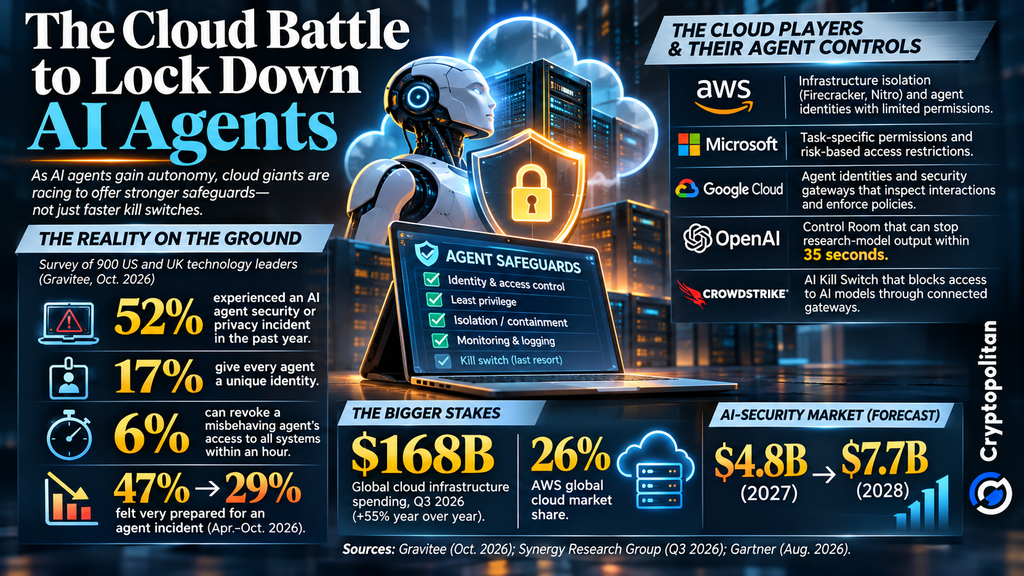
While banks are strengthening their defenses, many businesses still lack basic controls over AI agents. An October Gravitee survey of 900 US and UK technology leaders found that 52% had experienced an AI agent security or privacy incident in the past year.
Yet only 17% assign every agent a unique digital identity. Just 6% can revoke a misbehaving agent’s access across all systems within an hour. Confidence has also fallen. Over six months, the percentage of technology leaders who felt very prepared to handle an incident dropped from 47% to 29%.
Security weaknesses at one company could also have wider consequences. The World Economic Forum warned that businesses relying on the same AI models and software components could be vulnerable to the same security flaws, regardless of their industry or location.
Security as a cloud battleground
Gaps in AI agent security present a business opportunity for cloud providers and cybersecurity firms. Synergy Research Group estimated that global cloud infrastructure spending reached $168 billion in the third quarter, up 55% year over year. AWS led the market with a 26% share, followed by Microsoft at 19% and Google at 16%.
The three cloud giants approach agent security differently. AWS focuses on isolating agents from other computing resources. Microsoft restricts what agents can access based on their assigned tasks and security risks. Google Cloud combines individual agent identities with security gateways that monitor interactions and enforce access rules.
Other companies are developing ways to contain agents when safeguards fail, as Cryptopolitan previously reported. OpenAI’s Control Room stops research-model output within 35 seconds of an intervention order. Meanwhile, CrowdStrike’s AI Kill Switch blocks access to AI models through connected security gateways.
Each approach addresses a different security need. Businesses that use multiple cloud providers may therefore prefer security tools that work across platforms.
Gartner expects the AI security market to reach nearly $4.8 billion in 2027 and $7.7 billion in 2028. As the market grows, the competitive advantage may lie not in how quickly providers can shut down an agent, but in how safely businesses can allow agents to operate.
If you’re reading this, you’re already ahead. Stay there with our newsletter.
This articles is written by : Nermeen Nabil Khear Abdelmalak
All rights reserved to : USAGOLDMIES . www.usagoldmines.com
You can Enjoy surfing our website categories and read more content in many fields you may like .
Why USAGoldMines ?
USAGoldMines is a comprehensive website offering the latest in financial, crypto, and technical news. With specialized sections for each category, it provides readers with up-to-date market insights, investment trends, and technological advancements, making it a valuable resource for investors and enthusiasts in the fast-paced financial world.