
Search for a way for AI to help you with marketing, and you will have to pick among hundreds of tools.
Prefer to hire it out? See our list of top AI digital marketing agencies.
An artificial intelligence marketing tool uses a mix of machine learning, language processing, and generative AI to automate some marketing tasks and scale the efforts of human marketers. Larger datasets, faster workflows, version-testing campaigns and routine tasks free up time for high-level strategy and creativity.
All of this raises a practical problem — how to choose the right AI tool for the job, without paying for multiple subscriptions with a convoluted workflow.
Finding the most practical tool is not straightforward; even Google will still only recommend Google Bard and rank their product at the top. This guide will group tools by the job they can do. AI assistance is different for content, ads, social media and video, search visibility, personalization, or all-in-one services. All the best marketing tools for 2026 are listed here, with full features, pros and cons, pricing, and best-for applications.
Quick Glance: The Best AI Marketing Tools Compared
| Tool | Category | Best for | Free plan/trial | Starting price | Key AI capability | Integrations |
| Jasper | Content and copywriting | Building content; multi-brand marketing teams needing brand governance | 7-day free trial (no permanent free plan) | ~$59/mo/seat (billed yearly) or $69/mo/seat (monthly) on Pro | Marketing agents, Brand Voice & Knowledge customization, campaign workflows, and GEO/AI optimization | Zapier (5,000+ apps), Surfer SEO, Claude context/workflows, API (Business) |
| Copy.ai (Acquired by Fullcast) | Content and copywriting | Repeatable GTM & content workflows; teams wanting multi-LLM chat | No free tier or free trial (5-day money-back guarantee; view-only after cancellation) | $24/mo (billed annually, 5 seats) or $29/mo (monthly) on Chat; Growth/Workflows at $1,000/mo | Multi-model chat (OpenAI, Anthropic, Gemini) and repeatable automated GTM/content workflows & agents | Zapier (9,000+ apps), CRM/GTM tools, API & bulk runs (Enterprise) |
| Narrato (Discontinued — folded into Typeface) | Content and copywriting | Content planning, collaboration, & batch/workflow management | Limited free plan (up to 2 members / 25 items/mo) & trial | No public pricing after acquisition by Typeface | AI Content Genie for recurring blog/social drafts, bulk generation, SEO briefs, & workflow automation | WordPress, Webflow, Zapier, social channels, Facebook Ads Manager |
| AdCreative.ai | Ad creative and paid campaigns | Generating & scoring high-volume static/video ad creatives for paid social & display | 7-day free trial (typically 10 credits) | ~$20/mo (billed yearly) or $39/mo (monthly) on Starter (10 credits) | Conversion-focused ad creative & copy generation, creative scoring, compliance check, and ad video/UGC (higher tiers) | Ad platforms (Meta, Google, LinkedIn, etc. via exports/ad workflows) & brand/product feeds |
| Smartly.io | Ad creative and paid campaigns | Enterprise cross-channel ad production, feed automation, & media buying at scale | No self-serve free plan or trial (demo-led) | Custom / quote-based enterprise pricing | Feed- and template-driven creative/video versioning at scale, predictive budget allocation, & cross-channel AI orchestration | Meta, Google, TikTok, Pinterest, Snapchat, Amazon, Reddit, Spotify, YouTube, CTV/programmatic |
| Predis.ai | Social media and short-form video | Generating carousels, short videos/Reels/UGC, & branded social/ad posts fast | Free tier / 3-day free trial (card required on trial) | ~$19/mo (billed yearly) or 29–32/mo on Core | Prompt/URL-to-carousel, short video/UGC & voiceover generation, competitor ad insights, & scheduling | Instagram, Facebook, TikTok, LinkedIn, YouTube Shorts, X, Google Business; Shopify, WooCommerce, Wix, Squarespace; MCP |
| SocialBee | Social media and short-form video | Category-based social scheduling, evergreen recycling, & multi-brand social calendars | 14-day free trial (no credit card required; no permanent free plan) | ~24–29/mo (Bootstrap) | AI Copilot & post/caption generator for category-based content creation, scheduling, & evergreen queues | Canva, Unsplash, GIPHY, major social networks |
| Opus Clip | Social media and short-form video | Repurposing long-form videos (podcasts, webinars, YouTube) into short clips | Free forever plan (60 credits/mo, 1080p, watermarked) + free trial of paid plans (no card required) | $15/mo on Starter (monthly only) or $14.50/mo billed annually ($29/mo monthly) on Pro | AI clipping with Virality Score, animated captions (20+ languages), active-speaker auto-reframe, AI B-Roll, filler removal, & AI dubbing | YouTube, TikTok, Instagram Reels, Facebook, LinkedIn, X; direct export to Adobe Premiere Pro & DaVinci Resolve; Google Drive, Dropbox |
What to Consider Before Choosing AI Marketing Software
Consider the bottleneck fit for your marketing tasks: which jobs does the tool handle completely? Is it content, ad campaigns, social media, search visibility, personalization, or automation? This initial assessment will help you select the most suitable AI marketing tools.
To estimate the most suitable AI tools for marketing, analyze the following points:
- Point solution or platform. Does it do one job, or bundle CRM and customer data with AI features?
- True cost. How is it billed (seats, credits or usage), what does a team of five actually pay, and is there a free plan or trial?
- Integrations. Does it connect to your CRM, ad accounts and CMS?
- Brand voice and output control. Can you train it on your style, and how much editing does the output need?
- Data handling. Do the vendor’s terms say what happens to customer data you paste in, and who owns the outputs?
Match the tool to your bottleneck
For marketing agencies, usually one point of pain is the bottleneck in terms of expenses or time-consuming tasks.
To make the choice easier, we grouped the AI marketing tools based on their category in solving a specific bottleneck.
See also Best AI agent builders in 2026
Task-specific tools can handle a significant amount of work, but still require administrative tasks and a human in the loop. Integrated solutions and platforms offer a unified approach, often resulting in a lighter overall workload for the marketing team.
Point solution vs platform
AI marketing tools range from specific point solutions to platforms spanning multiple tasks.
See also Best AI voice agent platforms in 2026
Point solutions offer targeted solutions for one task, such as AI copywriting, social media posts, or cart handling. Those solutions can be deployed rapidly within a marketing project, without disturbing some of the high-level workflows.
The advantage of point solutions is the ability to add or drop the tools if they have limited effect on end results. A single tool may be more suitable than a platform if the team does not wish to automate its entire process.
The drawback of those tools is increasingly complex coordination and integration. If a team uses five or six specialized tools, subscriptions add up to a significant monthly bill. Additionally, all data and resources remain siloed into the different tools — meaning humans need to serve as the interface and export data manually. Since those are all AI marketing tools, the task also includes new instructions for each AI assistant or agent as needed.
An AI marketing platform tries to consolidate the process into a core workflow, allowing the team to observe from a single interface. Those platforms require a bigger commitment with onboarding and a larger upfront investment, but they can streamline agency work. Potentially, AI platforms may lower total costs in terms of subscriptions, fees, training data, and maintenance. The biggest advantage of platforms is the lower demand for administrative work, where marketing teams can focus on scaling.
Platforms also allow the agency to add new modules for additional tasks, without the need for new tools and subscriptions. This integrated solution will also allow the team to build and retain a workflow, automating many processes and tasks, simplifying the work for both humans and AI assistants.
Pricing model (seats, credits, usage) and free tiers
Some of the complexity in choosing the right AI marketing tool comes from the varied pricing models of AI-assisted tools.
Understanding the pricing model, available tiers, and the units of pricing is key for teams that do not want to be surprised by the final bill.
Pricing models vary for each tool and platform. Often, a free tier is included. Billing can come in team member seats, credits, or general usage. Understanding fixed and variable fees may help teams predict their expenses and not go overboard with extra compute credits.
Integrations with your existing stack
The right tools produce minimal additional tasks for administrative work or IT support. This guide categorizes the best AI marketing tools for 2026 based on their integrations, with a clear explanation of the additional demand for cross-platform data transfers.
Brand voice and output control
AI-assisted tasks can produce practically limitless content. However, achieving the exact required output may be more time-consuming or expensive. We have also looked into the potential of various tools to achieve a specific brand voice and allow maximal output control for the marketing team.
Data privacy and who owns your inputs and outputs
Online marketing often includes a sensitive data component, including personal or financial information. Selecting the right marketing AI software, tool, or platform also includes the need to shield data. For creative work, it is important to understand beforehand how the platforms store, use, or control inputs and outputs.
How We Selected These Tools
We selected the best AI marketing tools in 2026 by comparing existing pricing and capabilities. We ordered the tools based on the tasks encountered by marketing teams and their potential workflows and solutions.
We tracked indispensable tools from previous SEO iterations, now working with additional AI capabilities. The latest pricing and subscription tiers were also included, based on information as of November 2026. None of the tools were directly tested, either for user-facing functionality or marketing results. This guide does not promise a return on marketing budgets and only compares pros and cons in balance, without promising returns on marketing budgets.
Content and Copywriting
In this section, we will present the specialized tools for content creation and their integration with creative and marketing teams. We will compare their ease of use, depth of assistance, and the potential quality of generative AI output.
Jasper
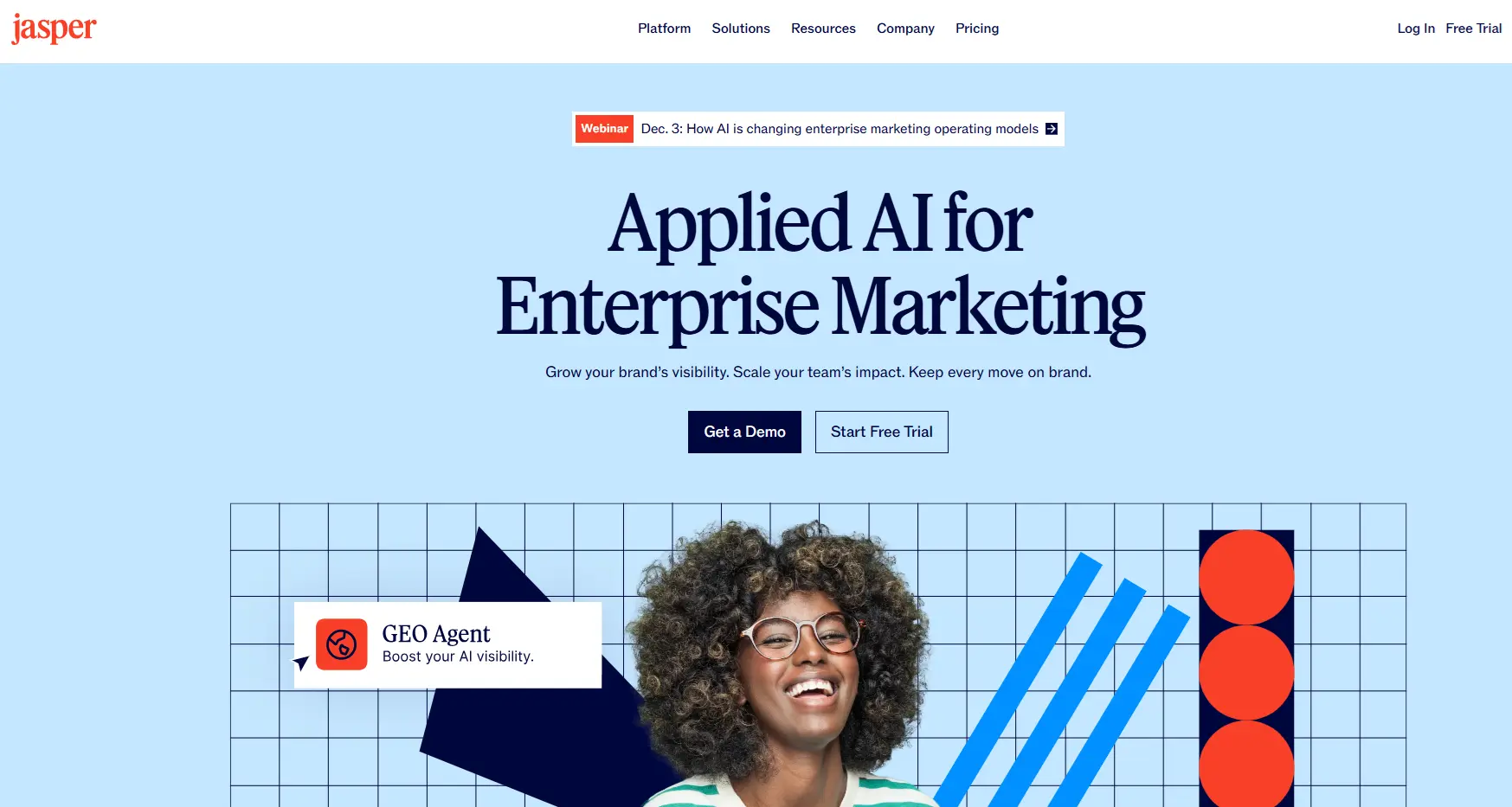
Jasper is an applied AI tool for marketing and content creation, created for business clients, agencies, and marketing teams. The service originally launched as an early generative AI assistant for copy generation, but evolved into more complex generative models.
In 2026, Jasper offers a more rounded service with brand voice, specific company knowledge, and automated AI agents. The Jasper copy generation capabilities go beyond general chatbots. Since consistency is important, Jasper retains the brand identity and can recall and automate multi-channel marketing campaigns at scale.
The Jasper IQ and Brand Voice feature retains context on company facts, products, audience personas, style guides, and tone-of-voice rules. Generation and refinement use the Canvas Workspace feature, which includes drafting, editing, and repurposing for multiple copy types such as social media, email campaigns, or blogs.
Jasper also includes ready-made AI agents for specific workflows, including SEO, Generative Engine Optimization (GEO), in-depth research, personalization, and localization in 27 languages.
Jasper Grid organizes the content process in a spreadsheet interface. The whole production process integrates with SurferSEO, with browser extension and API access for enterprises.
Jasper charges $59 per month on a per-seat basis, as well as a negotiated business plan. The tool has no free tier, and only a 7-day free trial. The business plan is custom and includes unlimited brand voice computation, knowledge base, Jasper Grid, custom AI agents, APi access and additional security and compliance tools.
Jasper is most suited for integrated marketing teams, established agencies and medium- to large businesses, with high-volume production and brand-oriented work. The main pros of Jasper are its business capacity and depth of computation. The cons are that the tool is too involved for small workflows and solo marketers.
Jasper emerged as a content-first platform, while Copy.ai started as a sales automation platform. Jasper prioritizes brand voice and marketing copy across teams and multiple editors, while Copy.ai offers sales and revenue automation.
Copy.ai
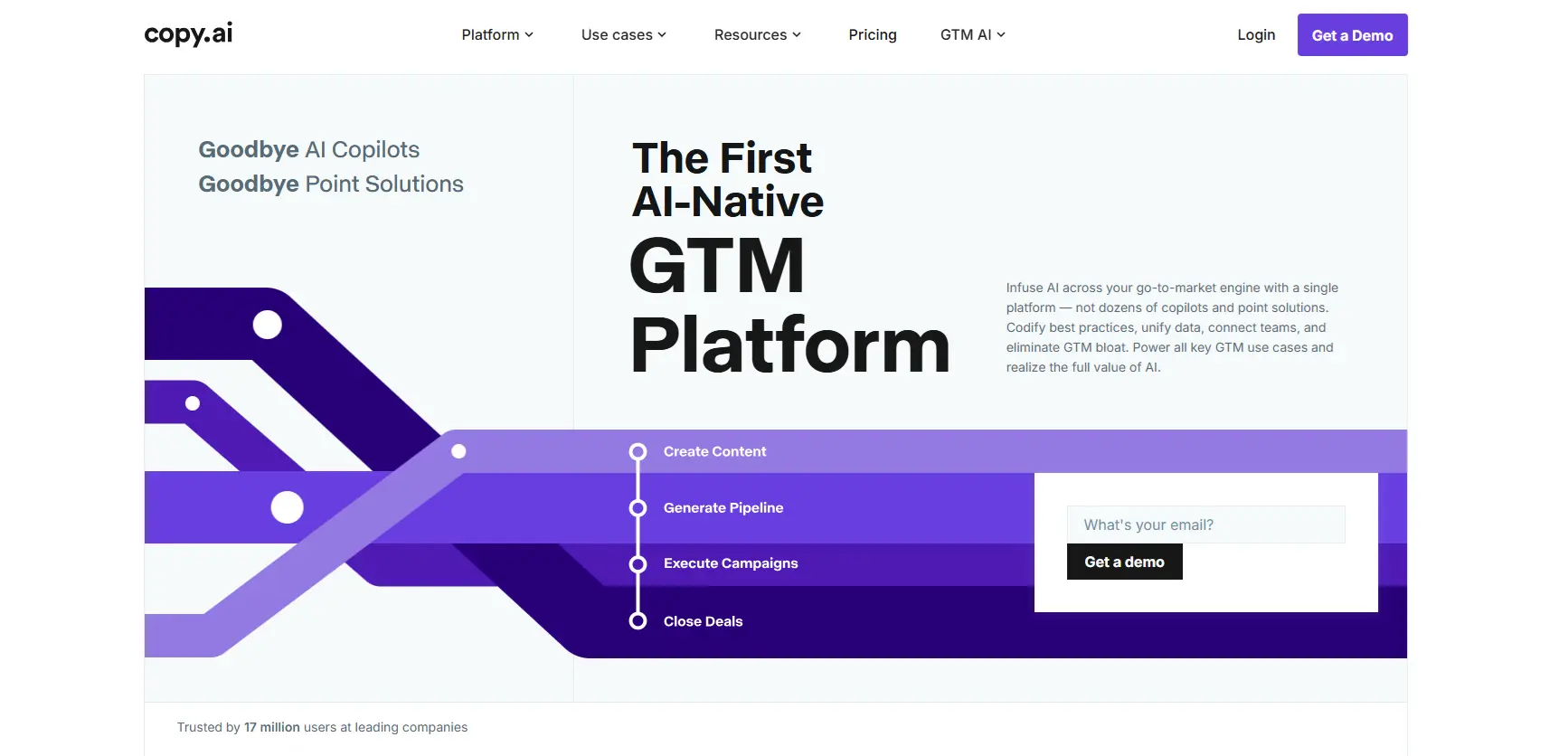
Copy.ai aims to solve and automate Go-To-Market tasks, such as repetitive sales problems and revenue operations. Copy.ai also started as an early copywriting tool for short-form ads, product descriptions, and social media posts,
Copy.ai automates the usual manual prompting for marketing tasks, allowing for multi-step AI workflows. The platform connects to existing tools like CRM, emailing platforms, and web scrapers for complex tasks at scale.
Businesses have access to no-code automation, chaining multiple processes that include analysis, data-gathering, and generating personalized outbound offers through email.
As with Jasper, Copy.ai offers a Tables tool for tracking all workflows. The platform includes multi-chat access, including ChatGPT, Claude, and Gemini without the need for separate subscriptions.
Similar to Jasper, Copy.ai has an internal memory for company information and brand voice, where the team can expand information about guidelines and messaging.
Integration is available for over 2,000 common business tools for communication or marketing, triggering automated workflows for new leads or customers.
Copy.ai starts at $29 monthly, $24 if billed annually, for one team seat, suitable for small-scale marketers. The free tier is available for one seat and 2,000 words in Chat, sufficient only for testing the interface. Enterprise pricing is negotiated, offering unlimited custom workflows, API calls, additional security and general IT support.
Copy.ai is well-suited for small teams, as a coordination hub for AI chat work, for a predictable monthly cost. The platform is tailored for growth marketing and can scale with the goals of enterprises. Cons include a lesser focus on copy-based tools and a quick run-up of costs for the enterprise tier once a team includes more seats per month.
Narrato
Narrato offers a unified environment for data analytics. The AI-assisted tool gathers all analytics in one interface and responds to queries in plain language, fetching the relevant data.
Narrato was acquired by Typeface in September 2024, and the standalone Narrato content service was discontinued in June 2024. Narrato is now part of the Typeface ecosystem
As of November 2026, Narrato is an integrated platform combining content creation, personalization, and scalable campaigns.
The advantage of Narrato is the possibility of a free 30-day trial. The main disadvantage is the need to negotiate a price for each business, requiring a clear plan and testing before adopting the content and branding platform.
Ad Creative and Paid Campaigns
Tools can be split by their role in the campaign, with some AI marketing tools focusing on the ad creative side. Others automate the workflow of campaign execution, while also keeping the ad tone and campaign goals as context. The campaign tools also offer constant syncing of the creative and the technical side. We picked two examples for this class of AI marketing tools.
AdCreative.ai
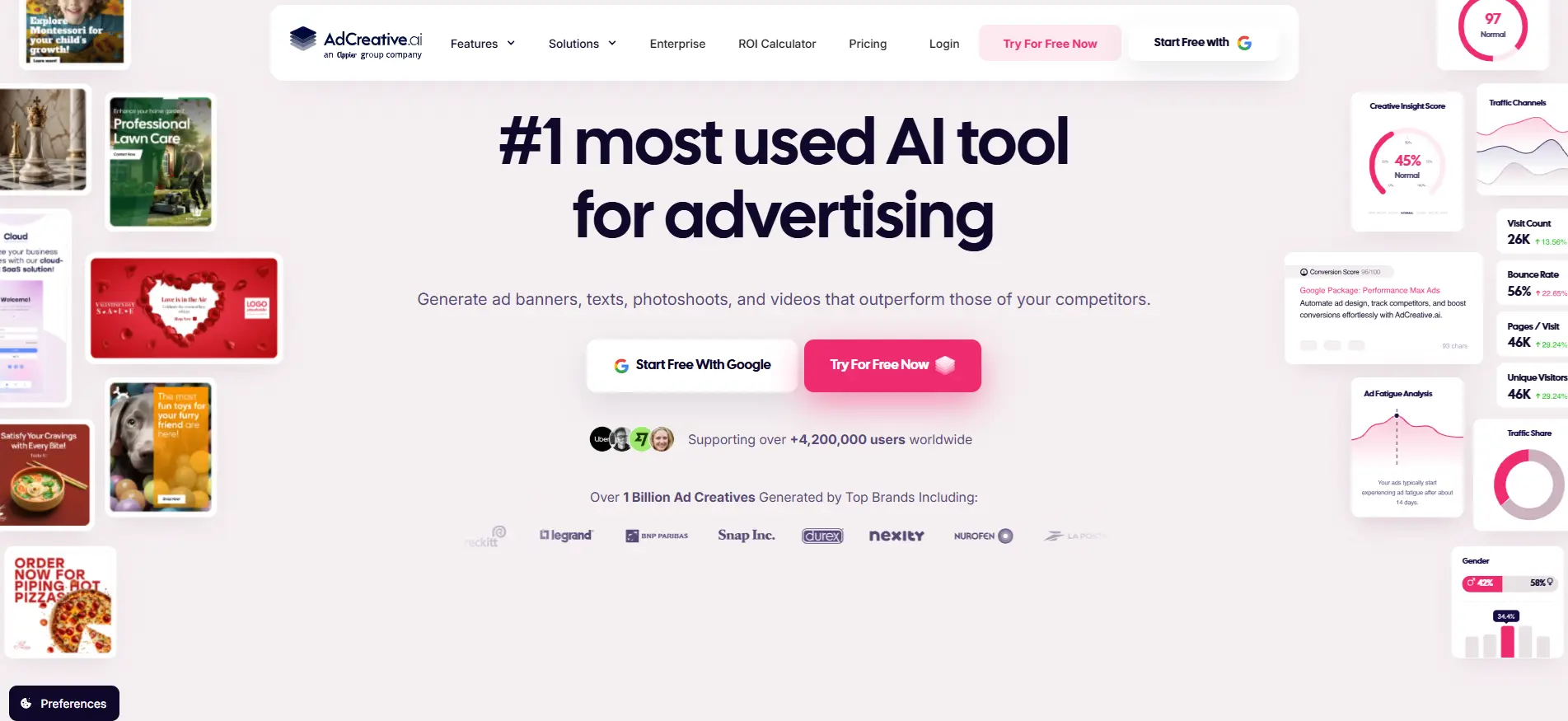
AdCreative.ai automates and scales the work of digital ad creatives, including banners, social media images, and video ads. The platform also supports AI-assisted ad copy.
AdCreative.ai adds a graphic design dimension, with models trained on already high-performing ad formats. This makes the tool ideal for banner generation, testing multiple visuals formatted for social media banner campaigns.
The tool also handles conversion data, helping the marketing team identify which format works best for clicks and purchases.
The tool also handles copy and video ads, as well as photo enhancement tools. AdCreative integrates with major ad software and can analyze competitor performance.
AdCreative starts at a promotional price of $ 20 per month as of November 2026 ($39 normal entry price), $249 for pro plans and $999 for limitless enterprise plans, with additional payments for negotiated extra services.
The pros of AdCreative include multiple ad formats and tailored plans for all team sizes up to large enterprise. The cons include more limited analytics compared to other tools.
Smartly.io
Smartly.io is an AI-enhanced marketing tool, with a history dating back to 2013. The platform automates media generation, with a focus on media buying and campaign scaling.
The platform is most suitable for large brands, large e-commerce enterprises, and established agencies with a large work volume.
Smartly’s creative AI generates multiple versions for localized campaigns. One specific focus for Smartly is its media buying automation and budgeting across multiple channels and networks. The tool also gathers intelligence on campaign impact.
The pros of Smartly are its scalability and reliability, coming from a long-established company. The main cons are for small-scale marketing teams and solo marketers.
Smartly applies custom pricing, based on the needs of enterprises.
Social Media and Short-Form Video
Online content is switching to visual, and short reels are gaining engagement on existing social media. We gathered the best tools capable of producing AI-assisted short-form video for social media marketing.
Predis.ai
Predis.ai offers automated social media content and ad creation, targeting small businesses, e-commerce brands, solo creators and marketing teams. The tool offers tailored social media content based on simple prompts, minimizing the time to publish.
Predis.ai offers speed with simple prompts, producing complete social media posts with images, carousel-style posts, short-form reels, captions, and other text. The tool uses brand kits to apply colors, fonts and logos to all campaigns. After that, the AI marketing tool automates content posting and publishes it directly on selected social media. Campaigns can also be analyzed and compared with competitive tools.
This tool is priced based on a credit system with three main tiers. Predis.ai has a three-day free version. After that, plans start at $32 monthly for 1,300 credits, best suited for one brand. The second tier is at $79 monthly for 3,200 credits, capable of carrying up to four brands. The business tier starts at $249 per month with 10,000 credits and unlimited brands.
The main pros are the low cost and suitability for smaller teams. The cons are relatively low scalability and over-focusing on social media.
SocialBee
SocialBee focuses on social media management and scheduling, targeting primarily solo teams and small marketing projects. The tool aims for an organic-looking social media presence, starting with content generation and organization, as well as handling evergreen posts.
One of the strengths of SocialBee lies in grouping posts based on themes, allowing the queue of evergreen content to be recycled and time-sensitive content to be replaced on time.
The tool is specifically selected for content curation and bulk content imports, with customizable posts for different social media.
Higher-tier plans include client workspaces, post-approval workflows for published content, and additional analytics.
SocialBee plans are priced by social media profiles and per workspace. Bootstrap tier starts at $348 per year, with discounts down to $174 as of November 2026. For 10 social profiles and expanded capabilities, the Accelerate profile starts at $588. Pro tier starts at $1,188 for up to 25 social profiles.
The pros of SocialBee are its specialization in curated social media content, with flexible pricing and relatively accessible lower tiers. The cons are relatively low scalability and a focus on content rather than advertising or campaign curation.
Opus Clip
OpusClip offers AI-powered marketing tools to curate and repurpose video content, turning long-form videos into short clips for other social media. The specialized tool analyzes long-form video for viral potential, giving it a 1-100 Virality Score based on hooks, pacing, and general content topics.
OpusClip can reframe video, turning the aspect ratio from 16:9 to 9:16 or square formats, while keeping the main speakers centered. The tool also offers video-editing automation for captions, highlighting, emojis, and language localization. In-depth editing includes cutting filler words and pauses, while also inserting relevant archive or stock footage, AI-generated visuals, and brand logos or templates on all clips.
The edited videos can then be scheduled and exported, or integrated with Adobe Premiere Pro and DaVinci Resolve for further editing.
OpusClip prices its services based on credit subscriptions, where one credit is a minute of uploaded source footage, while there is no limit on how many clips can be produced from the original video.
OpusClip starts with a 60-credit free tier, a $15 per month tier for 150 credits, a pro tier at $29 per month, and a negotiated-price business tier.
OpusClip is an accessible tool for solo creators and video content producers. The tool is less suited to agencies, campaigns, and SEO-oriented organizations.
SEO and AI Search Visibility
SEO and AI visibility are still key for written content producers. AI search visibility, also known as GEO, is the frequency or prominence of a brand, product, or website cited or mentioned by AI-powered search engines. AI visibility efforts aim to put brands into the answers of tools like ChatGPT, Google AI Overviews, and others. We will look at the best AI marketing tools focusing on ranking links and also satisfying the criteria of AI-powered search engines.
Profound
Profound automates Answer Engine Optimization (AEO) and AI search visibility. It also helps brands monitor their representation in AI-generated answers across multiple platforms. Unlike traditional SEO tools, Profound shows how LLMs retrieve, cite, and describe brands in chats with end clients.
Profound shows quantified representation of the brand, tracks prompt volumes, and analyzes AI-crawled activity. Additional features include claims and fact-checking, tracking inaccurate claims, and curating shopping features in chat. The tool can also detect lowered citation quality and generate AEO-optimized briefs and content to boost AI representation.
Profound targets medium-sized enterprises and teams, as well as general AEO managers. Pricing offers custom pricing packages, with higher tiers offering analytics for more LLM chat tools.
Profound is primarily built for mid-market to enterprise marketing teams, B2B SaaS companies, and digital agencies managing AEO across multiple clients.
The pros of this tool include in-depth observation of AI search engines. The cons are the negotiable pricing and relatively high costs. The tool is also highly specialized, requiring additional integrations with other agency workflows.
Surfer
The long-running SurferSEO tool, now available as Surfer.ai, is still one of the leading content optimization engines. Surfer offers on-page insights on content score and authority, with expanded capabilities on Answer Engine Optimization (AEO).
Surfer offers four subscription tiers, starting at $90 per month for basic tools, $110 for the standard tier, $200 for the Pro tier, and around $330 for the top tier with expanded capabilities and limits.
Semrush
Semrush is another digital marketing tool with AI capabilities. This industry-standard platform for SEO has now added AEO capabilities to its traditional search analytics.
Semrush integrates AI search and uses a single dashboard for AI visibility and general SEO. Pricing starts at $150 per month for SEO, $220 for the starter tier with AI capabilities, $315 for the Pro plan, and custom plans for scaling. The pricing is discounted for annual billing.
Personalization and Customer Engagement
Single-use tools also focus on personalization, using AI agents and other advanced techniques. The tools are suited for marketing teams looking for curation
Bloomreach
Bloomreach is an enterprise-ready platform, with its own AI agent engine and domain-specific knowledge for marketing. The tool tracks customer data, matching it with products and marketing automation.
Bloomreach unifies reach, personalization, and outbound messages in a single dashboard, augmented by AI. The central point is engagement, down to the very personal response of each customer. The Loomi AI engine predicts user behavior and purchase probability, then selects the optimal message for each channel and individual customer.
Bloomreach is ideal for marketers aiming at strict sales tracking, with the potential of fine-tuned conversational shopping and storefront AI agents.
While Bloomreach is comprehensive, its package starts at $60K a year for smaller teams. The main advantage is the in-depth outreach, but it must be balanced against the sales potential of each marketing team.
All-in-One Platforms, Design and AI Marketing Agents
Platforms are also competing to build even more integrated verticals. We will look at platforms that evolved to hold the entire marketing process, offering flexible workflows.
Kite AI
Kite.ai is a marketing tool to research and plan entire marketing campaigns. Growth tracking is integrated with Slack.
The tool runs a campaign from product analysis, takes into account competitor data, and proposes a whole communication and marketing strategy. Kite.ai can produce landing pages, comparison charts, video content, email marketing campaigns, and propose paid ad concepts.
The tool also carries SEO and AEO visibility analysis and suggestions. Kite.ai is integrated directly into a browser or inside Slack workflows.
Kite.ai offers a free tier, which can be upgraded when usage runs out. Growth tier is at $100 per month, with custom pricing at the Business tier.
Kite.ai’s advantage is its easy integration and suitability for small marketing teams starting from zero. The tool may need to be customized and integrated with more advanced agencies and enterprises with a well-developed brand voice.
HubSpot
HubSpot combines its Breeze AI layer with its Smart CRM system. In its current state, HubSpot goes beyond copywriting tools and tracks customer records, campaign history, as well as buyer behavior data. The process may also be handed over to autonomous AI agents.
HubSpot takes the AI agent approach to marketing and content workflows, combining content creation, social media, and prospecting into one workflow.
The platform starts with a free entry tier, offers a $7 per month per seat tier, a $90 per month professional tier, and $175 per seat per month for the enterprise tier. The pricing allows for small team onboarding, as well as scaling to large teams and enterprises.
The strength of HubSpot is in supporting context across media and customer workflows. The output may depend on the quality of data and good practices. The tool also consumes additional HubSpot credits for AI agent usage, which may increase costs unpredictably.
Canva
Canva is a long-running content creation tool for ad campaigns, social media, and general image creation.
The Canva AI and Magic Studio expand the original visual design platform, turning brand campaigns and social data into complete campaigns, ads, presentations, videos, and marketing copy.
Monthly plans per seat start with a free trial, run at $12 per seat for the Pro tier, $17 for the Business tier, and are negotiable for the Enterprise tier. Canva is the one tool that can make small teams start out with minimal costs, while higher tiers offer expanded AI usage and other computation and storage offers.
AI Marketing Platforms vs Point Solutions
To select a tool versus an entire platform, a team must identify its main bottleneck to successful marketing, and purchase the strongest tool for that task. The most time-consuming task may be content creation, or the subsequent curation. For some teams, data analysis and planning may be the leading concern. The best approach is to buy the subscription whose strongest suit matches the team’s bottleneck.
Common Pitfalls When Adopting AI Marketing Tools
The presence of multiple tools may lead teams to over-equip, buying subscriptions that overlap. This may lead to more complex workflows. Not all content tools are the same, and some may need extra editing. Brand voice memory may vary. Some tools may include additional credit usage that goes beyond the fixed subscription plan. Privacy and compliance are also concerns, depending on regional usage.
Final Verdict: How to Choose
The best approach is to select the tool that fits the size of the enterprise and its marketing goals. Sometimes, even a small bottleneck resolution may speed up the final process, without additional complex editing or rising AI agent costs.
Best picks for small businesses and startups
For bootstrapped teams or solo marketers, tools like Canva, Semrush, and Surfer may offer high-capability, entry-level tools that combine older SEO tasks with additional AI features. HubSpot and Kite.ai also match the profile with free tiers, making them ideal AI marketing tools for small businesses.
This articles is written by : Nermeen Nabil Khear Abdelmalak
All rights reserved to : USAGOLDMIES . www.usagoldmines.com
You can Enjoy surfing our website categories and read more content in many fields you may like .
Why USAGoldMines ?
USAGoldMines is a comprehensive website offering the latest in financial, crypto, and technical news. With specialized sections for each category, it provides readers with up-to-date market insights, investment trends, and technological advancements, making it a valuable resource for investors and enthusiasts in the fast-paced financial world.