
Block, the payments company founded by Jack Dorsey, wants federal regulators to let it custody bitcoin and stablecoins through a chartered trust bank. On Tuesday, the company said it applied to the Office of the Comptroller of the Currency (OCC) to establish Builders Bank & Trust, N.A., an uninsured, non-deposit-taking national trust bank.
If approved, Builders Bank is ready to offer custodial and fiduciary services for bitcoin and stablecoins, and some of Block’s existing digital asset activities will fall under a single federal regulatory framework.
The combination of Block’s experience with digital assets and Square Financial Services positions Builders Bank well “to support Block’s broader vision of economic empowerment,” said Lee Woolley, proposed president and CEO of Builders Bank.
Why custody is the prize, not deposits
One of the main attractions of an OCC national trust bank charter is custody. Davis Wright Tremaine describes custody as “the foundation of any digital-asset business”. A national trust bank charter can bring cryptocurrency companies under the federal umbrella and provide them with a certain level of comfort in dealing with various state regulations, as well as give institutional clients the comfort of using recognized oversight.
This is key for institutions that prefer to work with regulated counterparties when putting assets on the blockchain. In some cases, a federal charter can also help in achieving qualified-custodian status.
For a long time, Anchorage Digital was the only cryptocurrency company doing business in this way. But that is no longer the case, as more companies start applying for federal charter and the focus of their competition shifts toward security, compliance, tokenization services, and institutional scale.
A charter rush measured in numbers
The OCC says it received 40 new-bank charter applications over roughly the past 18 months. Twenty-three, or 57.5%, involve some form of digital-asset activity. The Block reports that 21 of the 40 have been approved and two denied.
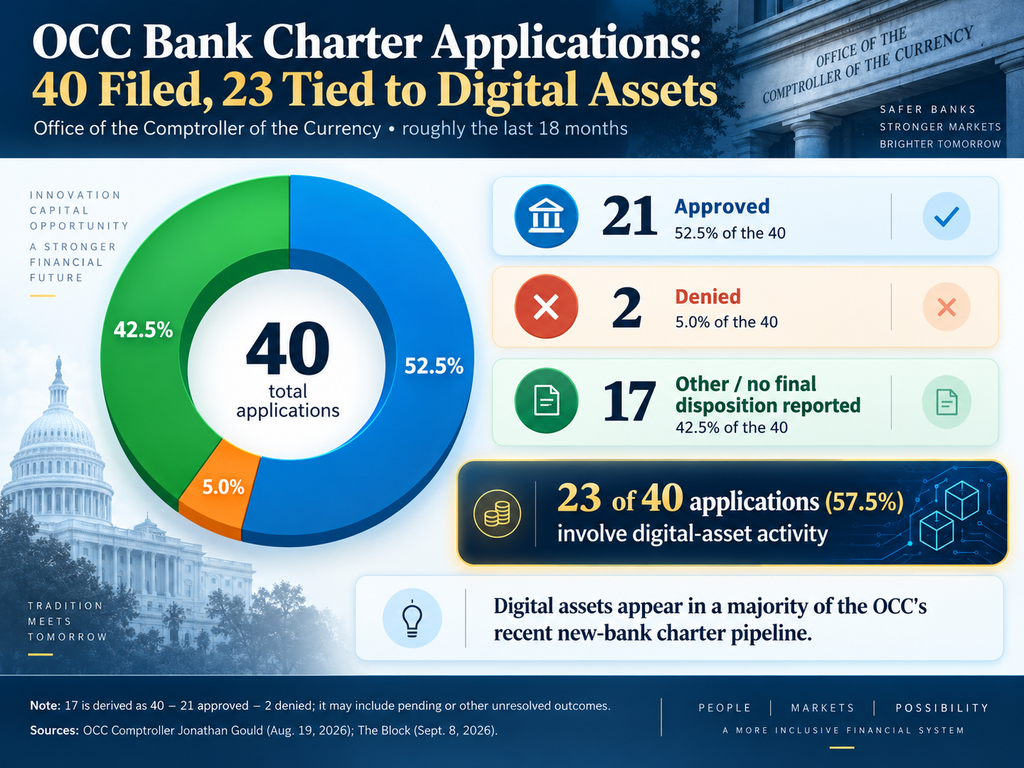
According to Comptroller Jonathan Gould, the 23 digital asset initiatives mark an increase of eight times over the past four years, indicating that cryptocurrency activities are gaining stronger foothold in the sphere of regulated banking.
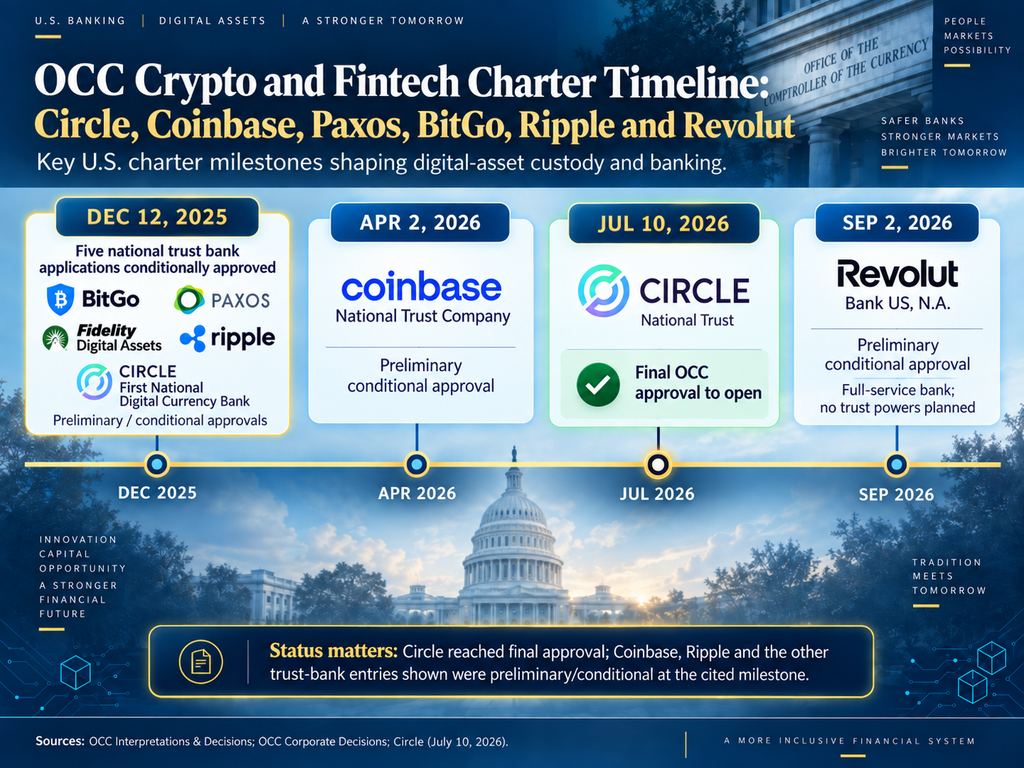
Despite sharing the same purpose, not all approvals are alike. The OCC conditionally approved the charter application or conversion requests for BitGo, Paxos, Fidelity Digital Assets, Ripple and Circle’s proposed First National Digital Currency Bank.
Stablecoin issuer, Coinbase, received its preliminary conditional approval for establishing a national bank on April 2, 2026. Circle, in turn, received its final approval on July 10 to set up Circle National Trust bank.
Revolut’s approval on September 2 is part of a wider phenomenon related to fintech charters, but what OCC provided was permission to do business as a full-service insured national bank, rather than as a national trust bank.
What these charters do not grant
National trust banks are not just commercial banks that put on a crypto label. According to Block, Builders Bank will not be able to take deposits or make loans unlike a commercial bank. Trust companies are often uninsured and have to comply with the approved fiduciary and other powers.
This distinction lies at the centre of the political opposition. In a letter to Gould written on May 18, Senator Elizabeth Warren pointed out that approval is an abuse of the National Bank Act and added:
These companies are effectively crypto banks that want to evade the fundamental safeguards and obligations that come with being a bank.
Moreover, a trust charter does not guarantee access to Federal Reserve payment systems. In May, the Fed proposed a special-purpose “payment account” for organizations that meet legal requirements, but this proposal does not extend the number of institutions eligible for Federal accounts.
The stablecoin backdrop and a global nerve
The charter rush is unfolding alongside the GENIUS Act, enacted July 18, 2025. The OCC proposed implementing rules in February covering reserves, redemption, custody, risk management and issuer applications.
The implications go beyond U.S. licensing. The BIS warned in August that wider use of dollar stablecoins could fuel “digital dollarisation” and weaken monetary sovereignty in some countries. The IMF has similarly argued that tokenization could accelerate cross-border capital flows and currency substitution.
For crypto markets, more federally chartered custodians could make bitcoin, stablecoins and tokenized assets easier for institutions to hold and move under familiar supervision. But the same infrastructure could also extend the reach of dollar-based tokens abroad, turning a U.S. custody race into a much bigger contest over who controls the rails of tokenized finance.
Don’t just read crypto news. Understand it. Subscribe to our newsletter. It’s free.
This articles is written by : Nermeen Nabil Khear Abdelmalak
All rights reserved to : USAGOLDMIES . www.usagoldmines.com
You can Enjoy surfing our website categories and read more content in many fields you may like .
Why USAGoldMines ?
USAGoldMines is a comprehensive website offering the latest in financial, crypto, and technical news. With specialized sections for each category, it provides readers with up-to-date market insights, investment trends, and technological advancements, making it a valuable resource for investors and enthusiasts in the fast-paced financial world.