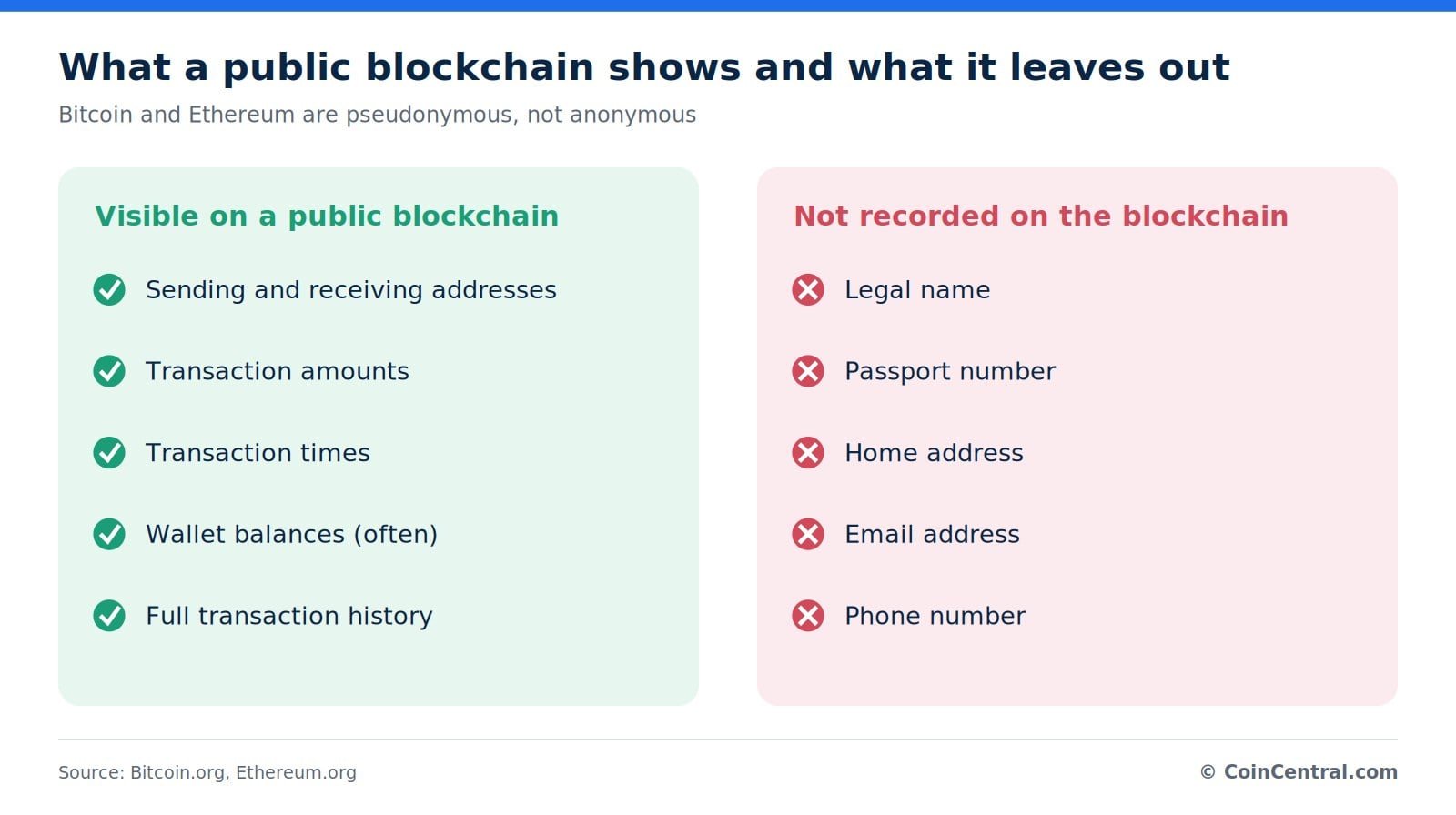
Cryptocurrency is often called anonymous digital money. The facts show something different. Most major coins can be followed on a public ledger.
Bitcoin and Ethereum record every transaction on a blockchain that anyone can read. The ledger shows addresses, amounts and times. It does not normally show a person’s name.
That is why experts call these coins pseudonymous, not anonymous. This article uses official documents, blockchain analysis firms and U.S. cases to explain how tracing works.
The short answer is yes, crypto can usually be traced. Tracing a payment and naming the person behind it are two different jobs.
Key Facts: What a Public Blockchain Reveals
A public blockchain is a shared record of every confirmed transaction. Bitcoin.org says all Bitcoin transactions are public, traceable and stored permanently. Ethereum’s documentation says the same about addresses, balances, transactions, contract calls and events.
Anyone can look at this data with a block explorer. A Bitcoin address, however, does not contain a name, passport number, home address, email or phone number.
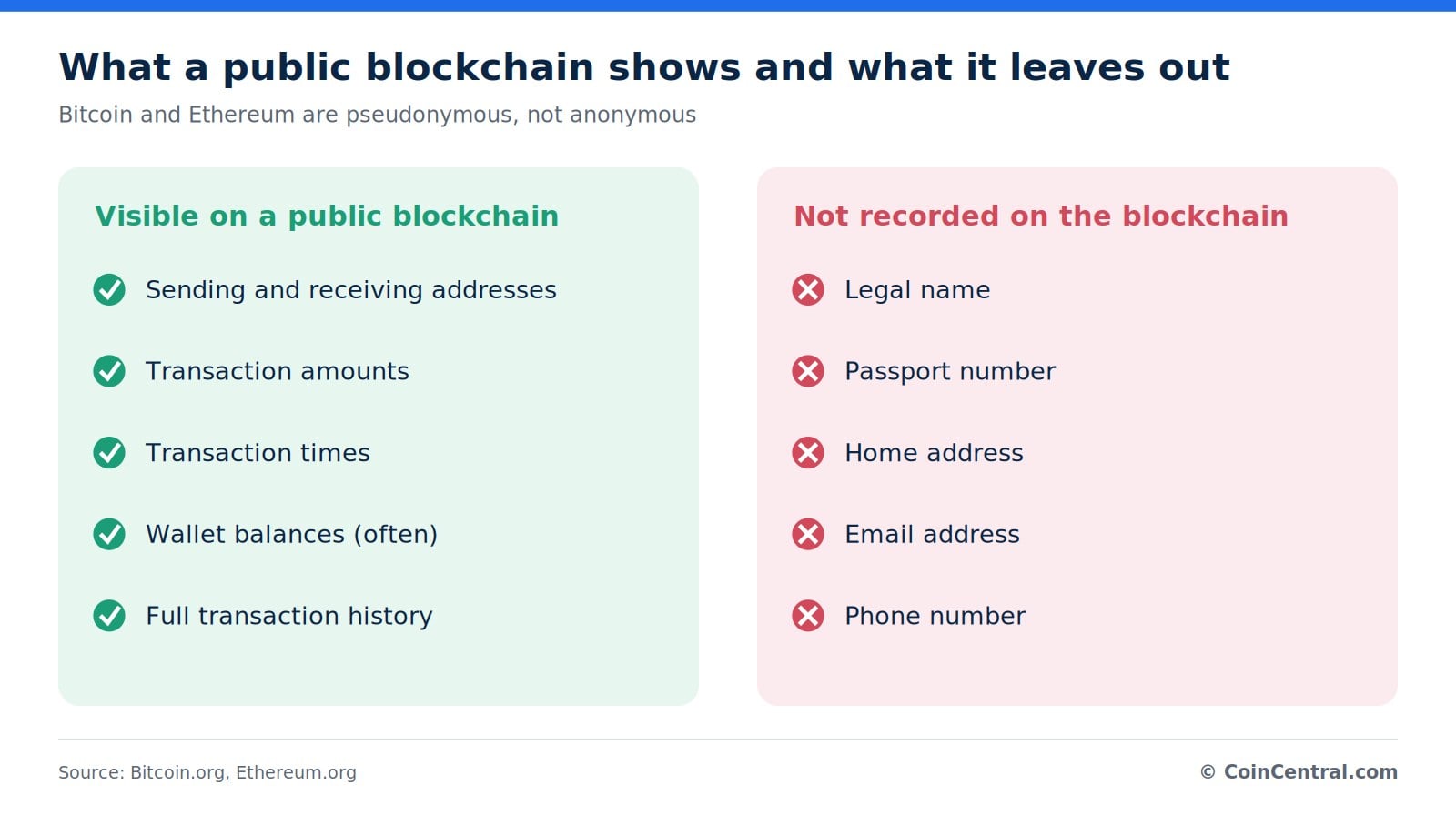
| Item | Visible on public blockchains? |
|---|---|
| Transactions | Yes, stored permanently |
| Sending and receiving addresses | Yes |
| Amounts | Usually |
| Transaction times | Yes |
| Wallet balances | Often, through calculation |
| Transaction history | Yes, open to anyone |
| Legal name of the owner | No, not automatically |
A single address shows activity, but not identity. An address holding 50 BTC could belong to one person, a company, an exchange, a hedge fund, a charity or a criminal. The blockchain alone does not say which.
The record also lasts. Bitcoin.org warns that information that is hard to trace today may be easier to link in the future. A wallet that cannot be named now may be named years later.
How a Blockchain Transaction Is Recorded
A simple example shows how the system works. Alice wants to send Bitcoin to Bob. Bob gives her a Bitcoin address.
Alice’s wallet builds a transaction that moves the coins to Bob’s address. The wallet then signs it with her private key. The signature proves she has the right to spend the coins.
The transaction goes out to the Bitcoin network. Nodes check that it follows the rules. Miners then place it in a block.
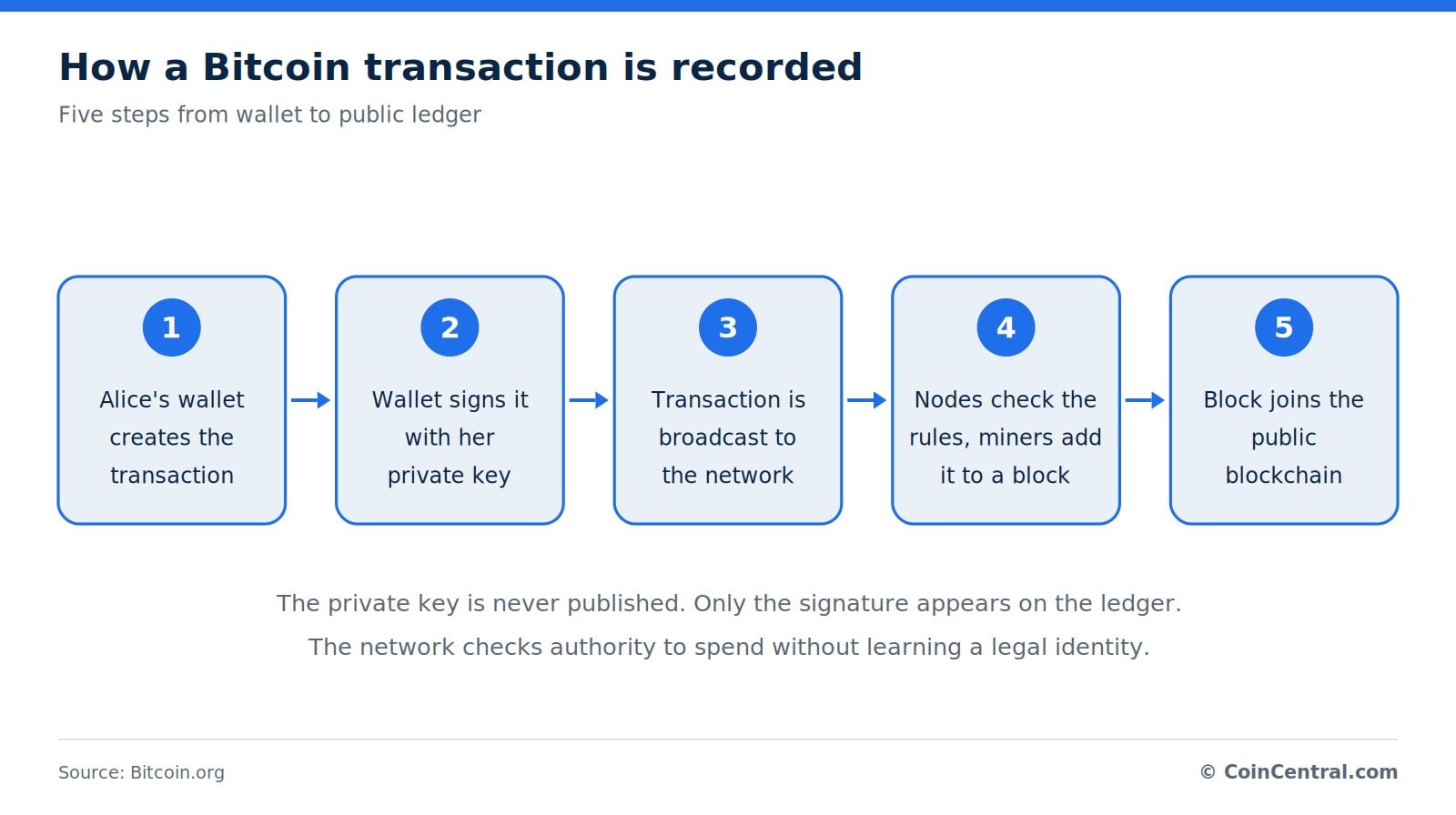
Once confirmed, the transaction becomes part of the blockchain. Bitcoin describes this as a shared public ledger of all confirmed transactions.
The private key is never published. Only the signature appears. This lets the network confirm that someone had the authority to spend the coins without learning that person’s legal identity.
What a block explorer shows
If you have a Bitcoin transaction ID, a public block explorer can show many details:
- Transaction ID
- Inputs and outputs
- Sending and receiving addresses
- Amounts
- Transaction fee
- Block number
- Confirmation status
- Timestamp
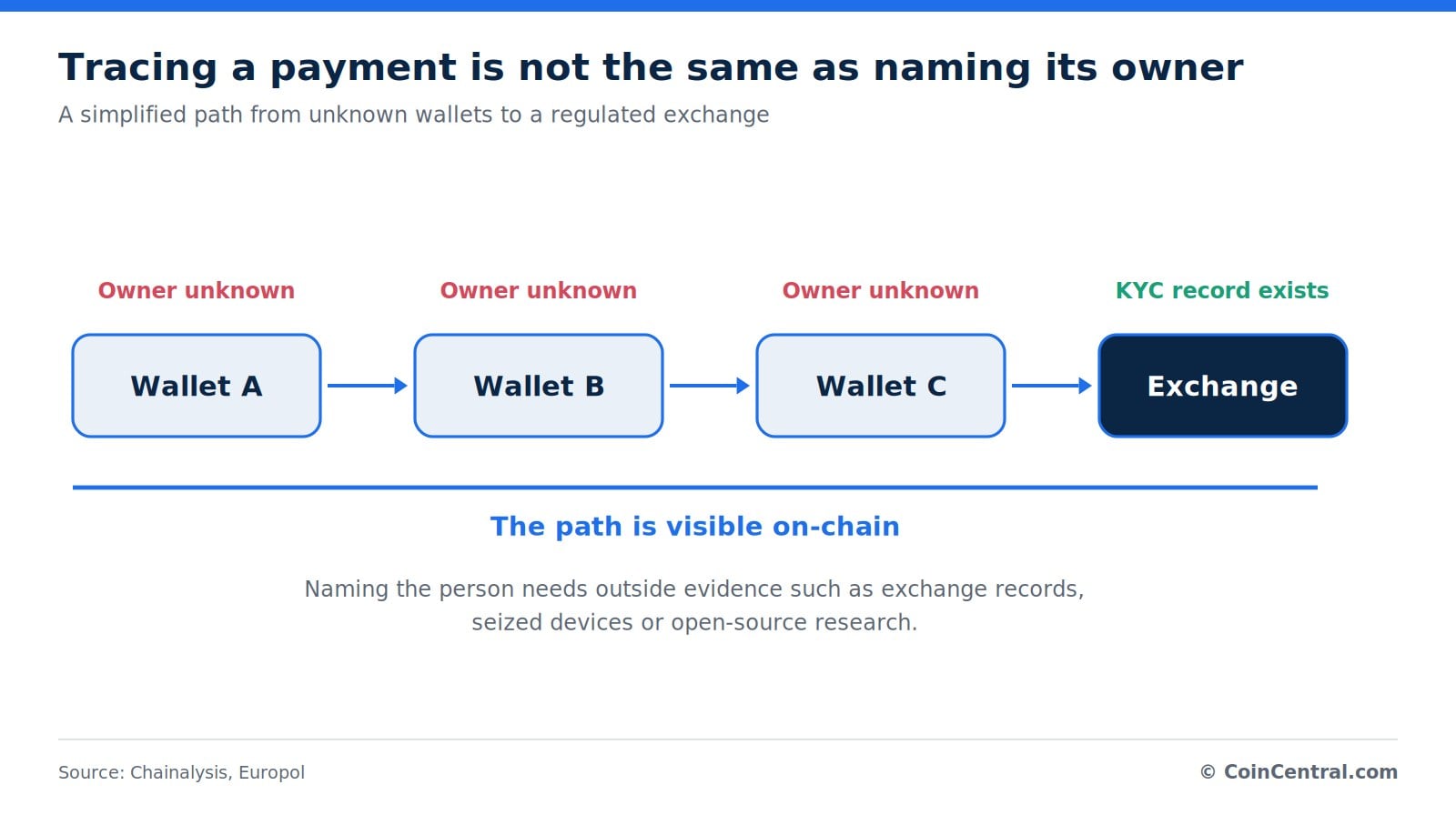
You can then follow the outputs into later transactions. A coin may move from Wallet A to Wallet B, then to Wallet C, then to an exchange. An investigator can follow that whole chain.
The hard part is learning who owns each wallet. That step is called attribution.
How Much Do Bitcoin and Ethereum Show?
Both networks are open to the public. Bitcoin shows the movement of coins between addresses. Ethereum shows that and more, because it runs smart contracts.
Ethereum’s documentation describes transactions as signed instructions that update the state of the network. Its privacy pages call the network radically public by design.
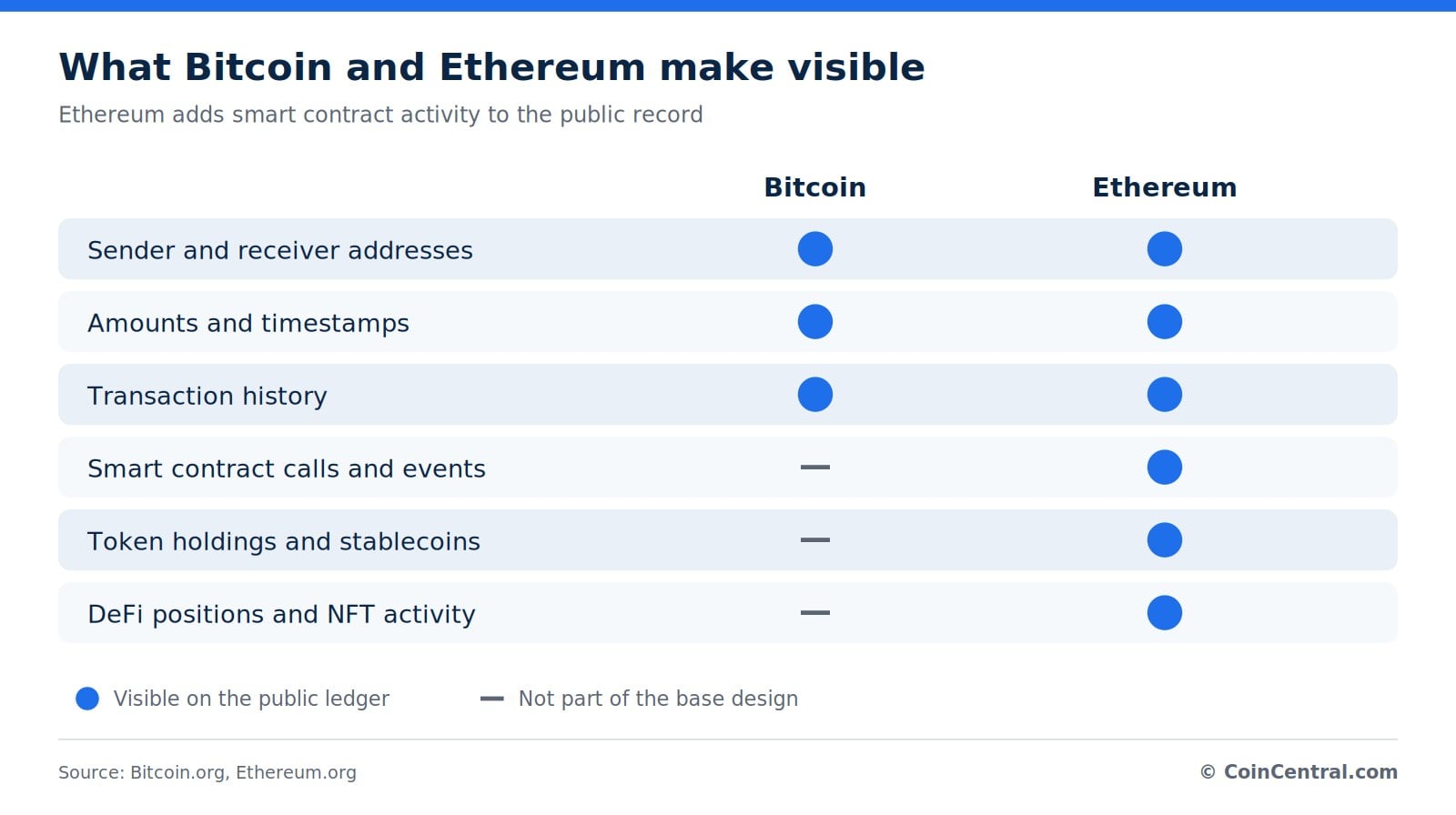
Public Ethereum data can show contact with many kinds of services:
- Decentralized exchanges
- NFT marketplaces
- Lending protocols
- Stablecoins
- Bridges
- Staking systems
- Prediction markets
Someone who knows your Ethereum address may see more than your ETH balance. They may also see the tokens you hold, your DeFi positions, your NFTs and your past transactions.
Can someone see how much Bitcoin you own?
Possibly, but not always. If a person knows one of your Bitcoin addresses, they can inspect it and follow related transactions. That does not automatically reveal every address you control.
Modern wallets can create a fresh receiving address for each payment. Bitcoin.org advises against reusing addresses because new ones make it harder for outsiders to link payments.
That protection has limits. Later spending can sometimes reconnect the addresses. Privacy on Bitcoin depends heavily on how a person uses it.
How Investigators Identify Wallet Owners
Chainalysis defines wallet attribution as linking an address or wallet cluster to the real-world person or group that controls it. Investigators use several sources to do this.
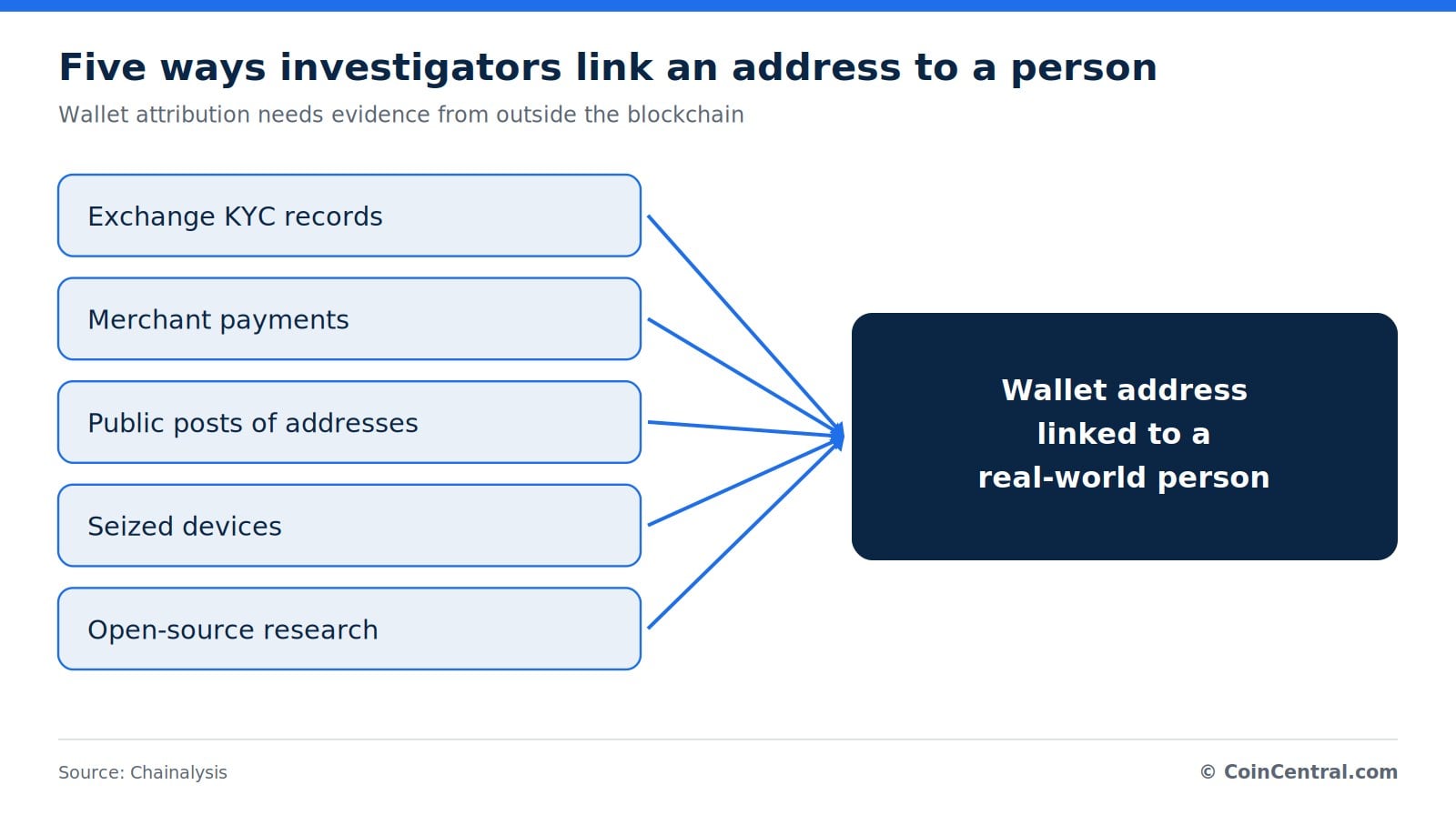
| Evidence source | How it can link an address to a person |
|---|---|
| Exchange KYC records | Exchanges collect names, ID, email, phone and bank details. A withdrawal to a private wallet ties the customer to that address. |
| Merchant payments | A shopper who gives a name and delivery address may link their identity to the paying address. |
| Public posts | Addresses shared on websites, social media, forums or donation pages are tied to the poster. |
| Seized devices | Phones and computers may hold addresses, seed phrases, records or exchange accounts. |
| Open-source research | Investigators combine blockchain data with websites, social posts and domain records. |
This is why tracing uses both on-chain and off-chain evidence. The blockchain gives the path. Outside records give the names.
What is wallet clustering?
One person can control hundreds of addresses. Bitcoin wallets often create new ones automatically. Investigators therefore look for signs that many addresses share one owner.
One method is co-spending, where a single transaction spends coins from several addresses at once. The U.S. Department of Justice has described clusters as groups of addresses tied to one person or entity using methods such as this.
Clustering is still an inference. Chainalysis draws a clear line: clustering groups addresses believed to share control, while attribution links a cluster to a named entity.
Exchanges are a key checkpoint
People can move crypto between private wallets without showing a passport. But many users eventually need an exchange to buy coins with dollars or euros, sell for cash or send money to a bank.
Regulated exchanges connect the blockchain to traditional identities. Say stolen funds pass through 20 wallets before reaching an exchange. Investigators may not know who ran the middle wallets, but they can see the path and ask the exchange about the final account.
Chainalysis says these entry and exit points remain one of the most important places where blockchain activity meets real names.
Blockchain analytics software
Following thousands of transactions by hand would take far too long. Analysis platforms build transaction graphs that show money moving between wallets, exchanges, mixers, bridges, DeFi protocols, gambling services, darknet markets and sanctioned entities.
They also keep databases of known wallet clusters. This can turn a path of Address A, B and C into something more useful, such as unknown wallet, known mixer, regulated exchange. Law enforcement, banks, exchanges, regulators and security firms all use these tools.
Crypto Seizure Statistics From 2026
Court and agency cases show tracing at work. The figures below come from U.S. Department of Justice announcements and related filings in the source material.
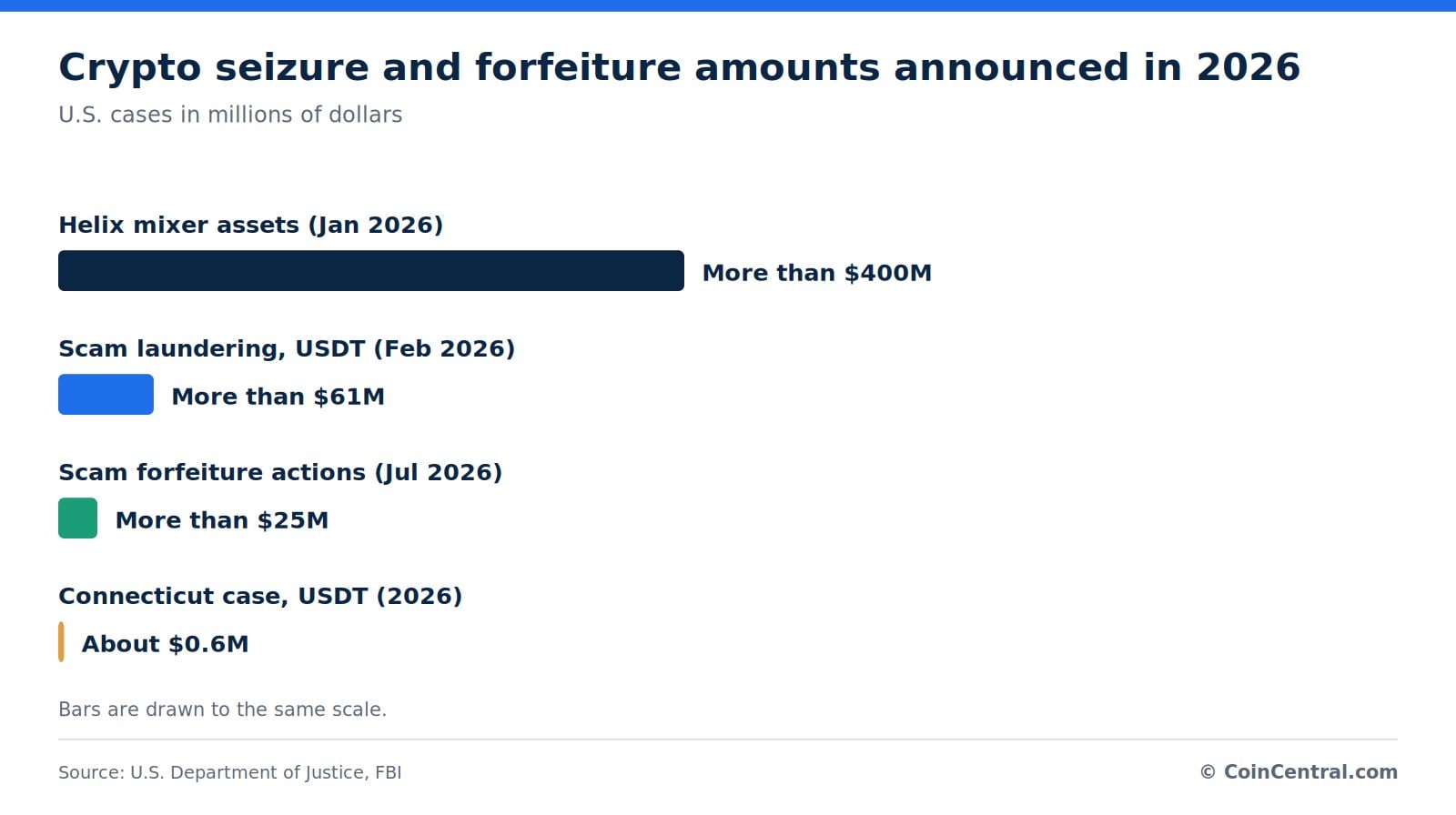
| Date | Case | Amount | Asset |
|---|---|---|---|
| January 2026 | Helix mixer forfeiture | More than $400 million | Assets tied to Helix |
| February 2026 | Investment scam laundering seizure | More than $61 million | USDT |
| 2026 | FBI and Connecticut State Police case | About $600,000 | USDT |
| July 2026 | Forfeiture actions in several scam cases | More than $25 million | Cryptocurrency |
In February 2026, U.S. authorities announced the seizure of more than $61 million of USDT. Investigators said they traced it to addresses linked to laundering money from crypto investment scams.
In another 2026 case, the FBI and Connecticut State Police followed funds across several wallets. About $600,000 of USDT was seized and forfeited.
In July 2026, prosecutors filed forfeiture actions for more than $25 million in cryptocurrency from several scam cases. The DOJ said investigators traced transactions through laundering networks that involved thousands of victims.
Moving stolen money through many wallets can slow an investigation. It does not erase the transaction history.
Why stablecoins can be easier to recover
Coins such as USDT and USDC run on public blockchains, so transfers are visible. They are also issued by identifiable companies. With the right legal process, an issuer may be able to freeze certain token addresses.
That helps explain why several recent recoveries involve USDT. The February 2026 seizure of more than $61 million involved Tether tokens.
Tracing is not the same as freezing
An investigator cannot simply freeze Bitcoin in someone’s self-custody wallet. Control depends on the private keys. Authorities can still act through other routes:
- Keys found on seized devices
- Control of custodial accounts
- Legal orders served on exchanges
- Work with stablecoin issuers
- Seizure of infrastructure
First, investigators find where the money went. Then they need a legal and technical way to take control of it.
The Financial Action Task Force’s 2025 asset-recovery guidance names public blockchain data as useful for tracing virtual assets quickly and supporting confiscation.
Mixers, Bridges and Cross-Chain Tracing
Mixers try to make money flows harder to follow. In a simple case, three users deposit Bitcoin and the service combines and redistributes it. The goal is to break the obvious link between deposits and withdrawals.
Some people use mixers for privacy. Others have used them to hide stolen or illegal money.
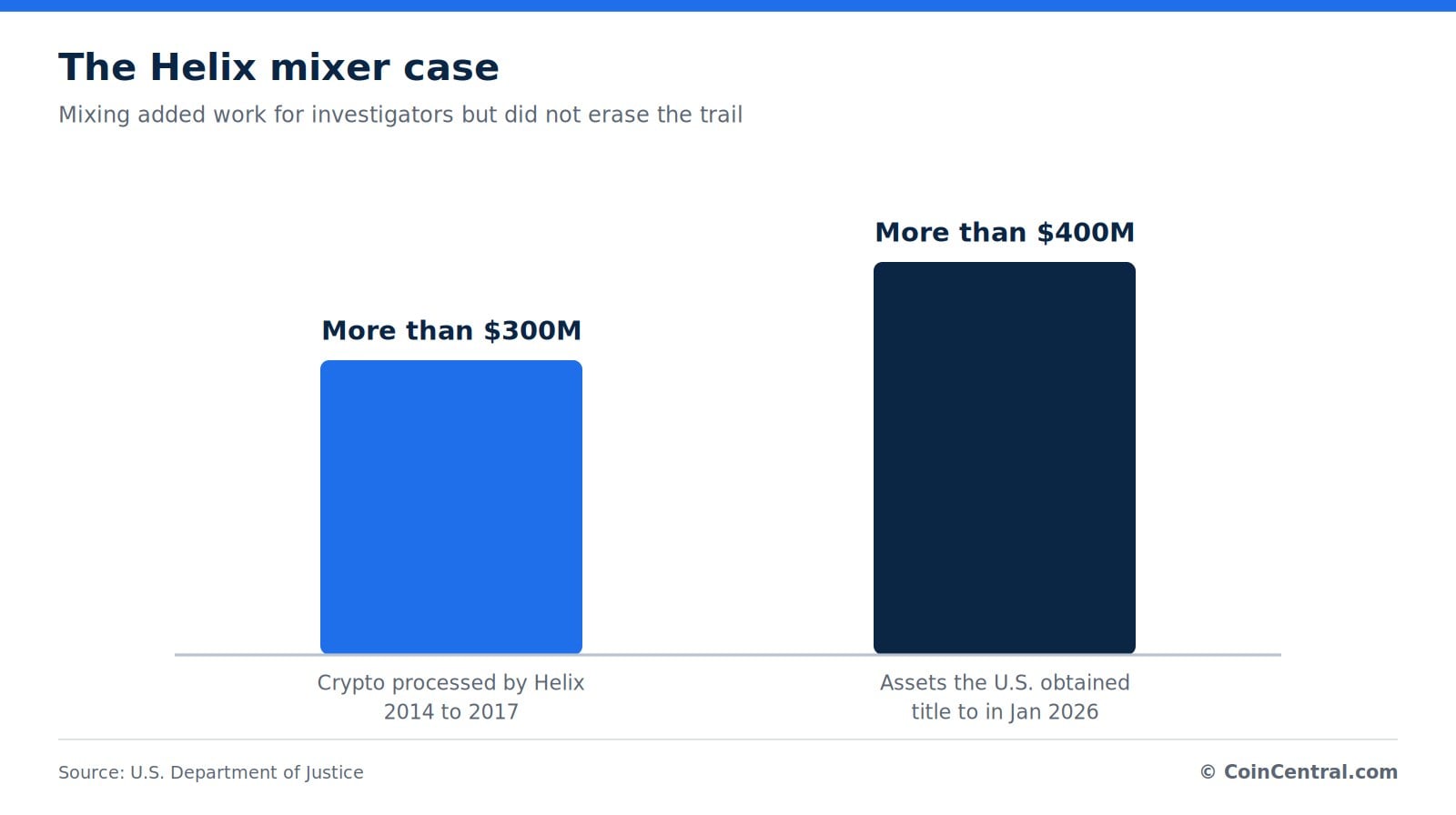
Mixing does not always make coins untraceable. A 2025 DOJ court filing described methods that investigators and analysis firms have built to trace some transactions through mixers. The process is sometimes called de-mixing.
The Helix case is an example. Helix was a darknet mixing service that processed more than $300 million in cryptocurrency between 2014 and 2017. In January 2026, the U.S. government obtained legal title to more than $400 million in assets tied to it.
Mixing adds work for investigators. It does not automatically erase the trail.
Following funds across blockchains
A person hiding funds might move Bitcoin to an exchange, then to Ethereum, then over a bridge to another chain, then into a stablecoin. This once forced investigators to rebuild activity across separate systems.
Cross-chain tracing is now more common. Chainalysis notes that bridge activity happens on-chain, so analysts can follow funds across many bridge transactions.
FATF’s 2025 guidance also says investigators increasingly use tools that link wallet activity across chains. Switching chains makes a trail longer. It does not make the trail vanish.
Privacy Coins and the Lightning Network
Not every crypto system works like Bitcoin’s main chain. Monero and the Lightning Network handle privacy in different ways.
Monero
Monero was built to hide what Bitcoin shows. Its documentation says its tools conceal the sender, the receiver and the amount. It uses ring signatures, stealth addresses and Ring Confidential Transactions, known as RingCT.
Stealth addresses create one-time destination addresses. Ring signatures make it much harder to tell the true source of a payment. RingCT hides amounts.
This gives Monero stronger on-chain privacy than Bitcoin. Even so, Monero warns that users can expose themselves through their own behavior, compromised devices, network data or details shared with the other side of a trade.
Lightning Network
Bitcoin’s Lightning Network moves many payments through channels off-chain. Individual Lightning payments are not written to the public blockchain the way normal Bitcoin transfers are.
The blockchain does record channel openings and closings. The payments in between happen inside the Lightning network. That makes tracing different, and often harder, than following ordinary on-chain payments.
So the claim that every Bitcoin payment is public needs a small fix. Every on-chain Bitcoin transaction is public. Activity on a second layer is not exposed in exactly the same way.
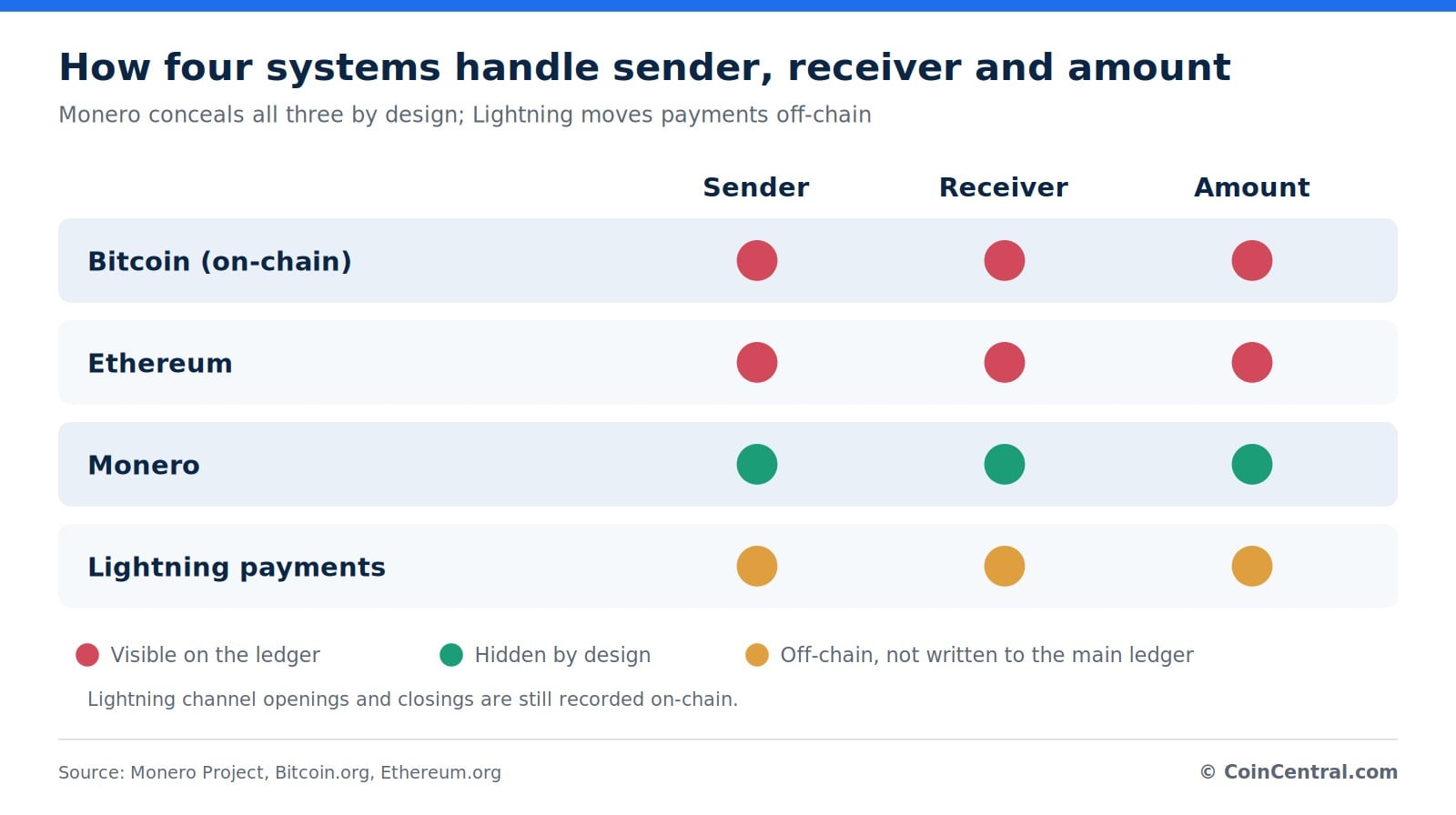
| System | Sender | Receiver | Amount |
|---|---|---|---|
| Bitcoin (on-chain) | Visible | Visible | Visible |
| Ethereum | Visible | Visible | Visible |
| Monero | Hidden by design | Hidden by design | Hidden by design |
| Lightning payments | Off-chain | Off-chain | Off-chain |
What Blockchain Tracing Cannot Prove
Blockchain analysis is strong, but it has limits. A ledger can show with high confidence that Wallet A sent 10 BTC to Wallet B. It does not show that a named person controlled Wallet A.
It also does not show why the payment was made. It could be a purchase, a transfer between a person’s own wallets, an exchange withdrawal, collateral, a gift or criminal proceeds.
Clustering can also be probabilistic. Chainalysis states that on-chain analysis alone cannot prove wallet ownership because identity does not live on the blockchain.
Crypto compared with cash and banks
Cash leaves no public record. If one person hands another 10,000 euros in notes, nothing records the sender, receiver, time or amount. Europol has noted that public blockchains can give investigators more transaction data than cash does.
Banks keep detailed records, but those records are private. Bitcoin records are public, but they start out pseudonymous.
| Money type | Who can see transactions | Is the owner known at the start? |
|---|---|---|
| Cash | No public record | No ledger records the parties |
| Bank transfer | The bank holds private records | Yes, the bank knows its customer |
| Bitcoin | Anyone can view the ledger | No, not until an address is linked to a person |
Once a Bitcoin address is tied to a person, its public history can show more than a bank customer would expect strangers to see.
Can an ordinary person trace crypto?
To a degree, yes. With a transaction hash, Bitcoin address or Ethereum address, anyone can use a block explorer and follow transfers. Simple cases are easy.
Hard cases involve hundreds of addresses, mixers, bridges, several blockchains, DeFi protocols, exchanges or privacy tools. Professional software handles graph analysis and entity attribution that would be hard to repeat by hand.
If you are the victim of a crypto scam
Seeing where your money went does not mean you can get it back. You would need the private key or a legal route to the funds. Keep records and report fast, because assets can keep moving.
- Wallet addresses
- Transaction IDs
- Exchange records
- Screenshots
- Emails and messages
- Website details
Report the crime to the proper authorities and the exchanges involved. Be careful with crypto recovery companies.
In 2024, the FBI seized three recovery-service websites after warning that some such services target past fraud victims and ask for upfront fees.
The Bottom Line
Can cryptocurrency be traced? On most major public blockchains, yes. Bitcoin is not anonymous, and Ethereum is similarly open.
The ledger does not automatically record who owns a wallet. Investigators fill that gap with clustering, exchange records, seized devices and open-source research.
The results are real. In 2026, U.S. authorities announced about $61 million seized in one scam case, more than $25 million across others and more than $400 million in assets tied to the Helix mixer.
Privacy coins such as Monero make analysis harder. Even so, exchange records, IP data, compromised devices or user mistakes can still expose people.
The blockchain can often show where the money went. The harder job is proving who controlled the wallets. Because records are permanent, a wallet that is unknown today may be named later.
Sources
- Bitcoin.org: Protect Your Privacy
- Bitcoin.org: Some Things You Need to Know
- Bitcoin.org: How Bitcoin Works
- Ethereum.org: Transactions
- Ethereum.org: Privacy Applications on Ethereum
- Chainalysis: Wallet Attribution
- Chainalysis: Blockchain Analytics
- Financial Action Task Force: Asset Recovery Guidance and Best Practices, 2025
- Europol: Cryptocurrencies, Tracing the Evolution of Criminal Finances
- Monero Project: Privacy and Technical Documentation
- U.S. Department of Justice: $61 Million Cryptocurrency Seizure, February 2026
- U.S. Department of Justice: Cryptocurrency Scam Seizures, July 2026
- U.S. Department of Justice: Helix Mixer Forfeiture, January 2026
- FBI: Cryptocurrency Recovery Website Seizures
The post Can Cryptocurrency Be Traced? Key Statistics and Facts appeared first on Blockonomi.
This articles is written by : Nermeen Nabil Khear Abdelmalak
All rights reserved to : USAGOLDMIES . www.usagoldmines.com
You can Enjoy surfing our website categories and read more content in many fields you may like .
Why USAGoldMines ?
USAGoldMines is a comprehensive website offering the latest in financial, crypto, and technical news. With specialized sections for each category, it provides readers with up-to-date market insights, investment trends, and technological advancements, making it a valuable resource for investors and enthusiasts in the fast-paced financial world.